Cofounder Breakup Post-Mortem: Lessons That Save
You built something together. Late nights, shared spreadsheets, the nervous energy of a first pitch. Then it fell apart — maybe slowly, maybe all at once — and now you're sitting alone with a half-finished product, a cap table that needs untangling, and a silence where your cofounder used to be.
A cofounder breakup post-mortem isn't about assigning blame or relitigating old arguments. It's the deliberate, structured act of turning wreckage into a blueprint.
This guide walks you through writing your own: a personal document (or one you share, your call) that captures what actually happened, why, and what you'll do differently when you find your next cofounder.
Why Cofounders Break Up (And Why You Need to Know Exactly Why Yours Did)
When cofounders split, the typical response is to vent to friends, bury yourself in work, or quietly rewrite history so you come out looking reasonable.
A post-mortem forces specificity. It moves you from "we just didn't see eye to eye" to "we had fundamentally different timelines for profitability, and neither of us surfaced that conflict until month eight." That precision is what separates founders who repeat patterns from founders who break them.
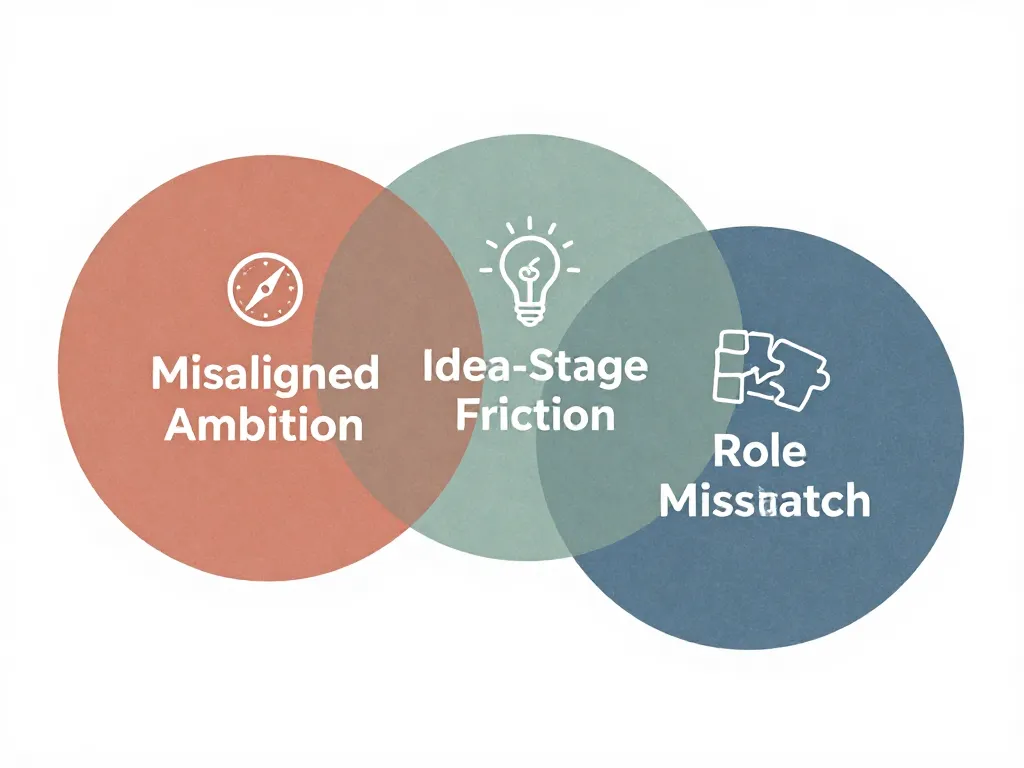
The Three Friction Zones
Across public and private cofounder split stories — from Paul Allen and Bill Gates to anonymous Y Combinator breakups on Hacker News — three root causes appear again and again:
-
Misaligned ambition: One cofounder wants a venture-scale outcome; the other wants a profitable lifestyle business. Or one is willing to sacrifice everything for three years while the other needs work-life balance now. These aren't character flaws — they're incompatibilities.
-
Idea-stage friction: Cofounders who team up before the idea is fully formed often discover they have deep disagreements about what to build, for whom, and why. The early "we're aligned on the vision" feeling was actually "we're both excited and haven't stress-tested anything."
-
Role mismatch: Two strategic thinkers and zero executors. Two builders and no one who wants to sell. Or a verbal agreement about who handles what that quietly erodes until both people feel they're doing everything.
Your breakup was probably caused by more than one of these, but one was the primary driver, and identifying it is step one.
The Cofounder Breakup Post-Mortem Framework: A Step-by-Step Guide

Step 1: Write the Timeline (Facts Only)
Open a blank document and write a chronological timeline of the partnership. Start with how you met or decided to work together, and end with the final conversation or event that marked the split.
- Facts only. "March 14: Alex said he wanted to pause fundraising" — not "March 14: Alex chickened out."
- Include dates as precisely as you can remember. Vague timelines hide patterns.
- Note decision points. Every time you made a meaningful joint decision (pivoting, hiring, splitting equity, delaying a launch), mark it.
This timeline is the spine of your post-mortem. Everything else hangs on it.
Step 2: Identify the Inflection Points
Go back through your timeline and circle the moments where the relationship shifted. Not the blowup fights — the quieter turns:
- The first time you disagreed and didn't resolve it
- A decision one person made unilaterally
- An external stressor (funding rejection, a competing offer, a personal crisis) that exposed a fault line
- The moment you started venting to someone outside the partnership instead of addressing the issue directly
For each inflection point, write two sentences: what happened, and what you think each person was feeling at that moment.
Step 3: Map It to the Friction Zones
Which of the three friction zones does each inflection point fall under? You might see a clear pattern: six out of eight trace back to ambition misalignment. Or you might see a more tangled picture.
This mapping matters because each friction zone has a different preventive protocol:
| Friction Zone |
What to Formalize Next Time |
| Misaligned ambition |
Written vision document covering timelines, risk tolerance, financial goals, and exit scenarios — before you write a line of code |
| Idea-stage friction |
A structured "kill criteria" process for validating ideas, with clear rules for when and how to pivot |
| Role mismatch |
A documented RACI (Responsible, Accountable, Consulted, Informed) chart that gets revisited monthly |
Step 4: Write Your Honest Self-Assessment
Answer these questions in writing:
- What did I avoid saying, and when should I have said it? Pinpoint the earliest moment you felt something was off and didn't address it.
- Where did I confuse agreement with alignment? Your cofounder nodding during a meeting isn't the same as genuine buy-in. Did you mistake silence for consensus?
- What was I optimizing for that I didn't admit? Maybe you wanted control more than collaboration. Maybe you wanted a cofounder for credibility, not because you valued their contribution. These are uncomfortable truths, and they're gold.
- What would I do differently in the first 30 days of a new partnership? Be specific. "Communicate better" is worthless. "Schedule a weekly 30-minute check-in with a standing agenda that includes one question about how the partnership itself is working" — that's actionable.
Step 5: Write the Lessons as If Advising a Friend
Imagine a close friend just told you they're about to start a company with a new cofounder. Based on everything you've written, what three to five specific things would you tell them?
Write these in plain language. No startup jargon:
- "Don't assume your cofounder wants the same financial outcome you do. Ask directly: what does success look like for you in dollar terms and timeline?"
- "If you can't have a difficult conversation in month one, you definitely won't be able to have one in month twelve. Test this early by deliberately raising something uncomfortable."
- "Divide ownership of decisions, not just tasks. Know who has final say on product, hiring, and fundraising — and write it down."
These are your post-mortem's deliverables. Print them. Share them with your next cofounder on day one.
Real Post-Mortem Excerpts (Anonymized)
"We Were Two CEOs"
Timeline pattern: Every major decision required a two-hour debate. Neither of us had final authority on anything. We called it 'collaboration' but it was a power vacuum.
Primary friction zone: Role mismatch.
Self-assessment: I wanted a cofounder who would validate my ideas, not challenge them. When she did challenge them — which was her job — I experienced it as disloyalty. That's on me.
Lesson for next time: Define decision domains in writing during the first week. Accept that 'disagree and commit' only works if you've agreed in advance on who gets to commit.
Timeline pattern: My cofounder started interviewing for full-time jobs in month four. I found out in month six. By month eight, he'd accepted an offer and framed it as 'reducing risk for both of us.'
Primary friction zone: Misaligned ambition.
Self-assessment: I saw early signs — he never put a personal financial deadline on the venture, and he kept his LinkedIn profile optimized for job searches. I told myself it didn't mean anything because I didn't want to have the conversation.
Lesson for next time: In the first month, both cofounders should explicitly state their personal runway, their Plan B, and the conditions under which they'd walk away. No judgment — but no ambiguity either.
"We Loved the Idea, Not the Same Idea"
Timeline pattern: We agreed on the problem space (healthcare scheduling) but had completely different users in mind. I was building for clinics. She was building for patients. We didn't discover this until we started wireframing and realized we'd been picturing different products for three months.
Primary friction zone: Idea-stage friction.
Self-assessment: We spent too long talking about the 'opportunity' at a high level and not enough time getting specific. I was so excited to have a cofounder that I didn't want to risk the relationship by pushing for clarity.
Lesson for next time: Before committing, build a one-page product spec together. If you can't agree on the first user persona and their top three pain points, you don't have alignment — you have parallel enthusiasm.
What to Do With Your Post-Mortem
A post-mortem that lives in a Google Doc you never reopen is just journaling. Here's how to make it operational:
Use it as a screening tool. When you're evaluating a potential new cofounder, revisit your lessons. Design your first conversations around the friction zones that burned you. If ambition misalignment was your issue, ask about it directly in your first substantive meeting.
Turn lessons into written agreements. The most common regret in cofounder breakups isn't "we chose the wrong person" — it's "we never wrote anything down." Your lessons should translate directly into clauses in a cofounder agreement: decision authority, commitment expectations, exit terms, equity vesting triggers. Tools like Servanda can help cofounders formalize these kinds of agreements early, before the goodwill fades and the stakes get higher.
Share selectively. You don't have to publish your post-mortem. But sharing relevant lessons with a trusted mentor, advisor, or future cofounder signals self-awareness — arguably the most undervalued founder trait.
Revisit it at six months. Your perspective will shift. Some things you blamed on your cofounder will start looking more like shared failures. Some things you blamed on yourself will look more like structural problems. Update the document.
Common Mistakes in Cofounder Post-Mortems
- Writing it as a prosecution brief. If your post-mortem reads like a case for why your cofounder was terrible, you've missed the point. The goal is self-insight, not vindication.
- Being too generous to yourself. If every lesson is "I was too trusting" or "I gave too much," you're still not being honest.
- Stopping at personality. "We had different personalities" isn't a root cause. Different personalities work together all the time. Dig deeper: what specific decisions or behaviors did those differences produce, and what structural safeguards could have contained them?
- Skipping it because you're already in a new venture. Unprocessed patterns travel with you.
Frequently Asked Questions
How soon after a cofounder breakup should I write a post-mortem?
Aim for 30 to 90 days after the split. Earlier than that, you're still emotionally reactive and likely to write something that skews toward blame. Later than that, your memory starts to smooth out the uncomfortable details that contain the most useful lessons.
Should I share my cofounder breakup post-mortem with my ex-cofounder?
It depends on the relationship. If you're on civil terms and both committed to learning, sharing can be powerful — they'll catch your blind spots. But if the split was acrimonious or there are legal proceedings involved, keep it private.
Can a cofounder post-mortem actually prevent future breakups?
No single document prevents breakups, but founders who reflect structurally on past partnerships make better choices in future ones. The post-mortem gives you a specific, personalized checklist of what to watch for, ask about, and formalize.
What if both cofounders were equally at fault?
That's the most common scenario, and it's a sign your post-mortem is honest. Most cofounder breakups are systems failures, not individual failures. Your job isn't to divide blame — it's to identify the specific structural gaps (missing agreements, undefined roles, unspoken expectations) that allowed the conflict to escalate.
Is a cofounder breakup post-mortem different from a startup post-mortem?
Yes. A startup post-mortem examines why the business failed — product-market fit, funding, timing. A cofounder breakup post-mortem focuses specifically on the relationship: how decisions were made, where expectations diverged, and what interpersonal dynamics contributed to the split.
Moving Forward
Writing a cofounder breakup post-mortem won't undo what happened. But it converts raw experience into structured insight — the kind that makes your next partnership more intentional and more honest from day one.
The founders who build lasting companies aren't the ones who never fail. They're the ones who know exactly how they failed last time and built specific guardrails against it. When you find your next cofounder, start the conversation with what you learned — not just what you're building.