
Silent Cofounder Breakups: The Conflict No One Sees
You used to finish each other's sentences in pitch meetings. Now you can't remember the last time you had a real conversation that wasn't about a deliverable. There was no screaming match, no dramatic Slack blowup, no ultimatum delivered over cold coffee. One day you just realized that your cofounder feels like a stranger sitting three feet away — and you have no idea when it started.
Silent cofounder breakups are the most common and most destructive form of founder conflict, precisely because they don't look like conflict at all. There's no villain, no inciting incident, no moment you can point to and say that's where it went wrong. Instead, there's a slow erosion — of trust, of shared excitement, of the willingness to be honest — that hollows out a partnership from the inside long before anyone says the word "leave."
This article is for the cofounder who suspects something is off but can't name it. And for the one who already knows but doesn't know what to do next.
Key Takeaways
- Most cofounder relationships don't end in blowups — they end in silence. Avoidance, resentment, and emotional withdrawal are far more common than dramatic fights.
- There are specific, observable warning signs — like decision-making without consulting each other, shorter replies, and avoiding one-on-one time — that signal a partnership is eroding.
- The "everything is fine" phase is the most dangerous. By the time one cofounder voices the problem, the other has often already mentally checked out.
- Structured, honest conversations (not vague "let's communicate better" advice) can reverse the slide — but only if you start before resentment calcifies.
- Written agreements about roles, equity, and exit terms aren't signs of distrust — they're protection for the relationship itself.

Why Cofounder Breakups Are Usually Silent
We have a cultural narrative about conflict that involves raised voices and slammed doors. But research and founder accounts tell a different story. A Harvard Business School study found that 65% of startups fail due to cofounder conflict — and the vast majority of those conflicts aren't spectacular implosions. They're quiet deteriorations.
Here's why silence is the default mode of cofounder breakdown:
1. The Stakes Feel Too High to Rock the Boat
You've raised money. You have employees. Customers depend on you. The idea of surfacing a fundamental disagreement feels like pulling a pin on a grenade in a room full of people who trust you. So you say nothing. You absorb the frustration. You tell yourself it's not a big deal.
2. Cofounders Confuse Harmony with Health
Many founding teams pride themselves on "never fighting." But the absence of conflict isn't the presence of alignment. It often means both people have stopped being honest — with each other and with themselves. A partnership where no one pushes back is a partnership where no one feels safe enough to push back.
3. There's No Language for the In-Between
It's easy to address a cofounder who steals money or misses every deadline. It's much harder to address the cofounder who's technically doing their job but has emotionally left the building. How do you say, "I feel like you don't care anymore" without sounding dramatic? Most people don't try.
The 7 Warning Signs of a Silent Cofounder Breakup
These aren't hypothetical. They come from patterns observed across dozens of founder stories, post-mortems, and conflict resolution cases. If three or more sound familiar, your partnership may be in more trouble than you think.
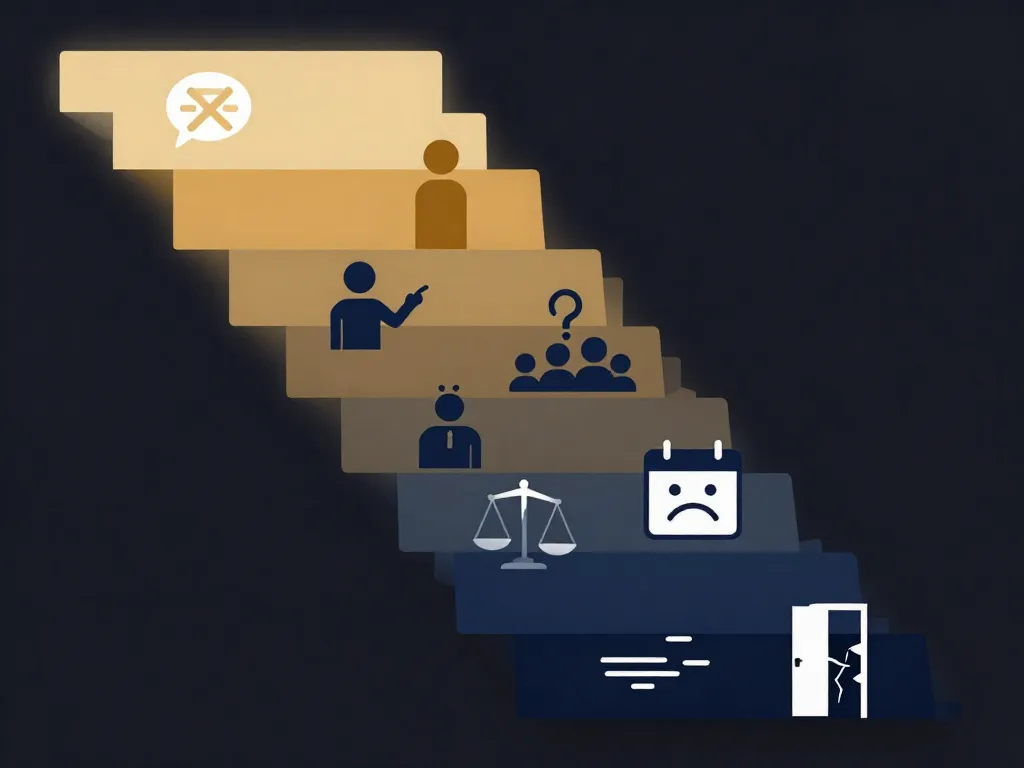
1. You've Stopped Having Unstructured Conversations
You used to riff on ideas over lunch. Now every interaction has an agenda. When the spontaneous, open-ended conversations disappear, it means at least one person has started rationing their emotional energy for the relationship.
2. Decisions Get Made Without Discussion
One cofounder hires someone, commits to a vendor, or changes a product roadmap — and the other finds out after the fact. This isn't always malicious. Sometimes it's just easier than having a conversation you're dreading. But it's a clear sign of fracture.
3. You Vent to Everyone Except Your Cofounder
Your spouse knows. Your advisor knows. Your college friend who works in tech knows. The only person who doesn't know how frustrated you are is the person you're frustrated with. When third parties become emotional outlets, direct communication has already failed.
4. You've Mentally Assigned Blame
You've started keeping a mental ledger: I closed the last three deals. I handled the board meeting alone. I fixed the production issue at 2 AM. When you start tracking contributions competitively, you've already stopped seeing your cofounder as a partner.
5. Meetings with Each Other Feel Like Obligations
There's a specific dread — not intense, just low-grade — that shows up before your one-on-ones. You catch yourself hoping they cancel. This is your nervous system telling you something your calendar won't.
6. You Disagree on Fundamentals but Treat It as Tactical
You have different visions for the company's direction, different risk tolerances, different definitions of success. But instead of naming these as the existential differences they are, you argue about surface-level tactics — this feature vs. that feature, this hire vs. that hire. The real conversation never happens.
7. One of You Has Quietly Started Exploring "Options"
Maybe it's a LinkedIn profile update. Maybe it's coffees with investors that aren't about this company. Maybe it's just a Google search for "cofounder buyout terms" at midnight. When one person starts building an exit ramp, the partnership is already in critical condition.
A Story You Might Recognize
Consider two founders — let's call them Priya and Marcus. They started a B2B SaaS company together after meeting at a startup accelerator. For the first year, they were inseparable: splitting every decision, debating strategy late into the night, genuinely thrilled about what they were building.
The first crack was small. Priya wanted to pursue enterprise clients; Marcus thought they should stay focused on SMBs. They had one tense conversation about it, didn't reach a resolution, and then — without either of them deciding to — just stopped bringing it up. Priya started taking enterprise calls on her own. Marcus doubled down on SMB features. They were building two different companies under one roof and pretending it was fine.
Six months later, Marcus told their lead investor he was thinking about leaving. Priya found out from the investor, not from Marcus. The breakup was devastating — not because of what was said, but because of everything that wasn't said for the year prior.
The tragedy isn't that they disagreed. It's that they never gave the disagreement room to breathe.

What to Do If You See Yourself in This Article
If you've read this far and your stomach is tight, here's what you can do — starting today, not "when the timing is right" (because the timing will never feel right).
Step 1: Name It, Even If Only to Yourself
Before you can fix a silent conflict, you have to admit it exists. Write down — literally, on paper or in a private doc — what you're actually feeling about your cofounder relationship. Not what you think you should feel. What you feel. Frustrated? Resentful? Lonely? Scared? Get specific.
Step 2: Request a "State of Us" Conversation
Don't ambush your cofounder with accusations. Instead, try something like: "I want to make sure our partnership is as strong as it can be. Can we set aside an hour this week to talk about how we're working together — not about any specific project, just about us as cofounders?"
This framing matters. It positions the conversation as maintenance, not crisis intervention.
Step 3: Use a Structure, Not Just Good Intentions
Unstructured "let's talk" conversations often spiral into defensiveness or dissolve into vague reassurances. Try this simple framework instead:
- What's working well in how we work together? (Start with genuine positives — they rebuild safety.)
- What's one thing I do that makes your job harder? (Ask for feedback on yourself first. This models vulnerability.)
- Is there a decision or direction we've been avoiding? (Give explicit permission to name the elephant.)
- What do we each need from this partnership going forward? (Get concrete. Vague needs lead to vague disappointments.)
Step 4: Write Down What You Agree On
One of the most common mistakes cofounders make is treating verbal agreements as durable. They're not. After any substantive conversation about roles, equity, decision-making authority, or the future of the company, document the outcome. Tools like Servanda can help cofounders create written agreements that capture these decisions clearly — not as a sign of distrust, but as a way to protect the understanding you worked hard to reach.
Step 5: Set a Recurring Check-In (and Actually Keep It)
A single honest conversation is a start, not a solution. The patterns that created a silent breakup will reassert themselves unless you build a counterweight. Schedule a monthly cofounder health check — 30 to 60 minutes, protected time, no agenda beyond the relationship itself. Treat it with the same seriousness you'd give a board meeting.
When the Conversation Reveals the Partnership Is Over
Sometimes the honest conversation doesn't save the relationship. Sometimes it reveals that the gap is too wide — that you want fundamentally different things, or that trust has eroded past the point of repair. That's painful, but it's still better than the alternative: a slow, silent decay that poisons the company and everyone in it.
If you reach this point, here's what matters:
- Separate the personal from the structural. You can respect someone and still recognize that you shouldn't build a company together.
- Get the financial and legal terms right. Equity splits, vesting, IP ownership, non-competes — these need to be settled clearly and fairly. This is not the place for handshake deals.
- Communicate to your team with honesty and care. Employees can sense a cofounder rift long before it's announced. A clear, non-dramatic explanation is always better than letting people fill the vacuum with speculation.
- Don't rewrite history. It's tempting to villainize your cofounder after a split. Resist it. In most silent breakups, both people contributed to the silence.
How to Prevent a Silent Breakup Before It Starts
If you're early in your cofounder relationship — or if you've resolved a rough patch and want to prevent a relapse — these practices can inoculate your partnership against quiet erosion:
- Establish a cofounder agreement in the first 90 days. Cover roles, decision rights, equity and vesting, what happens if someone leaves, and how you'll handle disagreements. Do this when you still like each other.
- Normalize disagreement early. Deliberately practice disagreeing on small things. This builds the muscle you'll need when the stakes get higher.
- Create explicit permission to raise concerns. Agree that either person can call a "cofounder check-in" at any time without it being interpreted as a crisis signal.
- Watch for your own avoidance patterns. If you notice yourself choosing not to bring something up, treat that as data. Ask yourself: Am I staying silent because it's genuinely not important, or because I'm afraid of the conversation?
- Get outside support before you need it. An advisor, coach, or structured mediation resource is most effective when introduced proactively — not when things are already on fire.
Frequently Asked Questions
How do I know if my cofounder relationship is in trouble or if we're just going through a busy phase?
Busy phases are real, and not every period of reduced connection is a crisis. The difference is intentionality. If you're both aware that you've been heads-down and actively plan to reconnect, that's healthy. If weeks turn into months and neither of you acknowledges the distance — or if acknowledging it feels risky — that's a warning sign worth taking seriously.
What should I do if my cofounder avoids every attempt at a real conversation?
Persistent avoidance is itself information. If you've made two or three genuine, non-confrontational attempts to talk and your cofounder deflects or postpones every time, say that directly: "I've tried to start this conversation a few times and it hasn't happened. That worries me. Can you help me understand what's going on?" If they still won't engage, consider bringing in a neutral third party — an advisor, a coach, or a mediator — to create a safer space.
Is it too late to fix things if my cofounder has already mentally checked out?
It depends on how far the disengagement has gone and whether your cofounder is willing to re-engage. Some partnerships recover from the brink when both people finally have the conversation they've been avoiding. Others don't — and that's not a failure, it's information. The worst outcome isn't a cofounder breakup; it's a cofounder breakup that happens two years later than it should have, after doing unnecessary damage to the company, the team, and both founders.
How do cofounder breakups affect fundraising and investors?
Investors consistently rank cofounder conflict as one of their top concerns. A transparent, well-managed cofounder transition can actually build investor confidence — it shows maturity and governance. What destroys confidence is finding out about a festering conflict after the fact, or watching a founding team slowly become dysfunctional while pretending everything is fine.
Should cofounders have a prenup-style agreement from the start?
Absolutely. A cofounder agreement isn't a sign that you expect things to go wrong — it's a sign that you take the partnership seriously enough to protect it. Cover equity and vesting, roles and decision-making authority, intellectual property, what happens if someone wants to leave, and how disputes will be resolved. Having this conversation early, when goodwill is high, is infinitely easier than having it later, when trust is low.
Conclusion
The most dangerous cofounder conflicts are the ones that don't look like conflicts at all. They look like two busy people drifting apart, making fewer decisions together, sharing less of what they're actually thinking. By the time the silence becomes unbearable, the damage is often deep.
But it doesn't have to end that way. If something in this article resonated with you — if you recognized your own partnership in these patterns — that recognition is itself a turning point. The silence only wins if no one breaks it.
You don't need a perfect speech. You don't need to have it all figured out. You just need to say, honestly, to the person you started this with: "I think we need to talk about us."
That sentence — awkward, vulnerable, and brave — is where every cofounder relationship gets its second chance.