Annual Cofounder Check-In: Questions That Prevent Blowups
Two years into building their SaaS platform, Rina and David hadn't had a single real conversation about where the company was heading. Not because things were bad — precisely because things seemed fine. Rina was heads-down on product. David was closing deals. Revenue was growing. Then David casually mentioned he'd been talking to a potential acquirer. Rina felt ambushed. David felt micromanaged. Within six weeks, they'd hired separate lawyers.
Their story isn't unusual. Most cofounder blowups don't start with a single dramatic betrayal. They start with a slow accumulation of unspoken assumptions — about money, workload, control, and the future. The explosion comes later, after months or years of quiet divergence.
An annual cofounder check-in is the simplest tool to prevent this. Not a casual "how's it going" over coffee, but a structured, honest conversation designed to surface the gaps between what each founder believes is true. Below is a complete framework for running one, including the specific questions that do the heavy lifting.
Why an Annual Cofounder Check-In Matters
Most cofounders sign their operating agreement or shareholders' agreement once and never revisit it. But the assumptions baked into those documents — who does what, how equity reflects contribution, what happens if someone wants out — become outdated fast.
Consider how much changes in a single year:
- One founder takes on 70% of the workload during a crisis and never mentions it
- Revenue changes the risk profile, shifting what "fair" compensation looks like
- Someone's life circumstances change — a new child, a health issue, burnout
- The market shifts, and one founder's original role becomes less relevant
- Strategic priorities diverge without anyone noticing
A study from the Kauffman Foundation found that cofounder conflict is a leading factor in 62% of startup failures attributed to "team problems." Most of these aren't disagreements about strategy — they're disagreements about expectations that were never explicitly discussed.
How to Structure Your Annual Cofounder Check-In
Before diving into the questions, some ground rules that make the conversation work:
Set the Right Conditions
- Schedule it like a board meeting. Put it on the calendar months in advance. Treat it as non-negotiable.
- Get out of the office. A different environment helps break the pattern of day-to-day tactical conversation. A conference room at a co-working space, a rented cabin, a long walk — anything that signals "this is different."
- Block real time. Plan for 3-4 hours minimum. Rushing leads to surface-level answers.
- Write before you talk. Each founder should answer the questions independently before the meeting. Comparing written answers reveals gaps that verbal conversation glosses over.
- Agree on confidentiality. What's said in the check-in stays between the founders unless you mutually agree otherwise.
Some cofounders alternate who "facilitates" each year. Others bring in a trusted advisor or mentor. The point is to create structure so the conversation doesn't devolve into a reactive argument.

The 25 Questions: A Complete Annual Cofounder Check-In Template
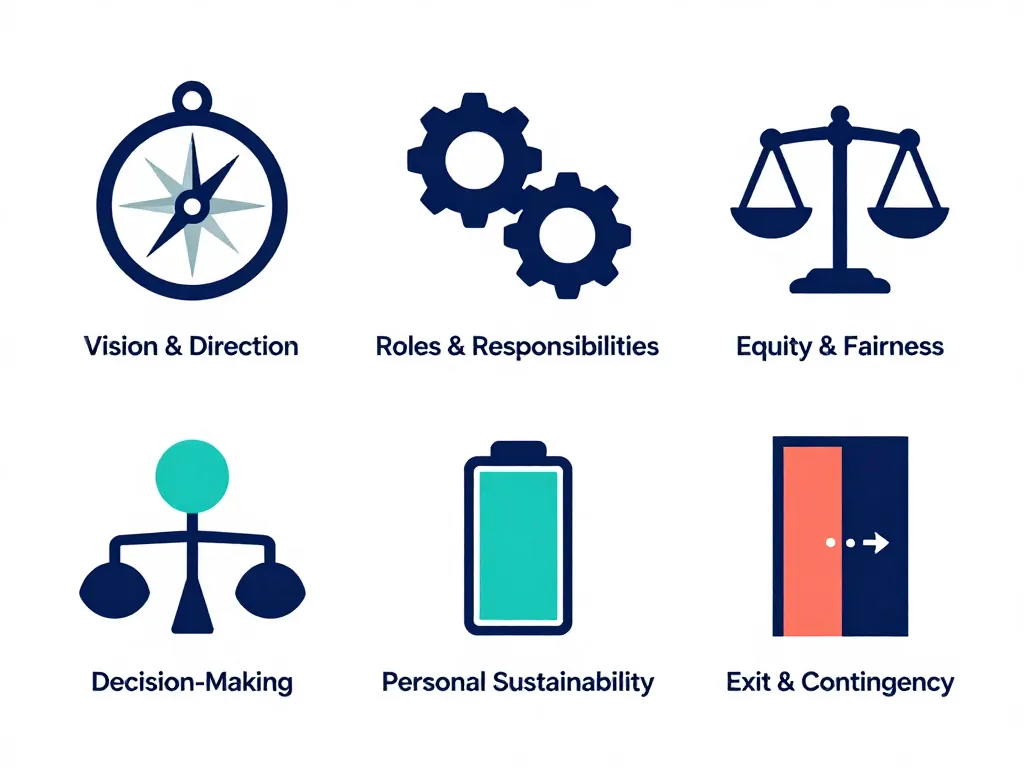
These questions are organized into six categories. Not every question will apply to every partnership — pick the ones that feel slightly uncomfortable. Those are the ones that matter.
1. Vision and Direction
These questions check whether you're still building the same company.
- What does success look like for this company in 3 years? In 10?
- If we received a $20M acquisition offer tomorrow, what would you want to do?
- What's the one strategic bet you think we should be making that we're not?
- Has your personal ambition for this company changed since last year?
2. Roles and Responsibilities
These questions surface invisible workload imbalances and territorial assumptions.
- What do you spend most of your time on? Is that where you should be spending it?
- What responsibilities have you taken on that weren't part of our original agreement?
- Is there anything I'm doing (or not doing) that makes your job harder?
- If we were hiring for your role externally, what would the job description say? Does your actual work match?
- What's one thing you wish you could stop doing?
3. Equity, Compensation, and Fairness
- Does our current equity split still feel fair to both of us? Be honest.
- How should we think about adjusting compensation as the company grows?
- Are either of us investing personal money, taking below-market salary, or making sacrifices the other doesn't fully see?
- If one of us were to reduce hours by 50% for personal reasons, how should that affect equity and compensation?
4. Decision-Making and Power
These questions prevent governance conflicts before they become legal ones.
- Was there a major decision this year where you felt excluded or overruled?
- How should we handle decisions where we fundamentally disagree?
- Are there areas where one of us should have unilateral authority? Are we clear on what those are?
- Do we need to formalize any of our decision-making processes that are currently informal?
5. Personal Sustainability
Burnout kills partnerships. These questions address it directly.
- On a scale of 1-10, how sustainable is your current pace?
- What's your biggest personal stressor right now, inside or outside of work?
- What would you need from me or from the company to make next year better than this year?
- Have your personal financial needs changed? Are they being met?
6. Exit, Contingency, and the Uncomfortable Stuff
These questions are the ones cofounders avoid. That avoidance is what causes the worst blowups.
- If one of us wanted to leave in the next 12 months, what would a fair process look like?
- Do we have a clear buyout mechanism? Does it still make sense given our current valuation?
- What happens if one of us gets seriously ill or has a major life event?
- Is there anything about our partnership that you've been avoiding bringing up?
What to Do With the Answers
A check-in without follow-through is just venting. Here's how to turn conversation into action:
- Document areas of alignment. Write down what you agree on. This becomes your shared reference point for the year.
- Flag areas of divergence. Don't try to resolve everything in one session. Identify the gaps and agree on a timeline to address each one.
- Update your agreements. If your conversation reveals that your operating agreement, equity split, or role definitions are outdated, update them. Consider formalizing your agreements with a tool like Servanda before small misalignments become entrenched positions.
- Set specific commitments. Replace vague promises ("I'll try to communicate more") with concrete ones ("We'll review the P&L together on the first Monday of each month").
- Schedule next year's check-in before you leave the room. Put it on the calendar.
Common Mistakes That Undermine the Check-In
Treating it as a performance review. This isn't about grading each other. It's about alignment.
Only doing it when things are bad. If you wait until there's a conflict, the check-in becomes crisis intervention. The whole point is to do it when things feel fine — because that's when people are most honest and least defensive.
Skipping the hard categories. If you only talk about vision and strategy but dodge equity and exit questions, you're having a strategy session, not a cofounder check-in.
Not writing anything down. Memory is unreliable, especially for conversations loaded with emotion. Document your takeaways.
Letting one person dominate. The pre-written answers help equalize this, but it's worth actively checking: "I've been talking for a while — what's your take?"
A Real-World Example
Marcus and Priya (names changed) co-founded a climate tech startup. After their second year, they ran their first structured annual cofounder check-in. Two things surfaced:
First, Priya had been quietly absorbing all of the investor relations work on top of her CTO responsibilities. She was exhausted and starting to resent Marcus, who she felt wasn't pulling his weight — even though Marcus genuinely didn't realize the imbalance.
Second, Marcus wanted to explore a pivot into a new market vertical. He'd been testing the idea with potential customers for weeks but hadn't told Priya because he "didn't want to distract her."
Both issues, left unaddressed, were heading toward a blowup. Instead, they restructured investor responsibilities, agreed on a 30-day exploration window for Marcus's pivot idea, and documented both decisions in writing. Three years later, they're still building together.
Conclusion
The annual cofounder check-in isn't a magic ritual. It's a maintenance practice — like servicing a car before the engine light comes on. The questions work because they force specificity in areas where most cofounders rely on vague assumptions.
Block three hours. Get out of the office. Write your answers independently. Compare them honestly. Document what you find. Then do it again next year.
The cofounders who stay together aren't the ones who never disagree. They're the ones who build a regular practice of saying the hard thing before it becomes the last thing.
Frequently Asked Questions
At minimum, cofounders should hold a structured check-in once a year, though some partnerships benefit from semi-annual conversations. The key is consistency — schedule it in advance and treat it as non-negotiable. Waiting until problems arise turns a prevention tool into crisis management.
What questions should cofounders ask each other every year?
The most important questions cover vision alignment ("Are we building to sell or building to run?"), workload fairness, whether the equity split still feels right, how you handle disagreements, personal sustainability, and exit scenarios. Prioritize the questions that feel slightly uncomfortable — those surface unspoken assumptions that lead to blowups.
How do you bring up equity fairness with your cofounder without starting a fight?
Use a structured annual check-in where both founders write their answers independently before discussing them. This removes the feeling that one person is ambushing the other. Framing equity as a recurring conversation rather than a one-time accusation normalizes the discussion, and tools like a shared template or neutral facilitator can keep it productive.
What causes most cofounder breakups?
Most cofounder breakups aren't caused by a single dramatic betrayal but by a slow accumulation of unspoken assumptions about workload, compensation, decision-making authority, and the company's future direction. Research from the Kauffman Foundation found that cofounder conflict drives 62% of startup failures attributed to team problems, and most stem from expectations that were never explicitly discussed.
Bringing in a trusted advisor, mentor, or neutral facilitator can be helpful, especially if one founder tends to dominate conversations or if you're tackling sensitive topics like equity and exit planning for the first time. Alternating who facilitates each year and using pre-written answers helps ensure both voices are heard equally.