
Co-Founder Breakup Post-Mortem: What I Learned
The text came in at 11:47 p.m. on a Tuesday: "I think we need to talk about the company."
If you've been through a co-founder breakup, you already know what that sentence really means. You know the pit-of-stomach feeling, the three a.m. spiral of was this my fault, and the bizarre grief of losing someone who isn't dead but is suddenly gone from the center of your daily life.
I went through it eighteen months ago. My co-founder and I had built together for nearly three years — late nights, shared bank accounts, the whole mythology. When it ended, I felt like the only founder on earth who'd ever failed at the relationship part of building a company. Turns out, I wasn't even close to alone. Roughly 65% of startups fail because of co-founder conflict, according to Noam Wasserman's research at Harvard Business School. Nobody just talks about it.
This post-mortem is my attempt to change that — not as a blame exercise, but as an honest look at what went wrong, what I'd do differently, and the tactical steps that would have saved us both a lot of pain.
Key Takeaways
- A co-founder breakup is a legitimate loss — treat the emotional aftermath with the same seriousness you'd give any major life disruption.
- Most co-founder splits trace back to undocumented expectations, not sudden betrayals. The conflict was always there; it just hadn't been named.
- Vesting schedules and operating agreements aren't just legal formalities — they are the structural floor that keeps a breakup from destroying the company.
- The conversation you're avoiding right now is the one that matters most. Scheduled, structured check-ins about roles, equity, and vision prevent slow-burn resentment.
- Moving forward after a co-founder split is possible — but only if you do an honest post-mortem instead of burying the experience.

The Story Nobody Tells at Demo Day
Startup culture worships the co-founder romance: the garage origin, the complementary skill sets, the "we finish each other's sentences" mythology. What it almost never talks about is what happens when that relationship fractures.
Here's what actually happened with me and my co-founder — I'll call him D.
D and I met at a hackathon. He was technical, I was the business-and-product person, and we had that instant founder chemistry everyone tells you to look for. Within two months we'd incorporated, split equity 50/50, and started building. We didn't write down roles. We didn't talk about what happens if one person wants to leave. We were too busy executing.
For the first year, momentum papered over every crack. But by month fourteen, things started to shift:
- I wanted to pivot toward enterprise; D wanted to stay consumer.
- I was working 70-hour weeks; D had started a side consulting gig he didn't tell me about.
- We'd never agreed on decision-making authority, so every disagreement became a power struggle.
- Neither of us knew how to say "I'm unhappy" without it sounding like an accusation.
By month twenty-eight, we were barely speaking outside of Slack. The breakup, when it finally came, wasn't dramatic. It was exhausted. D sent that Tuesday night text, and within six weeks he'd left the company.
What followed was the hardest quarter of my professional life — not because of the operational scramble (though that was real), but because of the emotional fallout I had zero framework for handling.
What Actually Went Wrong: The Autopsy
After enough distance, I sat down and tried to identify the actual failure points, stripped of ego and narrative. Here's what I found:
1. We Conflated Alignment on the Problem with Alignment on Everything Else
D and I both cared deeply about the same user pain point. We assumed that meant we were aligned on company vision, work ethic, financial goals, and risk tolerance. We weren't. We'd never asked each other basic questions like:
- What does success look like for you personally in five years?
- How much runway are you comfortable burning before we need revenue?
- Under what conditions would you want to walk away?
These aren't hypothetical questions. They're load-bearing walls. Without answers, the structure collapses under stress.
2. We Skipped the Operating Agreement Because It Felt "Unromantic"
This is the one that still stings. We had a bare-minimum incorporation document and a verbal handshake on 50/50 equity. No vesting schedule. No defined roles. No decision-making protocol. No exit clause.
When D left, we had to negotiate everything — equity, IP ownership, non-compete terms — from a place of mutual hurt. It cost us $14,000 in legal fees and three months of paralysis.

3. Resentment Compounded Silently
Neither of us ever said, "I feel like I'm putting in more than you." Instead, I kept a mental ledger. Every late arrival, every missed deadline, every half-hearted Slack response went into a column I never showed him. By the time I finally said something, I wasn't raising a concern — I was delivering a verdict. That's not a conversation. That's a sentencing.
4. We Had No Structured Space to Disagree
Our "meetings" were informal, unstructured, and usually interrupted by actual work. There was no recurring time to discuss the partnership itself — not the product, not the pipeline, but us. Strategic disagreements festered because there was no container for them.
The Emotional Aftermath Nobody Prepares You For
Here's the part most post-mortems skip.
After D left, I experienced what I can only describe as a breakup — socially, emotionally, even physically. I stopped sleeping well. I questioned whether I was the kind of person who could maintain any partnership. I felt embarrassed in front of our small team, our investors, and my family.
A few things that helped me, in case you're in this place right now:
- Name the grief. This was a real relationship that ended. You're allowed to feel that.
- Talk to a therapist, not just advisors. Advisors will help you with the cap table. A therapist will help you with the shame spiral.
- Resist the urge to rewrite history. D wasn't a villain. I wasn't a saint. The truth was muddier than either story, and accepting that was the beginning of actually learning from it.
- Set a timeline for the post-mortem. I gave myself sixty days to process emotionally before I tried to extract lessons. Trying to analyze while you're still in pain just produces justification, not insight.
What I'd Do Differently: A Tactical Playbook
If I could go back, here's exactly what I would change — and what I'd recommend to any co-founders formalizing their relationship today.
Write a Co-Founder Agreement Before You Write a Line of Code
This document doesn't need to be a legal masterpiece on day one. But it should cover, at minimum:
- Roles and decision-making authority. Who has final say on product? Hiring? Finances? What happens when you disagree?
- Equity split and vesting schedule. A four-year vest with a one-year cliff is standard for a reason — it protects both parties if someone leaves early.
- Commitment expectations. Full-time or part-time? Side projects allowed? Define what "all in" means in writing.
- Exit terms. What happens to equity if one founder leaves voluntarily? Involuntarily? What's the buyback mechanism?
- Dispute resolution process. How will you handle disagreements before they become deal-breakers? Mediation clause? Advisory board tiebreaker?
Tools like Servanda can help co-founders create these written agreements early, using structured prompts and AI-guided frameworks — a worthwhile step when the conversation feels awkward but the stakes are high.
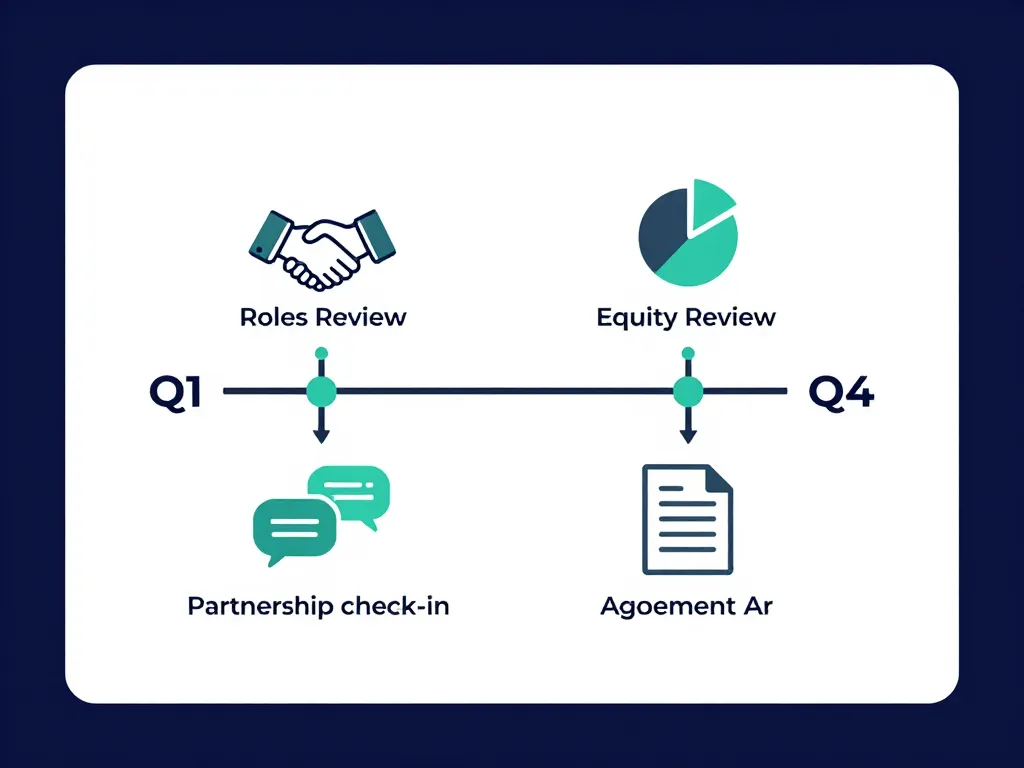
Schedule Monthly "State of the Partnership" Check-Ins
Not a standup. Not a product review. A dedicated hour, once a month, where the only agenda is the partnership itself. I use a simple framework now:
- What's working between us?
- What's not working between us?
- Is there anything unsaid?
- Are we still aligned on where we're headed?
This feels uncomfortable the first two times. By the third month, it becomes the most important meeting on your calendar.
Establish a "Pre-Nup" Culture, Not a "Pre-Nup" Moment
The problem with treating the co-founder agreement as a one-time document is that startups change constantly. Revisit your operating terms quarterly. Roles evolve. Equity conversations may need to shift. A document written at incorporation might be irrelevant twelve months later.
Get an Outside Perspective Early
D and I were too insular. We didn't have an advisory board, a coach, or even a mutual friend who felt empowered to say, "Hey, it seems like you two aren't on the same page." An outside perspective — a formal advisor, a founder peer group, even a structured mediation session — can surface tensions before they calcify.
Separate Identity from Company
This is the one I'm still working on. When your co-founder leaves, it can feel like a referendum on your worth as a founder, a partner, a person. It's not. But the only way to truly internalize that is to build an identity that isn't 100% fused with your startup. Maintain friendships outside of work. Have interests that aren't "hustle-adjacent." Your company is something you do, not something you are.
After the Breakup: What Happened Next
D and I eventually reached a settlement. He walked away with a reduced equity stake (we negotiated down from 50% given his early departure and the absence of a vesting schedule — a conversation that would have been unnecessary if we'd set up proper vesting from day one). We aren't close anymore, but there's no active animosity.
The company survived. Barely. I brought on a new technical lead three months later — this time with a detailed operating agreement, a four-year vesting schedule, defined roles, and a monthly partnership check-in on the calendar before we merged a single pull request.
I won't pretend the experience made me stronger in some neat, narrative way. It made me more careful. It made me less romantic about the mythology of co-founding. And it made me deeply, specifically aware of how much damage avoidable silence can do.
Frequently Asked Questions
How do you know when a co-founder relationship is beyond repair?
When you've clearly communicated your concerns, attempted structured resolution (mediation, advisory input, formal check-ins), and the fundamental misalignment — on vision, values, or commitment — persists for more than two to three months, it's likely time to plan a transition rather than force a fix. Chronic avoidance of the conversation itself is also a signal.
What should a co-founder agreement include?
At minimum, it should cover equity split and vesting terms, defined roles and decision-making authority, commitment expectations (full-time vs. part-time, side project policies), exit and buyback terms, and a dispute resolution mechanism. Think of it as the structural document that makes hard conversations manageable instead of catastrophic.
Can you stay friends with a co-founder after a breakup?
Sometimes, but not always, and not immediately. Give yourself space before trying to rebuild the personal relationship. The founders I've talked to who maintained friendships post-split all had two things in common: a clean, well-documented separation process, and enough time (usually six-plus months) before attempting regular contact.
How do you tell your team and investors about a co-founder split?
Be honest without being dramatic. A short, factual message — "[Name] has decided to leave the company; here's the transition plan" — is better than a long, emotional narrative. Investors especially want to hear that you have a plan for continuity, not a detailed account of what went wrong between you.
Is a 50/50 equity split a bad idea?
It's not inherently bad, but it's dangerous without a clear decision-making framework attached to it. A 50/50 split with no tiebreaker mechanism means every disagreement is a potential deadlock. If you go 50/50, pair it with a defined process for resolving disputes — an advisory vote, a specific domain-based authority structure, or a formal mediation clause.
Moving Forward
A co-founder breakup is one of the most disorienting experiences in a founder's life — partly because it's so common and so rarely discussed openly. If you're in the middle of one, know that you're not uniquely broken. The vast majority of founding teams face serious friction, and many don't survive it.
But the experience doesn't have to be wasted. The founders who come out of a split sharper are the ones who do the post-mortem honestly: not to assign blame, but to build better structures next time. Write the agreement. Schedule the check-in. Say the thing you're avoiding.
The best time to formalize your co-founder relationship was at incorporation. The second best time is today.