
Cofounder Equity Splits That Prevent Ugly Breakups
Two friends launch a startup on a Saturday afternoon. They're buzzing with energy, finishing each other's sentences, and sketching the future on a whiteboard. When the question of equity comes up, neither wants to seem greedy—so they shake hands on 50/50 and move on to the exciting stuff.
Eighteen months later, one cofounder is working 70-hour weeks while the other has quietly drifted into a consulting gig. The company has traction, maybe even revenue. But that handshake deal means the absent cofounder still owns half of everything. The conversation that follows—if it happens at all—is one of the most painful moments in any founder's life.
This scenario isn't hypothetical. It plays out in startups every single day. The good news: cofounder equity splits don't have to become ticking time bombs. With the right structure from day one, equity becomes a source of alignment rather than resentment.
Key Takeaways
- Never default to 50/50 without a conversation. Equal splits can work, but only when they're intentional and paired with protective mechanisms like vesting.
- Vesting schedules are non-negotiable. A four-year vesting schedule with a one-year cliff protects every cofounder—including the one who stays.
- Define contributions explicitly. Who's bringing capital, code, customers, or full-time commitment? Put it in writing before launch.
- Build in exit mechanisms early. Buyback clauses and separation terms are far easier to agree on when everyone still likes each other.
- Revisit equity conversations annually. Roles evolve. A rigid, never-discussed equity arrangement breeds silent resentment.

Why the Default 50/50 Split Is So Dangerous
The 50/50 split feels democratic. It signals trust. It avoids an uncomfortable negotiation during the honeymoon phase of a new venture. That's exactly why it's so common—and why it causes so much damage later.
Here's what the 50/50 split actually communicates: We haven't talked about what each of us is contributing, what happens if one of us leaves, or how we'll handle disagreements. It's not an agreement—it's the absence of one.
The Vestd Cautionary Tale
The team at Vestd, a UK equity management platform, has documented dozens of stories where founders settled equity casually and paid for it later. In one case, two cofounders split equity equally at incorporation. When one left after just six months, the departing founder retained 50% of the cap table—equity that was effectively dead weight. The remaining founder spent years and thousands in legal fees trying to restructure.
This pattern is so predictable that Y Combinator, Techstars, and nearly every serious accelerator now require vesting schedules as a condition of investment.
What Research Tells Us
Noam Wasserman's landmark study of over 10,000 founders (published in The Founder's Dilemmas) found that teams who split equity within the first month of working together were significantly more likely to have conflict later. The reason: early splits tend to reflect relationships rather than roles. When roles shift—as they always do—an equity structure frozen in time becomes a source of friction.
A Better Framework: Contribution-Based Equity Splits
Instead of asking "What feels fair right now?" ask "What reflects the actual value each person is creating over time?"
Here's a practical framework for structuring cofounder equity splits that hold up under real-world pressure.
Step 1: Map Each Cofounder's Contributions
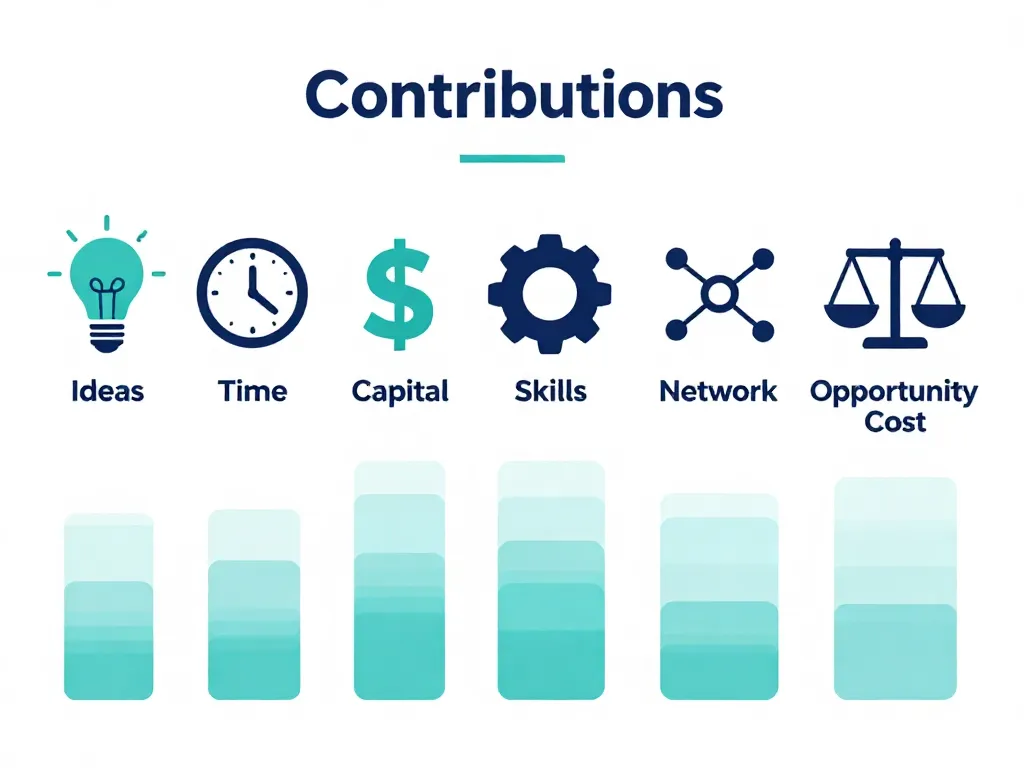
Before discussing percentages, list what each person is bringing to the table across these categories:
- Idea and intellectual property — Who originated the concept? Who holds relevant patents, research, or domain expertise?
- Time commitment — Is everyone going full-time? If one cofounder keeps a day job, that matters.
- Capital — Is anyone funding the early stage out of pocket?
- Skills and execution — Who's building the product? Who's selling? Who's managing operations?
- Network and reputation — Whose relationships are opening doors to customers, advisors, or investors?
- Opportunity cost — Is someone leaving a $300K job? Is someone fresh out of school? These aren't identical sacrifices.
Write this down. Literally. A shared document with each cofounder's contributions listed side by side creates clarity that a verbal conversation never can.
Step 2: Use a Structured Allocation Method
Several tools and frameworks exist to translate contributions into equity percentages. Two worth knowing:
The Slicing Pie Model (Mike Moyer) This dynamic equity model assigns a relative value to each type of contribution—time, money, ideas, relationships, equipment—and adjusts equity continuously based on what each person actually puts in. It's particularly useful for pre-revenue startups where roles are still fluid.
The Founders' Pie Calculator A simpler, one-time calculation that weights factors like idea origination, business plan development, domain expertise, commitment level, and existing responsibilities. It produces a suggested percentage split based on weighted inputs.
Neither method is perfect. But both force the conversation that 50/50 handshakes skip entirely.
Step 3: Add Vesting—Always
Vesting is the single most important mechanism for protecting cofounders from each other and from themselves. Here's the standard structure:
- Four-year vesting period — Equity is earned over four years of continued involvement.
- One-year cliff — No equity vests until the first anniversary. If someone leaves in month eight, they walk away with nothing.
- Monthly vesting after the cliff — After year one, equity vests in monthly increments (1/48th of the total per month).
Vesting doesn't mean you don't trust your cofounder. It means you both agree that equity should reflect sustained contribution. Every serious investor will expect this, and every experienced founder will tell you they wish they'd had it from the start.
Step 4: Define Exit and Buyback Terms
What happens if a cofounder leaves? Gets fired? Becomes incapacitated? These aren't morbid questions—they're essential ones.
Your cofounder agreement should address:
- Voluntary departure — Can the company repurchase unvested shares? At what price?
- Termination for cause — What constitutes "cause"? How does it affect vested equity?
- Involuntary separation — What if cofounders simply disagree on direction? Who gets to stay?
- Disability or death — How is the departing cofounder's estate handled?
- Non-compete and IP assignment — Does the departing cofounder retain any claim to future work?
A buyback clause at fair market value (or a pre-agreed formula) prevents the nightmare scenario where a departed cofounder holds equity hostage.
Three Equity Structures That Actually Work
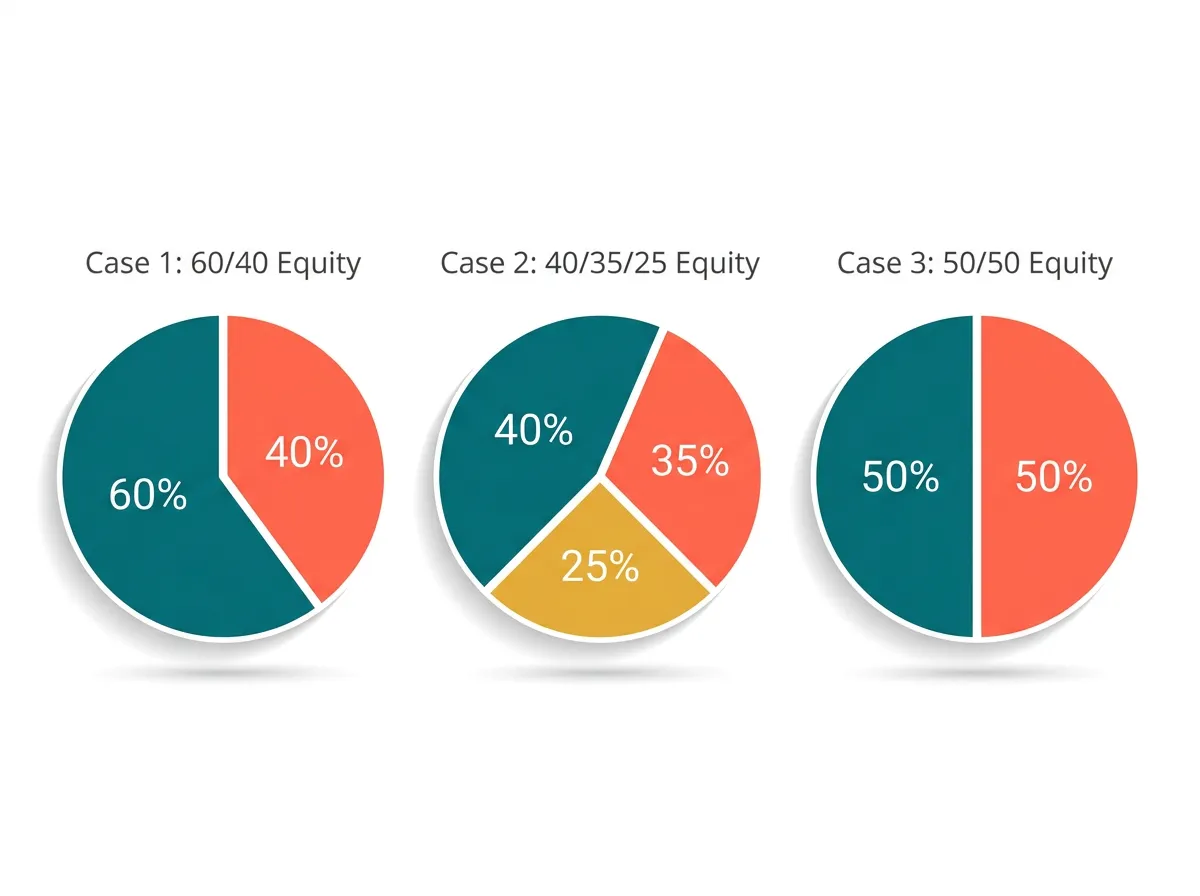
Let's look at how real (anonymized) founding teams have structured their splits successfully.
Case 1: The Technical/Business Split
Situation: Two cofounders — one building the product full-time, one handling sales and fundraising part-time while keeping a day job.
Structure: - Technical cofounder: 60% equity, fully vesting over four years. - Business cofounder: 40% equity, with accelerated vesting tied to going full-time. Vesting pauses if part-time status continues beyond 12 months.
Why it worked: The differential reflected the asymmetry in time commitment. The vesting acceleration clause gave the business cofounder a clear incentive to go all-in, and a fair adjustment if they didn't.
Case 2: The Three-Founder Balance
Situation: Three cofounders — one with the original idea and industry connections, one as CTO, one as operations lead.
Structure: - Idea originator: 40%, with 5% subject to milestone-based vesting (tied to closing three enterprise partnerships in year one). - CTO: 35%, standard four-year vesting. - Operations lead: 25%, with a provision to increase to 30% upon hitting specific revenue operations targets.
Why it worked: Performance-linked equity adjustments gave everyone a path to earning more—and made the initial split feel less permanent and high-stakes.
Case 3: The Equal Split Done Right
Situation: Two cofounders with genuinely equal contributions, equal time commitment, and equal risk.
Structure: - 50/50 equity, both on four-year vesting with one-year cliff. - Shotgun clause: if cofounders reach an irreconcilable disagreement, either can offer to buy the other out at a named price. The other must either accept the offer or buy the first cofounder's shares at the same price. - Tiebreaker advisor: a mutually agreed-upon advisor holds a casting vote on deadlocked board decisions.
Why it worked: The 50/50 split reflected reality, but the shotgun clause and tiebreaker mechanism prevented the deadlock that typically kills equal partnerships.
How to Have the Equity Conversation Without Destroying the Relationship
The reason most cofounders avoid this conversation is fear—fear of seeming greedy, fear of offending a friend, fear of exposing differences in commitment level. Here's how to navigate it:
-
Frame it as protection, not negotiation. "Let's build a structure that protects both of us if life gets complicated" lands very differently than "I think I deserve more equity."
-
Use a framework as a neutral starting point. When a calculator or model suggests numbers, neither cofounder is "asking for more." You're both responding to an external reference point.
-
Separate the conversation from the decision. Have the first discussion without committing to anything. Sleep on it. Let each person think privately about what feels right.
-
Put it in writing. A founders' agreement doesn't require a $10,000 lawyer. Tools like Servanda help cofounders create written agreements that prevent future conflicts, giving you a structured way to document decisions before they become disputes.
-
Set a date to revisit. Agreeing to review the equity structure at a specific future milestone (first revenue, first hire, first funding round) reduces the pressure on getting it perfectly right today.
The Real Cost of Skipping This Step
Founder breakups don't just hurt feelings—they kill companies. According to data from Harvard Business School, 65% of high-potential startups fail due to cofounder conflict. Not market failure. Not product failure. People failure.
The financial costs are staggering: legal fees for restructuring equity, lost investor confidence, team attrition as employees sense instability, and months of productivity lost to internal drama instead of building.
But the emotional costs are arguably worse. Broken friendships. Public disputes. The grinding sense that you could have avoided all of it with a few honest conversations and a document.
The best time to structure your equity split was before you incorporated. The second best time is today.
FAQ
Is a 50/50 equity split ever a good idea?
Yes—but only when it genuinely reflects equal contributions, equal commitment, and equal risk. Even then, it should always include vesting schedules, a tiebreaker mechanism for deadlocked decisions, and a buyback clause. A 50/50 split without these protections is the equity equivalent of driving without a seatbelt.
When should cofounders finalize their equity split?
Not on day one, and not after the company is worth something. The sweet spot is after you've worked together long enough to understand each person's real contribution (usually four to eight weeks) but before any significant value has been created. Waiting too long makes the conversation exponentially harder because the stakes are higher.
Do we need a lawyer to create a cofounder equity agreement?
A lawyer adds value, but you don't need to wait for one to start the process. Document your agreed terms clearly—equity percentages, vesting schedule, cliff, exit terms, decision-making process—then have a startup-experienced attorney review and formalize the document. Many founders use online frameworks and templates to create a solid first draft before involving legal counsel.
What happens to a cofounder's equity if they leave the startup?
It depends on your vesting schedule and buyback terms. With standard four-year vesting and a one-year cliff, a cofounder who leaves before 12 months forfeits all equity. After the cliff, they keep whatever has vested. Best practice is to include a repurchase option that lets the company buy back vested shares at fair market value, preventing a departed cofounder from holding a passive ownership stake indefinitely.
How do you handle equity when one cofounder contributes money and the other contributes time?
Separate financial investment from sweat equity. The capital-contributing cofounder can receive equity for their investment (or structure it as a convertible note for cleaner accounting), while the time-contributing cofounder earns equity through standard vesting. This prevents conflating two very different types of contribution and makes it easier to value each one on its own terms.
Conclusion
Cofounder equity splits are one of the most consequential decisions you'll make in the life of your startup—and one of the most frequently botched. The founders who get it right aren't smarter or less trusting. They simply treat the equity conversation as an act of partnership rather than a threat to it.
Structure your split around actual contributions. Add vesting so equity is earned, not gifted. Build in exit mechanisms while you're still friends. And revisit the arrangement as roles evolve.
The goal isn't to plan for failure—it's to build a foundation strong enough that disagreements become conversations instead of catastrophes. The thirty minutes you spend on this today could save your company, your finances, and your most important professional relationship.