
Co-Founder Breakups: Why They Happen & Warning Signs
You co-founded a company with someone you trusted completely. Maybe it was a college roommate, a former colleague, or a friend with the perfect complementary skill set. For a while, everything clicked—late nights felt electric, decisions came easily, and the shared vision was enough to paper over any disagreement.
Then, gradually, things shifted. A decision gets made without a conversation. Resentment builds over who's working harder. Equity splits that seemed fair on day one feel lopsided after twelve months of uneven effort. One morning you realize you've been avoiding your co-founder's calls.
Co-founder breakups are staggeringly common. Research from Harvard Business School professor Noam Wasserman found that 65% of high-potential startups fail due to conflict among co-founders—not because the market rejected the product, but because the founding team fractured from within. And the wreckage isn't just emotional. It's financial, legal, and often career-altering.
This article draws on real post-mortem stories and documented patterns from startup breakups to help you see the warning signs while there's still time to act.
Key Takeaways
- Most co-founder breakups follow predictable patterns around roles, equity, commitment, and unspoken expectations—not sudden betrayals.
- The silent period is the most dangerous phase. When co-founders stop arguing and start avoiding, the relationship is often past the tipping point.
- Formal written agreements created early—covering roles, equity vesting, decision rights, and exit terms—prevent the majority of fatal conflicts.
- A diagnostic checklist (included below) can help you assess your co-founder relationship health today, before small tensions become irreparable fractures.
- Addressing problems at the "annoyance" stage costs almost nothing. Addressing them at the "lawyer" stage can cost your entire company.

The Anatomy of a Co-Founder Breakup
Co-founder breakups rarely happen in a single explosive moment. They follow a slow, recognizable arc that looks remarkably similar across industries, stages, and geographies.
Stage 1: The Honeymoon
Everything is aligned. You finish each other's sentences. Disagreements are minor and resolved quickly because the energy of building something new overwhelms friction. During this stage, founders frequently skip formalizing agreements because "we trust each other" and "we're aligned on everything."
This is precisely when the seeds of future conflict get planted—not through malice, but through avoidance.
Stage 2: The Drift
Reality sets in. One founder is doing more customer-facing work while the other codes. One is investing savings while the other keeps a day job. Small irritations accumulate: decisions made unilaterally, credit taken unevenly, work hours that don't match. Neither founder names the tension directly because it feels premature or petty.
Stage 3: The Silence
This is the most dangerous stage. Co-founders stop raising issues altogether. Conversations become transactional. Meetings that once lasted hours become fifteen-minute standups. Both parties begin building private narratives about the other's failures. External advisors or team members start noticing the chill.
Stage 4: The Rupture
A triggering event—a funding decision, a hire, a pivot, or simply exhaustion—forces the conflict into the open. By now, both founders have months of accumulated grievances. The conversation quickly becomes about "everything," making resolution nearly impossible. Lawyers get involved. The company stalls or dies.
Why Co-Founder Breakups Really Happen: 6 Root Causes
After analyzing dozens of startup post-mortems and founder interviews, clear patterns emerge. These aren't abstract theories—they're the specific fracture points that destroyed real companies.
1. Misaligned Commitment Levels
The pattern: One founder goes all-in while the other hedges, keeping a full-time job, a side project, or one foot out the door.
Real example: The founders of a promising fintech startup agreed to build together "part-time until we get traction." Six months in, Founder A had quit her job and was working 60-hour weeks. Founder B was putting in 10 hours on weekends. When Founder A raised the imbalance, Founder B pointed to the original agreement: "We said part-time." They'd never defined what part-time meant, and the resentment had been compounding silently for months.
Why it's lethal: Commitment asymmetry creates a toxic dynamic where one founder feels exploited and the other feels pressured. Without an explicit agreement about expected hours, milestones, and what triggers a transition to full-time, this is almost inevitable.
2. Undefined or Unequal Roles
The pattern: Both founders are "doing everything," which means nobody owns anything. Or one founder's role gradually expands while the other's shrinks, creating a de facto hierarchy that was never agreed upon.
Real example: Two technical co-founders launched a SaaS product together. Both were engineers. Neither wanted to do sales. For months, they both built features while the pipeline sat empty. When they finally acknowledged the problem, neither wanted to be the one to shift into a business role. The company ran out of runway while they negotiated.
Why it's lethal: Role ambiguity leads to duplicated effort, dropped responsibilities, and ego clashes. It's especially common when co-founders share similar skill sets and neither wants to step into uncomfortable territory.

3. Equity Disputes That Fester
The pattern: Equity was split 50/50 on day one based on friendship rather than contribution. As contributions diverge, the split feels increasingly unfair to whoever is contributing more.
Real example: A widely cited Y Combinator post-mortem described a startup where a 50/50 equity split became a source of growing bitterness when one founder relocated to be closer to customers and took on all the fundraising while the other continued working remotely at a comfortable pace. There was no vesting schedule. When the active founder finally proposed renegotiating, the other founder refused—and the stalemate killed the company.
Why it's lethal: Equity is the most emotionally charged element of any startup. Without vesting schedules and contribution-based milestones, a "fair" split on day one can become a poison pill within a year.
4. Decision-Making Without a Framework
The pattern: There's no agreed-upon process for making major decisions. One founder starts making calls unilaterally—not out of malice, but because someone has to. The other founder feels sidelined.
Real example: The co-founders of an edtech startup had no decision-making framework. Founder A, who was more extroverted and better connected, gradually began making product and hiring decisions in hallway conversations and investor meetings. Founder B learned about pivotal choices after the fact. By the time they confronted the dynamic, Founder B felt like an employee, not a co-founder.
Why it's lethal: Every startup needs speed. But speed without a decision-rights framework creates a winner-loser dynamic that erodes trust at the foundation.
5. Different Visions for the Company's Future
The pattern: Co-founders align on the initial idea but diverge on where to take it. One wants to bootstrap; the other wants to raise venture capital. One wants to build a lifestyle business; the other wants a billion-dollar exit.
Real example: The founders of a food-delivery startup initially aligned on building a local service. After early traction, one founder wanted to raise a Series A and expand nationally. The other founder loved the local focus and didn't want the pressure of VC expectations. Neither vision was wrong—but they were incompatible, and neither founder had raised the question of long-term direction before the decision became urgent.
Why it's lethal: Vision misalignment is especially painful because both founders can be acting in good faith. There's no villain. There's just a fork in the road and two people who want to go in different directions.
6. Personal Life Changes
The pattern: A founder gets married, has a child, faces a health crisis, or simply burns out. Their available time, risk tolerance, and priorities shift in ways neither founder anticipated.
This is the hardest cause to plan for, but it's also the most human. The co-founder relationships that survive these transitions are the ones that have built enough structural flexibility—through vesting schedules, documented role expectations, and exit provisions—to adapt without shattering.
The Diagnostic Checklist: 15 Warning Signs Your Co-Founder Relationship Is in Trouble
Use this checklist honestly. If you check five or more, your relationship needs active attention. If you check eight or more, consider it urgent.
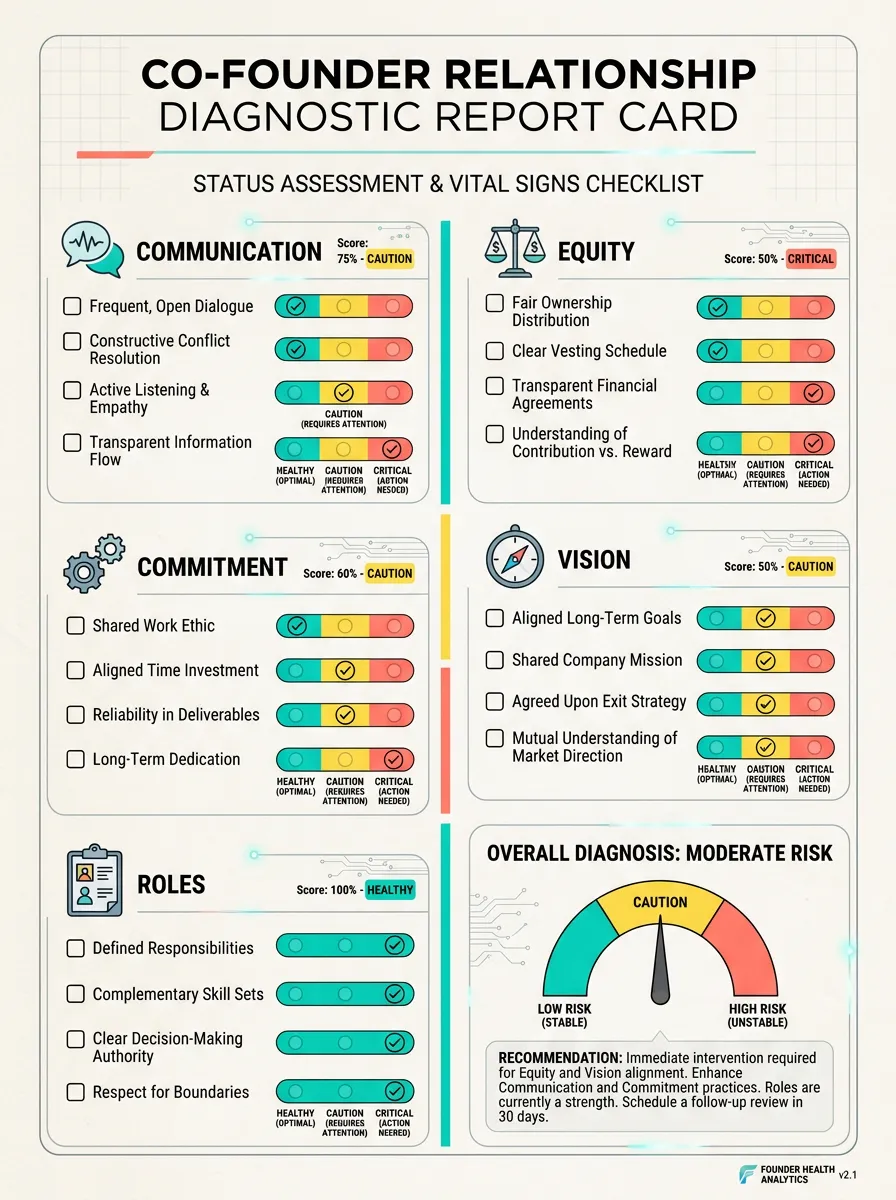
Communication
- [ ] You avoid bringing up topics because you know they'll lead to conflict
- [ ] Important decisions are made by one person and communicated after the fact
- [ ] You vent about your co-founder to team members, advisors, or friends instead of addressing issues directly
- [ ] Your meetings have become shorter, less frequent, or purely transactional
Commitment & Effort
- [ ] You feel like you're working significantly harder or contributing more than your co-founder
- [ ] Your co-founder has outside commitments (another job, side project) that compete for their attention
- [ ] There's no shared agreement on expected working hours or availability
Roles & Decision-Making
- [ ] You frequently duplicate work or step on each other's toes
- [ ] Critical responsibilities (sales, hiring, fundraising) are going unowned
- [ ] One founder has become the de facto CEO without a deliberate conversation
Equity & Finances
- [ ] The equity split feels unfair to at least one founder
- [ ] There's no vesting schedule in place
- [ ] You haven't discussed what happens financially if one founder leaves
Vision & Values
- [ ] You disagree on the company's direction but avoid the conversation
- [ ] You have different risk tolerances (bootstrapping vs. fundraising, slow growth vs. aggressive scaling)
Scoring: - 0-2 checks: Healthy. Keep being intentional. - 3-4 checks: Yellow flag. Schedule a structured co-founder conversation this week. - 5-7 checks: Orange flag. Consider bringing in a neutral third party—a mentor, advisor, or an AI-powered mediation tool like Servanda—to help structure the conversation and formalize agreements before positions harden. - 8+ checks: Red flag. The relationship is actively deteriorating. Act now, not next month.
What to Do When You See the Warning Signs
Recognizing the signs is only valuable if you act on them. Here's a practical framework for intervention at each stage.
If You're in the Drift Stage
Have the conversation you've been avoiding. Not all of them—pick the single most important unresolved issue and address it directly. Use this structure:
- Name the observation: "I've noticed we haven't talked about [topic] even though it's becoming important."
- Share your perspective without blame: "Here's how I'm experiencing the situation."
- Invite their perspective: "I'd like to hear how you see it."
- Propose a next step: "Can we agree on a specific resolution or timeline?"
Then, write it down. The single most protective action co-founders can take is putting their agreements in writing—even informal ones.
If You're in the Silence Stage
Bring in a third party. This isn't a sign of failure; it's a sign of maturity. A neutral advisor, mentor, or structured mediation process can break the dynamic where neither founder wants to be the one to raise the hard issue.
Also, formalize what you can. Even if the relationship is strained, getting equity vesting, role definitions, and exit terms into a written document protects both parties and the company.
If You're at the Rupture Stage
Get professional help—legal and emotional. At this point, you likely need a lawyer to protect your interests. But also recognize that this is a grief process. The loss of a co-founder relationship often feels like a divorce, and treating it with that emotional seriousness is not overdramatic. It's realistic.
The Agreements That Could Have Saved These Companies
Looking back at the stories in this article, most of these breakups could have been prevented—or at least managed without destroying the company—if the co-founders had formalized a few key agreements early:
- A vesting schedule (typically four years with a one-year cliff) so that equity is earned over time, not granted upfront.
- A roles and responsibilities document that clearly defines who owns what, reviewed quarterly.
- A decision-making framework specifying which decisions require consensus, which require a majority, and which one founder can make autonomously.
- An exit and buyout provision that defines what happens if one founder leaves—voluntarily or involuntarily.
- A commitment agreement that specifies expected time investment, financial contributions, and conditions for going full-time.
None of these require a lawyer on day one. They require two co-founders, an honest conversation, and something to write it down with.
FAQ
How common are co-founder breakups in startups?
Extremely common. Research suggests that co-founder conflict is a leading cause of failure in nearly two-thirds of high-potential startups. It's more common than product failure or running out of cash—yet it receives far less attention in startup education and planning.
When should co-founders create a formal agreement?
As early as possible—ideally before any code is written, any money is spent, or any significant time is invested. The best time is when things are going well and both parties are optimistic, because that's when negotiations are collaborative rather than adversarial. If you haven't done it yet, the second-best time is today.
Can a co-founder breakup be handled without lawyers?
Sometimes, yes—especially if both parties are acting in good faith and the breakup is caught early. A clear operating agreement with exit provisions can allow co-founders to part ways cleanly. However, if equity, IP ownership, or significant financial assets are involved, legal counsel is strongly recommended to protect everyone.
What's the difference between a co-founder disagreement and a real breakup warning sign?
Disagreements are normal and even healthy—they mean both founders are engaged. The warning signs are about patterns, not individual incidents. When disagreements stop happening (because one or both founders have given up on raising issues), when resentment replaces respect, or when conversations become purely transactional—those are the signs that the relationship itself is deteriorating, not just a single decision.
Should co-founders split equity 50/50?
There's no universal right answer, but a 50/50 split should be a deliberate choice, not a default. It works when both founders are contributing equally in time, capital, skills, and risk. It becomes dangerous when contributions diverge and there's no mechanism to adjust. Whatever split you choose, pair it with a vesting schedule so equity is earned over time.
Conclusion
Co-founder breakups follow predictable patterns, and the warning signs are almost always visible long before the relationship reaches a breaking point. The challenge isn't awareness—it's action. Most founders can feel the drift happening. They just don't intervene because the conversation feels awkward, premature, or confrontational.
But awkward conversations in month three are infinitely cheaper than legal battles in month eighteen. The founders who survive aren't the ones who never disagree. They're the ones who build the structural and emotional scaffolding to handle disagreement before it arrives.
Start with the checklist in this article. Be honest with yourself about what you find. And if the signals are there, do the one thing that separates companies that survive co-founder tension from those that don't: put your agreements in writing, have the conversation today, and treat your co-founder relationship with the same rigor you bring to your product.