
Cofounder Alignment: The Template That Prevents Breakups
Key Takeaways
- Most cofounder breakups trace back to misalignment that existed from day one — on vision, equity, roles, or decision-making authority — but was never surfaced explicitly.
- A cofounder alignment template works like a startup prenup: it forces uncomfortable-but-essential conversations while the relationship is still strong enough to handle them honestly.
- The five critical alignment areas are vision and values, roles and responsibilities, equity and compensation, decision-making authority, and exit scenarios.
- You should revisit your alignment agreement every 6–12 months, because what's true at founding rarely stays true through growth, pivots, and funding rounds.
- Writing things down isn't a sign of distrust — it's a sign of respect for the partnership and the venture you're building together.
Picture this: You and your cofounder have been building together for fourteen months. You've shipped the product, landed early customers, and just got a term sheet from a credible investor. This should be the best week of your startup's life. Instead, you're in a coffee shop having a conversation that feels more like a deposition. Your cofounder believes the equity split should shift because they wrote all the code. You believe your fundraising and customer development work was equally critical. Neither of you is wrong. But neither of you ever wrote down what you agreed to, or why.
This scenario plays out constantly. Research from Harvard Business School professor Noam Wasserman found that 65% of high-potential startups fail due to conflict among cofounders. Not market failure. Not product failure. People failure. And in nearly every case, the fracture started long before anyone noticed — in the assumptions that were never spoken aloud.
Cofounder alignment isn't a one-time conversation. It's a living document. And this article gives you the template to build one.

Why Cofounder Breakups Happen (And Why They're Predictable)
Cofounder breakups rarely come from a single blowout argument. They accumulate. One person thinks they're building a lifestyle business; the other is optimizing for a billion-dollar exit. One person assumes they'll be CEO forever; the other assumes the role will rotate based on stage. One person thinks weekends are sacred; the other thinks they signal a lack of commitment.
These aren't personality defects. They're misalignment — and they're entirely preventable if you surface them early.
The most common fault lines include:
- Vision divergence: Cofounders who never explicitly agreed on what success looks like — scale, timeline, impact, or lifestyle.
- Equity resentment: Splits that felt fair at founding but feel wildly unfair twelve months in, after contributions have been uneven.
- Role ambiguity: Two people making decisions in the same domain, or critical domains where nobody is making decisions at all.
- Effort mismatch: Different expectations around working hours, intensity, and sacrifice — especially when one cofounder has different life circumstances.
- Exit scenario blindness: No plan for what happens if someone wants to leave, gets sick, or simply stops performing.
The Startmate cofounder alignment framework — widely used across the Australian and global startup ecosystem — was designed precisely to address these gaps. What follows is a practical template inspired by that framework, adapted for cofounders at any stage.
The Cofounder Alignment Template: Five Sections You Can't Skip
1. Vision and Values Alignment
This is where most templates start, and where most cofounders rush through. Don't. Vision misalignment is the number one predictor of cofounder conflict because it contaminates every decision downstream.
Sit down separately and write answers to these questions before comparing:
- What does success look like in 5 years? Be specific. Revenue number? Team size? IPO? Acquisition? Profitable small team?
- What kind of company culture do we want? Remote-first or in-office? Flat or hierarchical? Move-fast-and-break-things or methodical?
- What are our non-negotiable values? Not aspirational poster values — the real ones. The ones you'd fire someone over.
- How do we feel about taking venture capital? This one question has ended more cofounder relationships than almost any other.
- What would make us walk away from this company?
Compare your answers side by side. The goal isn't perfect overlap — it's understanding where you differ and deciding whether those differences are manageable or fundamental.
Example: Two cofounders — let's call them Priya and Marcus — discovered during this exercise that Priya wanted to build a venture-scale SaaS company and Marcus wanted to build a profitable consultancy that might productize over time. They'd been operating for three months without realizing they were building two different companies. Catching this at month three saved them from a devastating split at month eighteen.
2. Roles and Responsibilities
The question isn't just "who does what." It's "who has final say on what."
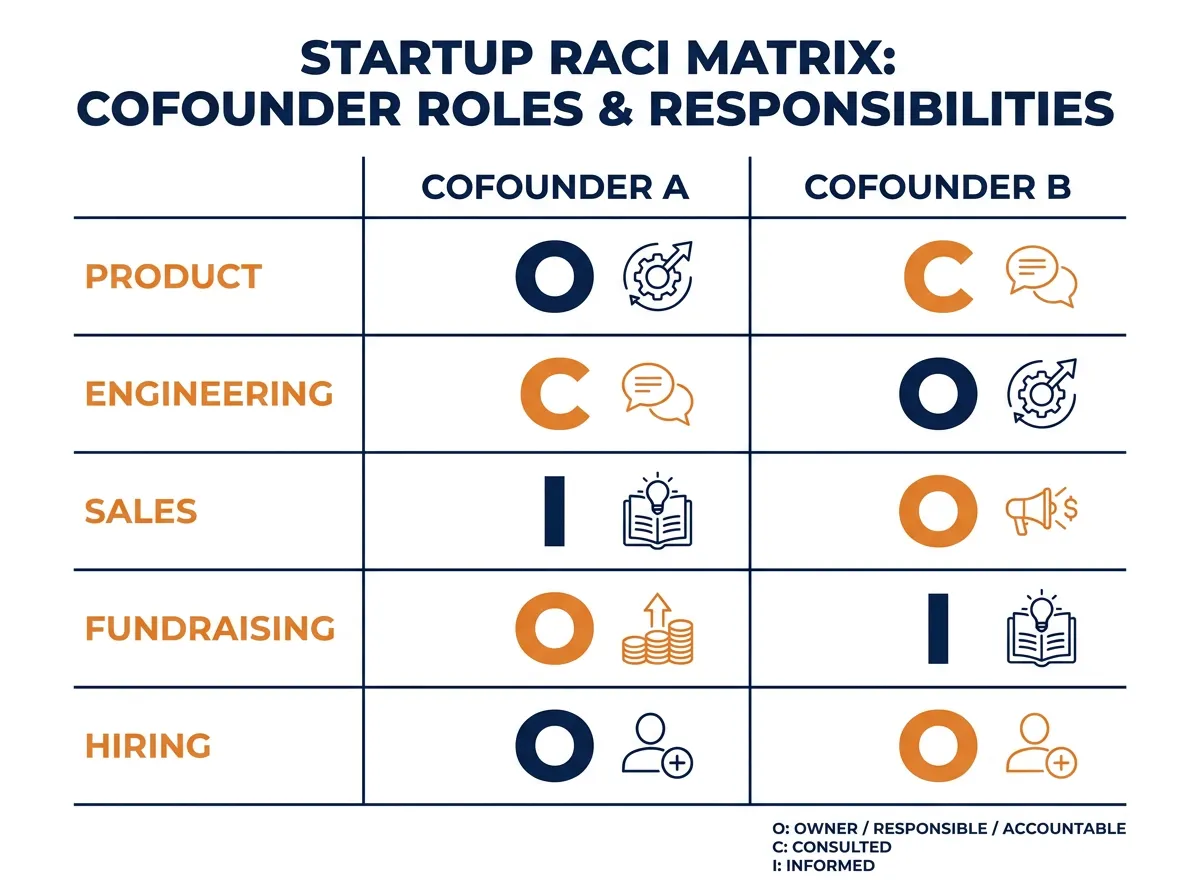
Map out every critical function of your startup and assign clear ownership:
| Function | Owner | Consulted | Informed |
|---|---|---|---|
| Product direction | |||
| Engineering/technical | |||
| Sales & revenue | |||
| Fundraising | |||
| Hiring & culture | |||
| Finance & legal | |||
| Marketing & brand |
For each function, define:
- Who owns the final decision (one person, not both)
- Who must be consulted before that decision is made
- Who needs to be informed after
This is essentially a RACI framework simplified for a two-person team. The critical principle: every domain gets one owner. When two people co-own a decision, nobody owns it.
Also discuss:
- What's the expected weekly time commitment from each cofounder?
- Are there outside commitments (another job, consulting, caregiving) that affect availability?
- How will you handle it if one person's role evolves or their contribution level changes?
3. Equity, Compensation, and Vesting
Equity is where emotions run hottest, so it deserves the most structured conversation.
Address each of these explicitly:
- What is the equity split, and what's the rationale? Write down the reasoning, not just the numbers. "50/50 because we're equal partners" means something different than "60/40 because one person has been working on this full-time for six months."
- Is there a vesting schedule? (The answer should almost always be yes.) A standard four-year vest with a one-year cliff protects both cofounders.
- What triggers accelerated vesting? Acquisition? Termination without cause?
- What happens to unvested shares if someone leaves?
- When will cofounders start drawing salary, and how much? Mismatched financial situations create silent resentment faster than almost anything else.
A common mistake: treating the equity conversation as a one-time negotiation. In reality, it should be revisited at each major milestone — first revenue, first hire, first funding round — to confirm that the original rationale still holds.
4. Decision-Making and Conflict Resolution
Every cofounder pair will disagree. The question is whether you have a system for resolving disagreement or whether you default to whoever argues longest, loudest, or most passive-aggressively.
Define your decision-making protocol:
- Day-to-day decisions: The domain owner decides. No committee needed.
- Significant decisions (hiring, large expenditures, pivots): Both cofounders discuss, domain owner decides, but must genuinely consider the other's perspective.
- Existential decisions (shutting down, taking funding, selling the company): Both must agree. If you can't agree, you follow your tiebreaker protocol.
Establish a tiebreaker mechanism before you need one. Options include:
- Designated CEO has final say on business decisions; CTO has final say on technical decisions
- An agreed-upon advisor or mentor serves as tiebreaker
- A structured "disagree and commit" protocol with a defined review period
- A formal mediation step — tools like Servanda can help cofounders work through structured disagreements with AI-guided frameworks before positions harden into grudges
Also agree on how you'll handle the emotional side of conflict:
- How do we tell each other hard truths without it becoming personal?
- What does a productive disagreement look like between us?
- What are our individual triggers or communication styles that the other should know about?

5. Exit Scenarios and the "What If" Conversations
Nobody wants to talk about the end at the beginning. But this is precisely when you should — when goodwill is high and stakes feel abstract.
Document your agreements on:
- Voluntary departure: What happens if one cofounder wants to leave? What's the notice period? How are unvested shares handled? Is there a buyback clause for vested shares?
- Performance issues: How do you define underperformance? What's the process — conversation, warning period, mediation, separation?
- Life changes: What happens if a cofounder has a health crisis, family emergency, or simply burns out? Is there a leave-of-absence policy?
- Removal: Under what circumstances can a cofounder be removed? What's the vote/process?
- Company dissolution: If you decide to shut down, how do you handle remaining assets, IP, and obligations?
Example: A pair of cofounders in the fintech space — call them Jamie and Sam — included a "conscious uncoupling" clause in their agreement: if either wanted to leave within the first two years, they'd give 90 days notice, forfeit unvested equity, and sell vested equity back to the company at fair market value. When Sam left after 18 months for personal reasons, the transition was painful but orderly. Without that clause, it would have been a lawsuit.
How to Actually Use This Template
Having the template matters less than how you use it. Here's the process:
- Schedule a dedicated session. Not over lunch. Not in a Slack thread. Block 3–4 hours with no distractions.
- Write independently first. Each cofounder fills out every section alone before comparing answers. This prevents anchoring bias.
- Compare and discuss with curiosity, not advocacy. The goal is understanding, not winning.
- Document everything. Put your alignment agreement in a shared document. Sign it. It doesn't need to be legally binding to be powerful — the act of writing creates accountability.
- Schedule a 6-month review. Put it on the calendar now. Startups change fast. Your alignment document should keep pace.
- Pair it with a legal agreement. This template is not a substitute for a proper shareholders' agreement or operating agreement drafted by a lawyer. It's the foundation that makes the legal document meaningful.
Common Objections (And Why They Don't Hold Up)
"We trust each other — we don't need to write this down." Trust is exactly why you should write it down now. Documenting alignment while trust is high means you'll have clarity when stress tests the relationship. It's not a sign of distrust. It's a trust multiplier.
"We'll figure it out as we go." You will. The question is whether you'll figure it out proactively or reactively — during a calm Saturday morning or during a board meeting where investors are asking who's actually in charge.
"This feels too corporate for our stage." The earlier you do this, the simpler it is. A two-person alignment conversation takes one afternoon. A two-person legal dispute takes months and can cost tens of thousands of dollars.
Frequently Asked Questions
When should cofounders create an alignment agreement?
Ideally before you write a single line of code or make your first dollar. But the second-best time is right now. If you've been operating without one, schedule the conversation this week. The longer you wait, the more assumptions accumulate — and assumptions are where resentment grows.
Is a cofounder alignment template the same as a legal agreement?
No. A cofounder alignment template is a working document that captures your shared understanding of vision, roles, equity rationale, and decision-making. A legal agreement (like a shareholders' agreement or operating agreement) makes certain elements legally enforceable. You need both. The alignment template informs and strengthens the legal one.
What if my cofounder doesn't want to do this exercise?
That reluctance is itself valuable information. It might signal discomfort with commitment, a desire to keep options ambiguous, or simply anxiety about hard conversations. Approach it gently: "I want to make sure we're building on the same foundation. Can we try this and see if it's useful?" If they still refuse, consider what that tells you about how they'll handle harder conversations down the road.
How often should we revisit our cofounder alignment?
At minimum, every six months or at any major inflection point — closing a funding round, making your first hire, pivoting the product, or hitting a significant revenue milestone. The company you're building at month twelve is different from the one you envisioned at month one. Your alignment should evolve accordingly.
Can you fix a cofounder relationship that's already misaligned?
Often, yes — but it requires both people to be willing. Start by acknowledging the misalignment without blame. Then work through the template together, treating it as a reset rather than an indictment. If you can't have the conversation productively on your own, bring in a neutral third party: an advisor, coach, or mediator.
Conclusion
Cofounder breakups aren't inevitable. They're the predictable result of conversations that never happened. The template outlined here — covering vision, roles, equity, decision-making, and exit scenarios — won't eliminate disagreement. Disagreement is healthy. What it will do is give you a shared language, a shared document, and a shared process for navigating the hardest parts of building something together.
The best time to have these conversations is before you need them. Block the time this week. Fill out each section independently. Compare your answers honestly. Write down what you agree on. Negotiate what you don't. And then revisit it in six months, because you'll both have changed — and your alignment should change with you.
Your startup deserves a foundation as strong as your ambition. Build it on paper first.