
Cofounder Breakup Post-Mortem: Signs You Missed
You built a pitch deck together at 2 a.m. You finished each other's sentences in investor meetings. You genuinely believed you'd found your professional soulmate. And then, eighteen months later, one of you is drafting a buyout email while the other is quietly updating their LinkedIn.
The cofounder breakup is one of the most common — and most painful — reasons startups die. Y Combinator has cited cofounder conflict as a leading killer of early-stage companies, and yet nearly every founder who goes through it says the same thing afterward: "The signs were there. I just didn't want to see them."
This article is a post-mortem — not of a company, but of the cofounder relationship itself. Drawing from real breakup stories (including the widely-shared account on yirenlu.com and other founder retrospectives), we'll dissect the red flags that appear months or even years before the final blow-up. The goal isn't to make you paranoid. It's to give you a vocabulary for what you might already be feeling.
Key Takeaways
- Misaligned ambition is the most dangerous red flag because it often masquerades as a difference in "work style" when it's actually a fundamental disagreement about what the company should become.
- Unspoken resentment compounds like debt. The things cofounders avoid saying in month three become the things they scream about in month twelve.
- Diverging visions don't announce themselves loudly. They show up in small decisions — which feature to build next, whether to take a meeting, how to spend $5,000 — long before they surface as existential disagreements.
- The absence of a written operating agreement is itself a warning sign. If you can't have the uncomfortable conversation about equity, roles, and exit terms when things are good, you definitely won't handle it well when things go bad.
- Most cofounder breakups are survivable — for the company — if caught early. The ones that kill startups are the ones that fester for six to twelve months in silence.
Why Cofounder Breakups Follow a Pattern
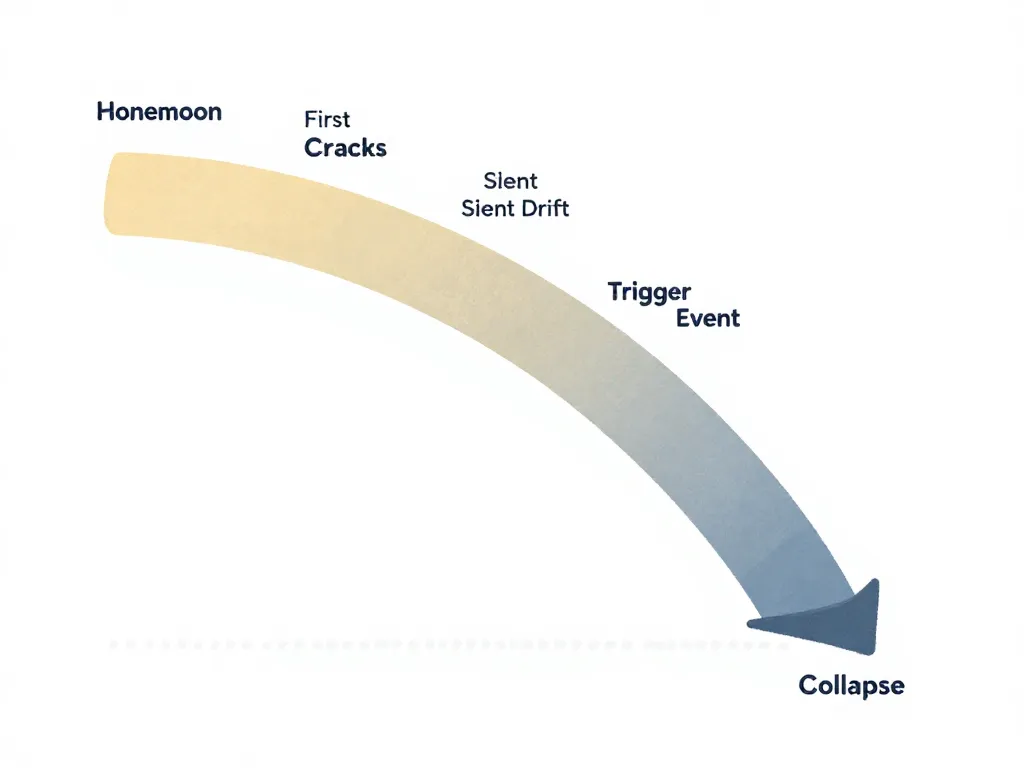
Startup post-mortems have become a genre unto themselves. Founders write them to process failure, warn others, and sometimes just to feel less alone. But cofounder breakup stories share an eerily consistent arc:
- The Honeymoon: Everything clicks. You marvel at how complementary your skills are.
- The First Cracks: Small disagreements arise, but you brush them off. "We'll figure it out."
- The Silent Drift: You stop having real conversations about strategy. You each start building your own version of the company in your head.
- The Trigger Event: A funding decision, a hire, a product pivot — something forces the underlying tension to the surface.
- The Collapse: Weeks or months of painful negotiation, lawyer involvement, or simply one person walking away.
Yiren Lu's widely-read account of her cofounder experience follows this pattern almost exactly. So do dozens of others on Hacker News, Indie Hackers, and Reddit's r/startups. The specifics differ; the structure doesn't.
The question isn't whether your cofounding relationship will face tension. It will. The question is whether you'll recognize the early signals — the ones that show up in Phase 2 and Phase 3 — before you reach Phase 5.
Red Flag #1: You Have Different Definitions of Success
This is the most common root cause of cofounder breakups, and it's the hardest to spot because it rarely presents as an explicit disagreement.
What It Looks Like in Practice
Consider two cofounders — let's call them Maya and Jordan. Maya wants to build a venture-scale business. She's thinking about Series A timelines, TAM calculations, and eventual acquisition targets. Jordan wants to build a profitable, sustainable product that gives them both financial freedom and creative control.
Neither vision is wrong. But they are fundamentally incompatible, and that incompatibility will eventually manifest in every single decision:
- Hiring: Maya wants to hire aggressively. Jordan thinks they should stay lean.
- Pricing: Maya wants to undercut competitors to grab market share. Jordan wants to charge a premium and grow slowly.
- Fundraising: Maya wants to take the VC meeting. Jordan doesn't see why they need outside money.
In the early days, these disagreements feel like healthy debate. Six months in, they feel like a power struggle. A year in, they feel personal.
The Question You Should Be Asking
Sit down separately and each write a one-page description of what the company looks like in three years. Compare them. If they describe fundamentally different companies, you don't have a strategy disagreement — you have a compatibility problem.

Red Flag #2: Resentment Is Accumulating in Silence
In her post-mortem, Yiren Lu describes a dynamic that countless cofounders will recognize: the slow buildup of grievances that never get voiced directly. One person feels they're doing more of the work. The other feels their contributions are undervalued. Neither says anything because the relationship still "feels fine" on the surface.
The Resentment Ledger
Every cofounder keeps a mental ledger, whether they admit it or not. It tracks who made the last sacrifice, who got the last win, who worked the last weekend. When the ledger feels balanced, the relationship is healthy. When it tips — and stays tipped — resentment starts to build.
Here are the early warning signs:
- You start keeping score. You notice exactly how many hours your cofounder worked last week, and it bothers you.
- You vent to others instead of your cofounder. Your spouse, your friends, your advisor — everyone knows about the tension except the person who matters.
- You interpret neutral actions negatively. Your cofounder takes a Friday off, and instead of thinking "they needed rest," you think "must be nice."
- You rehearse arguments in your head. You've had the confrontation ten times in the shower. Zero times in real life.
What to Do About It
Schedule a recurring "state of us" conversation — not about the product, not about metrics, but about the relationship. Some cofounders do this monthly, others biweekly. The format matters less than the consistency. One useful structure:
- What's one thing I did this month that you appreciated?
- What's one thing that frustrated you?
- Is there anything you've been avoiding saying?
It feels awkward at first. That awkwardness is the point. If you can't navigate mild discomfort in a structured conversation, you won't survive a genuine crisis.
Red Flag #3: Decision-Making Has Become a Zero-Sum Game
Healthy cofounder relationships have a rhythm. Sometimes you defer to your partner's expertise. Sometimes they defer to yours. Decisions feel collaborative even when one person has the final say.
When the relationship is deteriorating, every decision starts to feel like a referendum on who's in charge.
Symptoms to Watch For
- You can't remember the last time you genuinely changed your mind based on your cofounder's argument.
- Decisions that should take five minutes take five days because neither of you will concede.
- You start making decisions unilaterally — not maliciously, but because it's "easier than arguing about it."
- You invoke your title or equity stake to settle disputes. ("I'm the CEO, so...")
One founder described it this way in a Hacker News post-mortem: "We stopped debating ideas and started debating authority. That was the beginning of the end."

Red Flag #4: Your Roles Have Never Been Clearly Defined
Ambiguity is comfortable in the beginning. "We both do everything" feels democratic and scrappy. But undefined roles create two specific problems:
- Duplicate effort and territorial conflict. You both show up to the same meeting thinking you're in charge.
- Accountability gaps. When something falls through the cracks, there's no one clearly responsible — which quickly becomes "it's your fault" vs. "no, it's yours."
Many of the most painful cofounder breakup stories trace back to this root cause. Not because the founders were careless, but because defining roles felt premature or unnecessarily formal when the company was just two people and a shared Google Doc.
The Fix
Write down your roles. Not a 20-page job description — just a clear, honest answer to three questions:
- Who owns which domains (product, engineering, sales, ops, finance)?
- Who has final say when we disagree on something in the other person's domain?
- What decisions require both of us to agree?
This is also where formalizing your cofounder agreement matters enormously. Tools like Servanda help cofounders create written agreements that cover roles, equity, decision-making authority, and what happens if someone leaves — the exact topics that feel awkward to discuss but become catastrophic when left unaddressed.
Red Flag #5: You're Building Parallel Companies
This is the most advanced warning sign, and by the time it's visible, the breakup is often already inevitable.
What It Looks Like
- You each have separate relationships with key investors, advisors, or customers — and you don't share information from those conversations.
- You've started thinking of certain parts of the company as "mine" and other parts as "theirs."
- Your product roadmaps, if you each wrote one independently, would look completely different.
- You've mentally rehearsed what you'd do if your cofounder left.
One anonymous founder on Indie Hackers described discovering that their cofounder had been having side conversations with their lead investor about a pivot — a pivot the other cofounder had explicitly argued against. "That was when I realized we weren't running the same company anymore. We were running two companies that happened to share a bank account."
What Surviving Cofounders Did Differently
Not every story ends in a breakup. The cofounders who navigate these tensions successfully tend to share a few traits:
- They addressed problems when they were small. They didn't wait for the "right time" to have hard conversations, because the right time is always now.
- They wrote things down. Agreements, roles, expectations — even informal ones. Writing creates clarity that conversation alone can't.
- They brought in a third party early. An advisor, a coach, a mediator. Someone who could reflect the dynamic back to them without taking sides.
- They separated their identity from the company. The founders who survived conflict were the ones who could say, "This isn't working" without hearing, "You're a failure."
- They had explicit exit terms from day one. Not because they expected to break up, but because they knew that having an exit plan made it safer to stay.
Frequently Asked Questions
How do you know when a cofounder disagreement is normal vs. a sign of a breakup?
Normal disagreements are about specific decisions and resolve within days. Warning signs include disagreements that repeat without resolution, arguments that shift from the topic to the person, and a growing feeling that your cofounder fundamentally doesn't understand what you're trying to build. If you dread your next conversation with them, that's not normal friction — that's a signal.
Can a cofounder breakup be done without destroying the startup?
Yes, but it requires acting before the relationship becomes toxic. The cleanest cofounder separations happen when both parties agree on the problem, have a pre-existing agreement about equity and vesting, and can negotiate the transition in weeks rather than months. The ones that destroy companies are the ones that drag on in silence until lawyers and lawsuits are the only option left.
What should a cofounder agreement include to prevent a messy breakup?
At minimum: equity split and vesting schedule (with a cliff), clearly defined roles and decision-making authority, what happens if one cofounder leaves or is asked to leave (including how equity is handled), IP assignment, and a dispute resolution process. It doesn't need to be a 50-page legal document, but it does need to exist in writing before you need it.
How early do cofounder problems usually start?
Most founders who write breakup post-mortems trace the first real signs of trouble to the three-to-six-month mark. That's when the initial excitement fades and the daily grind exposes differences in work ethic, ambition, and vision. The breakup itself often doesn't happen until month twelve to eighteen — which means there's usually a long window where early intervention could change the outcome.
Moving Forward
If you've recognized your own situation in any of these red flags, that awareness itself is valuable. Most cofounders who go through painful breakups say their biggest regret isn't the breakup itself — it's how long they waited to acknowledge what was happening.
You don't need to have all the answers today. But you do need to start the conversation. Write down your vision for the company and ask your cofounder to do the same. Schedule a real check-in about your working relationship — not the product, not the metrics, the relationship. Put your agreements in writing, even if they feel obvious right now.
The best time to address cofounder tension is before it feels urgent. The second best time is today.