
How to Break Up With Your Cofounder Gracefully
You cofounded this company with someone you trusted deeply—maybe a college roommate, a former colleague, or a friend who shared your exact vision for the future. Now, months or years later, something has shifted. Conversations feel strained. Decisions that used to take minutes now take weeks. One of you wants to pivot; the other wants to double down. You've started dreading Monday mornings, and not because of the workload.
You know something has to change. But the thought of a cofounder breakup is paralyzing. What happens to the equity? Who tells the investors? Will the company survive? Will the friendship?
Here's what most founders don't realize: staying too long in a broken partnership does more damage than a clean, well-managed exit. The founders who handle separations gracefully aren't lucky—they're prepared. This article gives you the playbook they used.
Key Takeaways
- Recognize the difference between rough patches and fundamental misalignment. Not every conflict means it's over, but persistent disagreements about vision, values, or commitment levels are serious signals.
- Have the conversation early and frame it as a shared problem. The longer you wait, the more resentment accumulates and the harder the logistics become.
- Negotiate equity, IP, and role transitions with a written separation agreement. Handshakes won't survive a dispute six months from now.
- Control the narrative together. Coordinate investor, team, and public communication before either of you says a word to anyone outside the room.
- Protect the friendship by protecting the business. Ironically, the more professional and structured you make the process, the more likely the personal relationship survives.
Step 1: Acknowledge What's Actually Happening
Distinguish Friction From Fracture
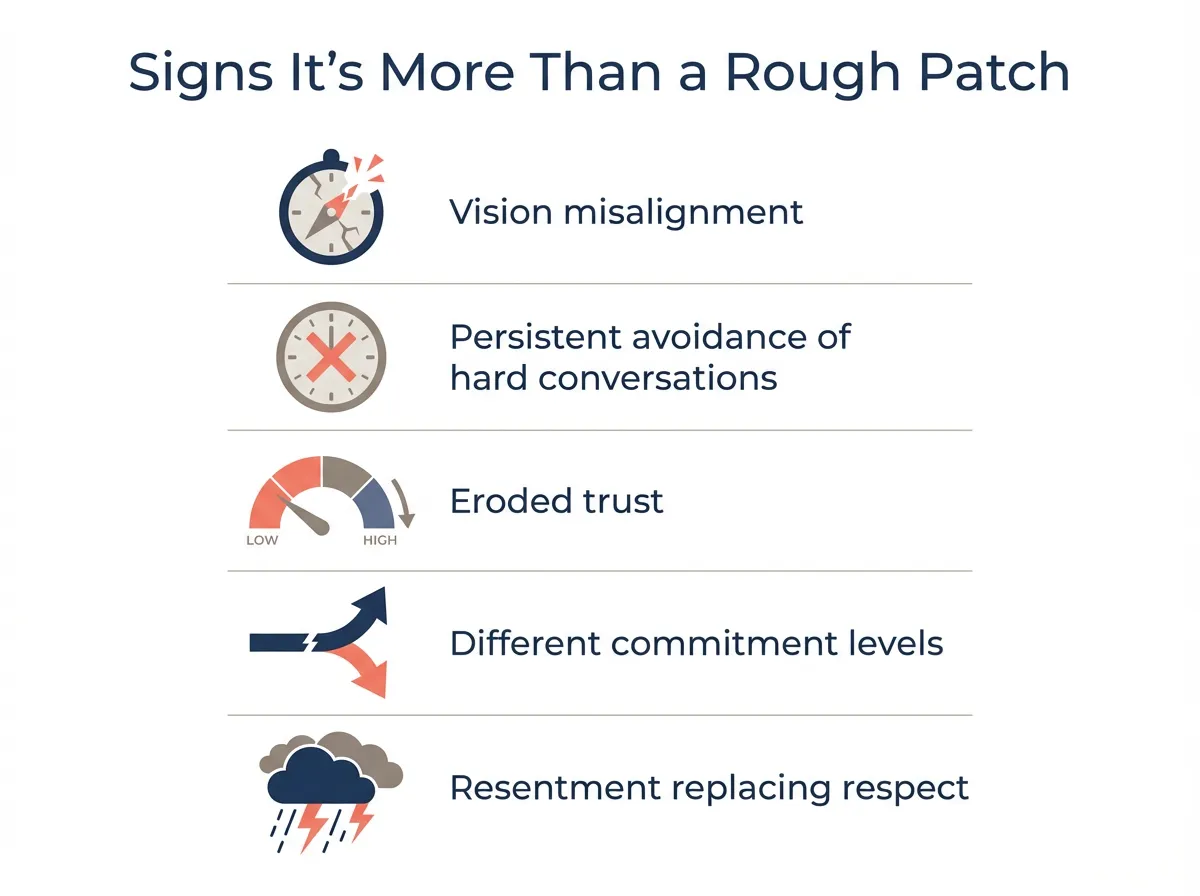
Every cofounder relationship has conflict. That's healthy. What isn't healthy is a persistent pattern where you and your cofounder disagree on the things that matter most: company direction, work ethic, financial decisions, or core values.
Yiren Lu, a founder who publicly chronicled her cofounder breakup on her blog, described the moment she knew it was over: it wasn't a single blowup. It was the slow realization that she and her cofounder had fundamentally different ideas about what the company should become. As she put it, the hardest part wasn't the disagreement itself—it was admitting that no amount of talking would resolve it.
Ask yourself these questions honestly:
- Do we still share the same vision for where this company should be in two years?
- Do I trust this person to make decisions when I'm not in the room?
- Has resentment replaced respect?
- Am I staying out of obligation or guilt rather than genuine partnership?
If the answers point toward a fundamental misalignment, you're not looking at a rough patch. You're looking at the beginning of a separation.
Don't Wait for a Crisis
One of the most consistent findings from startup post-mortems—discussed at panels like the SXSW "Cofounder Breakups" session and echoed across Y Combinator founder stories—is that founders wait far too long to act. They hope things will improve. They tell themselves the next funding round, the next product launch, the next hire will fix the dynamic.
It won't. The longer you wait, the more complicated the separation becomes—more investors to inform, more employees affected, more equity vested, more resentment baked in.
Step 2: Have the Conversation
Set the Right Conditions
This is not a Slack message. It's not a conversation you have while exhausted at 11 PM after a product launch. Choose a time and place where you both have space to think clearly. Some founders find it helpful to have this conversation outside the office entirely—a walk, a coffee shop, somewhere that doesn't feel like a boardroom.
Frame It as a Shared Problem
The worst way to open this conversation: "I want out." The best way: "I think we need to talk about whether our current setup is working for either of us."
This isn't manipulation—it's accurate. A deteriorating cofounder relationship is hurting both of you. Framing the conversation as collaborative rather than adversarial sets the tone for everything that follows.
Here's language that has worked for founders who've been through this:
- "I've been thinking a lot about our dynamic, and I don't think the current arrangement is serving the company or either of us well."
- "I want to figure out the best path forward—for the business and for us."
- "I'd rather we make a thoughtful decision now than let things deteriorate to a point where we can't."
Expect Emotion, But Don't Let It Drive Decisions
The initial conversation will likely be emotional. That's fine. Let it be. But separate the emotional processing from the decision-making. Agree to take a few days before discussing logistics. The goal of the first conversation is alignment on the fact that something needs to change—not hammering out a term sheet.

Step 3: Define the Terms of Separation
This is where most cofounder breakups go wrong. The emotional conversation happens, but the business logistics get neglected, half-done, or handled informally. Six months later, there's a dispute over who owns the code, who keeps the equity, or who has the right to use the company name.
You need a written separation agreement. Period.
Equity and Vesting
Equity is the most contentious issue in any cofounder breakup. Here are the most common arrangements:
- Accelerated vesting cutoff: The departing founder keeps whatever equity has vested to date and forfeits unvested shares. This is the cleanest option if you have a standard vesting schedule.
- Equity buyback: The remaining founder (or the company) buys back some or all of the departing founder's vested shares at a negotiated price. This is common when the departing founder wants a clean break.
- Partial retention with advisory conversion: The departing founder retains a reduced equity stake and transitions to an advisory role. This works when the departure is amicable and the departing founder still believes in the company.
If you didn't establish a vesting schedule at the start—and many early-stage founders don't—this negotiation will be harder. But it's still possible. The key principle: compensation should reflect actual contribution, both past and future. A cofounder who worked full-time for two years and is leaving a functional business deserves different treatment than one who checked out six months in.
Intellectual Property Assignment
Who owns the code, the designs, the brand, the patents? This needs to be unambiguous in writing. In most cases, IP created for the company should stay with the company. But if the departing founder brought in pre-existing IP—code from a previous project, a proprietary methodology, design assets—you need to explicitly address what's licensed versus what's assigned.
Get an attorney involved here. A $2,000 IP assignment agreement is infinitely cheaper than a $200,000 lawsuit.
Non-Compete and Non-Solicitation
Will the departing founder agree not to start a competing company? Not to recruit your employees? These clauses need to be reasonable in scope and duration (most courts won't enforce anything over 12–24 months), but they provide important protection.
Financial Obligations
If the departing founder personally guaranteed any company debt, took a salary advance, or has unreimbursed expenses, spell out how those will be handled.
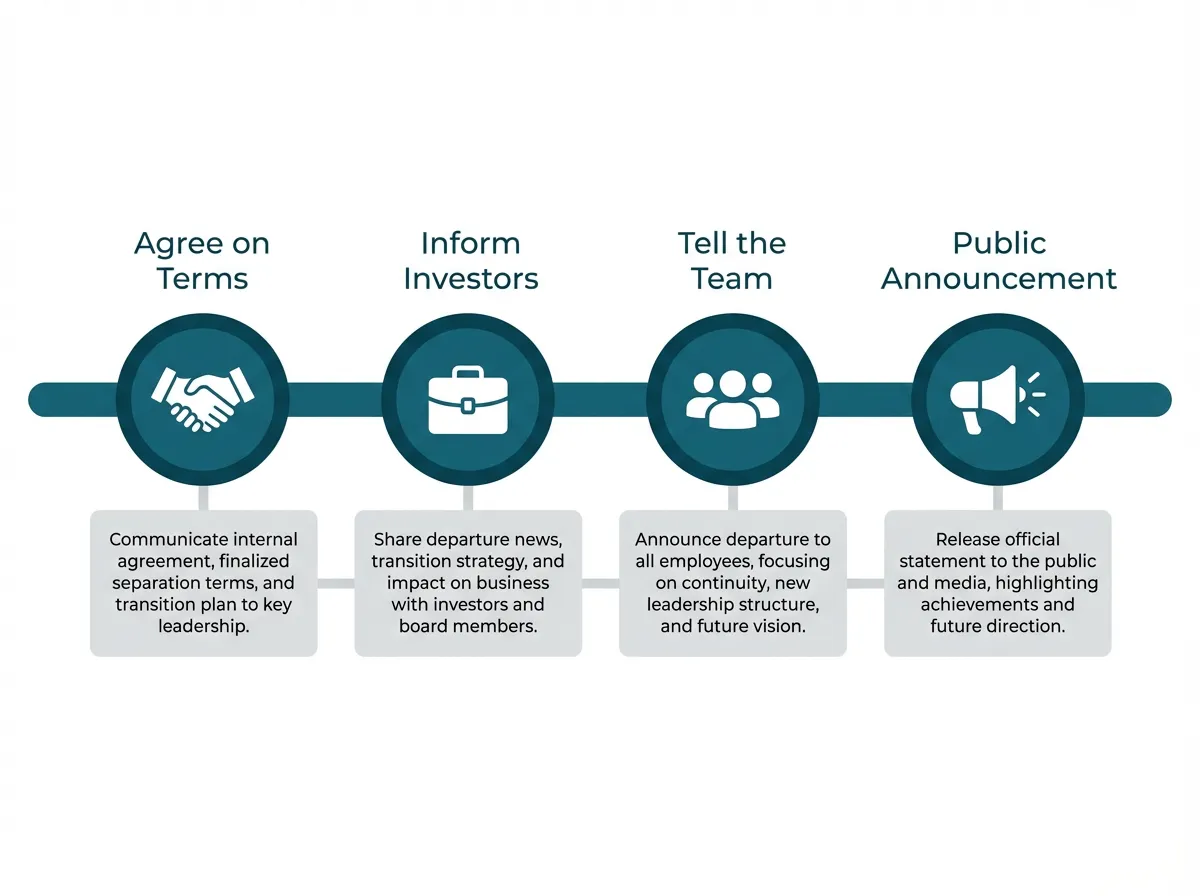
Step 4: Tell Your Stakeholders—Together
Investors
Investors have seen cofounder breakups before. What scares them isn't the departure—it's chaos, uncertainty, and the sense that nobody's in charge. Your job is to tell them:
- What happened (briefly, without airing dirty laundry)
- What the plan is (who's staying, who's going, what the transition looks like)
- Why the company is going to be fine (updated org chart, operational continuity plan)
Ideal timing: tell investors after you've agreed on terms but before any public announcement. Give them the courtesy of hearing it from you directly, not through the grapevine.
Template language: "[Departing founder] and I have mutually decided that [they/I] will be transitioning out of [Company]. This was a considered decision that we both believe is best for the company's future. Here's our plan for ensuring a smooth transition..."
Your Team
Employees are perceptive. Many of them already suspect something is off. Be honest without being dramatic. Present the decision as final, mutual, and forward-looking. The worst thing you can do is leave room for speculation or take sides.
Customers and Partners
In most cases, customers don't need a detailed explanation. If the departing founder had key relationships, plan a warm handoff. A brief, professional announcement is usually sufficient.
Step 5: Execute the Transition
Set a Clear Timeline
A cofounder departure isn't a resignation with two weeks' notice. Depending on the size and stage of your company, a transition period of 30 to 90 days is typical. During this time, the departing founder should:
- Transfer all account access and passwords
- Document processes and institutional knowledge
- Complete warm handoffs on key relationships
- Finalize any outstanding work
Formalize Everything in Writing
Every agreement you've reached—equity, IP, non-compete, transition responsibilities—should be captured in a formal separation agreement reviewed by attorneys representing both sides. Yes, both sides need their own counsel. This isn't adversarial; it's protective.
AI-powered mediation platforms like Servanda can provide structure when emotions run high, helping cofounders work through the terms of a separation agreement before (or alongside) attorney involvement.
Close the Loop
Once the transition is complete, update your corporate documents: cap table, operating agreement, board composition, bank signatories, and any contracts that reference both cofounders. Administrative loose ends have a way of becoming legal headaches.
What a Good Cofounder Breakup Actually Looks Like
Let's call them Alex and Jordan. They cofounded a B2B SaaS company in 2021. By mid-2023, Alex wanted to go upmarket and pursue enterprise deals. Jordan wanted to stay focused on SMBs and grow organically. Neither was wrong—they just wanted different companies.
Instead of letting the tension fester, they had the conversation over a long lunch. They agreed to bring in a neutral third party—a startup-savvy attorney they both trusted—to help structure the separation. Jordan left with their vested equity (about 18%), signed an IP assignment agreement, and transitioned key customer relationships over 60 days. They sent a joint email to investors and held an all-hands meeting the same week.
The company survived. The friendship survived. Jordan went on to start a new company in a non-competing space. Alex brought on a new COO three months later.
That's what graceful looks like. It's not painless—it's intentional.
Frequently Asked Questions
How do you know when it's time to break up with your cofounder?
When disagreements stop being about tactics and start being about vision, values, or commitment levels, that's a signal. If you've tried direct conversations, mediation, or restructuring roles and nothing has changed, it's likely time. Persistent dread and eroded trust are also reliable indicators that the partnership has run its course.
Can a startup survive a cofounder leaving?
Absolutely. Many successful companies—including Twitter, Uber, and countless smaller startups—have survived cofounder departures. The key is a managed transition: clear communication with stakeholders, a documented separation agreement, and an operational plan that doesn't depend on the departing founder. Survival depends on execution, not on keeping every original founder.
Do I need a lawyer for a cofounder separation?
Yes. Even if the split is amicable, you need a written separation agreement covering equity, IP, non-compete terms, and financial obligations. Each cofounder should have independent legal counsel review the agreement. The cost of an attorney now is a fraction of the cost of a dispute later.
How do you handle equity when a cofounder leaves?
The most common approaches are enforcing the existing vesting schedule (departing founder keeps vested shares, forfeits unvested), negotiating an equity buyback, or converting the departing founder's role to an advisor with a reduced stake. The right approach depends on the stage of the company, how much each founder contributed, and what both parties agree is fair.
Should you tell investors before or after the cofounder leaves?
Tell investors after you've agreed on terms but before any public announcement. Present the decision as mutual and planned, share your transition plan, and give them a chance to ask questions privately. Investors value transparency and preparedness far more than the illusion that everything is perfect.
Moving Forward
A cofounder breakup is one of the hardest things you'll go through as a founder. It's personal, it's financial, and it touches every part of the business you've built together. But it doesn't have to be destructive.
The founders who navigate this well share a common approach: they act early, they communicate directly, they put everything in writing, and they treat the process with the same rigor they'd bring to any other critical business decision.
If you're reading this and recognizing your own situation, take the first step today. Not tomorrow, not after the next board meeting—today. Write down what you want the outcome to look like. Then have the conversation. The company you've built deserves a thoughtful transition, and so does the person you built it with.