Cofounder Conflict: 5 Fights That Kill Startups
You started the company over beers and a whiteboard. You finished each other's sentences. You swore you'd never become one of those cofounder pairs — the ones who implode publicly, drag the company through months of paralysis, and walk away wondering what went wrong.
And yet here you are, three months into a disagreement about hiring that somehow turned into a referendum on who works harder, who deserves more equity, and whether the company should even exist in its current form.
Research from Harvard Business School professor Noam Wasserman found that 65% of high-potential startups fail due to conflict among cofounders. Not bad markets. Not weak products. People problems. The cruel irony is that these conflicts follow remarkably predictable patterns — patterns that are diagnosable, addressable, and often preventable if you know what you're looking at.
Why Cofounder Conflict Follows Predictable Patterns
A cofounder relationship is among the most intense partnerships a person can have. You're spending more waking hours with this person than with your spouse. You're making high-stakes decisions with incomplete information under constant pressure. And unlike a marriage, there's usually no formal structure — no prenup, no counselor, no agreed-upon process for resolving disputes.
That lack of structure is the gasoline. The match is any one of the five conflicts below.
Every surface-level argument — about which engineer to hire, whether to take that term sheet, who gets to talk to the press — traces back to one of these deeper tensions: control, fairness, identity, risk tolerance, and values.
Fight #1: The Vision Divide
What it looks like on the surface
"We keep arguing about product direction." One cofounder wants to go upmarket and sell to enterprises. The other wants to stay scrappy and serve SMBs. Or one wants to pivot entirely while the other wants to double down.
What's actually happening
This fight is about identity and purpose. Each cofounder has a mental model of what the company is — and by extension, what they are as founders. When those models diverge, every product discussion becomes existential.
A well-documented example: the cofounders of a Y Combinator-backed startup that built a promising developer tool in 2019. One founder saw the company as a venture-scale platform play. The other saw it as a sustainable, profitable tool business. They agreed on what to build for the first year. By year two, every roadmap discussion became a proxy war for the soul of the company. They shut down with $1.2 million still in the bank.
How to diagnose it in your own startup
Ask each cofounder to independently answer: "What does this company look like in five years if everything goes right?" If the answers don't converge on scale, customer type, funding model, and lifestyle, you have a Vision Divide — and no amount of roadmap planning will fix it.
What to do about it
- Schedule a dedicated off-site (even two hours at a coffee shop) exclusively to discuss long-term vision. Not product. Not tactics. Vision.
- Write down your aligned vision in a shared document. One paragraph. Both sign off.
- Revisit it quarterly. Visions evolve — that's fine. Unacknowledged drift is what kills.
Fight #2: The Equity Wound
What it looks like on the surface
"I don't think the equity split is fair anymore." Or, more commonly, no one says it out loud — but resentment seeps into every interaction.
What's actually happening
This fight is about fairness and recognition. Equity is the most tangible proxy for "how much do you value me?" When one cofounder feels they're contributing more — more hours, more skills, more sacrifice — but the cap table doesn't reflect it, the relationship starts to corrode silently.
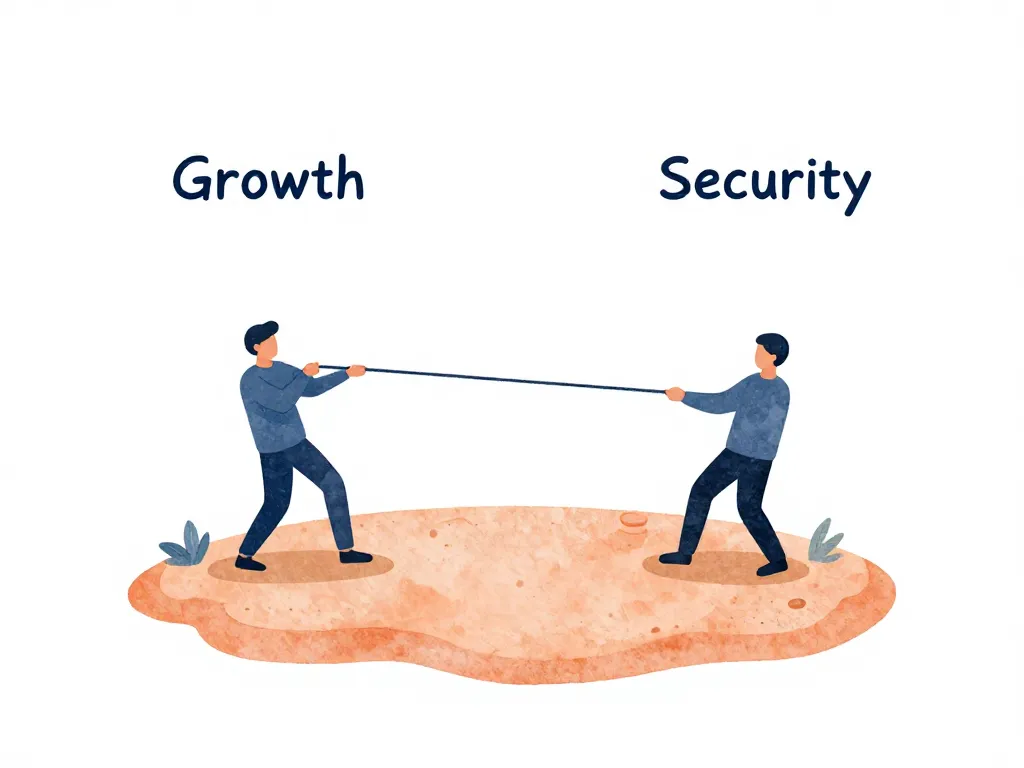
The most dangerous version of the Equity Wound isn't the one where cofounders argue about it. It's the one where they don't. One founder quietly accumulates resentment for months, then detonates — often at the worst possible moment, like during a fundraise or a key hire negotiation.
A founder post-mortem on a startup review site described it this way: "We split 50/50 because it felt fair at the time. Eighteen months later, I was working 80-hour weeks and my cofounder was treating it like a side project. I couldn't bring myself to say anything because it felt petty. By the time I did, we were both too angry to hear each other."
How to diagnose it
If you find yourself mentally tallying who's working harder, keeping score of sacrifices, or feeling irritation when your cofounder takes a vacation — you're carrying an Equity Wound.
What to do about it
- If you haven't formalized your equity split with a vesting schedule, do it today. Four-year vesting with a one-year cliff is standard for a reason: it protects both of you.
- Have an explicit conversation about what "full-time commitment" means. Define it. Hours? Availability? Output?
- Build in a mechanism for revisiting equity if roles or contributions change dramatically. This isn't distrust — it's realism.
- Consider formalizing your agreements with a tool like Servanda before resentment builds, so that expectations around equity, roles, and commitment are documented and mutually understood.
Fight #3: The Role Collision
What it looks like on the surface
"We keep stepping on each other's toes." Both cofounders show up to the same meeting trying to lead. Both give conflicting direction to the same engineer. Both think they're the one who should be talking to investors.
What's actually happening
This fight is about control and identity. In the earliest days, overlap is natural — everyone does everything. But as the company grows, undefined roles create friction. And beneath the tactical annoyance ("Why did you email that client without telling me?") is a deeper question: Who am I in this company?
Role Collisions are especially common among cofounders with similar skill sets. Two technical founders who both want to be CTO. Two business-minded founders who both want to own the investor narrative. The collision isn't just about logistics — it's about status and self-concept.
How to diagnose it
Count the number of times in the past month that you and your cofounder gave different answers to the same question from a team member, investor, or customer. If it's more than twice, you have a Role Collision.
What to do about it
- Draw a clear line: who owns which decisions? Use a simple RACI framework (Responsible, Accountable, Consulted, Informed) for your top 10 recurring decisions.
- Assign titles that reflect actual responsibility, not ego. If one of you is CEO, that person is the tiebreaker on strategic decisions. Name it.
- Accept that dividing roles will feel awkward. It might even feel like a demotion. It isn't. It's how companies survive past 10 employees.
Fight #4: The Spending War

What it looks like on the surface
"We disagree about how to spend money." One cofounder wants to hire aggressively and invest in growth. The other wants to preserve runway and stay lean.
What's actually happening
This fight is about risk tolerance. Risk tolerance is deeply personal — shaped by financial background, family obligations, and prior experiences with success and failure. It's hard to change, and easy to judge.
The Spending War often intensifies after a funding event. Pre-funding, scarcity forces alignment. Post-funding, the cash creates optionality — and optionality creates conflict. One founder sees the money as fuel to pour on a fire. The other sees it as a buffer against an uncertain future.
A founder who wrote a detailed post-mortem of their startup's failure noted: "The fundraise didn't save us — it gave us more rope to hang ourselves with. Every dollar became a fight. He wanted to hire a VP of Sales. I wanted to extend our runway. Neither of us was wrong. But we had no framework for deciding, so we did nothing — which was the worst option of all."
How to diagnose it
You have a Spending War if your budget conversations regularly escalate into arguments about the kind of company you're building (lean vs. growth-stage, bootstrapped vs. venture-backed). The money is never really about the money.
What to do about it
- Set explicit spending thresholds. Below $X, either founder can approve. Above $X, both must agree. Above $Y, the board weighs in.
- Agree on a target runway number (e.g., "We always keep at least 12 months of runway") and let that constraint guide decisions rather than arguing each expense in isolation.
- Acknowledge the difference in risk tolerance openly. You're not going to change each other. You need a system that accounts for both perspectives.
Fight #5: The People Clash
What it looks like on the surface
"We can't agree on who to hire — or who to fire." One cofounder wants to bring on a friend. The other wants to run a rigorous process. One wants to let go of an underperformer. The other wants to give them another chance.
What's actually happening
This fight is about values. Hiring and firing decisions are the most visible expressions of what a company actually stands for. When cofounders disagree on people decisions, they're rarely arguing about the individual candidate — they're arguing about what kind of culture they're building, how they define performance, and how much loyalty should matter versus merit.
People Clashes are also often the final straw. A startup can survive a Vision Divide or an Equity Wound for a while. But when cofounders start openly disagreeing about people in front of the team, the damage multiplies — because now the team is destabilized.
How to diagnose it
If your last three arguments about a hire or a fire devolved into character judgments ("You're too soft" / "You're too ruthless"), you have a People Clash.
What to do about it
- Agree on hiring criteria before you have a candidate. Define what "great" looks like for each role in writing.
- Set a clear process for performance conversations and termination decisions. How many warnings? What's the timeline? Who has the final call?
- If one cofounder owns a function (engineering, sales, etc.), that cofounder gets final say on people decisions within that function — with the other having veto power only for culture-critical concerns.
Look at all five conflicts, and you'll notice a shared structure:
- A foundational tension exists (vision, fairness, control, risk, values)
- No formal process exists to address it
- A trigger event surfaces the tension (a product decision, a funding round, a hire)
- The cofounders argue about the trigger, not the tension
- Nothing gets resolved, resentment compounds
- The next trigger is worse
Breaking this cycle requires intervening at step 2: building the structure before you need it. Written agreements, defined decision-making processes, regular cofounder check-ins with structured agendas — these aren't bureaucracy. They're the scaffolding that lets two ambitious, opinionated people build something together without destroying each other.
How to Diagnose Which Fight You're Actually Having
The next time you're in a heated disagreement with your cofounder, pause and ask yourself these questions:
- Is this about where the company is going? → Vision Divide
- Is this about whether contributions are recognized fairly? → Equity Wound
- Is this about who's in charge of what? → Role Collision
- Is this about how much risk to take? → Spending War
- Is this about what kind of people and culture we want? → People Clash
You might find that a single argument touches multiple categories. That's common — and it's actually useful information, because it tells you the relationship needs more than a single conversation. It needs structural repair.
Frequently Asked Questions
How do you resolve a cofounder dispute without ruining the relationship?
Start by diagnosing which of the five conflict types you're actually experiencing — most cofounders argue about symptoms rather than root causes. Then have a structured conversation focused specifically on the underlying tension (vision, fairness, control, risk, or values), ideally with a written outcome you both commit to. The relationship is more likely to survive a direct, honest conversation than months of simmering avoidance.
When should cofounders consider splitting up?
Consider a separation when the underlying tension is truly irreconcilable — particularly a Vision Divide where both cofounders want fundamentally different companies. If you've had multiple structured conversations, attempted written agreements, and still find yourselves in the same fight every few weeks, it may be healthier for both the founders and the company to part ways. A clean, planned separation almost always beats a slow, resentful decline.
What's the most common reason cofounder relationships fail?
Equity disagreements and role ambiguity are the two most frequently cited causes. But the deeper cause underneath both is a failure to formalize expectations early. Cofounders who document their agreements around equity, roles, decision rights, and exit terms in the first few months are dramatically less likely to face a destructive breakup later.
How do you prevent cofounder conflict before it starts?
Have the uncomfortable conversations before they're urgent: Who gets what equity, and under what vesting terms? Who owns which decisions? What happens if one person wants to leave? What does "full-time" mean? Put the answers in writing. Then schedule a monthly cofounder check-in where you revisit these agreements and surface any emerging tensions. Prevention isn't about avoiding disagreement — it's about building a container strong enough to hold it.
A trusted third party — whether an advisor, executive coach, or structured mediation platform — can be invaluable when emotions have escalated past the point of productive one-on-one conversation. Involve them before the relationship is beyond repair. Think of it as preventive maintenance, not emergency surgery.