Cofounder Wants Cheap Offshore Talent: Now What?
It usually starts with a Slack message. Something like: "I found a dev shop in [country] that can build our MVP for $15/hour. Why are we paying $150K for a local engineer?"
Your stomach drops. Not because offshore talent is inherently bad — it isn't — but because you and your cofounder clearly see the company's future through different lenses. One of you is optimizing for runway. The other is optimizing for quality, speed, or culture. And neither of you is wrong, exactly, which is what makes this disagreement so painful.
This fight isn't about geography or hourly rates. It's about values, risk tolerance, and what kind of company you're building.
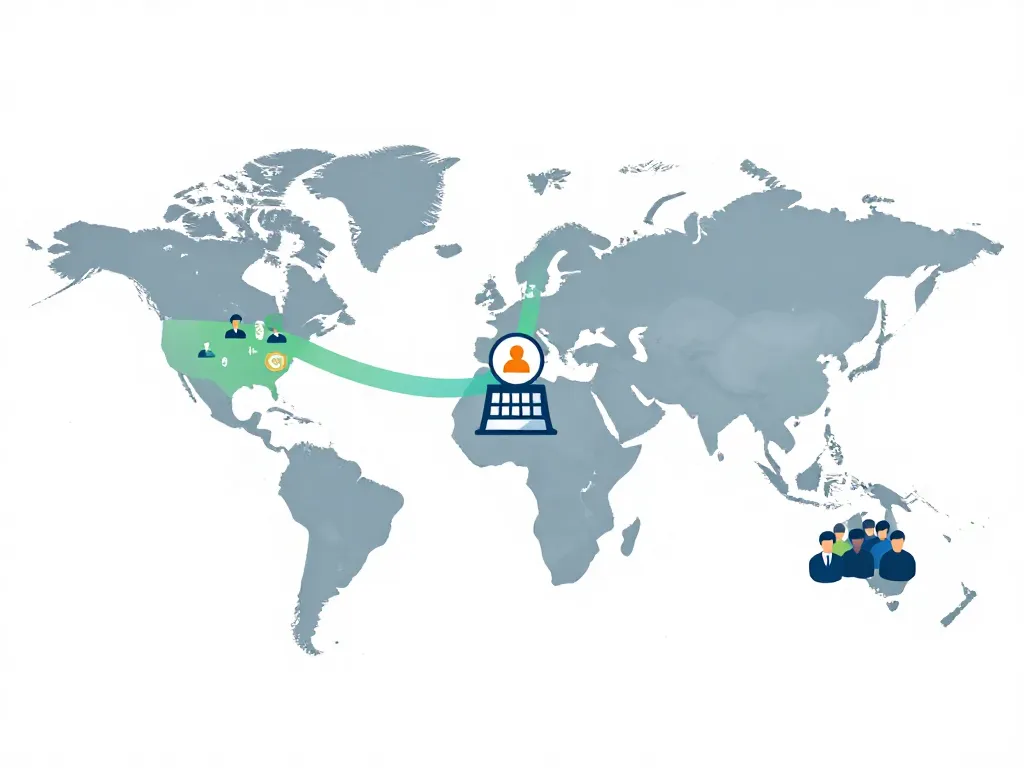
Why This Disagreement Cuts Deeper Than It Seems
On the surface, the offshore-vs-local hiring debate looks like a spreadsheet problem. Run the numbers, compare the costs, pick the cheaper option. It escalates because it touches several foundational questions at once:
- How do we spend our limited capital? Every dollar spent on a senior local engineer is a dollar not spent on marketing, sales, or extending runway.
- What does "quality" mean to us? One cofounder might define quality as pixel-perfect code with thorough documentation. The other might define it as "ships fast and works well enough."
- How much management overhead can we absorb? Offshore teams often need more structure, more documentation, and more asynchronous communication rituals. Who's going to manage that?
- What's our timeline? If you need to launch in six weeks, the calculus is different than if you have six months.
When your cofounder says "let's hire offshore," what they're actually saying is often: "I'm scared we're going to run out of money." And when you push back, what you're actually saying is: "I'm scared we're going to build something mediocre."
Neither fear is irrational. Both deserve to be heard.
The Real Tradeoffs: Beyond the Hourly Rate
Too often, the pro-offshore cofounder is looking only at cost savings, while the anti-offshore cofounder is imagining worst-case horror stories. The truth lives in between.
Where Offshore Hiring Often Works Well
- Well-defined, modular tasks. If you have clear specs, detailed wireframes, and a technical cofounder who can review code daily, offshore developers can deliver solid work at a fraction of the cost.
- Scaling a proven process. Once you've built your core product and need to add features, test variations, or maintain existing code, distributed teams can handle this efficiently.
- Non-core functions. QA testing, data entry, certain design tasks, and DevOps work often translate well across time zones.
Where Offshore Hiring Often Struggles
- Ambiguous, early-stage product work. When you're still figuring out what to build, the feedback loops between founder and developer need to be tight — sometimes measured in minutes, not hours. A 10-hour time zone gap makes this brutal.
- Highly collaborative, cross-functional work. If your engineer needs to be in the room (or the Zoom) with your designer, your first customers, and your cofounder three times a day, proximity matters.
- Culture-building in the first five hires. Your earliest team members set the DNA of the company. If you're building a culture of intense ownership and rapid iteration, it's harder (not impossible, but harder) to instill that remotely across cultural and language differences.
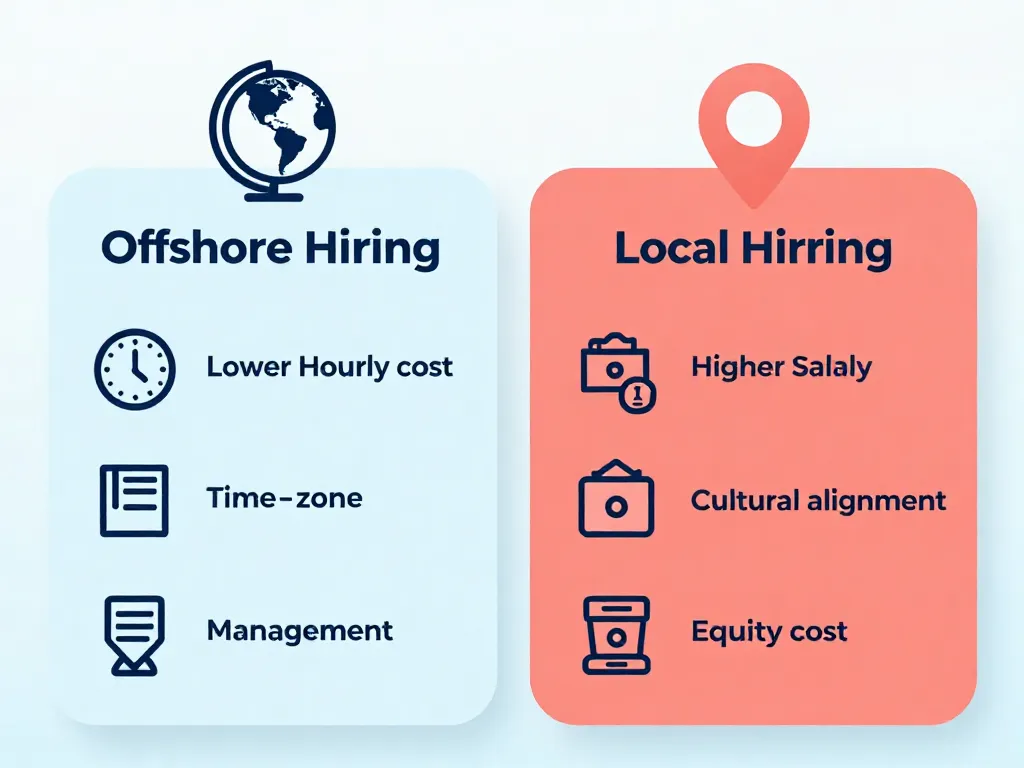
The Hidden Costs Nobody Mentions
The cofounder pushing for offshore hiring usually underestimates these:
- Management time. Someone has to write detailed specifications, review pull requests across time zones, and handle miscommunications. That "someone" is usually a cofounder, and their time has a real cost.
- Rework cycles. When specs are misunderstood — and they will be — the cost of fixing mistakes can erase the savings on the hourly rate.
- Turnover and knowledge loss. Offshore contractors and agencies rotate developers on and off your project. Every new developer needs onboarding time.
- Coordination overhead. Asynchronous communication works beautifully when everyone is disciplined about documentation. At a scrappy early-stage startup, that discipline often doesn't exist yet.
None of this means offshore hiring is a bad idea. It means the savings are rarely as dramatic as the sticker price suggests.
How to Have This Conversation Without Wrecking the Partnership
Most cofounders argue positions instead of exploring interests. One person says "offshore," the other says "local," and they volley back and forth until someone gives in or blows up.
Step 1: Separate the Decision from the Relationship
Acknowledge out loud that this is a legitimate strategic disagreement, not a character flaw:
"I can see why you're pushing for this. You're trying to protect our runway, and I respect that. I have different concerns, and I want us to work through them together."
Step 2: Define What You're Actually Deciding
"Should we hire offshore?" is too broad. Better questions:
- Should our first engineering hire be offshore or local?
- Should we use an offshore team for the MVP build while hiring a local technical lead?
- Are we open to a hybrid model — a senior local architect paired with offshore developers?
- What's the specific role we're hiring for, and what does it require day-to-day?
Narrowing the question often reveals that you're closer to agreement than you thought.
Step 3: Run a Realistic Scenario Together
Pull out a spreadsheet — or even a napkin — and map out both options honestly.
For the offshore scenario:
- Hourly rate × estimated hours
- Management time (your time) valued at some reasonable rate
- Estimated rework percentage (be honest — 15-25% is common for early-stage work with a new team)
- Communication tools and process costs
- Realistic timeline including onboarding and time zone delays
For the local scenario:
- Salary or contract rate
- Recruiting costs and time to hire
- Equity implications
- Realistic timeline
When you look at the total cost of delivery rather than the hourly rate, the gap often narrows significantly.
Step 4: Agree on a Trial Period
If you're still at an impasse, propose a low-risk experiment:
- Hire an offshore developer for a specific, well-scoped project with a two-week deadline.
- Define success criteria in advance: Was it delivered on time? How many revision cycles? How much cofounder time did it consume?
- Evaluate honestly afterward.
This transforms the argument from ideology to evidence, and it gives the pro-offshore cofounder a fair shot at being right.

What If You Still Can't Agree?
- Do we have a decision-making framework? In most successful cofounder relationships, certain domains belong to certain people. If one cofounder is the CTO, do they get final say on engineering hiring? If so, honor that. If you haven't established these boundaries, now is the time.
- Is this a one-way door or a two-way door? Hiring an offshore contractor for a three-month project is a two-way door — if it doesn't work, you stop. Hiring a full-time local engineer with equity is closer to a one-way door. The reversibility of the decision should influence how much consensus you require.
- Are we fighting about this specific decision, or about something bigger? Sometimes the offshore debate is a proxy for a deeper disagreement about the company's ambition level, spending philosophy, or each cofounder's role. If that's the case, address the root issue.
Consider formalizing your decision-making process with a tool like Servanda before these disagreements accumulate — clear, written agreements about who owns which domain of decisions prevent a hiring argument from becoming an existential crisis.
A Real-World Example: How Two Cofounders Found a Middle Path
"Alex" and "Jordan" (names changed) were building a B2B SaaS product. Alex, the business-focused cofounder, wanted to hire a team of four offshore developers through an agency at $25/hour each. Jordan, the technical cofounder, wanted to hire one senior full-stack engineer locally at $160K.
They argued for three weeks. Then they did the math together.
Alex's plan: 4 developers × $25/hour × 40 hours/week × 12 weeks = $48,000. Plus an estimated 15 hours/week of Jordan's time managing the team. Plus two estimated rework cycles adding three weeks to the timeline.
Jordan's plan: $160K/year salary ÷ 12 × 3 months = $40,000 for the same period. Plus equity. Minimal management overhead. Faster iteration.
The raw cost difference was smaller than Alex expected. But Jordan also realized that $160K committed them to a full-time hire before they'd validated their core assumptions.
Their compromise: they hired one experienced offshore developer (not through an agency — a direct hire they vetted carefully) at $45/hour, paired with a local part-time technical advisor at $5K/month who could review architecture decisions and code quality.
Total cost: roughly $30K for the first three months. They got the cost savings Alex needed and the quality oversight Jordan needed. It wasn't either person's original plan, and it worked.
Preventing This Fight Before It Starts
- Include hiring philosophy in your cofounder agreement. Even a simple statement like "We agree to prioritize local hires for our first three engineering roles" or "We're open to distributed teams from day one" gives you a reference point.
- Set spending thresholds. Agree that any hire (or contract) above $X requires both cofounders' approval. Below that threshold, the domain owner decides.
- Revisit quarterly. Your hiring strategy at pre-seed should look different from your strategy at Series A. Build in checkpoints to reassess.
Frequently Asked Questions
How do I convince my cofounder that offshore developers aren't the right choice?
Rather than trying to "win" the argument, sit down together and calculate the total cost of delivery for both options, including your management time, estimated rework cycles, and onboarding delays. Often the real cost gap is much smaller than the hourly rate suggests, and presenting honest numbers side by side is more persuasive than debating in the abstract.
Is it a bad idea to use offshore developers for an MVP?
It depends on how well-defined your product is. If you have clear specs, detailed wireframes, and a technical cofounder who can review work daily, offshore developers can deliver a solid MVP at lower cost — but if you're still figuring out what to build and need rapid, real-time iteration, the time zone gaps and communication overhead can slow you down significantly.
How should cofounders decide who gets final say on hiring decisions?
Establish domain ownership early in your cofounder agreement — for example, the CTO typically owns engineering hiring decisions while the CEO owns go-to-market hires. For major commitments above a set spending threshold, require mutual agreement, and revisit these boundaries quarterly as your startup evolves.
What's a good compromise between hiring offshore and hiring locally?
A common middle path is pairing one carefully vetted offshore developer (hired directly, not through an agency) with a local part-time technical advisor or architect who reviews code quality and key decisions. This gives you meaningful cost savings while maintaining the quality oversight and strategic direction that early-stage products require.
How do you prevent cofounder disagreements about spending from becoming personal?
Acknowledge upfront that the disagreement is a legitimate strategic difference, not a character flaw, and explicitly reframe the conversation from adversarial to collaborative. Having a written decision-making framework — including who owns which domains and how disputes are escalated — prevents recurring arguments from eroding trust over time.