Cofounder Hired a CTO Without Asking? What to Do Next
You find out on a Tuesday. Maybe it's a Slack message introducing someone new. Maybe it's a LinkedIn post where your cofounder announces a "major addition to the leadership team." Or maybe the new person just shows up to the standup meeting and your cofounder says, "Oh, I forgot to mention — meet our new CTO."
Your stomach drops. Not because you hate the idea of hiring a CTO. Maybe the company needs one. What guts you is that your cofounder made a leadership-level hire — one that reshapes equity conversations, decision-making authority, and the company's entire technical direction — without ever asking you.

When a cofounder makes a major hire without consulting you:
- Your authority is undermined. If one cofounder can unilaterally add to the C-suite, what decisions are actually shared?
- Your role becomes ambiguous. A new CTO changes the org chart. If you were handling technical decisions, you've just been replaced without a conversation.
- Trust erodes. The implicit agreement between cofounders — that you're building this together, that big moves are mutual — has been broken.
- Third parties take notice. The new hire, your team, your investors — everyone is now reading the power dynamics of your company differently.
This isn't about being controlling. A cofounder who brings on a CTO without asking has made a statement: I can make leadership decisions without you.
The worst thing you can do right now is fire off an angry text or confront your cofounder in front of the new hire. The second worst thing is to say nothing and let resentment calcify.
Was This Truly Unilateral?
Think back carefully. Did your cofounder mention wanting to bring someone on in a vague way weeks ago? Did you half-agree to something in a late-night conversation you barely remember? Sometimes what feels like a power grab was a badly communicated decision your cofounder genuinely believed had your buy-in.
This doesn't excuse it — a C-level hire requires explicit, documented agreement — but it changes how you approach the conversation.
What's the New CTO's Actual Role?
There's a difference between "my cofounder gave their college roommate the CTO title and 8% equity" and "my cofounder brought on a senior engineer with the CTO title but no equity or board seat." Both are problems if they happened without your consent, but the severity and the remedies are different.
Find out:
- Has any equity been promised or granted?
- Is there a signed employment agreement or offer letter?
- What authority has the new CTO been told they have?
- Who do they report to?
What Was the Motive?
- Your cofounder is anxious about technical gaps and panicked into hiring someone fast.
- Your cofounder is deliberately consolidating power and diluting yours.
- Your cofounder made a social commitment to a friend, mentor, or investor's referral and didn't think through the implications.
- Your cofounder genuinely thought this was fine because you never formalized how hiring decisions work.
Each of these calls for a different response.

The Conversation You Need to Have
Set the Stage
Don't ambush your cofounder in front of others. Request a private one-on-one. Be direct about the topic: "I want to talk about the CTO hire. I have concerns about how it happened, and I want to work through them with you."
Lead with Impact, Not Accusation
- ❌ "You went behind my back and hired a CTO without telling me."
- ✅ "I found out we have a new CTO, and I wasn't part of that decision. That's created real problems for me and I think for the company."
The second version describes the same situation but doesn't start a fight.
Ask Direct Questions
- "Walk me through how this decision happened." — This gives your cofounder space to explain without being defensive.
- "What commitments have been made to this person?" — You need to know the legal and financial exposure.
- "How did you see my role in this decision?" — This is the core question. The answer tells you everything about how your cofounder views the partnership.
State Your Position Clearly
- "Leadership hires need to be joint decisions. That's non-negotiable for me."
- "If equity was promised without my consent, that's a governance issue we need to resolve."
- "I'm open to having a CTO on the team, but the process of getting here was wrong, and we need to fix the process."
- Pausing the CTO's start date until both cofounders formally agree on terms
- Renegotiating whatever was offered if it was beyond your cofounder's authority
- Drafting a written decision-making framework for all future leadership hires
What If Your Cofounder Doesn't See the Problem?
If your cofounder responds with "I didn't think it was a big deal" or "I'm the CEO, this is my call," you're dealing with a deeper issue than one hire.
- "I didn't think it was a big deal" means your cofounder doesn't understand (or respect) shared governance. You need a cofounder agreement that makes decision-making authority explicit.
- "I'm the CEO, this is my call" means your cofounder sees the partnership as hierarchical, not equal. This is a fundamental disagreement about the nature of your relationship that won't resolve itself.
In either case, escalate — not emotionally, but structurally.
Structural Escalation Options
-
Bring in a neutral third party. A mutual advisor, a board member, or a professional mediator — someone without a stake in the outcome. Servanda provides structured mediation when cofounders need to work through governance issues without spiraling into personal attacks.
-
Invoke your operating agreement. Review what it says about hiring authority, equity grants, and major decisions. If your cofounder violated the agreement, say so plainly.
-
If you don't have an operating agreement, that's your answer. The absence of written governance is what allowed this to happen. Fixing that becomes the immediate priority.
How to Prevent Unilateral Hires in the Future
Define Decision-Making Authority in Writing
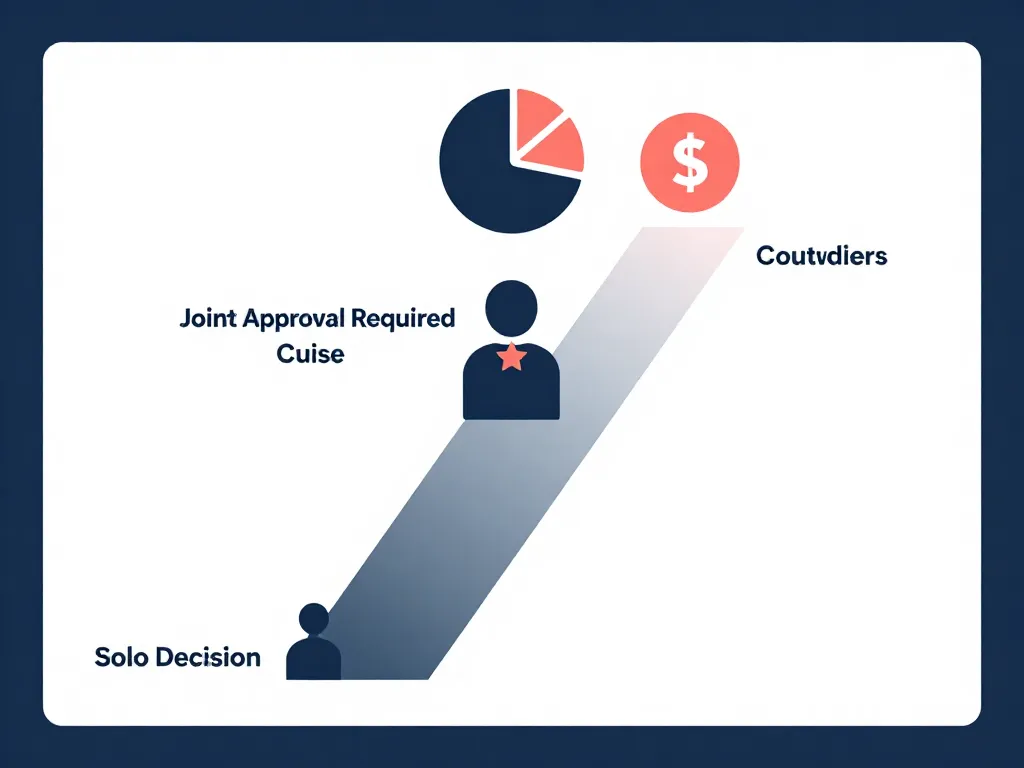
Every cofounder relationship needs a clear, written answer to this question: Who can make what decisions without the other's approval?
| Decision Type |
Authority Required |
| Day-to-day operational decisions |
Either cofounder independently |
| Hires under a certain salary threshold |
Either cofounder with notification |
| Leadership/C-suite hires |
Unanimous cofounder consent |
| Equity grants of any size |
Unanimous cofounder consent + board approval |
| Spending above a set amount |
Unanimous cofounder consent |
| Pivoting the product or business model |
Unanimous cofounder consent |
This isn't bureaucracy. It's the scaffolding that lets you move fast on small things while protecting both cofounders on big ones.
The most dangerous version of this scenario is when equity is involved. If your cofounder promised someone 5% of the company without your knowledge, you have a legal mess on top of a trust problem.
Your operating agreement or stockholders' agreement should specify:
- Who has the authority to issue new shares or options
- What approvals are required (board vote, cofounder consent, etc.)
- Whether there's an option pool already allocated for hires
- Vesting schedules and cliffs for any new equity grants
Build a Hiring Process for Key Roles
For any role that reports directly to a cofounder or carries a C-suite title:
- Both cofounders agree the role is needed
- Both cofounders align on the job description and compensation range
- Final candidates are interviewed by both cofounders
- The offer is a joint decision
- The offer letter is reviewed by both cofounders before it goes out
That's one or two extra conversations, and it prevents exactly the crisis you're dealing with now.
Schedule Regular Cofounder Check-Ins
Many unilateral decisions happen not out of malice but because cofounders drift apart. You stop talking about strategy. You stop sharing what you're thinking. And then one of you makes a move the other didn't see coming.
A weekly 30-minute cofounder sync — separate from team standups or board meetings — gives you a space to surface plans before they become unilateral actions. Use it to discuss:
- Major decisions on the horizon
- Concerns either of you have about the business
- Changes in roles, responsibilities, or team structure
- Anything that feels off
What About the New CTO?
There's a real person in the middle of this. The new CTO may have no idea their hiring was contentious. They may have left another job.
- If you decide to keep them: Welcome them genuinely. Don't punish them for your cofounder's mistake. Make sure their role and authority are clearly defined in a way both cofounders agree to.
- If you decide to unwind the hire: Be honest and professional. If commitments were made in bad faith, consider whether the company has an obligation to honor some portion of what was promised.
- If the terms need to change: Renegotiate openly. A CTO who was promised 8% equity without proper authorization needs to hear that directly, with an explanation and a revised offer that both cofounders stand behind.
A Real Scenario
Jade and Marco cofounded a fintech startup. Jade handled product and fundraising; Marco led engineering. After a frustrating quarter of missed deadlines, Marco brought on his former manager, Derek, as CTO — complete with a 6% equity promise and authority over the entire engineering team.
Jade found out when Derek was introduced at an all-hands meeting.
What saved their partnership was a weekend session with an outside advisor where they:
- Acknowledged that Marco's move was a governance violation, regardless of intent
- Revised Derek's offer to 3% equity with a standard four-year vest and one-year cliff, jointly approved
- Created a written decision-making matrix
- Committed to a weekly cofounder sync every Monday morning
Derek stayed. The company survived. Jade's summary afterward: "If we'd had a real cofounder agreement from the start, none of that pain would have happened."
Frequently Asked Questions
Can my cofounder hire someone without my approval?
It depends on your operating agreement and how decision-making authority is structured. If you have no written governance documents, there may be no formal rule preventing it — but that's exactly the gap you need to close. For C-suite hires and any role involving equity, the standard is to require unanimous cofounder consent.
What should I do if my cofounder promised equity to a new hire without my knowledge?
First, find out exactly what was promised and whether anything has been legally executed, such as a signed offer letter or stock grant. Then address it as a governance violation with your cofounder and, if necessary, renegotiate the terms with the new hire directly so that any equity grant is jointly approved and properly documented.
How do I bring up a cofounder conflict without destroying the relationship?
Request a private one-on-one conversation and frame the issue around its impact on the company rather than making personal accusations. Using a structure like "here's what happened, here's how it affected me and the business, and here's what I need going forward" keeps the discussion productive and solution-oriented.
Do cofounders need a written agreement about decision-making?
Yes. The absence of written governance is one of the most common reasons cofounder conflicts escalate. A clear decision-making matrix that defines who can approve hires, equity grants, major spending, and strategic pivots prevents unilateral moves and protects both partners.
Should I fire the CTO my cofounder hired without telling me?
Not necessarily — the CTO may be a strong addition to the team, and the real issue is the broken process, not the person. Evaluate the hire on its merits after you and your cofounder have resolved the governance breakdown, and then jointly decide whether to keep, renegotiate, or unwind the arrangement.