
Cofounder Relationship Audit: Is Your Partnership Actually Working?
It's February. Your social feeds are drowning in heart emojis and couple selfies. Nobody's posting the relationship question that actually determines whether your company survives: is your cofounder partnership healthy?
Most cofounders met during a rush of shared excitement — a late-night brainstorm, a hackathon, a mutual frustration with how something worked. That early chemistry felt electric. You finished each other's product pitches. You split the work without thinking about it. You couldn't imagine building this with anyone else.
But somewhere between your first commit and your latest board meeting, things shifted. Maybe you're avoiding a hard conversation about equity. Maybe one of you quietly resents how decisions get made. Maybe you just feel... off.
A cofounder relationship audit isn't about grading your partnership or pointing fingers. It's about pausing long enough to honestly assess what's working, what's fraying, and what needs to change before small tensions become existential threats.

Why Cofounders Need a Relationship Audit
Research from Harvard Business School professor Noam Wasserman found that 65% of high-potential startups fail due to conflict among cofounders. Not bad markets. Not weak products. People problems.
The insidious thing about cofounder conflict is how slowly it builds. Unlike a product launch that either works or doesn't, relationship erosion happens in micro-moments — the eye-roll during a pitch, the Slack message left on read for three days, the decision made without a heads-up. Each one is small enough to dismiss. Together, they form a pattern that can kill a company.
And yet most cofounders never proactively evaluate their partnership. They wait until something breaks — a blowup over strategy, a surprise resignation letter, a whispered ultimatum from an investor.
The 7-Point Cofounder Relationship Audit
For each area, rate your partnership honestly on a scale of 1 (major concern) to 5 (strong and healthy). Then — and this is the important part — have your cofounder do the same, separately. Compare notes afterward.
1. Role Clarity: Do You Both Know Who Owns What?
In the early days, everyone does everything. That scrappy energy is part of what makes startups work. But if you're past the first year and still can't clearly articulate who owns product decisions versus go-to-market strategy, you have a role clarity problem.
Warning signs: - You frequently step on each other's toes without realizing it - Team members come to both of you for the same decision and get different answers - One cofounder feels like they're doing "the real work" while the other gets credit
What to do about it: Write down your top five responsibilities. Have your cofounder do the same. Where they overlap, have a direct conversation about who has final say. This doesn't mean one person can never weigh in — it means one person is the decision-maker.
2. Strategic Alignment: Are You Building the Same Company?
Cofounders often think they agree on vision but are building toward fundamentally different outcomes. One wants a bootstrapped lifestyle business. The other is optimizing for a Series B. One sees the product as a platform; the other sees it as a focused tool.
These aren't small disagreements. They're tectonic plates that will eventually shift.
Try this exercise: Each of you independently write a one-paragraph description of what the company looks like in three years — revenue, team size, product scope, your personal role. Read them aloud to each other. The gaps will be immediately obvious.
3. Decision-Making: How Do You Handle Disagreements?
Every cofounder pair disagrees. That's not the problem. The problem is not having a clear process for resolving those disagreements.
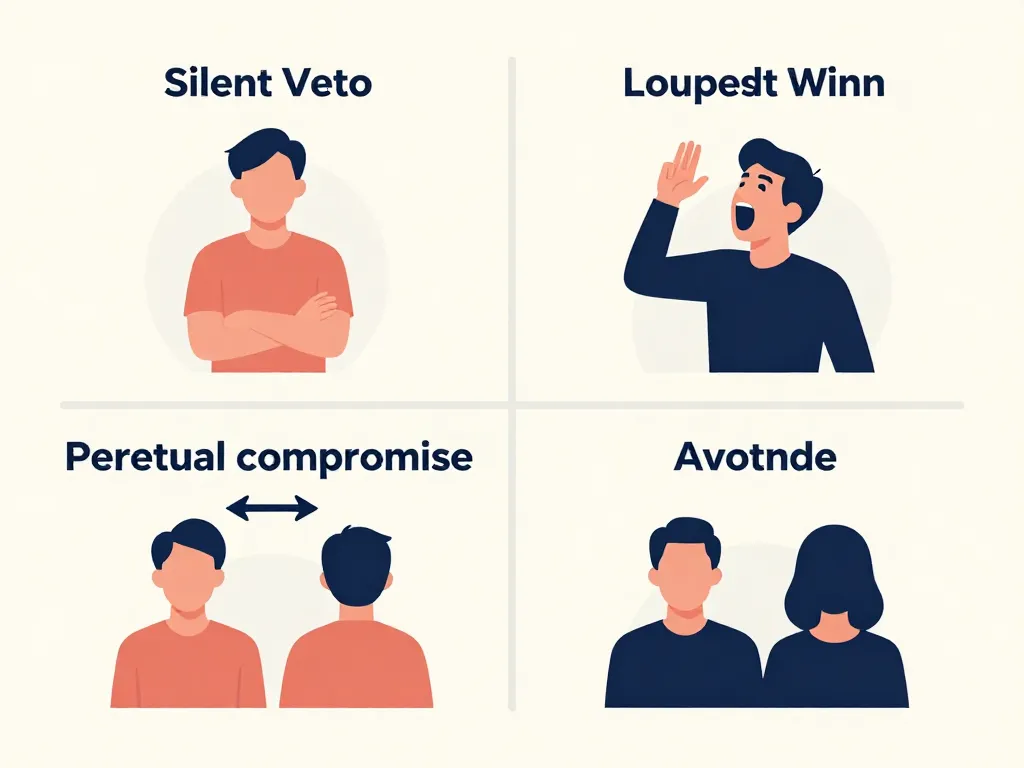
Common dysfunctional patterns:
- The silent veto: One cofounder passively resists by dragging their feet on execution
- The loudest voice wins: Whoever argues more aggressively gets their way, breeding resentment
- Perpetual compromise: You split every difference, ending up with watered-down decisions that satisfy nobody
- Avoidance: You table hard decisions indefinitely, hoping the "right answer" will become obvious
Healthy cofounder pairs have explicit agreements about how they make decisions. Maybe the CEO has final say on business strategy while the CTO has final say on technical architecture. Maybe you use a "disagree and commit" framework. The specific method matters less than having one.
4. Equity and Compensation: Is the Split Still Fair?
Nothing poisons a cofounder relationship faster than a festering sense of unfairness around equity. And the equity split you agreed to over beers eighteen months ago may no longer reflect reality.
Maybe one cofounder went full-time six months before the other. Maybe someone's role expanded dramatically while the other's contribution plateaued. Maybe you never formally agreed on vesting schedules, and now there's an unspoken anxiety about what happens if someone leaves.
These are hard conversations. They're also non-negotiable ones. If you haven't formalized your equity arrangement in a written agreement — with vesting, cliff periods, and departure terms — you're sitting on a time bomb. Tools like Servanda can help cofounders structure these agreements clearly before resentment takes root.
5. Trust and Transparency: What Aren't You Saying?
Trust between cofounders isn't about liking each other. It's about believing your partner is being honest about money, workload, outside commitments, and their actual feelings about the business.
Ask yourself: - Is there something about the business I'm afraid to bring up with my cofounder? - Do I believe my cofounder tells me the full truth about how they're feeling? - Have I caught my cofounder making commitments (to investors, hires, or partners) without telling me?
If you answered "yes" to the first or third question, or "no" to the second, you have a trust gap. Trust gaps don't close on their own. They widen.
6. Workload and Sacrifice: Is the Burden Shared?
When both cofounders feel like they're sacrificing equally, the shared hardship becomes bonding. When one cofounder feels like they're carrying a disproportionate load, it becomes corrosive.
This isn't just about hours logged. It includes: - Financial sacrifice (who took a bigger pay cut?) - Emotional labor (who handles the difficult employee conversations?) - Opportunity cost (who turned down a lucrative job offer to stay?) - Personal impact (whose family life has taken the bigger hit?)
Perception matters as much as reality here. Your cofounder might be working just as hard as you — on things you don't see or don't value as highly. That's worth exploring.

7. The Gut Check: Would You Choose This Person Again?
Forget the sunk costs. Forget the cap table. Forget what investors would think.
If you were starting a company today, knowing everything you now know about this person — their strengths, their blind spots, their work habits, their values — would you choose them as your cofounder?
If your honest answer is "yes, absolutely," your partnership has a strong foundation even if some of the other areas need work.
If your answer is "I'm not sure" or "no," that's critical information. It doesn't necessarily mean you need to split up. But it means the other six areas of this audit demand urgent attention.
How to Use Your Audit Results
Once you've both completed the audit independently, set aside two hours — outside the office, away from Slack — to compare your scores.
- No defending. If your cofounder scored "trust" a 2 and you thought it was a 4, your job is to listen and understand why, not to argue them into a higher rating.
- Focus on the biggest gaps. If you scored "role clarity" a 4 and they scored it a 2, that gap is more important than the absolute number. It means you're experiencing the partnership very differently.
- Pick one area to address first. Choose the area that, if improved, would have the biggest positive impact on the business and the relationship.
- Write down what you agree to. Verbal commitments after emotional conversations have a habit of becoming fuzzy memories. Even a shared Google Doc with three bullet points is better than nothing.
- Set a check-in date. Put 90 days on the calendar to revisit your audit and assess whether things have changed.
When the Audit Reveals Something Serious
If your audit reveals fundamental misalignment — on vision, values, or trust — you need outside help. That could mean:
- A trusted mutual advisor who can facilitate a structured conversation
- A startup-focused executive coach who's worked with cofounder dynamics before
- A mediator who specializes in business partnership disputes
- A lawyer, if the issues involve equity, IP ownership, or departure terms
Seeking outside help isn't a sign of failure. The founders who destroy their companies are the ones who let unresolved conflict metastasize in silence.
A Real-World Example
Two cofounders — call them Priya and Marcus — launched a B2B SaaS company together after meeting at a previous employer. Priya handled product and engineering; Marcus led sales and fundraising. For the first year, the partnership hummed.
By year two, cracks appeared. Marcus was closing deals that required product features Priya hadn't agreed to build. Priya was making architectural decisions that affected the sales roadmap without looping Marcus in. Neither was acting maliciously. They'd simply outgrown their informal handshake arrangement and hadn't built structures to replace it.
After a particularly tense board meeting — where an investor bluntly asked, "Are you two on the same page?" — they did something like the audit above. Priya scored decision-making a 2. Marcus scored it a 3 but scored trust a 2. Both scored role clarity below 3.
The conversation was uncomfortable. But it led to a written operating agreement: clear decision domains, a weekly 30-minute cofounder sync with a standing agenda, and a commitment to quarterly partnership check-ins. Eighteen months later, they credit that forced audit with saving the company.
Frequently Asked Questions
How often should cofounders do a relationship audit?
A good cadence is quarterly, though at minimum you should run a structured audit every six months. Regular check-ins prevent small tensions from compounding into existential threats, and they normalize honest conversation as part of how you operate rather than something that only happens during a crisis.
What percentage of startups fail because of cofounder conflict?
Research from Harvard Business School professor Noam Wasserman found that 65% of high-potential startups fail due to conflict among cofounders. This makes people problems — not bad markets or weak products — the single largest category of startup failure.
How do you bring up cofounder problems without starting a fight?
Use a structured framework like the 7-point audit so the conversation is about comparing scores on specific areas rather than airing personal grievances. Set ground rules that emphasize listening over defending, and focus first on the areas where your scores diverge most — those gaps reveal where you're experiencing the partnership very differently.
Should cofounders get a mediator or coach for their relationship?
If your audit reveals deep misalignment on vision, values, or trust that a two-hour conversation can't resolve, outside help is strongly recommended. A startup-focused executive coach or professional mediator can facilitate structured conversations that cofounders often can't navigate productively on their own, and seeking that help is a sign of maturity, not failure.
How do you fix an unfair cofounder equity split?
Start by formalizing your equity arrangement in a written agreement that includes vesting schedules, cliff periods, and departure terms if you haven't already. If contributions have shifted significantly since the original split, have a direct conversation about restructuring — tools like Servanda can help cofounders document these agreements clearly before resentment takes root.