
How to Do a Cofounder Breakup Post-Mortem
The company Slack was born from the wreckage of a failed video game startup. Stewart Butterfield didn't just walk away from Glitch — he studied the debris. Most founders aren't that deliberate. After a cofounder breakup, you're gutted. You cycle between anger, grief, and relief, sometimes all in a single afternoon. The last thing you want to do is sit down and methodically dissect what happened.
But that's exactly why you should.
A cofounder breakup post-mortem isn't about assigning blame. It's a structured process for extracting honest, usable lessons from one of the most painful experiences in your professional life. Without it, you carry forward invisible patterns — the same blind spots in how you choose partners, divide responsibilities, and handle conflict — straight into your next venture.
This guide gives you a concrete framework for conducting your own post-mortem: when to do it, what questions to ask, and how to turn raw emotion into a document that actually protects your future.
Key Takeaways
- Wait 30 days before starting your post-mortem. You need enough emotional distance to be honest with yourself, but not so much that you've rewritten the narrative.
- Use a structured framework with five specific lenses: Origin, Roles, Conflict Patterns, Decision-Making, and The Final Break. Freeform reflection leads to rumination, not insight.
- Write it down. A post-mortem that lives only in your head will morph over time to protect your ego. Put it in a document you can revisit.
- Separate the person from the pattern. Your goal isn't to catalog your ex-cofounder's flaws — it's to identify systemic failures you can prevent next time.
- Create a "Partnership Spec" from your findings — a concrete list of requirements, dealbreakers, and structural safeguards for your next cofounding relationship.

Why Most Founders Skip This Step (and Pay for It Later)
Startup culture celebrates the post-mortem when a company dies. Blog posts analyzing "Why We Failed" get thousands of upvotes on Hacker News. But a cofounder breakup is different. It's personal. It feels like a divorce, and nobody writes a public teardown of their divorce.
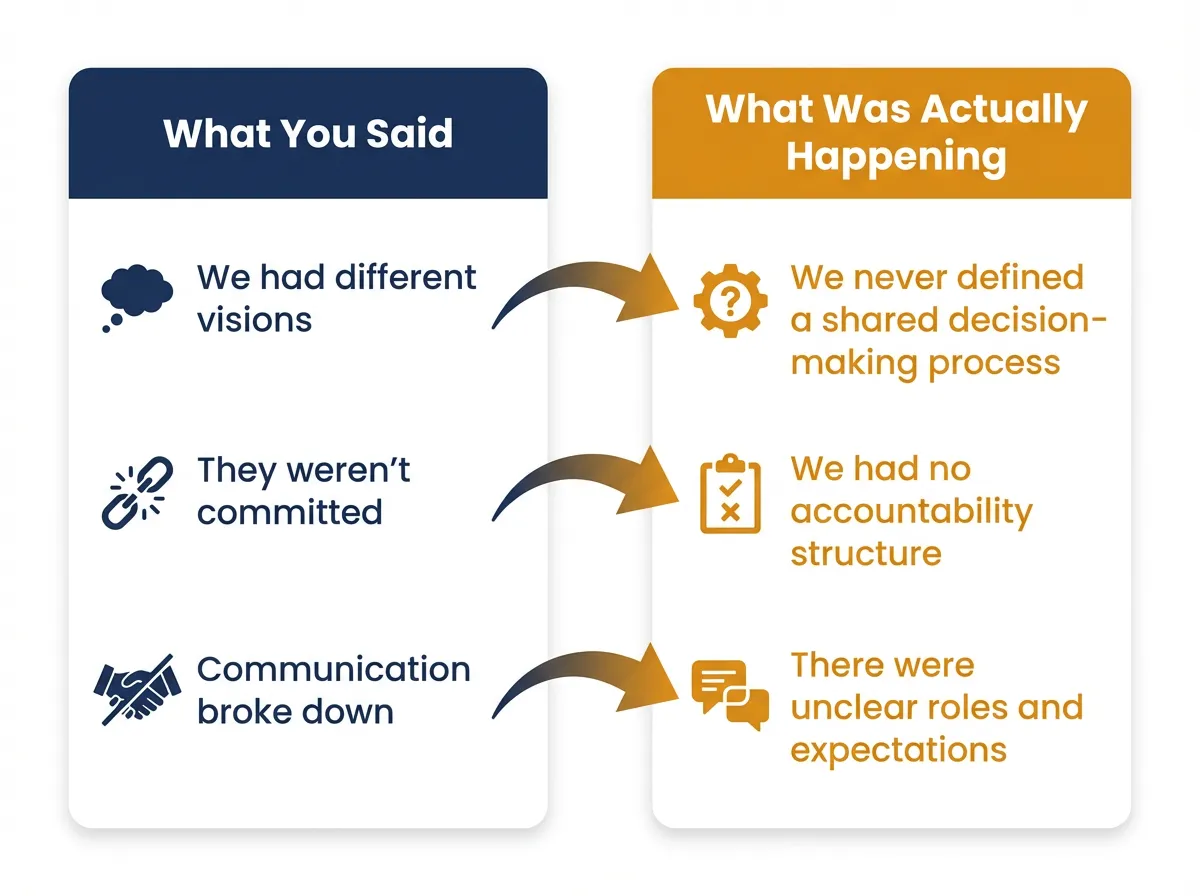
So founders do what humans do with painful memories: they compress them into a simple story. "We had different visions." "They weren't pulling their weight." "We should have set expectations earlier." These narratives feel true, but they're dangerously incomplete. They're the highlight reel, not the game tape.
The cost of skipping a real post-mortem is concrete. Research from Noam Wasserman's work at Harvard Business School shows that 65% of startup failures stem from cofounder conflict. And the patterns are remarkably consistent — founders who split once tend to encounter the same friction in their next partnership, because the structural issues that caused the break were never identified.
You don't need to make peace with your ex-cofounder. You need to make peace with the data.
When to Start Your Cofounder Breakup Post-Mortem
Timing matters more than you think.
Too early (within the first two weeks): You're still flooded with cortisol. Your brain is in threat-response mode, and everything you write will read like a prosecution brief. You'll focus on the other person's failures because that's what emotional pain does — it points outward.
Too late (six months or more): Memory is reconstructive, not reproductive. By now, you've told "the story" to friends, advisors, and your therapist enough times that it's hardened into myth. The messy, uncomfortable details — the ones that contain the real lessons — have been sanded away.
The sweet spot: 30 to 60 days after the separation is finalized. Legal matters are (hopefully) settled. The acute grief has dulled enough that you can sit with discomfort. But the details are still vivid.
Block three to four hours on a weekend. Not a coffee-shop brainstorm — a real, uninterrupted session. Treat it like you'd treat a product post-mortem at a serious company, because that's what this is.
The Five-Lens Framework for Your Post-Mortem
Freeform journaling about what went wrong leads to spiraling, not insight. Instead, use these five lenses. Each one examines a different structural layer of the partnership.
Lens 1: The Origin Story
How did you choose this person as your cofounder? This is where most founders discover their first mistake — not in the partnership itself, but in how it formed.
Ask yourself:
- Did you cofound because of genuine complementary skills, or because you were friends who got excited about the same idea over drinks?
- How long did you know each other before committing? Did you do a trial project first?
- Were there early yellow flags you rationalized away? What story did you tell yourself to dismiss them?
- Who initiated the partnership, and did the other person feel social pressure to say yes?
Example: One founder I spoke with — call her Priya — realized during her post-mortem that she'd chosen her cofounder primarily because he was the only technical person in her network willing to work for equity. "I was solving for availability, not alignment," she said. "I knew within three weeks that we had fundamentally different ideas about what 'good enough' meant for a product. But by then we'd already told everyone."
Lens 2: Roles and Ownership
The question isn't whether you divided responsibilities. It's whether you divided them explicitly, and whether those divisions held up under pressure.
Ask yourself:
- Were roles formally defined, or did they evolve through unspoken negotiation?
- When responsibilities overlapped, how was the conflict resolved? Was there a default "winner"?
- Did either cofounder feel they were doing more than their fair share? When did that feeling start?
- Were equity splits, vesting schedules, and IP ownership documented in writing before the first real disagreement?
This lens almost always reveals a gap between what was agreed to and what actually happened. Pay attention to when the gap first appeared. That's the pressure point.
Lens 3: Conflict Patterns
This is the most uncomfortable lens, and the most valuable. You're not looking at individual fights — you're looking for the pattern underneath them.
Ask yourself:
- Think of the first three serious disagreements. What were they actually about? (Hint: it's rarely the surface topic.)
- How did each person behave during conflict? Did one person withdraw? Did the other escalate?
- Was there a third party (advisor, investor, mutual friend) who got triangulated into disagreements?
- Did you ever avoid raising a concern because you feared the other person's reaction? How often?
- What was the ratio of direct conversation to passive signals (slack tone changes, delayed responses, venting to others)?
Example: Two cofounders — let's call them Marcus and Dave — had a recurring fight about hiring. On the surface, it was about whether to hire a marketer or a second engineer. But Marcus's post-mortem revealed the real pattern: Dave made commitments to candidates without discussing them first, and Marcus's "hiring disagreements" were actually about feeling excluded from decisions. The conflict wasn't about who to hire. It was about how decisions got made.
Lens 4: Decision-Making Infrastructure
Every founding team has a decision-making system. The question is whether it was designed or whether it emerged by accident.
Ask yourself:
- For major decisions (strategy, hiring, spending, pivots), was there a clear process? Or did whoever felt most strongly just push it through?
- Did you have regular structured check-ins, or did important conversations only happen in crisis mode?
- When you disagreed on a fundamental direction, what was the tiebreaker? Was there one?
- Did the decision-making process change after you raised funding, hired employees, or hit a rough patch?
This lens often reveals that cofounders operated with two completely different assumptions about authority. One person thinks decisions require consensus. The other thinks the CEO decides after hearing input. Neither assumption is wrong, but the mismatch is lethal.
Tools like Servanda can help cofounders formalize these decision-making structures into written agreements early — before unspoken assumptions have a chance to calcify into resentment.
Lens 5: The Final Break
Now zoom in on how the breakup actually happened.
Ask yourself:
- Was there a single triggering event, or a slow erosion? If slow, when did you privately decide it was over — and how long did you wait to say it out loud?
- Who initiated the conversation? How did the other person respond?
- Was the separation handled professionally (clear terms, legal agreements, transition plan), or was it chaotic?
- What did you lose — financially, relationally, emotionally — that could have been avoided with better structure?
- Is there anything you wish you'd said, or wish you hadn't said?

Turning Your Post-Mortem Into a Partnership Spec
A post-mortem is only useful if it changes future behavior. The final step is to convert your findings into a Partnership Spec — a personal document that outlines what you need from your next cofounding relationship.
Your spec should include three sections:
Non-Negotiable Requirements
These are structural conditions that must be in place before you commit to a cofounder. They come directly from your post-mortem findings.
Examples: - "We will complete a paid two-week trial project before any formal commitment." - "Equity vesting, role definitions, and a decision-making framework must be documented in writing before we incorporate." - "We will establish a monthly structured check-in with a predefined agenda that includes partnership health."
Personal Dealbreakers
These are patterns you've now recognized in yourself or in partnership dynamics that you know lead to failure.
Examples: - "I will not cofounder with someone primarily because they fill a skill gap I'm anxious about." - "If I notice myself avoiding a difficult conversation for more than two weeks, I will treat that as an emergency, not a preference." - "I will not cofounder with a close friend unless we've explicitly discussed how the friendship survives if the company doesn't."
Early Warning Signals
These are the specific behaviors and feelings that preceded the collapse of your last partnership. Think of them as your personal dashboard warning lights.
Examples: - "Feeling surprised by a decision my cofounder already made." - "Rehearsing arguments in my head instead of having them out loud." - "Noticing that we only talk about tasks and never about how the partnership is working."
The Hardest Part: Owning Your Contribution
Every cofounder breakup has two incomplete stories. Your post-mortem will be worth very little if it reads like a list of things the other person did wrong.
This doesn't mean the split was 50/50. Maybe your cofounder genuinely behaved badly. Maybe they checked out, lied about progress, or made unilateral decisions that torched the company's runway. That can all be true.
And it's also true that you chose them. You stayed past the first warning signs. You may have avoided hard conversations, accepted vague agreements, or let resentment build instead of addressing it directly.
The parts you own are the parts you can actually change. Everything else is just weather.
For each lens in your post-mortem, force yourself to answer one additional question: "What was my specific contribution to this dynamic?" Not in a self-flagellating way. In a structural way. What did you do — or not do — that allowed the pattern to persist?
Should You Share Your Post-Mortem With Your Ex-Cofounder?
Maybe. But probably not right away.
If your relationship ended with any degree of hostility, sharing your analysis will likely be received as an attack, no matter how carefully you frame it. People don't hear "I've identified patterns" — they hear "here's what you did wrong."
If enough time has passed and both parties are open to it, a mutual post-mortem can be extraordinarily valuable. Some former cofounders have found that sharing their separate reflections — months later, with a mediator or mutual advisor present — revealed misunderstandings that reframed the entire experience.
But the post-mortem's primary audience is you. Write it for yourself. If it eventually becomes a conversation, that's a bonus.
Frequently Asked Questions
How long should a cofounder breakup post-mortem take?
Plan for three to four hours for the initial writing session, spread across one or two sittings. Then revisit the document a week later with fresh eyes. The revision pass is where the most honest insights usually surface, once the relief of getting it all down has faded.
What if my cofounder breakup involved legal disputes — should I still do a post-mortem?
Yes, but keep the legal and personal reflections separate. Your post-mortem is a private learning document, not a legal record. Don't share it with anyone involved in active litigation. Focus the post-mortem on relationship and structural patterns, and let your attorney handle the legal specifics.
Can I do a post-mortem if the breakup just happened?
You can start collecting raw notes — write down specific incidents, dates, and feelings while they're fresh. But hold off on the analytical framework for at least 30 days. Early notes are useful data, but early conclusions are usually unreliable because they're shaped more by emotion than by reflection.
Is it worth doing a post-mortem if I'm never going to start another company?
Absolutely. Cofounder dynamics mirror patterns that show up in any high-stakes collaboration — business partnerships, leadership teams, even marriages. The patterns you identify in a cofounder post-mortem are rarely specific to startups. They're specific to you.
What if I realize the breakup was mostly my fault?
That's one of the most valuable things a post-mortem can reveal, even though it stings. The goal isn't to arrive at a comfortable conclusion — it's to arrive at a true one. If you recognize your own patterns clearly, you're in a far stronger position than someone who walks away convinced they were blameless.
Moving Forward With Clear Eyes
A cofounder breakup is a loss, and it deserves to be grieved. But it also contains more concentrated lessons about partnership, leadership, and self-awareness than most founders get from years of reading business books.
The post-mortem framework above — Origin, Roles, Conflict Patterns, Decision-Making, and The Final Break — gives you a structure for extracting those lessons before memory softens them into something less useful.
Write it down. Be specific. Own your part. And then build your Partnership Spec so that the next time you shake hands with a cofounder, you're doing it with a clear understanding of what you need, what you won't tolerate, and what warning signs to watch for.
The breakup already happened. The only remaining question is whether you learn from it on purpose, or accidentally repeat it.