
How to Fix CoFounder Conflicts Before They Kill Your Startup
You started this company together. Late nights whiteboarding the product. Splitting a single desk at a coworking space. Finishing each other's pitches. Now you sit in the same room and feel a low hum of resentment every time your cofounder opens their mouth.
Maybe it's about equity. Maybe it's about who actually does the work. Maybe it's a slow accumulation of small decisions made without you. Whatever the trigger, you can feel the partnership fracturing — and you know your startup can't survive it.
You're not imagining things. Research from Harvard Business School professor Noam Wasserman found that 65% of high-potential startups fail due to cofounder conflicts. Not bad markets. Not weak products. People problems. The good news: most cofounder conflicts are fixable — if you intervene before positions harden into ultimatums. This article gives you a concrete, step-by-step playbook to do exactly that.
Key Takeaways
- Most cofounder breakups follow a predictable pattern — and recognizing the early warning signs gives you a window to intervene.
- The "three conversations" framework (roles, values, exits) can resolve the vast majority of cofounder disputes before they escalate.
- Written operating agreements aren't bureaucratic overhead — they're relationship insurance that protects both founders.
- Bringing in a neutral third party early is a sign of strength, not failure, and dramatically increases the odds of saving the partnership.
- The founders who save their partnerships aren't the ones who avoid conflict — they're the ones who build a repeatable process for moving through it.
The Anatomy of a CoFounder Breakup
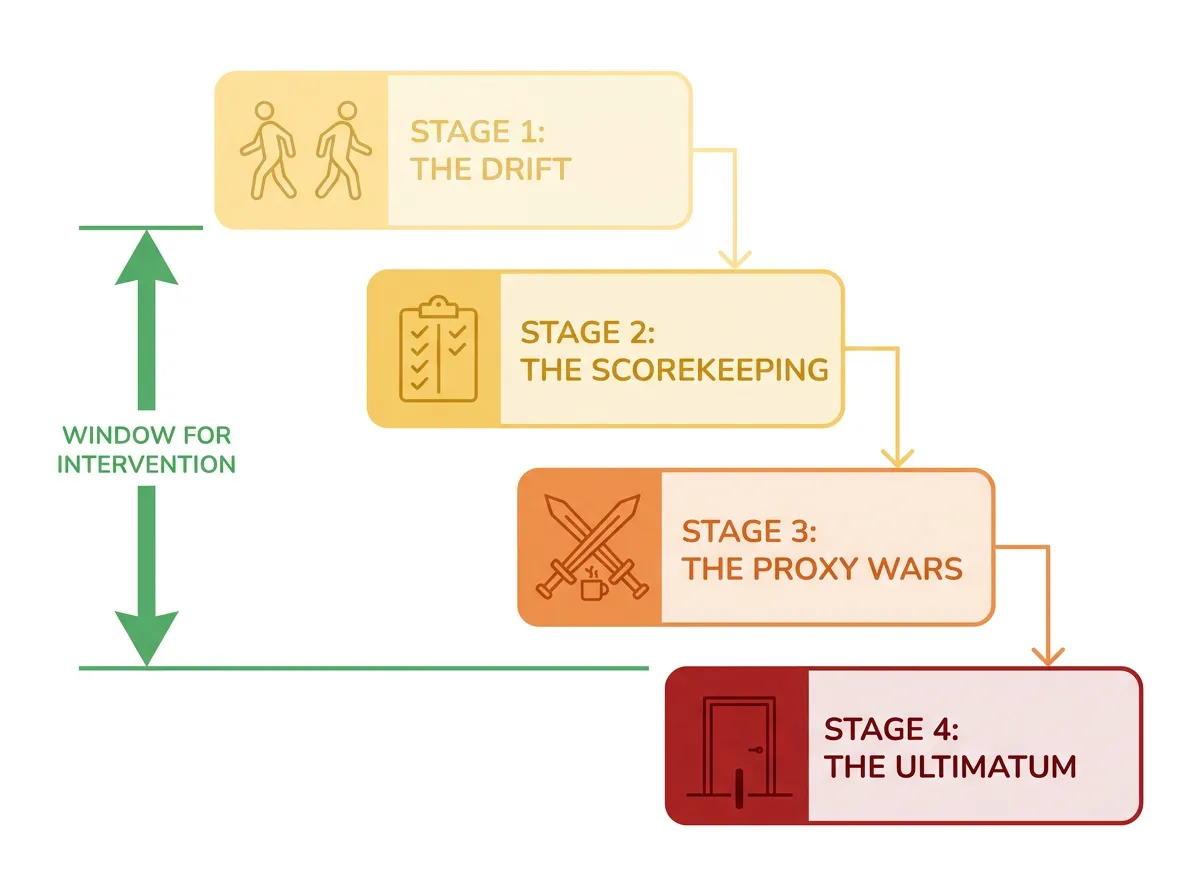
Cofounder conflicts rarely explode overnight. They follow a pattern that's almost boringly predictable once you've seen it enough times.
Stage 1: The Drift
You stop having the hard conversations. One founder starts making decisions unilaterally — not out of malice, but because it's faster. The other founder notices but doesn't say anything because the company is "too busy" for that conversation right now.
Stage 2: The Scorekeeping
Resentment builds. You start tracking who works harder, who gets more credit, who takes more risk. Every interaction gets filtered through an internal ledger of grievances. "I closed that deal. They just showed up to the meeting."
Stage 3: The Proxy Wars
Instead of addressing the real issue (usually power, respect, or money), you fight about surface-level decisions. The argument about whether to hire a marketing contractor is actually an argument about who gets to set company strategy. The debate about office space is really about who's in charge.
Stage 4: The Ultimatum
By this point, one or both founders have mentally checked out. Someone threatens to leave, or quietly starts exploring other opportunities. Now you're negotiating a divorce instead of solving problems.
The window for intervention is between Stage 1 and Stage 3. If you're reading this article and recognizing yourself somewhere in that progression, the time to act is right now — not after the next board meeting, not after the fundraise, not next quarter.
Step 1: Name the Conflict Out Loud
This sounds deceptively simple, but it's where most founders fail. The first step in fixing cofounder conflicts is refusing to let them stay underground.
Here's a script that works. It's not elegant, but it's direct:
"I think we have a real disagreement about [specific issue], and I'm worried that if we don't address it directly, it's going to get worse. Can we set aside an hour this week to talk through it — just the two of us, no agenda items, no sprint planning?"
What makes this effective:
- It names a specific issue, not a vague "we need to talk."
- It acknowledges the stakes without being dramatic.
- It proposes a concrete next step with a time boundary.
Consider the case of two SaaS cofounders — let's call them Priya and Marcus. They'd been avoiding a conversation about Marcus's diminishing role in product decisions for five months. By the time Priya finally brought it up, Marcus had already interviewed at another company. But when she used a version of the script above — naming the specific issue ("I've been making product calls without you, and I think that's damaging our relationship") — it opened a two-hour conversation that ultimately restructured their decision-making process and kept the company intact.
The key insight: specificity defuses defensiveness. "We have a communication problem" triggers eye rolls. "I made three product roadmap decisions last month without consulting you, and I want to understand how that landed" triggers an actual conversation.

Step 2: Have the Three Conversations
Once you've surfaced the conflict, you need a framework for working through it. Most cofounder disputes — regardless of how they manifest on the surface — trace back to misalignment in one of three areas. Have each conversation separately, ideally on different days.
Conversation 1: Roles and Decision Rights
This is the conversation about who decides what. Not titles. Not org chart positions. Actual decision-making authority.
Questions to work through together:
- Which decisions can each of us make unilaterally?
- Which decisions require both of us to agree?
- When we disagree on a shared decision, what's our tiebreaker? (Coin flip? Data threshold? External advisor?)
- How do we handle the gray areas — decisions that don't clearly fall into one person's domain?
Write down the answers. Seriously. A shared document that says "Marcus has final call on product features under $10K development cost; Priya has final call on anything sales-facing" eliminates an enormous category of daily friction.
Conversation 2: Values and Vision Alignment
This is the conversation about where you're going and why. It's also the one most founders skip because they assume they're aligned. (They're often not.)
Questions to work through:
- What does success look like for this company in three years? (Be specific: revenue number, team size, market position.)
- What would make you personally walk away from this company, even if it were succeeding?
- How do we each feel about raising venture capital vs. bootstrapping vs. a hybrid approach?
- What kind of company culture are we building? What behaviors are non-negotiable?
You'll be surprised how often cofounders discover they've been building toward fundamentally different visions. One founder wants a $100M venture-backed rocketship. The other wants a profitable $5M lifestyle business. Neither vision is wrong — but they're incompatible, and discovering this at Series A is devastating.
Conversation 3: The Exit Conversation
This is the hardest one, and it's the one that will save your company. You need to talk about what happens if one of you wants to leave — while you still like each other enough to be fair about it.
Questions to work through:
- If one of us leaves, what happens to their equity? (Vesting cliff, accelerated vesting, buyback provisions.)
- How do we value the company for a buyout scenario?
- What's the non-compete situation? Can a departing founder start something in the same space?
- If we both want to stay but can't work together, how do we decide who goes?
This conversation is uncomfortable precisely because it forces you to imagine the partnership ending. But having this discussion while you're still collaborative — and documenting the answers in a formal cofounder agreement — is one of the single highest-ROI hours you'll spend as a founding team. Tools like Servanda can help you turn these conversations into structured written agreements, so the hard-won clarity doesn't evaporate the moment you go back to putting out fires.
Step 3: Build a Conflict Protocol
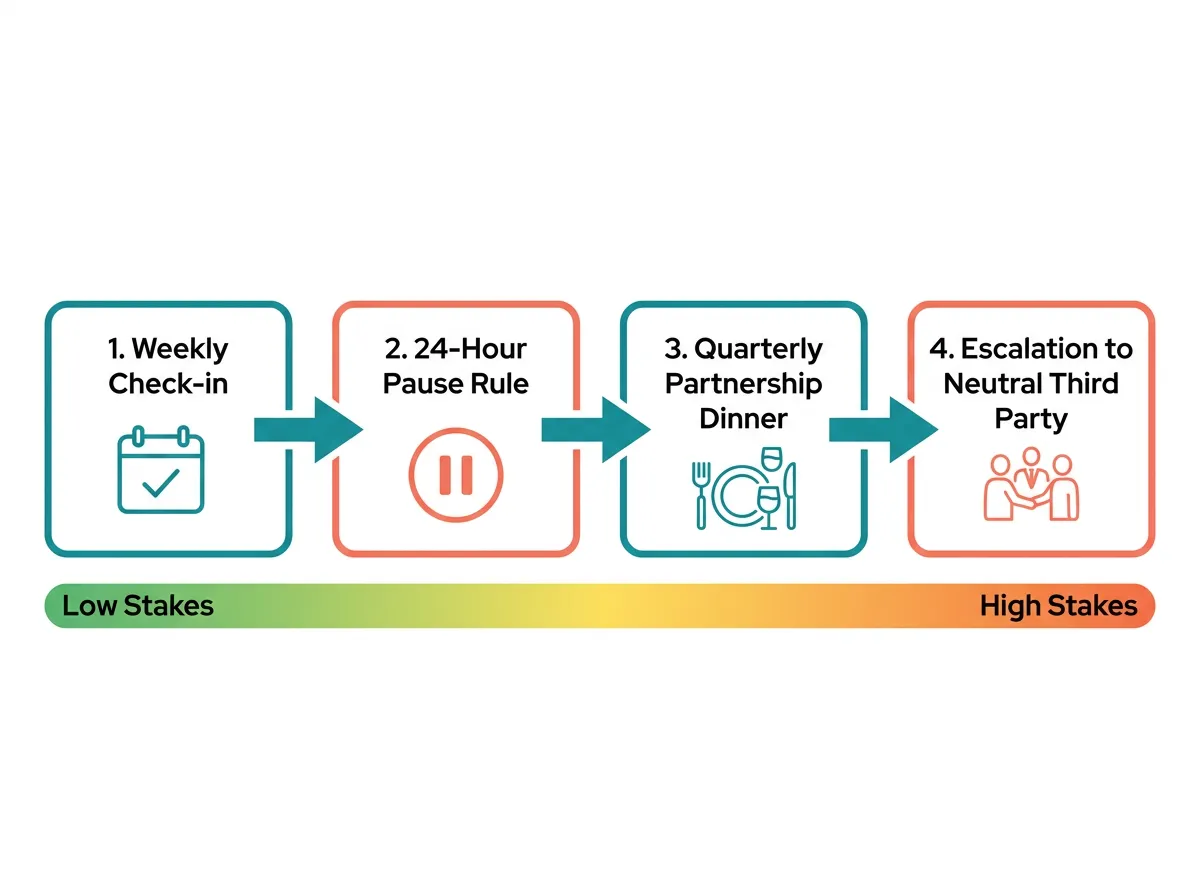
One honest conversation won't protect you forever. Cofounders who sustain healthy partnerships don't avoid conflict — they have a repeatable process for handling it.
Here's a conflict protocol used by a two-person founding team that survived a near-breakup and went on to raise a Series B:
-
Weekly founder check-in (30 minutes, protected on the calendar). Not a status update. Not a standup. A dedicated conversation with two prompts: "What's working between us?" and "What's not working between us?" If the answer to the second question is "nothing" for three consecutive weeks, one of you isn't being honest.
-
The 24-hour rule. When a disagreement gets heated, either founder can call a 24-hour pause. No decisions get made, no emails get sent, no passive-aggressive Slack messages. You come back to the table the next day with a written one-paragraph summary of your position and proposed solution.
-
The quarterly "state of the partnership" dinner. Once every three months, go somewhere that isn't the office. Eat food. Talk about the relationship, not the company. What's changed? What are you afraid of? What do you need more of? This sounds soft. The founders who do it swear by it.
-
The escalation ladder. If you can't resolve an issue between the two of you after two dedicated attempts, you escalate to a mutually agreed-upon third party — an advisor, a board member, or a professional mediator. Agree on this person before you need them.
Step 4: Know When to Bring in Outside Help
There's a persistent myth in startup culture that needing outside help with your cofounder relationship means you've already failed. This is exactly backward. The founders who bring in a mediator or advisor early are the ones who save their partnerships. The ones who white-knuckle it alone are the ones who end up in lawsuits.
Consider bringing in a third party when:
- You've had the same argument more than three times without resolution
- One or both of you has started venting to employees about the other founder
- You're making company decisions based on relationship dynamics rather than business logic (e.g., avoiding a necessary strategy change because it will trigger a fight)
- You've stopped having your weekly check-ins because they're "too uncomfortable"
- Either founder has mentioned leaving, even casually
The third party doesn't have to be a professional mediator (though that's a great option). It can be:
- A founder who's been through a similar conflict and resolved it
- A board member or advisor both founders respect
- An executive coach experienced with founding teams
- A startup-focused attorney (particularly for equity and governance disputes)
The key requirement is that both founders agree this person is neutral and credible. If one founder picks the mediator unilaterally, the other founder will never trust the process.
Step 5: Document Everything You Agree On
Verbal agreements between cofounders have the shelf life of a banana. You will remember the conversation differently. You will interpret the same words differently. And six months later, when the conflict resurfaces, you'll be back to square one with the added burden of "But we already talked about this!"
After every significant conversation — and especially after the three conversations outlined in Step 2 — write down what you agreed on. This doesn't require a lawyer (though some agreements should eventually be reviewed by one). It requires:
- A shared document both founders can access and edit
- Specific, testable language ("Marcus approves all hires under $80K" vs. "Marcus handles some hiring stuff")
- A date and revision history so you can see how your agreements have evolved
- Signature or explicit acknowledgment from both founders
The act of writing forces precision. It surfaces the ambiguities you glossed over verbally. And it gives you a reference point that short-circuits the next argument before it starts.
What If It's Too Late?
Sometimes you do everything right and the partnership still isn't working. That's not a failure of character — it's a recognition that two people have grown in different directions.
If you've worked through the steps above and you're still stuck, a clean separation is better than a slow, destructive collapse. The companies that survive a cofounder departure are the ones where:
- The leaving founder's equity is handled fairly and according to a pre-agreed framework
- The transition is communicated clearly to the team, investors, and customers
- Both founders behave with enough integrity that they could work together again someday (even if they never do)
- The remaining founder has a realistic plan for filling the gaps the departing founder leaves behind
A good cofounder breakup is one where the company survives and both people can look back without bitterness. That's a high bar, but it's achievable — especially if you've built the documentation and protocols described in this article.
Frequently Asked Questions
How do I bring up a conflict with my cofounder without making things worse?
Lead with a specific observation, not a general accusation. Say "I noticed I've been making product decisions without your input lately, and I want to fix that" rather than "We have a problem." Naming the behavior — especially your own contribution to it — lowers defensiveness and opens the door to a real conversation.
What's the number one cause of cofounder breakups?
Misalignment on roles and decision-making authority. It's not usually about money or equity at the root — it's about one or both founders feeling sidelined from decisions they believe they should own. This is why the "Roles and Decision Rights" conversation is the single most important one to have early and revisit often.
Should cofounders get a cofounder agreement even if they're friends?
Especially if they're friends. Friendship adds emotional complexity to business disagreements and makes it harder to have direct conversations about money, power, and exits. A written cofounder agreement protects the friendship by giving you a framework to fall back on when emotions run high.
When should cofounders consider mediation?
When you've had the same unresolved disagreement more than three times, when the conflict is starting to affect hiring or product decisions, or when either founder has mentioned leaving. Mediation isn't a last resort — it's most effective when used early, before positions have calcified.
Can a startup survive a cofounder leaving?
Yes, many successful companies have survived and thrived after a cofounder departure — but only when the transition is handled intentionally. The companies that struggle are the ones where the departure is sudden, acrimonious, or creates a leadership vacuum. Planning for this possibility (even if it never happens) is what the exit conversation in Step 2 is designed to do.
Conclusion
Cofounder conflicts are not a sign that your partnership is broken. They're a sign that your partnership is real — and that it needs a structure strong enough to hold the weight of building a company together.
The founders who make it aren't the ones who never fight. They're the ones who name their conflicts early, have the three essential conversations (roles, values, exits), build a repeatable protocol for working through disagreements, and document what they agree on so they're never re-litigating the same ground.
If you're reading this and feeling the first tremors of a cofounder rift, you're not too late. The fact that you're looking for answers instead of looking for the exit means the partnership still matters to you. Start with one conversation this week. Make it specific. Write down what you agree on. And build from there. Your startup — and your relationship — are worth the effort.