Renegotiating Equity After a Pivot: A Founder's Guide
You and your cofounder split equity 50/50 eighteen months ago. Back then, you were building an AI-powered scheduling tool. She handled the machine learning models; you handled sales and operations. The split felt right.
Then the pivot happened.
Now you're building a B2B compliance platform. Her ML expertise is still relevant but less central. You've taken on product management, hired the first three engineers, and personally closed your first enterprise client. She's been contributing part-time while finishing a contract elsewhere. The 50/50 split that once reflected equal commitment now feels like a source of quiet resentment.
Renegotiating equity after a pivot is one of the most emotionally charged conversations cofounders face. It touches on identity, fairness, loyalty, and money all at once. But avoiding it doesn't make the tension disappear — it just lets it compound. This guide walks you through how to approach the conversation with clarity, fairness, and a real framework for moving forward.

Why a Pivot Changes the Equity Equation
When cofounders agree on an initial equity split, that agreement reflects a specific set of assumptions: who's contributing what, what the company is building, how much risk each person is absorbing, and what the future roles will look like.
A pivot invalidates some or all of those assumptions.
Consider what typically shifts during a pivot:
- Skill relevance changes. The cofounder whose deep expertise was the reason for a larger share may now be working in an area that's less critical to the new direction.
- Time commitment diverges. One cofounder may go all-in on the new vision while the other is slower to commit or continues straddling the old model.
- Risk absorption shifts. If one founder deferred salary, invested personal savings, or took on new responsibilities during the transition, they've absorbed more risk than the split reflects.
- Role scope expands or contracts. Pivots often demand that one founder takes on multiple hats — product, hiring, fundraising — while the other's responsibilities narrow.
None of this means anyone did anything wrong. It means the underlying deal changed, and the equity structure needs to catch up.
The Real Reason Cofounders Avoid This Conversation
Most founders avoid this conversation because they're afraid of what happens next.
Common fears include:
- "They'll think I'm greedy." Asking for a larger share feels like you're devaluing your cofounder's contribution.
- "It'll blow up the relationship." If the conversation goes poorly, you could lose a cofounder and a friend.
- "We don't have the language for it." There's no script for telling someone you want to change the deal you shook hands on.
- "Maybe it'll work itself out." Unspoken resentment doesn't dissipate. It metastasizes.
The irony is that avoiding the conversation is often what destroys the partnership. By the time founders finally address the imbalance, months of bottled frustration have turned a solvable problem into an existential one.
A Step-by-Step Framework for Renegotiating Equity After a Pivot
Step 1: Separate the Conversation from the Decision
Don't walk into a meeting expecting to leave with a new equity split. Instead, frame the first conversation as an exploration.
Try language like:
"Our company looks really different from when we started. I think it's worth revisiting our equity agreement to make sure it still reflects where we both are. I'm not proposing anything specific — I just think we owe it to ourselves to have the conversation."
This lowers the stakes. You're not ambushing anyone. You're opening a door.
Step 2: Build a Shared Fact Base
Before anyone proposes numbers, align on what's actually true. Create a simple document that captures:
- Original assumptions — What was each person's expected role, time commitment, and contribution when you set the initial split?
- Current reality — What is each person actually doing now? How many hours per week? What responsibilities have they taken on or let go of?
- Forward-looking commitments — What does each person plan to contribute over the next 12–18 months? Are both cofounders going full-time? Is one stepping back?
- Financial contributions — Has either cofounder invested capital, deferred salary, or taken on personal financial risk that the other hasn't?
Writing this down forces both parties to confront the same reality. It's much harder to argue with a shared document than with competing narratives.

Step 3: Choose an Equity Reallocation Method
There's no single "correct" formula, but here are three approaches cofounders commonly use:
Method A: Contribution-Based Reassessment
Assign relative weights to different contribution categories and score each founder. Common categories include:
| Category |
Weight |
Founder A |
Founder B |
| Idea / IP |
10% |
5 |
5 |
| Time commitment (past) |
20% |
9 |
5 |
| Time commitment (future) |
20% |
9 |
7 |
| Domain expertise for new direction |
15% |
8 |
6 |
| Capital invested |
10% |
7 |
3 |
| Network / business development |
15% |
8 |
4 |
| Leadership / management |
10% |
7 |
5 |
This isn't meant to produce a precise number to three decimal places. It's meant to make implicit judgments explicit so you can negotiate from shared ground.
Method B: Fresh-Start Valuation
Ask the question: "If we were forming this company today — with this product, this market, and these roles — what split would we agree to?"
This method works well when the pivot is dramatic enough that the new company barely resembles the original. It sidesteps the emotional baggage of "taking away" equity and instead reframes the discussion around the current venture.
Method C: Vesting Reset with Cliff
Keep the existing equity but restructure the vesting schedule. For example:
- Both cofounders retain their vested shares to date.
- Unvested shares are returned to a pool and reallocated based on new roles and commitments.
- A new vesting schedule (often with a 6-month cliff) begins.
This is often the most politically palatable option because nobody "loses" equity they've already earned. It simply adjusts what happens going forward.
Step 4: Account for Emotional Equity, Not Just Economic Equity
The cofounder who came up with the original idea, recruited the team, or pushed through the hardest months of the pivot carries a sense of ownership that goes beyond spreadsheets.
Acknowledge this directly. You might say:
"I want to be clear — I know you were the one who got this thing off the ground, and that matters. I'm not trying to erase that. I'm trying to make sure the structure we have going forward motivates both of us to go all-in."
Recognizing someone's emotional contribution changes the entire tone of the conversation.
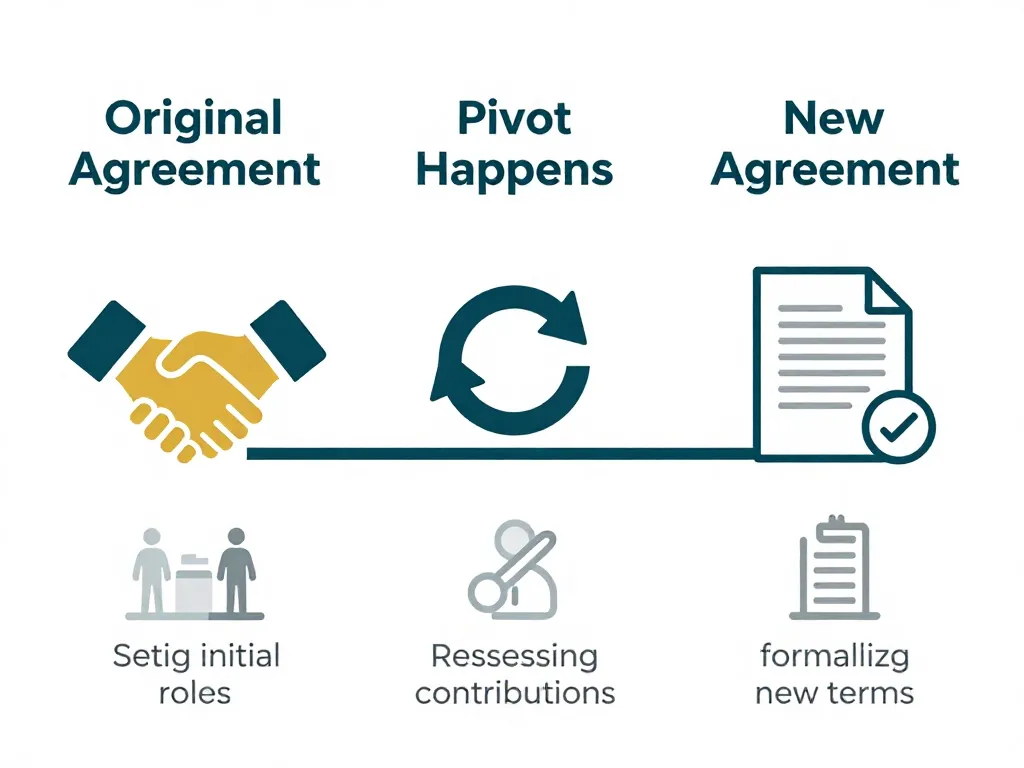
A handshake is not an agreement. A text message is not a contract. Whatever you decide, write it down and make it legally binding.
Your formalized agreement should include:
- The new equity split and how it was determined
- Updated vesting schedules and any cliffs
- Clear role definitions going forward
- What happens if one cofounder leaves (voluntary or involuntary)
- A trigger for future renegotiation (e.g., "We'll revisit this if we raise a Series A or if either cofounder's time commitment drops below 30 hours/week")
Tools like Servanda can help cofounders create structured written agreements that capture these terms clearly, especially when the emotional weight of the conversation makes it hard to think like a lawyer.
Real-World Scenarios: How Other Founders Have Navigated This
Scenario 1: The Part-Time Cofounder
Situation: Two cofounders started a consumer app with a 50/50 split. After pivoting to an enterprise SaaS model, Founder A went full-time while Founder B kept her day job and contributed 10–15 hours per week.
Resolution: They agreed on a 65/35 split going forward, with Founder B's unvested shares reallocated. They also agreed that if Founder B went full-time within six months, 5% would vest back to her on an accelerated schedule.
Why it worked: The deal acknowledged Founder B's past contributions while creating an incentive for future commitment.
Scenario 2: The Technical Cofounder Whose Skills No Longer Fit
Situation: A startup pivoted from a hardware product to a pure software play. The cofounder who designed the hardware (Founder C) had a 45% stake but limited software engineering skills.
Resolution: Founder C retained 25% equity with standard vesting, shifted to an advisory role with a small monthly stipend, and the freed-up 20% was allocated to a new technical hire and an employee option pool.
Why it worked: Founder C maintained meaningful ownership without blocking the company's ability to attract the talent it now needed.
Scenario 3: The Reluctant Conversation That Came Too Late
Situation: Founder D waited nine months after a pivot to raise the equity issue with Founder E. By then, Founder D had built the entire new product, landed three paying customers, and was deeply resentful. Founder E felt blindsided and personally attacked.
Resolution: After several heated arguments, they brought in a neutral third party to mediate. They eventually reached a 60/40 split, but the relationship never fully recovered.
Lesson: Earlier is almost always better. The longer you wait, the more emotional debt accumulates.
What to Do If Your Cofounder Refuses to Renegotiate
Sometimes, despite your best efforts, your cofounder won't engage. They might feel threatened, defensive, or simply disagree that anything has changed.
Here's a tiered approach:
- Reframe the ask. Instead of "I want more equity," try "I want to make sure our structure supports the company we're actually building." Make it about the startup, not about you.
- Introduce external data. Show them what typical equity splits look like for your respective roles in comparable startups. Resources like the Slicing Pie framework or published YC advice can provide neutral reference points.
- Suggest a time-bound trial. Propose revisiting the split after three months based on agreed-upon milestones. This makes the conversation feel less permanent.
- Bring in a neutral third party. A startup lawyer, a trusted advisor, or a structured mediation process can break a deadlock that two emotionally invested parties can't resolve alone.
- Evaluate your options honestly. If your cofounder won't engage at all, you need to decide whether the current arrangement is something you can live with — or whether it's a dealbreaker.
Common Mistakes to Avoid
- Don't negotiate over text or Slack. These conversations deserve face-to-face time (or at minimum, a video call). Tone gets lost in writing.
- Don't use ultimatums. "Give me more equity or I'm leaving" poisons every conversation that follows, even if the other person agrees.
- Don't compare hours as the only metric. Quality of contribution, strategic value, and risk absorbed all matter alongside time spent.
- Don't skip the lawyer. Equity changes can have tax implications, affect existing investor agreements, and create legal complications if done informally.
- Don't treat this as a one-time event. Build renegotiation triggers into your agreement so the next pivot, funding round, or role change doesn't require another painful conversation from scratch.
Conclusion
Renegotiating equity after a pivot isn't a sign that something went wrong between you and your cofounder. It's a sign that your company is evolving — and your partnership structure needs to evolve with it.
The founders who navigate this well share a few things in common: they have the conversation early, they ground it in shared facts rather than feelings, they choose a clear method for reallocation, and they formalize whatever they agree to.
Your equity split is the financial architecture of your partnership. When the building changes shape, the architecture has to change too. Cofounders who can navigate this conversation honestly tend to build stronger, more resilient partnerships on the other side of it.
Don't let a spreadsheet disagreement become the thing that kills a company worth building.
Frequently Asked Questions
How do you bring up renegotiating equity without offending your cofounder?
Frame the conversation around the company's evolution rather than personal dissatisfaction. Use language like "Our company looks really different now — I think we owe it to ourselves to revisit our equity agreement" to signal collaboration, not confrontation. Opening the topic as a shared exploration rather than a demand significantly lowers the emotional stakes.
Is it normal to change a startup equity split after a pivot?
Yes, it's both normal and often necessary. The original equity split was based on assumptions about roles, contributions, and company direction that a pivot fundamentally changes. Adjusting the split is a sign of a maturing partnership, not a failure of the original agreement.
What's the easiest way to restructure cofounder equity without someone feeling like they lost?
A vesting reset with a cliff is often the most palatable approach — both cofounders keep their already-vested shares, and only unvested shares are returned to a pool for reallocation based on new roles. This preserves what each person has already earned while aligning future equity with forward-looking contributions and commitments.
What should I do if my cofounder refuses to discuss changing our equity split?
Start by reframing the conversation as being about the startup's health rather than your personal share, and introduce neutral external references like the Slicing Pie framework or published YC guidance. If they still won't engage, suggest a time-bound trial tied to milestones, or bring in a neutral third party such as a startup lawyer or mediator to facilitate the discussion.
Do I need a lawyer to change a cofounder equity agreement?
Yes, you should involve a lawyer even if the conversation between cofounders goes smoothly. Equity changes can trigger tax consequences, conflict with existing investor agreements, or create legal exposure if handled informally. A properly drafted amendment protects both parties and ensures the new terms are enforceable.