5 Boundaries That End Co-Parenting Arguments Fast
It's 9:47 PM on a Tuesday. Your phone buzzes. A text from your co-parent about this weekend's pickup time, the same issue you argued about last month, and the month before that. Your stomach tightens. You start typing a response, delete it, type another one, delete that too. You know where this is heading.
Most co-parenting advice tells you to communicate better during a conflict. But by the time you're mid-argument, the damage is already happening. What works is building boundaries before the argument starts: clear, agreed-upon rules that make most fights unnecessary.
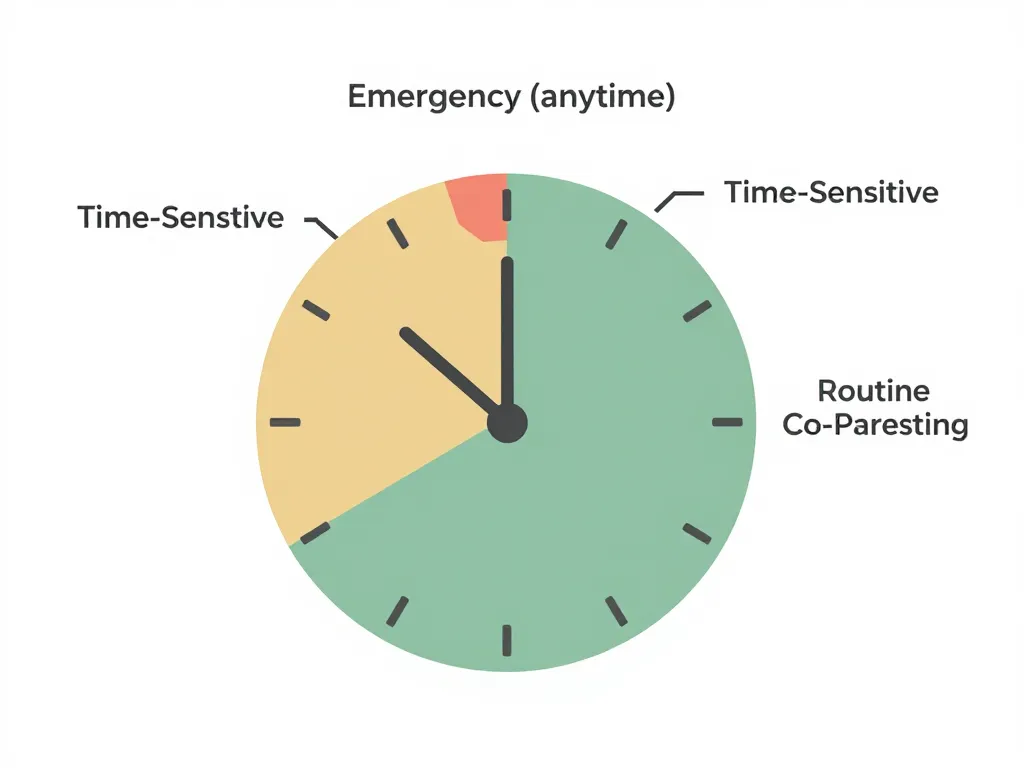
Boundary #1: The Communication Window
Why This Fight Keeps Happening
When either parent can text at any hour about any topic, small issues escalate because they arrive at the worst possible moment: during a work meeting, at bedtime, in the middle of dinner with the kids. The problem isn't what's being said. It's when.
How to Set This Boundary
Agree on specific communication windows for non-urgent matters. This doesn't mean you ignore emergencies. It means you separate the urgent from the administrative.
- Emergency communication (child is hurt, safety concern): Call or text anytime. Define what qualifies as an emergency in writing.
- Time-sensitive logistics ("School called; Jamie has a fever and needs pickup"): Text within the day, response expected within 2 hours.
- Routine co-parenting business (schedule requests, activity signups, school forms): Communicate during a designated window, for example weekday evenings between 7:00–8:30 PM, or through a weekly Sunday email.
What This Looks Like in Practice
Suppose two co-parents are averaging 23 texts a day, most of which spiral into arguments. They agree to batch all non-urgent topics into a single email exchange every Sunday evening. Within three weeks, daily text volume drops to two or three messages, almost all logistical. The arguments don't just decrease; most of them never start.
The key: both parents must commit to not responding to non-urgent messages outside the window, and to not sending them. If you catch yourself composing a 10 PM text about next month's soccer schedule, save it as a draft.
Boundary #2: The Decision Matrix
Why This Fight Keeps Happening
One parent signs the child up for swim lessons. The other parent is furious because they weren't consulted. Or one parent lets the kids stay up until 10 PM, and the other feels undermined. These battles aren't about swimming or bedtime. They're about who gets to decide what.
How to Set This Boundary
Write a decision matrix that sorts parenting decisions into three categories:
- Joint decisions (both parents must agree): Major medical procedures, school enrollment, religious milestones, relocation, therapy.
- Notify-and-proceed decisions (one parent decides but informs the other): Extracurricular signups during their parenting time, haircuts, playdates, non-emergency doctor visits.
- Independent decisions (no notification needed): What the child eats for dinner, daily clothing choices, household routines, entertainment choices.
The specific items in each category will vary by family. What matters is that both parents agree to the framework before the next decision comes up.
What This Looks Like in Practice
A parent wants to enroll their daughter in a weekend art class that falls during the other parent's time. The old dynamic would be an explosive text exchange. With a decision matrix, they'd already agreed that extracurricular activities affecting the other parent's time were joint decisions. The information goes out during the communication window, gets reviewed, and gets discussed without the emotional charge of feeling blindsided.
Consider formalizing your decision matrix with a tool like Servanda, where you can create a written agreement both parents can reference, reducing the "I never agreed to that" arguments.
Boundary #3: The 24-Hour Response Rule
Why This Fight Keeps Happening
Parent A sends a message. Parent B doesn't respond for three days. Parent A feels ignored. The follow-up message is sharper. Parent B feels attacked and gets defensive. The actual issue, say who's buying new cleats, becomes a proxy war about respect and who cares more about the kids.
The reverse also happens: Parent B feels pressured to respond immediately while angry, and the rapid-fire exchange escalates a minor issue into a major conflict. Both patterns stem from the same problem: no shared expectation about response timing.
How to Set This Boundary
Agree that all non-emergency messages receive a response within 24 hours. The response doesn't have to be a final answer. It can be:
- "Got it. I'll think about this and respond by Wednesday."
- "I need more information. Can you send me the dates?"
- "I'm not comfortable with this. Can we discuss during our Sunday check-in?"
The point is acknowledgment. The sender knows they've been heard. The receiver has space to think before reacting.
Ground Rules That Make This Work
If you need more time to decide, say so and give a specific timeframe. If a parent consistently ignores the rule, the other sends one follow-up, not five. Never use delayed responses as a power move. And silence is not a response: even "I disagree and here's why" beats nothing.

Boundary #4: The "Your House, Your Rules" Framework
Why This Fight Keeps Happening
Co-parents often try to control what happens in each other's homes. Bedtimes, screen time limits, food choices, chore expectations, and every one of these disagreements sends an implicit message: I don't trust your parenting. You will never fully agree on how to run a household. You don't have to.
How to Set This Boundary
Divide parenting decisions into consistency items, which need to match across both homes, and household items, which don't.
| Consistency items (same in both homes) |
Household items (each parent decides) |
| Medication schedules and medical routines |
Bedtimes, within reason |
| Safety rules (car seats, supervision) |
Screen time rules |
| Major behavioral expectations (no hitting) |
Food and meal routines |
| Academic commitments (homework, attendance) |
Chore expectations and how weekends are spent |
The Hard Part
This boundary requires letting go. Your co-parent might let the kids eat cereal for dinner. They might allow more video games than you'd prefer. Unless the child's safety or health is at risk, this falls under their authority in their home.
Research consistently shows that kids handle different rules in different environments. They do it every day at school versus home. What damages children is not different bedtimes. It's witnessing their parents in constant conflict over different bedtimes.
When to Override This Boundary
If a child's physical or emotional safety is at risk, "your house, your rules" doesn't apply. Concerns about abuse, neglect, substance use around the children, or dangerous living conditions are not boundary disagreements. They're safety issues that require professional or legal intervention.
Boundary #5: The Schedule-Change Protocol
Why This Fight Keeps Happening
Few things ignite co-parenting conflict faster than last-minute schedule changes. They feel like a power move, or proof that the other parent doesn't value your time. Even when the change is genuinely necessary, the way it's requested determines whether it becomes a minor adjustment or a three-day argument.
How to Set This Boundary
- Minimum notice period: Agree on a minimum advance notice for non-emergency changes. Seven days is common. For holiday swaps and vacation scheduling, 30 days.
- Request format: Put it in writing. Include specific dates, times, reason, and a proposed makeup plan.
- Response window: The other parent has 48 hours to accept, decline, or propose an alternative.
- Swap bank (optional): Keep an informal tally. "I took an extra weekend in March, so you get one in April."
- Default rule: If no agreement is reached, the existing schedule stands. This prevents one parent from bulldozing changes through.
A Sample Request
Instead of: "Hey, I need to switch weekends. Something came up."
Try: "I have a work conference April 12-13 and would like to swap our weekends. I'd take your April 19-20 weekend instead, same pickup and drop-off times. Let me know by Wednesday if that works, or if you'd prefer a different makeup weekend."
The second message is specific, offers a solution, and includes a response deadline. It treats the co-parenting relationship like what it is: a business partnership focused on your child's wellbeing.
What About Emergencies?
Real emergencies happen. Build in flexibility by agreeing in advance that emergency changes require a phone call rather than a text, that the requesting parent arranges backup care first where possible, that emergency swaps don't count against the swap bank, and that both parents assume good faith.
How to Actually Implement These Boundaries
Start with one, not five. Pick the boundary that addresses your most frequent argument. For most co-parents, that's either the communication window or the schedule-change protocol. Run it for 30 days before adding another.
Put it in writing. Verbal agreements erode. When conflict arises, you can reference the written agreement instead of arguing about what was said.
Expect a testing period. There will be violations, from both sides. The goal isn't perfection. It's having a framework to return to when things go sideways.
Revisit quarterly. A boundary that was essential when your child was three might be unnecessary at thirteen.
When one parent won't cooperate, document the pattern in writing, enforce the boundary on your own side anyway (don't respond to non-emergency texts outside the window, even if they keep coming), and seek a family mediator or your attorney if violations are persistent and affect your child.
Frequently Asked Questions
Do co-parenting boundaries work if we have a high-conflict relationship?
Boundaries are most important in high-conflict situations. What therapists call "parallel parenting," where each parent operates more independently with minimal direct contact, relies heavily on clear, firm boundaries. The less room there is for interpretation, the fewer opportunities there are for conflict.
How do I set co-parenting boundaries without sounding controlling?
Frame every boundary as something that benefits your child and reduces stress for both parents. Instead of "I need you to stop texting me at midnight," try "I think we'd both benefit from a communication window so neither of us feels pressured to respond when we're with the kids or winding down for the night. What times work for you?" The boundary is the same; the framing makes it collaborative.
Should co-parenting boundaries be included in our custody agreement?
Including key boundaries, especially around communication protocols, schedule-change procedures, and decision-making authority, gives them legal weight. Talk to your family law attorney about which are appropriate to formalize. Even boundaries that aren't in the legal agreement can be documented in a signed co-parenting plan both parties keep for reference.
How do I explain different rules at each house to my kids?
Keep it simple and age-appropriate: "Different homes have different rules, just like your classroom has different rules than the playground." Avoid criticizing the other parent's rules. Children adjust quickly to different expectations in different environments. What they struggle with is feeling caught between two warring parents.