You're standing in the driveway during Sunday evening drop-off. The kids are unbuckling their seatbelts in the back seat, and your co-parent says it — that one comment about how you "never" follow through, or how the kids are "always" a mess when they come from your house. Your chest tightens. Your jaw locks. You can feel the sharp reply forming before you've even taken a breath.
When your co-parent pushes your buttons, your nervous system doesn't care about custody agreements or parenting plans. It just wants to fight back — or shut down completely. What you say in the next five seconds can either escalate a conflict your children will absorb, or quietly redirect the entire exchange.
Below are five concrete, calm responses you can use starting today, drawn from research by MSU Extension and family conflict specialists.
Your co-parent isn't a stranger. They're someone who has — whether through years of marriage, shared parenting, or both — mapped your emotional landscape with extraordinary precision. They know your insecurities. They know your triggers. And during moments of frustration or resentment, those triggers get pulled, sometimes deliberately, sometimes out of habit.
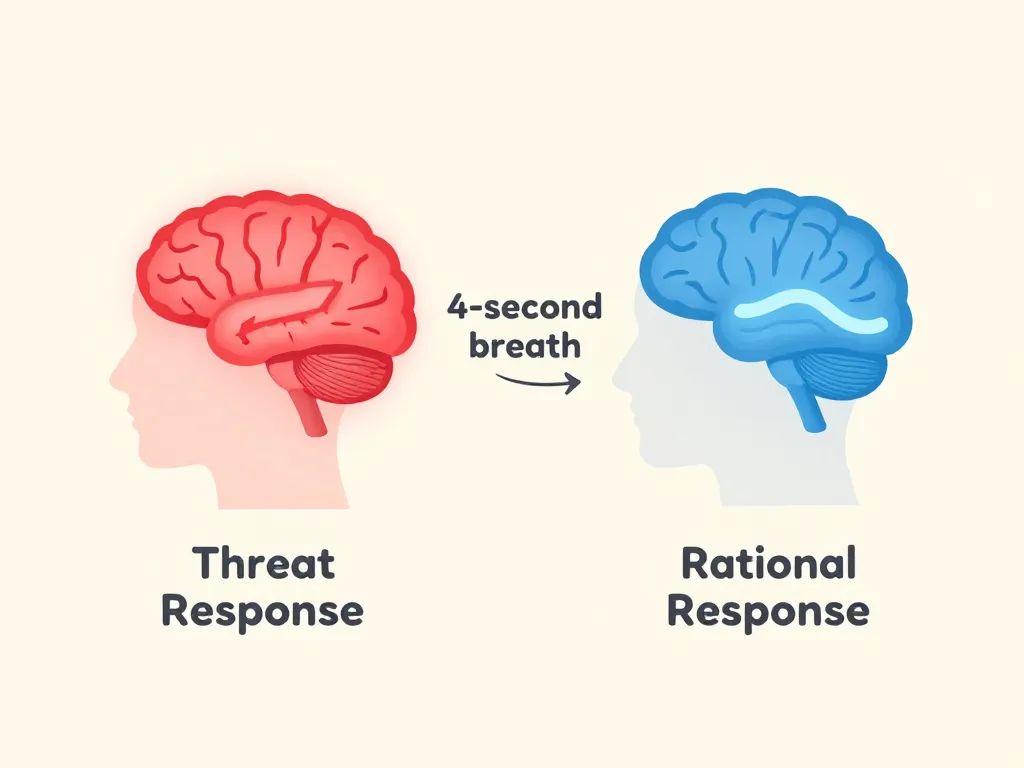
When you perceive a verbal attack, your amygdala — the brain's threat-detection center — fires before your prefrontal cortex (the rational, planning part) can weigh in. This is why you say things you regret. You're literally responding from a part of your brain that evolved to handle predators, not passive-aggressive comments about screen time.
The calm responses below are designed to buy your prefrontal cortex those critical extra seconds it needs to come online.
Response 1: The Strategic Pause (Breathe, Then Acknowledge)
What It Sounds Like
"Give me a moment. I want to respond to that thoughtfully."
Then: four seconds in through your nose, six seconds out through your mouth. One cycle.
Why It Works
MSU Extension's research on family conflict highlights deep breathing as the single most effective in-the-moment de-escalation tool available to parents. Slow exhalation activates your vagus nerve, which triggers your parasympathetic nervous system, which physically lowers your heart rate and cortisol levels.
By saying "give me a moment" out loud, you accomplish two things:
1. You signal to your co-parent that you're engaged, not ignoring them.
2. You create a social contract — a brief, acknowledged pause — that makes silence feel intentional rather than hostile.
When to Use It
Use it every time you feel heat rising, especially during in-person exchanges when your children are within earshot.
Real-World Example
Marcos described his co-parent frequently criticizing his parenting during pickups. His old pattern was to fire back with a list of her shortcomings. After practicing the strategic pause for two weeks, he reported: "The first few times, she looked confused when I just breathed and didn't snap back. By the third time, she actually lowered her voice. I didn't change her — I changed the pattern."
Response 2: The Reflect-and-Redirect
What It Sounds Like
"It sounds like you're concerned about [specific issue]. Can we set up a time to talk about that without the kids around?"
Why It Works
Active listening — specifically, reflecting back the content of what someone said — is one of the most well-documented de-escalation strategies in conflict resolution research. When people feel heard, their emotional intensity drops. You're not agreeing with the accusation. You're demonstrating that the words landed, which removes the other person's need to escalate to make them land.
The redirect to a future conversation removes the audience. Many co-parenting conflicts escalate because they happen in front of children, in doorways, in parking lots — settings with zero privacy and maximum pressure. Suggesting a dedicated time reframes the issue as solvable rather than urgent.
When to Use It
When your co-parent raises a legitimate (or semi-legitimate) concern but does it at the worst possible time or in the worst possible tone.

Real-World Example
Tanya's co-parent frequently said things like, "You clearly don't care about their homework" during school-night handoffs. Instead of defending herself, she started responding with: "It sounds like you're worried about how homework is going at my house. Let's talk Tuesday evening after they're in bed — I want to hear your concerns." The driveway arguments stopped.
Response 3: The Broken Record (Calm Repetition)
What It Sounds Like
"I understand you feel that way. I'm not going to discuss this right now."
Repeat as needed. Same tone. Same words.
Why It Works
Some provocations aren't invitations to problem-solve. They're invitations to fight. The broken record technique — repeating a neutral, boundary-setting phrase without variation — is effective because it refuses the invitation without creating new material for the conflict to feed on.
Every time you vary your response, you give your co-parent new words to react to, new openings to exploit. Repetition starves the conflict of fuel.
When to Use It
When your co-parent is venting, baiting, or bringing up old grievances that have no actionable solution in the current moment. This is especially useful in text-based exchanges where you might be tempted to write a paragraph-long defense.
Real-World Example
David's co-parent would send multi-paragraph texts rehashing their divorce. His old approach was to respond point-by-point, which led to hours-long text battles. He switched to a single response: "I understand you feel that way. I'd like to keep our texts focused on the kids' schedule." He sent the same message verbatim three times in one week. By the fourth exchange, the topic shifted to logistics.
Response 4: The Naming Move (Label Your Emotion Out Loud)
What It Sounds Like
"I'm feeling defensive right now, and I don't want to say something I'll regret. Let me come back to this."
Why It Works
Neuroscience research shows that putting a verbal label on an emotion reduces amygdala activation. When you say "I'm feeling defensive," you're performing an act of emotional regulation in real time — and modeling that regulation for your children if they're present.
This response also builds trust. When you admit you're struggling rather than pretending everything is fine (or lashing out), your co-parent gets information they can work with. Over time, this can shift a combative dynamic toward a more collaborative one.
When to Use It
When you catch yourself mid-activation — heart racing, thoughts spiraling — and you know you're about to say something reactive. This works best when you've built enough self-awareness to recognize your own escalation signals.

Real-World Example
Sarah found herself constantly triggered by her co-parent questioning her spending decisions related to the kids. During one phone call, instead of defending a purchase, she said: "I notice I'm getting defensive about this, and that's going to make this conversation worse. Can I call you back in an hour?" When she called back, calm, they resolved the issue in four minutes.
Response 5: The Clean Exit
What It Sounds Like
"This conversation isn't productive right now. I'm going to step away. We can revisit this [specific day/time]."
Then: leave. Hang up. Stop typing.
Why It Works
The calmest possible response is sometimes no further response at all. The clean exit isn't storming off — it's a deliberate, announced withdrawal with a specific return plan. The specificity matters. "We'll talk later" sounds like avoidance. "We can revisit this Thursday at 8 PM" sounds like a plan.
This technique protects children. Research consistently shows that children's stress responses are activated not by the existence of parental conflict but by their exposure to unresolved, hostile exchanges. Ending a deteriorating conversation is an act of parenting.
When to Use It
When the conversation has passed the point of return — voices are raised, the same accusations are cycling, or the kids are watching with wide eyes. Also effective in text exchanges that have devolved into rapid-fire messaging.
For co-parents who find that in-the-moment conversations consistently derail, AI-powered mediation platforms like Servanda can provide structure when emotions run high — helping you move difficult discussions into a written, asynchronous format where the clean exit is built into the process.
Real-World Example
Jamal's co-parent had a pattern of escalating during weekend handoffs, especially around holiday scheduling. He started using the clean exit with a specific callback time: "I can see we're both frustrated. I'll send you a message Tuesday with three options for Thanksgiving pickup, and we can go from there." Moving the negotiation away from the emotionally charged moment allowed both of them to engage more rationally.
How to Practice These Responses Before You Need Them
Knowing these scripts intellectually and deploying them under pressure are two very different things.
- Rehearse out loud. Say the phrases in your car, in the shower, while cooking. Your mouth needs muscle memory so the words come out even when your brain is flooded with cortisol.
- Identify your top three triggers. Write down the specific comments or behaviors that set you off. Then match each trigger to one of the five responses above. Having a pre-assigned response eliminates decision fatigue in the moment.
- Use a post-exchange debrief. After each interaction with your co-parent, spend two minutes writing down: (1) What triggered me, (2) How I responded, (3) What I'd do differently. This is about pattern recognition.
- Start with text-based exchanges. If face-to-face conversations are too activating right now, practice these techniques in text or email first, where you have built-in time to pause.
What About When Nothing Works?
Some co-parents aren't just pushing buttons — they're engaging in patterns of control, manipulation, or verbal abuse. The five responses above are designed for the normal friction of co-parenting with someone who triggers you. They are not a substitute for legal protection, therapeutic support, or safety planning if your co-parent's behavior crosses into abuse.
If you consistently feel unsafe, manipulated, or unable to function after interactions with your co-parent, reach out to a family law attorney or a licensed therapist who specializes in high-conflict co-parenting.
Frequently Asked Questions
What do you say when your co-parent is trying to provoke you?
The most effective response is the one that doesn't give the provocation anywhere to go. Try: "I understand you feel that way. I'm not going to discuss this right now." Delivered calmly and repeated without variation, this deprives the provocation of the reaction it needs to escalate. The key is committing to the same words every time rather than crafting a new defense.
How do I stop getting angry at my co-parent?
You probably won't. The goal isn't to eliminate anger; it's to create a gap between feeling the anger and acting on it. Deep breathing (four seconds in, six seconds out) physiologically reduces your stress response within a single breath cycle. Combine this with labeling the emotion — "I'm angry right now" — and you give your rational brain enough time to choose a response rather than react from instinct.
Is it okay to walk away from a co-parenting argument?
Yes, as long as you do it with clarity and a plan. Silently walking away can feel like stonewalling and often escalates conflict. Instead, announce your exit and provide a specific time to revisit the conversation: "This isn't productive right now. Let's talk about this Thursday evening."
First, limit the channels. Move as much communication as possible to writing — text, email, or a co-parenting app — where you have time to pause before responding. Second, pre-assign your responses: identify their three most common provocations and decide in advance which calm response you'll use for each one. When you've already made the decision, you don't have to make it under pressure.
How do I keep my kids from seeing me upset at their other parent?
Children are perceptive. But what matters more than hiding every emotion is modeling healthy regulation. If your child sees you take a breath, calmly say "I need a moment," and re-engage with composure, they're learning something invaluable — that big feelings can be managed without explosions.
Moving Forward, One Response at a Time
You don't need to master all five responses by next week. Pick one — the one that feels most natural or most needed — and commit to using it in your next three interactions with your co-parent.
Calm responses aren't about being passive. They're about being strategic. Every time you choose a measured reply over a reactive one, you're doing three things: protecting your children from the fallout of adult conflict, preserving your own mental health, and slowly shifting the dynamic between you and your co-parent.
The driveway will still be tense. The comments will still sting. But you'll have words ready.