5 Ways to Resolve Co-Parenting Disputes Calmly
It's 6:47 p.m. on a Wednesday. You're standing in the driveway during pickup, and your co-parent just said something about the kids' bedtime that made your jaw tighten. You can feel the argument building — the familiar rise in your chest, the urge to fire back. Your seven-year-old is watching from the back seat.
This moment is where most co-parenting conflicts either escalate or get resolved. The difference almost never comes down to who's "right." It comes down to whether you have practical, in-the-moment techniques to manage what's happening in your body and your brain before the conversation spirals.
Below are five specific, research-backed strategies you can use today.
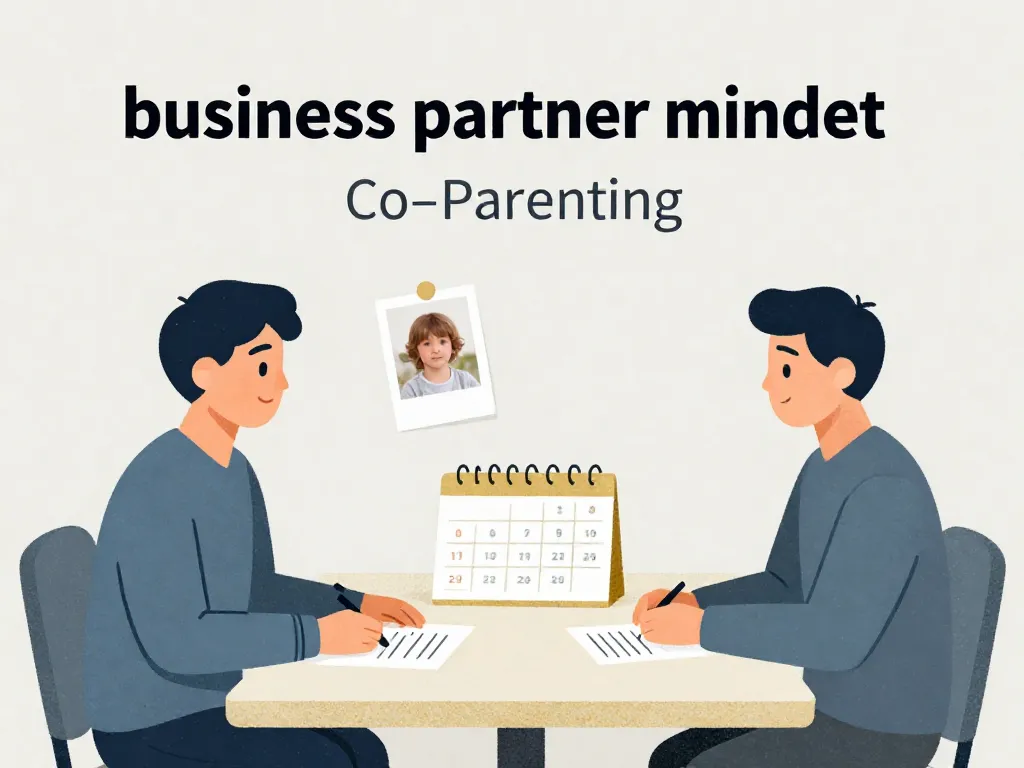
1. Adopt the Business Partner Mindset
Treat your co-parenting relationship like a business partnership. Your "business" is raising a healthy, secure child. Every interaction is a business meeting.
This creates a mental boundary between your parenting partnership and whatever emotional history exists between you and your co-parent.
What This Looks Like in Practice
- Before a conversation, ask yourself: Would I say this to a colleague? If the answer is no, rephrase.
- During a disagreement, stick to the agenda. If you're discussing holiday schedules, don't bring up who forgot the school permission slip last month.
- In written communication, use what family mediators call the "BIFF" method — keep messages Brief, Informative, Friendly, and Firm.
A Real Example
A mother we'll call Dana used to start custody exchange texts with "As usual, you..." — a phrase that immediately put her co-parent on the defensive. When she shifted to the business partner mindset, her texts started looking like this:
"Hi — just confirming Saturday pickup at 10 a.m. She'll need her soccer bag. Let me know if that time still works."
No accusations. No subtext. Just information. Her co-parent started responding in kind within two weeks.
Why It Works
Dr. Philip Stahl, a child custody researcher, has documented that children's adjustment after separation is most strongly predicted not by the family structure itself, but by the level of conflict between co-parents. When you reduce the emotional temperature of your interactions, you directly reduce the stress your child absorbs.
2. Use the 10-Second Pause Rule
Most co-parenting escalation happens in the first five seconds after a trigger. Your amygdala — the brain's threat-detection center — hijacks your response before your prefrontal cortex (the rational, problem-solving part) can catch up.
The fix is deceptively simple: pause for 10 seconds before responding.
How to Build the Pause Habit
- Recognize your physical cues. For some people, it's a tightening in the chest. For others, it's heat in the face or a clenched jaw. Identify yours.
- When you feel it, count to 10. Not in your head while composing your response — actually stop and count.
- During those 10 seconds, take two slow breaths. Diaphragmatic breathing activates your parasympathetic nervous system, which counteracts the fight-or-flight response.
- Then respond to the content, not the tone. If your co-parent said something dismissive, respond to the logistical issue underneath the dismissiveness.
For Text-Based Disputes
- Don't respond to non-urgent messages for at least 30 minutes. Draft your response, then re-read it after a break.
- Read the message as if a stranger wrote it. Research on text communication shows we project negative tone onto neutral messages, especially from people we have conflict histories with.
- Delete the first draft. The first version of your reply is almost always for your emotional relief, not for problem-solving.
3. Practice Reflective Listening — Not Just "Hearing"
The technique that de-escalates co-parenting disputes in real time is reflective listening — naming your co-parent's concern back to them before you state your own position.
"It sounds like you're concerned about [their concern]. Is that right?"
This does three critical things:
- It forces you to understand their position — which you may have distorted through your own emotional filter.
- It makes your co-parent feel heard — which reduces their defensiveness by up to 40%, according to conflict resolution research from the Gottman Institute.
- It slows the conversation down — which prevents the rapid-fire escalation pattern that most co-parenting arguments follow.
What This Sounds Like
Instead of:
"You always do this. You can't just change the schedule whenever you want."
Try:
"It sounds like something came up and you need to adjust Saturday's plan. Let me understand what you're thinking before we figure this out."
You haven't agreed to anything. You haven't given up your position. You've slowed the exchange enough to have a productive conversation instead of a reactive one.
When Your Co-Parent Isn't Doing This Back
Reflective listening works even when only one person does it. Dr. John Gottman's research shows that one partner de-escalating is often enough to shift the entire dynamic of a conversation. You're doing it to protect the conversation from spiraling in front of your child.

4. Shift From Positions to Interests
A position is what you want. An interest is why you want it.
Most co-parenting arguments get stuck at the position level:
- "I want pickup at 5 p.m." vs. "I want pickup at 7 p.m."
- "She should do homework at my house" vs. "She should do homework at your house."
When you dig into the interests behind these positions, you often discover there's a solution that satisfies both.
A Worked Example
The argument: Marcus wants to pick up his daughter at 5 p.m. on Fridays. His co-parent, Tara, insists on 7 p.m.
The positions: 5 p.m. vs. 7 p.m. (no obvious middle ground — 6 p.m. satisfies neither).
The interests (uncovered through reflective listening):
- Marcus wants 5 p.m. because he plans a weekly Friday dinner tradition with his daughter and his parents, who eat early.
- Tara wants 7 p.m. because Friday is her daughter's art class, which ends at 6:15 p.m., and she doesn't want her to miss it.
The solution: Pickup at 6:30 p.m. — after art class, still in time for a slightly later dinner with grandparents. Neither person's original position "won," but both interests were fully met.
How to Uncover Interests
Ask:
- "Help me understand why that timing matters to you."
- "What are you trying to make sure happens for [child's name]?"
- "If we could find another way to meet that need, would you be open to it?"
The single biggest source of repeat co-parenting conflict is the "I never agreed to that" problem. Two co-parents have a conversation, reach what one of them believes is an agreement, and then remember it differently two weeks later.
Document every agreement in writing, within 24 hours, in a shared format.
What to Include in a Written Agreement
- The specific decision (not vague language like "we'll be flexible")
- Who is responsible for what
- The timeline or dates involved
- What happens if circumstances change (a contingency plan)
Example
Vague (will cause future conflict):
"We agreed to split holidays."
Specific (prevents future conflict):
"For 2025, Mom has Thanksgiving (Wed 5 p.m. through Fri 5 p.m.) and Dad has Christmas (Dec 24 at 10 a.m. through Dec 26 at 10 a.m.). We'll alternate each year. If either parent needs to travel, they'll notify the other by October 1."
AI-powered mediation platforms like Servanda can provide structure when emotions run high, helping co-parents turn verbal agreements into clear, written documents that both parties can reference — removing ambiguity before it becomes the next argument.
Written agreements between co-parents shouldn't read like legal threats. They should read like shared project plans. The goal is to create shared clarity so neither person has to rely on memory or interpretation.
Bringing It All Together: A Framework for Your Next Dispute
These five strategies work best as a sequence:
- Start with the business partner mindset — set the emotional tone before the conversation begins.
- Pause for 10 seconds when you feel triggered — let your rational brain catch up.
- Use reflective listening — make sure you understand what your co-parent actually wants before you respond.
- Dig into interests, not positions — find the why behind the what.
- Write it down — lock in agreements so they don't unravel.
Child psychology research consistently shows that one calm parent is enough to protect a child from the effects of co-parenting conflict.
Frequently Asked Questions
How do you resolve co-parenting disputes when the other parent won't cooperate?
Focus on what you can control: your own responses, your documentation, and your consistency. Research from Dr. Robert Emery at the University of Virginia shows that when one co-parent consistently de-escalates, the overall conflict level tends to decrease over time — even when the other parent is initially combative. If cooperation remains impossible, consider parallel parenting, where you minimize direct contact and communicate only through written channels.
What's the difference between co-parenting and parallel parenting?
Co-parenting involves shared decision-making and regular communication between both parents. Parallel parenting is a lower-contact model where each parent makes day-to-day decisions independently during their parenting time, and communication is limited to essential logistics (usually in writing). Parallel parenting is often recommended by family therapists when direct communication consistently leads to high conflict.
How do co-parenting disputes affect children's mental health?
Extensive research, including longitudinal studies by Dr. E. Mark Cummings, shows that exposure to inter-parental conflict — not divorce or separation itself — is the primary predictor of emotional and behavioral problems in children. Children who witness frequent, intense, or unresolved conflict between co-parents are at higher risk for anxiety, depression, and difficulty regulating their own emotions. Resolving disputes calmly and away from children significantly reduces these risks.
Yes, especially for recurring disputes or major decisions (schooling, medical care, relocation). A trained mediator helps both parents move from positions to interests and reach agreements that feel fair. Mediation is also significantly less expensive and less adversarial than litigation. Many co-parents find that even a single mediation session gives them tools they use for years.
What should I do if I lose my temper during a co-parenting argument?
First, stop the conversation. Say something like, "I need to take a break and come back to this when I'm calmer." Then follow through — revisit the issue within 24-48 hours so it doesn't become an avoidance pattern. If you lost your temper in front of your child, briefly acknowledge it: "I got upset earlier, and I'm sorry you saw that. Grown-ups sometimes have big feelings too, and I'm working on handling them better." This models emotional accountability, which is one of the most valuable things a parent can teach.