5 Ways to Pause Before Reacting to Your Co-Parent
It's 9:47 PM on a Tuesday. You're finally sitting down after bedtime routines, and your phone buzzes. It's a message from your co-parent — something about changing next weekend's schedule again — and you can feel the heat rising in your chest before you've even finished reading. Your thumbs are already hovering over the keyboard, ready to fire back.
The seconds between reading a message and hitting send are the most powerful seconds in your entire co-parenting relationship. What you do in that gap determines whether a disagreement stays small or spirals into a week-long standoff that your kids can feel even when no one says a word.
Research in family psychology shows that high-conflict co-parenting exchanges increase cortisol levels in children — even when those exchanges happen entirely over text and the children never see them directly. Kids are remarkably attuned to the tension between their parents.
Every angry reply you send becomes evidence — not just emotionally, but sometimes legally. Custody evaluators, mediators, and family court judges regularly review text messages and emails. A single heated exchange can undermine months of cooperative behavior.
Breaking this cycle doesn't require you to become a zen master. It requires a pause — and a plan for what to do inside that pause.
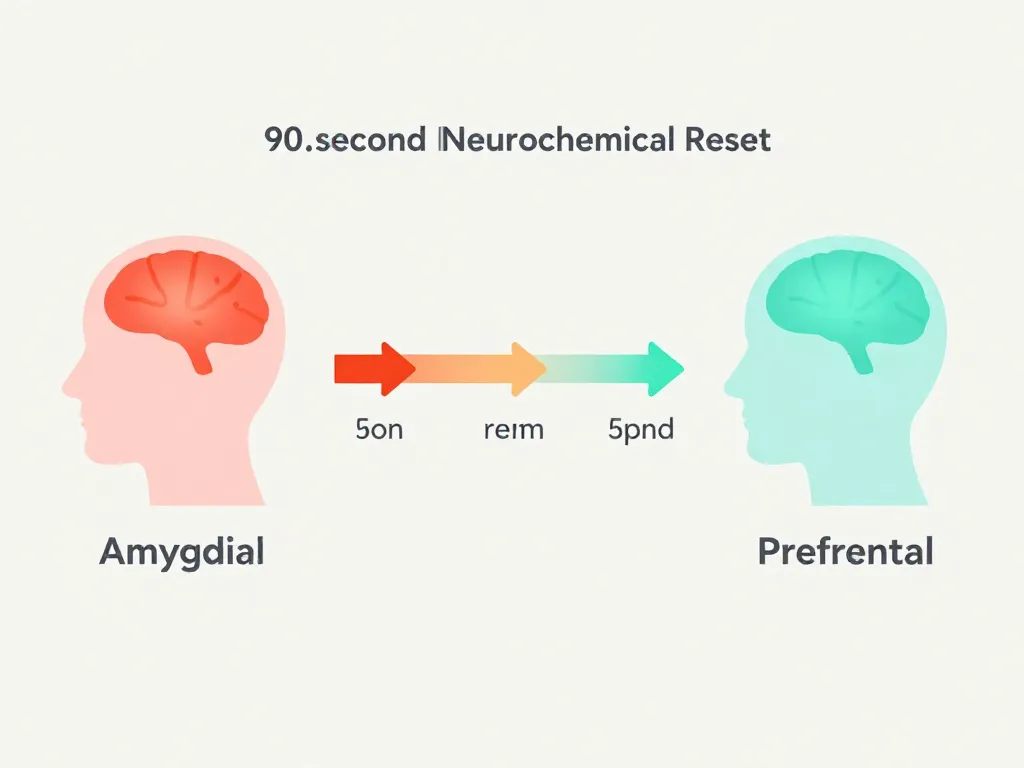
1. Use the 90-Second Neurochemical Reset
When you experience a strong emotional trigger, the resulting chemical process in your brain — the flood of adrenaline and cortisol — runs its course in approximately 90 seconds. The only reason anger lasts longer than 90 seconds is that we re-stimulate it — by re-reading the message, by mentally composing our argument, by rehearsing the injustice.
How to apply this tonight:
- When you feel the surge, put your phone face-down on a surface. Physically release it.
- Set a timer for 90 seconds.
- During those 90 seconds, do one purely physical thing: walk to another room, splash cold water on your wrists, or step outside and feel the air temperature on your skin.
- When the timer goes off, check in: Is my heart rate still elevated? Am I still clenching? If yes, reset for another 90 seconds.
This gives your prefrontal cortex — the part of your brain responsible for rational decision-making — time to come back online after your amygdala hijacked it.

2. Keep Scripted Placeholder Responses Ready
Many co-parenting guides tell you to "just don't respond." In practice, silence escalates conflict. Your co-parent interprets your silence as stonewalling, passive-aggression, or disrespect. Then they send a follow-up. And another.
The solution is a placeholder response that acknowledges receipt without engaging with the emotional content.
Sample scripted responses:
- "Got it. Let me think this through and get back to you by [specific time]."
- "I want to give this a thoughtful response. I'll follow up tomorrow morning."
- "I've read your message. I need some time before I respond."
These are respectful, brief, and commit to a timeline. They don't agree or disagree. They don't address tone. They simply buy you the space you need.
Marcus, a father of two, sent "Got it — I'll look at the calendar and respond by 9 AM tomorrow" when his co-parent requested schedule changes on Friday evenings. He reports that roughly 40% of the time, his co-parent sends a more reasonable follow-up before he even needs to respond.
3. Build a Physical Anchor to Interrupt the Reaction Loop
A physical anchor is a deliberate sensory action you pair with the intention to pause. Over time, the physical action itself becomes a trigger for calm — the same way a deep breath before a free throw becomes automatic for a basketball player.
Choose one and practice it outside of conflict first:
- The thumb press: Press your thumb firmly into the center of your opposite palm for five seconds. Focus on the pressure.
- The cold splash: Run cold water over your wrists for 10 seconds. The temperature change activates your dive reflex and slows your heart rate.
- The 5-4-3-2-1 grounding: Name one thing you can see, one you can hear, and one you can feel. Takes about eight seconds.
Practice your chosen anchor two to three times a day for a week. When a triggering message arrives, your body already knows what to do.
4. Create a "Decision Tree" for Triggering Messages
Not every message needs the same response. A decision tree helps you quickly categorize incoming messages so you know which ones need an immediate response and which ones can wait.
Decision tree for co-parent messages:
Step 1: Is this about immediate safety?
- Yes → Respond now (call if necessary).
- No → Move to Step 2.
Step 2: Is a decision needed in the next 2 hours?
- Yes → Use a placeholder response, then respond within the timeframe.
- No → Move to Step 3.
Step 3: Am I emotionally activated right now?
- Yes → Use your 90-second reset + physical anchor, then draft a response without sending it.
- No → Respond thoughtfully.
Step 4: Before sending, ask yourself:
"Would I be comfortable if a judge or mediator read this?"
This framework takes the decision out of the emotional moment and puts it into a logical structure you've already agreed to follow. Tools like Servanda can provide additional structure by helping co-parents create written agreements and structured communication frameworks that reduce the number of triggering messages in the first place.
5. Draft, Wait, Revise — The "DWR" Method
Telling yourself "don't send that angry message" fights against your brain's need for completion. The DWR method works with your psychology instead of against it.
The three steps:
- Draft: Write exactly what you want to say. Don't hold back. Write it in your notes app — never in the actual messaging thread.
- Wait: Close the app. Set a specific time to come back — one hour minimum, overnight if possible.
- Revise: Re-read your draft with this filter: Keep only the parts that are about logistics, the children's needs, or a specific request. Delete everything else.
Example:
The draft:
"You always do this. You change plans whenever it's convenient for you and never think about how it affects the kids or me. I'm so tired of being the flexible one while you do whatever you want."
After waiting and revising:
"The schedule change on the 15th doesn't work because the kids have soccer practice. Can we keep the original plan, or would switching to the 16th work for you?"
You still get the catharsis of writing the first version. You just don't send it.
Putting It All Together: Your Pause-Before-Reacting Plan
The most effective approach combines several of these strategies:
- Triggering message arrives → Phone goes face-down.
- 90-second reset → Step away, cold water on wrists.
- Physical anchor → Thumb press while taking three deep breaths.
- Decision tree → Categorize the message's actual urgency.
- Placeholder response → "Got it — I'll respond by tomorrow morning."
- DWR method → Draft your real feelings in notes, wait, revise.
- Send the revised version → Logistics only, respectful tone.
Will you follow every step perfectly every time? No. You're human. But even catching yourself at step one — putting the phone down — changes the trajectory of the entire conversation.
Frequently Asked Questions
Unless it involves the immediate safety of your children, you are not obligated to respond instantly. A placeholder response like "I need time to think about this — I'll get back to you by [time]" is a complete, respectful answer. A thoughtful delayed response is always preferable to an impulsive immediate one.
Does pausing before reacting mean I'm letting my co-parent "win"?
Pausing isn't surrendering — it's strategy. Reacting in anger weakens your position, whether in day-to-day communication or in a legal context. The co-parent who consistently responds with calm, clear, solution-focused messages builds credibility with mediators, therapists, and judges over time.
How do I pause when my co-parent is being deliberately provocative?
Provocative messages are designed to bypass your pause. That's exactly why pre-planned strategies matter — you've already decided how you'll respond before the provocation arrives. Treat a provocative message like a fire alarm pulled as a prank: acknowledge it, verify there's no actual emergency, and don't evacuate the building.
Can these strategies work for in-person co-parenting exchanges?
Absolutely. The 90-second reset and physical anchors are especially useful during pickups and drop-offs. If your co-parent raises a contentious topic in person, use a verbal placeholder: "That's worth discussing — can we handle it over email this week?" This moves the conversation to a medium where you have more control over your response time.
How long does it take for these techniques to become habit?
Most behavioral research suggests that consistent practice over 3-6 weeks begins to create automatic patterns. You'll likely notice a difference within the first week, not because the techniques are perfect yet, but because the simple awareness that you have a plan changes your relationship with triggering moments.
You didn't develop your current reaction patterns overnight, and you won't replace them overnight either. But you don't have to overhaul everything at once. Pick one strategy from this list — just one — and commit to it for the next week. Maybe it's the placeholder responses. Maybe it's the 90-second reset. Maybe it's moving your angry drafts to the notes app.
The next time your phone buzzes with a message that makes your chest tighten, you'll have something to do besides react. In that small pause — those few seconds of choosing a different path — you're not just protecting yourself from a bad exchange. You're modeling something for your children that they'll carry into their own relationships for the rest of their lives.
Start with the pause. Everything else gets easier from there.