
65% of Startups Die From Cofounder Conflict: Why
You didn't quit your job, drain your savings, and work eighty-hour weeks just to watch your startup implode because you and your cofounder couldn't agree on who makes the final call on hiring. But that's exactly how it happens — not with a dramatic blowout, but with a slow accumulation of resentment over roles, equity, vision, and a hundred small decisions nobody thought to talk about in the early days.
Harvard Business School professor Noam Wasserman studied over 10,000 founders and found that 65% of high-potential startups fail due to conflict within the founding team. Not because the product was wrong. Not because the market disappeared. Because the people at the center couldn't hold it together. Cofounder conflict is the leading cause of startup death, and almost nobody sees it coming — because they're too busy worrying about product-market fit, fundraising, and growth metrics.
This article unpacks exactly why cofounder relationships fracture, drawing on Wasserman's research and real stories from the startup graveyard.
Key Takeaways
- The #1 startup killer isn't market risk — it's cofounder conflict. Wasserman's research shows 65% of startup failures trace back to founding team breakdowns, not product or market problems.
- Most cofounder disputes stem from just five root causes: unequal expectations around roles, equity splits made too early or too casually, diverging visions for the company, imbalanced workloads, and money disagreements.
- The "honeymoon phase" is the most dangerous period. Cofounders avoid hard conversations early because things feel good — and by the time they don't, resentment is already baked in.
- Written agreements created before conflict arises are exponentially more effective than trying to negotiate when emotions are already high.
- Conflict itself isn't the problem — the absence of a framework for resolving it is. Startups that survive cofounder tension almost always have explicit decision-making protocols.
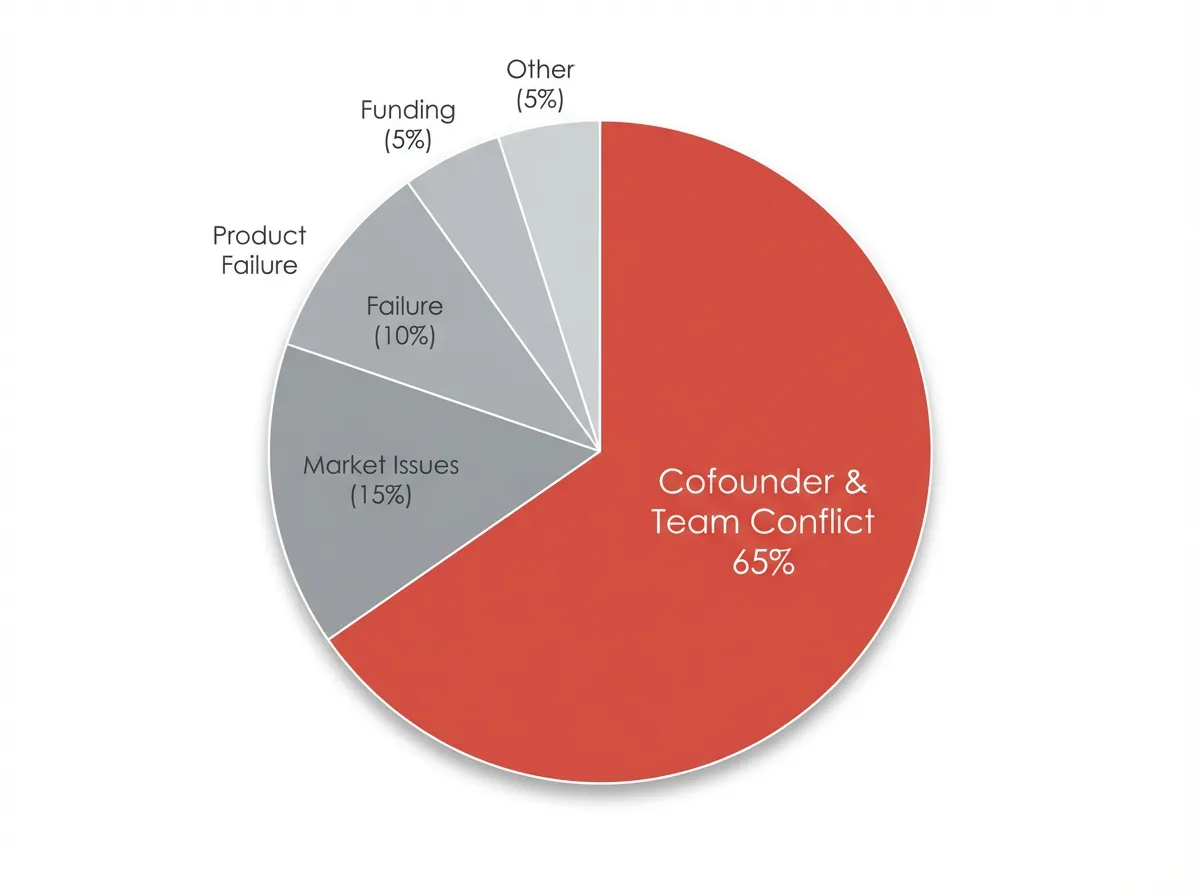
The Statistic Nobody Takes Personally
Every cofounder has heard some version of the "most startups fail" warning. But most interpret it as a cautionary tale about other people. The market will be tough, sure. Fundraising will be brutal, absolutely. But our relationship? We're best friends. We finish each other's sentences. We've been through hard things before.
This is exactly the blind spot Wasserman identified. In his book The Founder's Dilemmas, he writes that founding teams routinely overestimate their alignment and underestimate the structural forces that will pull them apart. The 65% statistic isn't about bad people or toxic personalities. It's about good people who never built the scaffolding to survive disagreement.
Let's look at what actually goes wrong.
The Five Root Causes of Cofounder Breakups
1. The Role Ambiguity Trap
In the earliest days, everyone does everything. That feels scrappy and egalitarian. But "everyone does everything" quietly becomes "nobody owns anything," and then — inevitably — "why are you making that decision without me?"
Real example: Two technical cofounders launched a SaaS product together in 2019. Both had engineering backgrounds. Neither explicitly took ownership of product direction versus technical architecture. For the first year, they debated every feature as equals. By year two, one cofounder had started making product decisions unilaterally — not out of malice, but because someone had to. The other felt sidelined. They spent six months arguing about process instead of building. The company ran out of runway.
The pattern is remarkably consistent: ambiguity feels generous in the beginning and suffocating later.
What this looks like in practice: - Both cofounders showing up to the same meetings, unclear on who has final say - Decisions getting revisited repeatedly because ownership was never assigned - One cofounder quietly taking on a leadership role, the other feeling demoted without ever being told
2. The Equity Time Bomb
Equity conversations are among the most avoided discussions in startup history. Cofounders split equity on a napkin during the excitement of day one, before anyone knows who will contribute what, who will sacrifice more, or what the company will even look like in eighteen months.
Wasserman's research found that teams who split equity within the first month were far more likely to face conflict later than those who waited and negotiated deliberately. The reason is simple: a 50/50 split feels fair when you're both equally excited. It stops feeling fair when one cofounder is working nights and weekends while the other has gradually become a part-time contributor.
Real example: A consumer app startup split equity 50/50 between a technical cofounder and a business-oriented cofounder. Within a year, the technical cofounder had built the entire product. The business cofounder had secured some early press but hadn't closed a single partnership. Neither had discussed performance benchmarks or vesting milestones beyond the standard four-year cliff. The technical cofounder grew resentful. Rather than renegotiate — which felt impossible without blowing up the relationship — she simply left. The startup dissolved within three months.

3. Vision Drift
You started with the same dream. Then reality happened.
One cofounder wants to bootstrap; the other wants to raise a Series A. One wants to stay focused on a niche; the other sees a platform play. One is building to sell in five years; the other wants to build a generational company.
These divergences don't appear on day one. They emerge gradually — through offhand comments, different reactions to investor meetings, conflicting priorities on the product roadmap. By the time they surface explicitly, both cofounders have been silently building toward different futures for months.
Real example: The founders of a well-known food delivery startup in Southeast Asia publicly split after one cofounder pushed for aggressive expansion into new markets while the other wanted to perfect operations in their home city. The disagreement wasn't about ambition — both were ambitious. It was about sequencing and risk tolerance. Without a shared framework for making that kind of strategic decision, the disagreement became personal. One cofounder accused the other of lacking vision. The other accused the first of recklessness. Both were right. Both were wrong. The company stalled.
Vision drift is especially dangerous because it masquerades as strategic disagreement. It feels like a business problem. But underneath, it's an alignment problem between two people who never stress-tested their assumptions about the future.
4. The Workload Imbalance Resentment Spiral
This is the most emotionally charged cause of cofounder conflict, because it's deeply personal. When one cofounder feels they're carrying the company while the other coasts, every interaction becomes charged.
The tricky part: workload imbalance is often perceptual. The cofounder handling fundraising might feel like they're doing the hardest work, while the cofounder building the product feels the same way about their own contribution. Neither is wrong — but without explicit conversations about expectations, contributions, and accountability, perception hardens into resentment.
Common triggers: - One cofounder has a family and can't work weekends; the other is single and expects equal hours - One cofounder's work is visible (sales, fundraising); the other's is invisible (infrastructure, operations) - Life circumstances change — a health crisis, a new child, a personal loss — and there's no agreement on how to adjust
5. Money: Salary, Spending, and Financial Stress
Startups are financially stressful by definition. Add two (or more) people with different financial situations, risk tolerances, and spending philosophies, and you have a recipe for conflict.
Real example: Two cofounders agreed to take no salary for the first year. One had significant savings and a partner with a stable income. The other was burning through a modest emergency fund. By month eight, the second cofounder was under severe financial stress and needed a salary — even a small one. The first cofounder saw this as a lack of commitment. The conversation about compensation turned into a conversation about dedication, which turned into a conversation about equity, which turned into a conversation about whether they should even be doing this together. They weren't.
Financial stress doesn't just strain the relationship. It changes how people think. A cofounder under financial pressure will make different strategic decisions — more conservative, more short-term — than one with a comfortable cushion. Neither perspective is wrong, but the divergence creates friction.

Why These Conflicts Go Unresolved
If these problems are so predictable, why don't cofounders address them proactively? Three reasons:
1. The friendship fallacy. Many cofounders are friends first. They believe their personal relationship will carry them through business disagreements. But business partnerships operate under fundamentally different pressures than friendships. Friendship is built on unconditional acceptance; business requires accountability, negotiation, and sometimes uncomfortable honesty.
2. The urgency trap. There's always something more pressing — a product launch, a funding deadline, a customer crisis. Having a structured conversation about roles, equity, or decision-making authority feels abstract and deferrable. Until it doesn't.
3. The conflict-aversion paradox. The cofounders most likely to avoid difficult conversations are often the same ones who'll face the most destructive conflicts later. Avoiding small, manageable disagreements early allows pressure to build until the inevitable blowup is catastrophic.
What Surviving Startups Do Differently
The 35% of startups that survive cofounder tension aren't lucky. They're structured. Here's what they tend to have in common:
They Write Things Down Early
Not because they distrust each other — because they respect the relationship enough to protect it. Written cofounder agreements that cover roles, equity, vesting, decision-making authority, exit scenarios, and conflict resolution processes are not a sign of paranoia. They're a sign of maturity.
Tools like Servanda help cofounders create these written agreements before tensions arise, using structured frameworks that surface the conversations most teams avoid.
They Assign Decision-Making Authority Explicitly
Not everything needs consensus. Healthy founding teams define clear domains: one cofounder owns product, another owns go-to-market, another owns engineering. Within those domains, the owner has final say. Cross-domain decisions have a defined escalation process.
They Schedule Regular "State of Us" Conversations
Not just board meetings or sprint reviews — dedicated time to talk about the relationship. What's working? What's not? Where are you feeling frustrated? What do you need from me that you're not getting?
This feels awkward exactly once. Then it becomes the most important hour of your month.
They Agree on Vesting and Equity Adjustments
Smart founding teams build in mechanisms for equity adjustment based on actual contribution, not just initial negotiation. Dynamic equity models (like Slicing Pie or milestone-based vesting) provide a framework for ensuring equity reflects reality over time.
They Define the Breakup Before It Happens
Prenups aren't romantic. They're also not supposed to be. The best cofounder agreements include explicit buy-sell provisions, deadlock resolution mechanisms, and clear processes for what happens if one person leaves. Discussing this on day one — when everyone is aligned and goodwill is high — is a thousand times easier than negotiating it during a crisis.
The Cost of Getting This Wrong
When cofounder conflict destroys a startup, the damage extends far beyond the business:
- Employees lose their jobs — often with minimal warning, because the founding team was too consumed by internal conflict to plan for the fallout
- Investors lose their money — and their trust, making it harder for both cofounders to raise again
- Friendships end — sometimes permanently, with years of mutual resentment replacing years of shared history
- Mental health suffers — cofounder breakups are routinely described as more emotionally devastating than divorce, because they involve the simultaneous loss of a relationship, an identity, and a livelihood
The 65% statistic isn't just a number. It represents hundreds of thousands of real companies, real people, and real consequences.
Frequently Asked Questions
What is the #1 reason cofounders break up?
According to Noam Wasserman's research, role ambiguity and disputes over decision-making authority are the most common triggers for cofounder conflict. Equity disagreements are a close second. In most cases, the root cause isn't a single event but an accumulation of unaddressed tensions over months or years.
How do you prevent cofounder conflict before it starts?
The most effective prevention is having explicit, written agreements about roles, equity, vesting, decision-making authority, and exit scenarios — created before any conflict exists. Regular check-in conversations about the health of the relationship (not just the business) also help surface issues before they become crises.
Is it normal for cofounders to fight?
Absolutely. Disagreement is a sign that both cofounders care and are thinking critically. The difference between healthy and destructive conflict is whether there's a framework for resolving it. Startups that survive cofounder disagreements almost always have explicit processes for making decisions when consensus isn't possible.
Should cofounders split equity 50/50?
Not automatically. While equal splits feel fair in the beginning, Wasserman's research suggests they often create problems later. The best approach is to wait until roles, contributions, and commitments are clearer — usually at least a few weeks into working together — and to include vesting schedules and mechanisms for adjustment based on actual contribution.
When should cofounders consider mediation?
Earlier than you think. If you've had the same disagreement more than twice without resolution, if conversations about the business consistently turn personal, or if one cofounder is avoiding the other — these are signs that a neutral third party could help before the conflict becomes irreparable.
Moving Forward
The 65% statistic is sobering, but it's not destiny. Cofounder conflict destroys startups not because disagreement is inevitable — it is — but because most founding teams never build the infrastructure to survive it. They assume alignment will persist. They defer hard conversations. They treat their partnership as inherently resilient without doing the work to make it so.
The cofounders who beat the odds aren't the ones who never fight. They're the ones who decided, early and deliberately, how they would fight — and what they would do when the fight got hard. They wrote things down. They defined roles. They talked about money and equity when it was uncomfortable but not yet urgent.
You can do this. The conversation you're avoiding right now? It's the one that might save your company. Start it today.