
How to Split With Your Cofounder Without Killing the Startup
You co-founded a company with someone you trusted deeply. You finished each other's product roadmap sentences. You split ramen costs and equity in the same week. And now, eighteen months later, you sit across from each other in a conference room knowing it's over — but terrified that saying it out loud will kill everything you've built together.
Here's the truth most founders learn too late: the cofounder breakup doesn't kill startups. The avoidance of the cofounder breakup does. When misaligned founders stay locked together out of guilt, fear, or inertia, they slowly poison the culture, stall decision-making, and drain the company of momentum. A clean, intentional split — handled with professionalism and a real plan — can actually be the thing that saves your startup.
This article is a tactical playbook for getting through a cofounder breakup without destroying the company, the cap table, or your reputations.
Key Takeaways
- A cofounder breakup doesn't have to mean the end of the startup. Many successful companies — including Twitter, Plaid, and Zipcar — survived major founder departures.
- Start with a private, honest conversation before involving lawyers, investors, or the team. Aligning on the why first prevents adversarial negotiations later.
- Equity treatment is the single highest-stakes decision. Use vesting cliffs, buyback agreements, or accelerated vesting to find a structure that's fair to both sides.
- Communicate the transition to investors and employees with a unified narrative. Surprises erode trust; a calm, planned announcement preserves it.
- Formalize everything in writing — even (especially) the parts that feel obvious. Verbal agreements between departing cofounders are a lawsuit waiting to happen.

Step 1: Have the Honest Conversation First
Before you talk to your lawyer, your lead investor, or your team, talk to your cofounder. Not about logistics — about reality.
This conversation is the foundation for everything that follows. If it goes sideways, every subsequent negotiation becomes adversarial. If it goes well, you can navigate the rest like adults.
What to cover in the first conversation
- Acknowledge what's happening. Name it plainly: "I don't think this partnership is working anymore." Avoid blame. Avoid relitigating old arguments.
- Separate the person from the problem. You may genuinely like your cofounder. You may also be fundamentally misaligned on vision, work ethic, or role expectations. Both things can be true.
- Express what you each want. Does the departing founder want a clean exit? Do they want to stay involved in an advisory capacity? Do they want to keep their equity? Getting these preferences on the table early prevents weeks of guessing.
One founder I spoke with — let's call her Priya — described the moment she told her cofounder she wanted to part ways: "I'd been rehearsing this devastating speech in my head for weeks. And when I finally said it, he looked relieved. He'd been feeling the same thing for months. The hardest part wasn't the conversation. It was the six months of silence before it."
Don't wait six months.
Step 2: Decide Who's Staying and Who's Leaving
This sounds obvious, but it's often the most emotionally charged part. In some cases, both founders want to keep running the company. In others, neither does, and the breakup is really a wind-down conversation.
Most commonly, one founder stays and one goes. Here's how to figure out who:
Ask these questions honestly
- Who does the team follow? Not who has the title — who does the team actually look to for direction?
- Who has the domain expertise the company needs right now? A technical cofounder may be indispensable during the build phase but less critical during a sales-heavy growth phase, or vice versa.
- Who has the investor relationships? This matters more than founders like to admit.
- Who actually wants to keep going? Sometimes the answer is clear when you ask directly.
If you can't agree, consider bringing in a neutral third party — a mutual mentor, a board member, or an advisor — to help facilitate the decision. AI-powered mediation platforms like Servanda can also provide structure when emotions run high and you need to document agreements in real time.

Step 3: Handle the Equity — This Is Where Startups Die
Equity is where cofounder breakups become cofounder wars. A departing founder who keeps a massive equity stake without contributing to the company creates resentment, complicates future fundraising, and demoralizes the remaining team. A departing founder who gets stripped of all equity feels cheated and may become litigious.
You need a middle path, and it needs to be specific.
Option A: Let vesting do its job
If you set up a proper vesting schedule with a cliff (you did set up vesting, right?), the simplest approach is to let the departing founder walk away with their vested shares and forfeit the unvested portion.
- Standard 4-year vesting with a 1-year cliff means a cofounder leaving at month 18 keeps roughly 37.5% of their original grant.
- This is clean, defensible, and what most investors expect.
Option B: Equity buyback
In some cases, the remaining founder or the company buys back some or all of the departing founder's vested shares. This is common when:
- The departing founder wants liquidity
- The remaining founder wants to consolidate control
- Investors want a cleaner cap table before the next round
How to price a buyback: Use the most recent 409A valuation, or negotiate a fair market value with a third-party valuation. Don't try to lowball your cofounder here — it poisons goodwill and invites legal challenges.
Option C: Partial acceleration or negotiated settlement
Sometimes the departing founder has contributed disproportionately in ways the vesting schedule doesn't capture — maybe they brought in the first enterprise client, or they built the entire V1 of the product. In these cases, you might negotiate:
- Partial acceleration of unvested shares (e.g., an additional 6-12 months of vesting credited)
- An advisory equity grant if the departing founder will continue to provide guidance
- A one-time cash payment in exchange for forfeiting unvested shares
What to avoid
- Don't leave equity discussions vague. "We'll figure it out later" is the most expensive sentence in startup law.
- Don't let the departing founder keep board seats without a clear rationale. A disengaged board member with veto power is a governance nightmare.
- Don't skip the 83(b) implications. Talk to a tax advisor about the consequences of any equity transfer.
Step 4: Handle IP, Non-Competes, and Legal Cleanup
This is the unsexy but essential part. A cofounder breakup creates legal loose ends that can unravel a company months or years later if left unresolved.
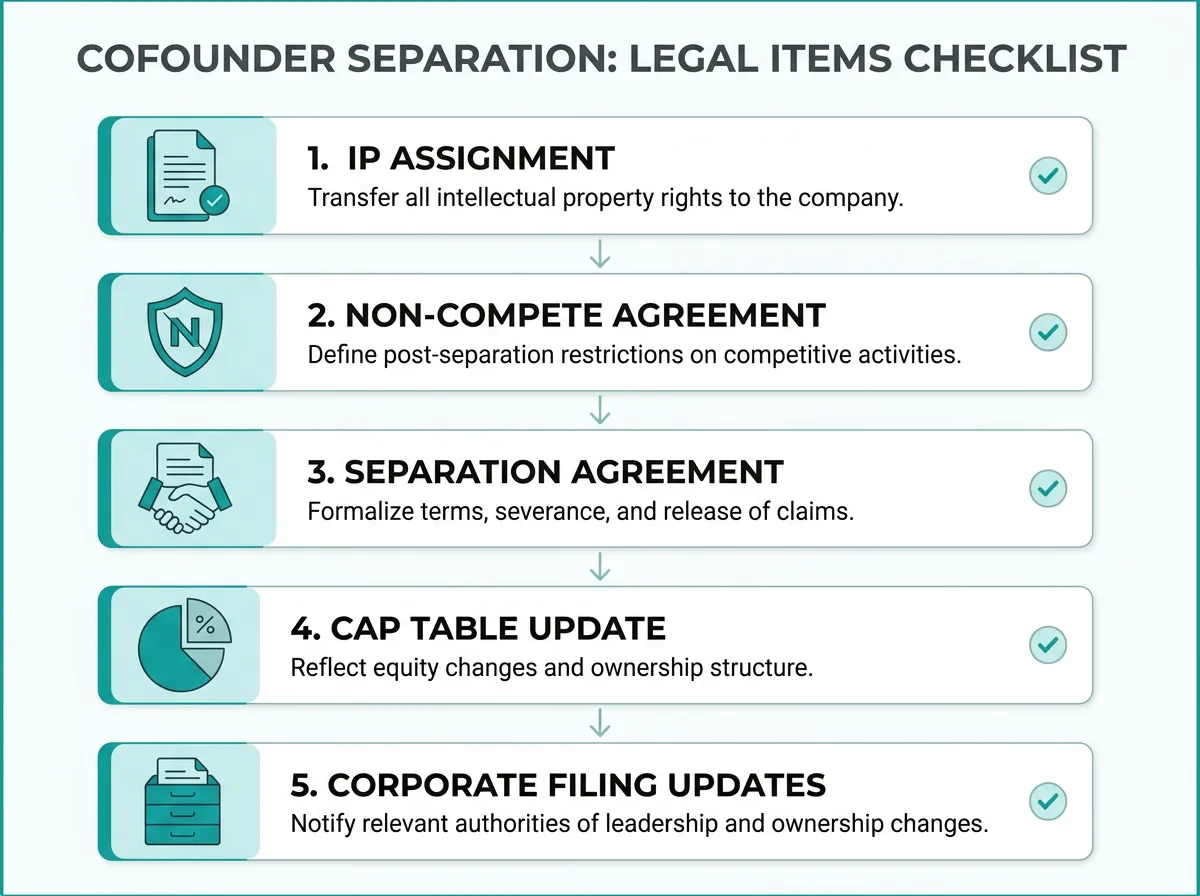
Key legal items to address
- Intellectual property assignment. Confirm in writing that all IP created during the cofounder's tenure belongs to the company, not the individual. If this wasn't in your original founder agreement, fix it now.
- Non-compete and non-solicit agreements. Decide whether the departing founder will be restricted from starting a competing venture or hiring away employees. Keep these reasonable — overly broad non-competes are unenforceable in many states and create unnecessary hostility.
- Separation agreement. Draft a formal separation agreement covering equity treatment, IP assignment, confidentiality obligations, mutual non-disparagement, and any ongoing advisory role. Both parties should have independent legal counsel review it.
- Corporate document updates. Update your operating agreement, cap table, board composition, and any relevant filings with the state.
Don't treat this as optional housekeeping. A future acquirer or Series A lead will ask to see these documents, and gaps will cost you leverage — or the deal.
Step 5: Tell Your Investors (Before They Hear It From Someone Else)
Investors have seen cofounder breakups before. What they haven't seen — and what terrifies them — is founders who try to hide it.
How to communicate with investors
- Tell your lead investor first, privately. A phone call, not an email. Frame it as a decision that's already been made, not a crisis you're reacting to.
- Present a plan, not just a problem. "Alex is transitioning out over the next 60 days. Here's how we've handled equity, here's who's taking over their responsibilities, and here's why this makes the company stronger."
- Be honest about the reason, but professional. "We had different visions for the company's direction" is fine. Detailed grievances are not.
- Send a follow-up email summarizing the transition plan for their records.
Most experienced investors will respect a well-handled breakup. Many will even be relieved — they may have seen the dysfunction before you did.
Step 6: Tell Your Team With a Unified Narrative
Your employees are watching. How you handle this transition signals how the company handles adversity, conflict, and change.
Principles for the team announcement
- Announce together if possible. Both cofounders in the same room (or video call) presenting a united front is powerful.
- Keep it brief and forward-looking. The team doesn't need (or want) the full story. They need to know: who's leaving, when, what changes for them, and what the plan is.
- Acknowledge the departing founder's contributions genuinely. This isn't performative — it sets the tone for how the company treats people.
- Leave space for questions, but don't invite drama. "We're happy to answer questions about how this affects your work. We won't be discussing the personal details of this decision."
The transition period
A clean transition typically takes 30-90 days. During this period, the departing founder should:
- Transfer all institutional knowledge, passwords, and key relationships
- Complete any in-progress work or hand it off properly
- Say goodbye to the team on their own terms
Rushing this creates chaos. Dragging it out creates awkwardness. Find the middle.
Real-World Proof: Cofounder Breakups That Saved Companies
If you need reassurance that a cofounder breakup isn't a death sentence, look at the evidence:
- Twitter survived the departure of multiple cofounders, including the removal of Jack Dorsey as CEO (twice), and went on to become one of the most influential platforms in history.
- Plaid lost cofounder William Hockey in 2022. The company continued operating under Zach Perret and maintained its position as a fintech infrastructure leader.
- Zipcar cofounders Antje Danielson and Robin Chase parted ways early. Chase continued building the company, which eventually sold to Avis for $500 million.
The pattern is consistent: what mattered wasn't whether a cofounder left, but how the transition was handled.
Frequently Asked Questions
Can a startup survive a cofounder breakup?
Absolutely. Many well-known companies have survived — and thrived after — a cofounder departure. The key is handling the transition professionally: addressing equity fairly, communicating proactively with investors and employees, and ensuring legal loose ends are tied up. A messy, unplanned split is what kills companies, not the split itself.
What happens to a departing cofounder's equity?
It depends on your vesting schedule and what you negotiate. Typically, the departing founder keeps their vested shares and forfeits unvested ones. In some cases, the company buys back vested shares at fair market value, or the departing founder receives partial acceleration of unvested shares. The specifics should be documented in a formal separation agreement.
Should I tell investors before or after the cofounder leaves?
Before — always before. Tell your lead investor as soon as the decision is final, ideally with a clear transition plan in hand. Investors lose trust when they're surprised by major team changes. A proactive, well-organized conversation signals maturity and builds confidence in the remaining leadership.
How long should a cofounder transition take?
Most clean transitions take 30 to 90 days. This gives the departing founder time to transfer knowledge, wrap up projects, and say goodbye to the team properly. Anything shorter risks operational chaos; anything longer creates an uncomfortable limbo that distracts the entire organization.
Do I need a lawyer for a cofounder breakup?
Yes. Even if the split is amicable, both founders should have independent legal counsel review the separation agreement, equity treatment, IP assignment, and any non-compete clauses. The cost of a lawyer now is a fraction of the cost of a lawsuit later.
Conclusion
A cofounder breakup is one of the most difficult experiences in a founder's life. It carries the emotional weight of ending a close relationship and the existential fear of endangering something you've built from nothing. But it doesn't have to be the end of your startup.
The founders who navigate this well share a common approach: they act early, they prioritize fairness over winning, they handle equity with precision, and they communicate with transparency. They treat the breakup not as a failure, but as a necessary evolution.
If you're reading this article because you suspect your cofounder relationship isn't working, trust that instinct. The conversation you're avoiding is almost certainly less destructive than the silence. Have it soon. Have it honestly. And have a plan for what comes next.
Your startup can survive this. The question is whether you'll give it the chance.