
How to Split Equity So Co-Founders Don't Split Up
Three months into building their SaaS product, Mira and Daniel sat in a coffee shop and "settled on" a 50/50 equity split. Neither of them wanted to have the awkward conversation about who deserved more. Mira had the original idea and had been working nights for six months before Daniel joined. Daniel brought the engineering chops to actually build the thing. But instead of talking through their different contributions, they shook hands, changed the subject, and got back to work.
Eighteen months later, Daniel had moved on to a full-time job but still held half the company. Mira, who had poured everything into the startup, was stuck. She couldn't raise funding because investors saw a missing co-founder holding 50% of the cap table. The company they'd built together collapsed—not from a bad product or a weak market, but from a co-founder equity split they'd been too uncomfortable to get right.
This story, echoed in cases documented by Vestd, Novastone Capital, and countless startup post-mortems, is painfully common. But it's also entirely preventable.
Key Takeaways
- A 50/50 equity split is a decision to avoid a decision. It feels fair in the moment but ignores real differences in contribution, risk, and commitment—differences that grow into resentment over time.
- Use a structured framework—like a contribution-based scorecard or dynamic equity model—to ground the conversation in facts, not feelings.
- Vesting schedules with a cliff are non-negotiable. They protect every co-founder from the scenario where someone leaves early but keeps a founder-sized stake.
- Revisit your equity agreement at major milestones. A split that made sense at incorporation may not make sense after a pivot, a funding round, or a life change.
- Document everything in writing before you write a single line of code. Verbal agreements corrode under pressure.

Why Avoidance Is the Real Danger
Most co-founder breakups don't start with a screaming match. They start with silence.
The Vestd team has written extensively about founders who "settled on" an equity split specifically to avoid an awkward conversation. In their analysis, the pattern is almost formulaic: two or three founders, excited about an idea, split equity equally because raising the topic of unequal shares feels like saying "I'm more valuable than you."
But here's the thing avoidance actually communicates: "I don't trust us enough to have a hard conversation." And that lack of trust compounds.
When one founder starts working 70-hour weeks while another dials back, the equal split becomes a daily irritant. When one founder invests personal savings while the other contributes only time, the imbalance festers. Research from Harvard Business School professor Noam Wasserman, who studied over 10,000 founders, found that teams who split equity within the first month—before understanding each other's true contributions—were significantly more likely to see their startups fail.
The irony is brutal: the conversation you avoid to preserve the relationship is the very conversation that would have saved it.
The Real Cost of Getting the Equity Split Wrong
Let's be concrete about what goes wrong when co-founder equity splits are poorly structured:
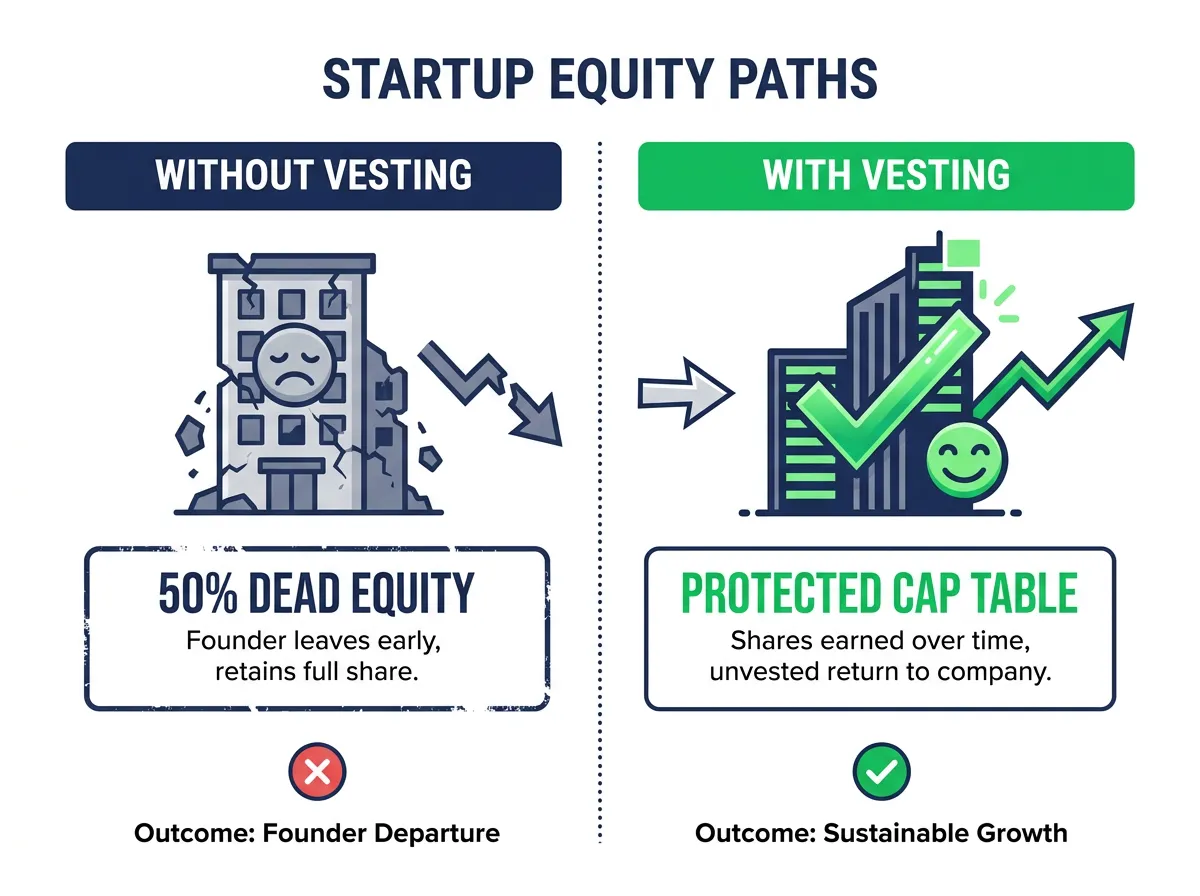
- Dead equity. A co-founder leaves but retains a large stake. The remaining founders are demotivated, and investors are spooked by a cap table with a ghost on it.
- Resentment spirals. One founder feels they're carrying the company while another reaps equal rewards. This doesn't stay quiet for long.
- Fundraising paralysis. Investors routinely pass on startups with messy or unexplainable cap tables. A 50/50 split with no vesting tells a VC that the founders haven't thought seriously about governance.
- Legal battles. Without written agreements, departing co-founders can—and do—claim equity they arguably haven't earned. Litigation can cost more than the company is worth.
Consider a case profiled by Novastone Capital: two co-founders launched a fintech startup with a handshake 50/50 deal. One brought the regulatory expertise and client relationships; the other built the platform. When the technical co-founder left after eight months for a higher-paying job, they still legally owned half the company. The remaining founder spent over a year and tens of thousands in legal fees negotiating a buyback. The startup never recovered its momentum.
Frameworks for Splitting Equity Fairly
There's no single "correct" way to divide co-founder equity. But there are frameworks that force you to think clearly and arrive at a split both sides can defend. Here are three, ranging from simple to sophisticated.
Framework 1: The Contribution-Based Scorecard
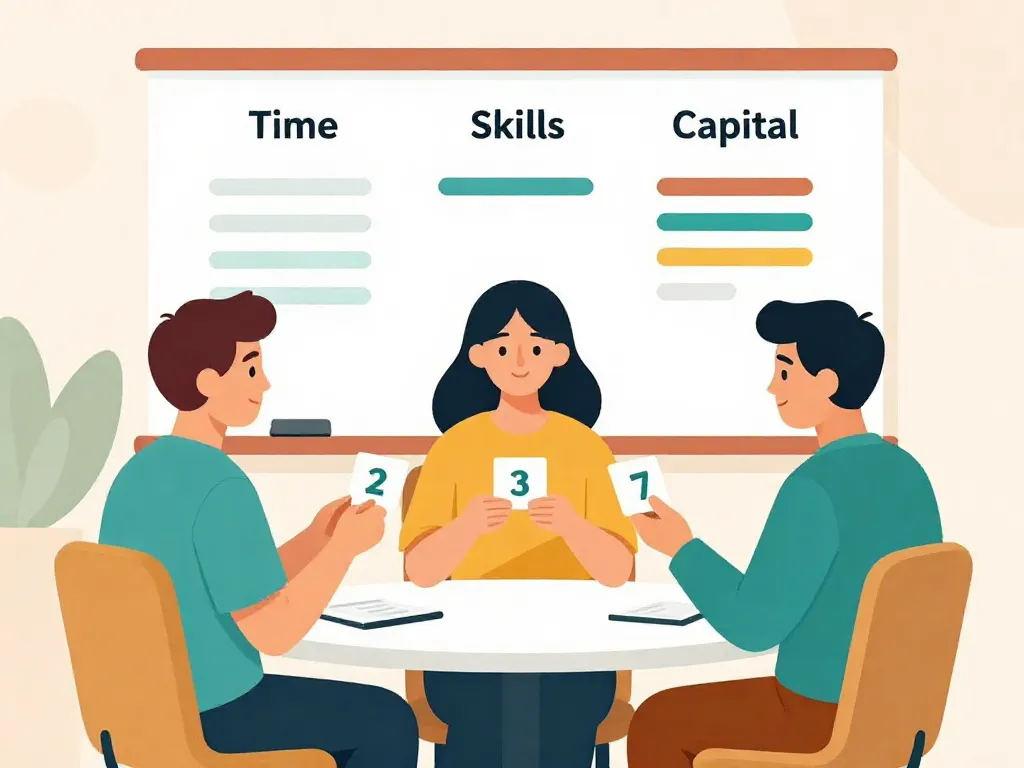
This is the most accessible approach. You and your co-founders independently score each person's contributions across several categories, then compare scores.
Categories to evaluate:
- Idea origination — Who conceived the concept? (Weight: 5-10%)
- Domain expertise — Who brings industry knowledge or credentials that are hard to replace? (Weight: 10-15%)
- Time commitment — Who is full-time vs. part-time? Who started earlier? (Weight: 20-25%)
- Financial investment — Who put in money or deferred salary? (Weight: 10-20%)
- Execution ability — Who can build the product, sell it, or operate the business? (Weight: 20-30%)
- Network and relationships — Who opens doors to customers, investors, or partners? (Weight: 5-10%)
- Risk and opportunity cost — Who left a high-paying job or took on personal financial risk? (Weight: 10-15%)
Each founder rates every founder (including themselves) on a 1-10 scale for each category. You then average the scores and convert to percentages.
The magic isn't in the math—it's in the conversation the exercise forces. When your scores diverge wildly on "time commitment," that's a signal you need to align expectations now, not six months from now.
Framework 2: Dynamic Equity (the Slicing Pie Model)
Developed by Mike Moyer, the Slicing Pie model treats equity as a living calculation rather than a fixed number. Each founder's share is determined by their relative contribution over time, measured in a common unit.
Here's how it works:
- Time contributions are valued at a fair market rate (what the person would earn elsewhere), multiplied by a risk multiplier (typically 2x-4x, since startup work is riskier than salaried work).
- Cash contributions are tracked at their dollar value, also with a multiplier.
- Other contributions—equipment, IP, relationships—are assigned agreed-upon values.
At any point, each founder's equity equals their share of the total "pie" of accumulated contributions.
Example: - Aisha contributes 500 hours at a notional rate of $150/hr (×2 multiplier) = $150,000 in value. - Ben contributes 300 hours at $100/hr (×2 multiplier) plus $20,000 cash (×4 multiplier) = $140,000 in value. - Aisha's equity: 150,000 / 290,000 = 51.7%. Ben's equity: 48.3%.
The dynamic model is especially useful for early-stage startups where roles and commitment levels are still evolving. It removes the pressure to "get it right" on day one because the split adjusts automatically as contributions change.
The downside: it requires diligent tracking and mutual trust in the accounting. It also needs a "freeze point"—typically a funding round or revenue milestone—where the equity becomes fixed.
Framework 3: Role-Based Allocation with Milestones
This approach assigns equity based on defined roles and ties portions of each founder's equity to specific, measurable milestones.
Example structure: - Base allocation (60% of each founder's total): Tied to the role they fill (CEO, CTO, etc.) and vests over four years. - Milestone allocation (40% of each founder's total): Unlocks when predefined goals are met—shipping the MVP, closing the first 10 customers, raising a seed round.
This framework works well when co-founders have clearly different roles and when there's a risk that one founder's contribution may be front-loaded (e.g., building the initial product) while another's is back-loaded (e.g., scaling sales).
Vesting: The Seatbelt You Must Wear
No matter which framework you choose for your co-founder equity split, vesting is the mechanism that protects everyone. Here's the standard structure and why each element matters:
- Four-year vesting period. Equity is earned over four years, not granted all at once. This aligns long-term incentives.
- One-year cliff. No equity vests until the first anniversary. If a co-founder leaves in month three, they walk away with nothing. This prevents the dead equity problem.
- Monthly vesting after the cliff. After year one, equity vests in monthly increments (1/48th of the total per month). This is smoother than annual vesting and more accurately rewards ongoing contribution.
What happens without vesting: Remember Mira and Daniel from the opening? If they'd had a standard vesting schedule with a one-year cliff, Daniel's departure at 18 months would have meant he vested roughly 37.5% of his allocation—not 50% of the entire company. Mira would have retained the unvested portion, and the cap table would have told a cleaner story to investors.
Additional Protective Clauses
- Acceleration on key events. Consider single-trigger or double-trigger acceleration clauses that speed up vesting if the company is acquired.
- Good leaver / bad leaver provisions. Define what happens to vested and unvested shares if a founder leaves voluntarily, is terminated for cause, or departs due to disability.
- Right of first refusal. Ensure remaining founders can buy back shares before a departing founder sells to an outside party.
How to Have the Equity Conversation Without Blowing Things Up
Knowing the frameworks is one thing. Sitting across from your co-founder and actually using them is another. Here's a step-by-step approach:
- Set the frame early. Before you start any negotiation, agree that the goal is a split both of you can advocate for enthusiastically—not one that merely avoids discomfort.
- Do the scorecard independently. Each founder fills out the contribution scorecard on their own. Compare results over a meal or a walk—somewhere low-pressure.
- Talk about the future, not just the past. Equity reflects expected future contribution as much as past contribution. Discuss each founder's planned commitment over the next 2-4 years.
- Use a mediator or structured tool if emotions run high. This doesn't have to mean hiring a lawyer. Tools like Servanda can help co-founders create written agreements and work through disagreements before they calcify into resentment.
- Write it down. Sign it. A verbal agreement is a future lawsuit. Use a proper co-founder agreement or shareholders' agreement. Include vesting terms, IP assignment, roles, decision-making processes, and exit provisions.
- Schedule a review. Agree to revisit the equity arrangement at defined milestones—six months in, after a funding round, after a pivot. This doesn't mean re-negotiating from scratch every quarter. It means checking in on whether the assumptions behind the split still hold.
When to Revisit Your Equity Split
Equity isn't meant to be renegotiated constantly, but certain events should trigger a review:
- A co-founder changes from full-time to part-time (or vice versa)
- The company pivots significantly, making one founder's skills more or less central
- A new co-founder or key hire joins and needs equity
- A funding round introduces new terms that affect founder shares
- One founder makes a significant capital contribution
The key is to build the review mechanism into your co-founder agreement from the start, so revisiting feels like a planned check-up, not an ambush.
FAQ
Is a 50/50 equity split always a bad idea?
Not always—but it's usually a lazy one. A 50/50 split is only defensible when both founders are contributing roughly equal time, capital, expertise, and risk, and you have a clear mechanism for breaking deadlocks (like a trusted advisor with a casting vote). In most cases, a slight imbalance (say, 55/45 or 60/40) more honestly reflects reality and makes decision-making cleaner.
What if my co-founder refuses to discuss equity?
This is itself a red flag worth paying attention to. A co-founder who won't engage in an equity conversation is either conflict-avoidant (which will cause problems beyond equity) or suspects they're getting a better deal by staying vague. Try framing the conversation as a shared protection: "I want to make sure we're both protected if things change." If they still refuse, consider whether this is someone you can build a company with.
Can we change the equity split after incorporation?
Yes, but it gets more complicated and potentially more expensive (tax implications, share transfers, amended articles). This is why it's so important to use vesting from the start. Vesting lets equity shift without renegotiating ownership—unvested shares simply return to the pool. If you need to restructure after incorporation, get a startup attorney involved.
How does equity splitting work when one founder had the idea?
Ideas are worth very little—execution is what creates value. Most frameworks assign only 5-10% weight to idea origination. The founder who had the idea might deserve a modest premium, but not a controlling stake based on the idea alone. What matters more is what each founder does next: who builds the product, who acquires customers, who raises capital.
Should we involve a lawyer in our equity agreement?
Yes, for the final documentation. You don't necessarily need a lawyer to have the initial conversation or choose a framework, but you absolutely need legal review of the co-founder agreement before signing. A startup attorney will catch blind spots—tax implications, IP assignment gaps, ambiguous exit clauses—that even well-informed founders miss. Budget $2,000-$5,000 for this; it's one of the highest-ROI investments you'll make.
Conclusion
The co-founder equity split is one of the most consequential decisions you'll make in the life of your startup—and one of the easiest to get wrong. Not because the math is hard, but because the conversation is uncomfortable. The frameworks exist: contribution scorecards, dynamic equity models, role-based allocations with milestones. Vesting schedules with cliffs exist. Written co-founder agreements exist. The only thing standing between you and a fair, resilient equity structure is the willingness to have an honest conversation before resentment makes that conversation impossible.
The startups that survive co-founder conflict aren't the ones where everyone always agrees. They're the ones where the founders built a structure strong enough to hold disagreement without breaking. Start with equity. Get it in writing. And revisit it before you need to.