
The Business Partner Method for Co-Parenting
It's 9:47 PM on a Tuesday. You open a text from your co-parent about this weekend's soccer schedule, and your chest tightens before you've even read the full message. The words are neutral enough — pickup time, jersey color, snack duty — but your brain is already replaying the argument from last month, bracing for subtext, scanning for tone. A simple logistics question has hijacked your entire nervous system.
You're not dramatic. You're not broken. You're a person trying to coordinate the most important project of your life — raising your child — with someone who still triggers very real emotional pain.
The business partner method for co-parenting offers a way out of that cycle. It's not about suppressing your feelings or pretending the past didn't happen. It's about building a concrete operational structure — with defined roles, meeting agendas, and communication protocols — so that parenting logistics never have to travel through your emotional wounds again.
Here's exactly how to set it up.
Key Takeaways
- Separate the relationship from the role. You're no longer partners in life — you're partners in a shared project called raising your child. Every interaction should serve that project.
- Use a written communication protocol. Define which channel you use (text, email, app), response time expectations, and what topics are off-limits in writing.
- Hold structured "board meetings." A biweekly or monthly co-parenting meeting with a set agenda replaces the drip of tense, reactive texting throughout the week.
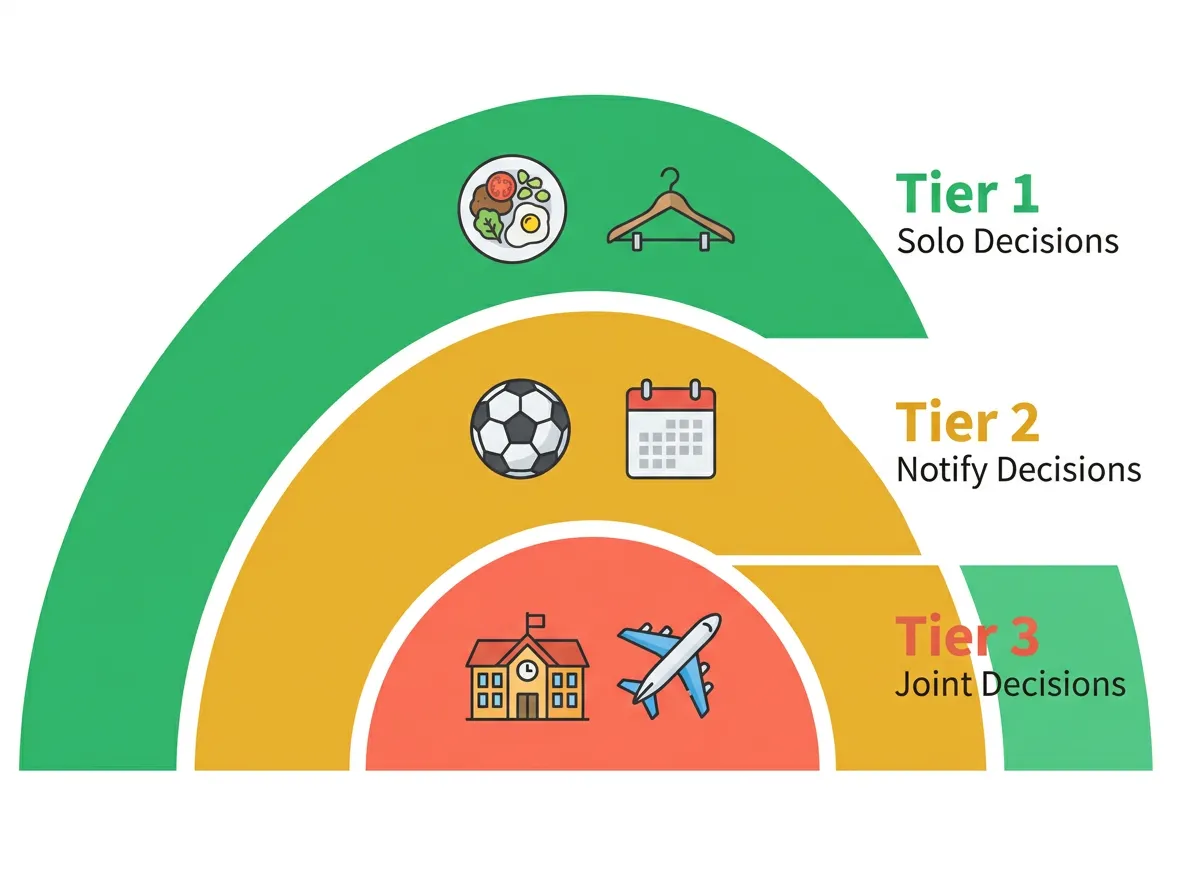
- Create decision-making tiers. Not every choice requires joint approval. Classify decisions as "solo," "notify," or "joint" to eliminate unnecessary friction.
- Document agreements like contracts. Verbal agreements breed misunderstandings. Write it down, confirm it, and reference it when disputes arise.

Why the Business Partner Framing Actually Works
The advice to "treat co-parenting like a business" has been circulating for years — the Raising Children Network in Australia recommends it, family therapists suggest it, and co-parenting books repeat it. But most people hear that advice and think: Okay, be professional. Got it. Then the next text arrives, and professionalism evaporates.
The problem isn't willpower. It's that "be professional" is a mindset, not a system. You wouldn't tell a new employee to "just be professional" and leave them without an org chart, a job description, or a meeting schedule. They'd flounder, improvise, and eventually burn out.
The business partner method gives you the system. It works because it:
- Externalizes structure. When you have a written protocol, you follow the protocol — not your mood.
- Reduces ambiguity. Most co-parenting conflicts aren't about big philosophical differences. They're about unclear expectations: who was supposed to bring the winter coat, who's covering Thursday pickup, whether the dentist appointment was confirmed.
- Depersonalizes friction. When a disagreement happens inside a structure, it's a process issue. When it happens over text at 11 PM, it's a fight.
What This Method Is Not
Let's be clear: this isn't about being cold, robotic, or treating your child like a line item. Your child still gets all of your warmth, spontaneity, and love. The business structure applies to the logistics layer between you and your co-parent — the layer that currently absorbs emotional shrapnel it was never designed to handle.
Step 1: Define Your Communication Protocol
Before you fix what you say, fix how and where you say it. Most co-parenting conflict escalates because of channel chaos — important decisions buried in a text thread between arguments, voicemails left when a simple message would do, or face-to-face conversations at pickup that go sideways in front of the kids.
Choose Your Channels
Assign specific channels to specific purposes:
| Channel | Use For | Not For |
|---|---|---|
| Text | Time-sensitive logistics only ("Running 10 min late") | Discussions, decisions, or emotional topics |
| Proposals, schedule changes, medical/school updates | Back-and-forth debate (limit to 2 replies, then escalate to a meeting) | |
| Co-parenting app | Shared calendar, expense tracking, document storage | Personal communication |
| Phone call | Genuine emergencies involving child safety | Rehashing past conflicts |
| In-person | Scheduled co-parenting meetings only | Improvised conversations at pickup/drop-off |
Set Response Time Expectations
One of the most common complaints in co-parenting is "they never respond" or "they expect an instant answer." Remove the guessing:
- Routine messages: Response within 24 hours
- Time-sensitive logistics: Response within 4 hours during waking hours
- Emergencies: Immediate callback
Write these down. Share them. Refer back to them when tensions rise.
The BIFF Method for Messages
Borrow from high-conflict communication expert Bill Eddy and keep all written messages BIFF: Brief, Informative, Friendly, and Firm.
Instead of this:
"You never told me about the field trip. I had to hear from another parent. This is exactly the kind of thing that keeps happening and it's really frustrating."
Write this:
"Hi — I didn't see information about the Oct 15 field trip. Could you forward the permission slip? I'd like to sign and return it by Thursday. Thanks."
Same issue. No emotional charge. Problem gets solved.

Step 2: Establish Your Co-Parenting "Board Meetings"
This is the backbone of the business partner method, and it's the piece most people skip. A structured, recurring meeting replaces the constant low-grade tension of managing logistics in real time.
Meeting Format
- Frequency: Every two weeks (adjust monthly once things stabilize)
- Duration: 30 minutes maximum — set a timer
- Location: Neutral ground (coffee shop, library, or video call). Never at either home.
- Rule: Kids are never present
Sample Agenda Template
- Calendar review (10 min) — Walk through the next 2-4 weeks. Confirm pickups, drop-offs, holidays, school events, activities.
- Open items (10 min) — Address any unresolved logistics: medical appointments, expenses to split, clothing or gear that needs to transfer.
- Decisions needed (10 min) — Raise and resolve any pending "joint decisions" (more on this below).
Ground Rules
- No discussion of the past relationship
- No blame language ("you always," "you never")
- If emotions escalate, either party can call a 5-minute break or table the topic for email follow-up
- End on time, even if items remain — carry them forward to the next meeting
Consider this a real example: Marcus and Denise (names changed) had been divorced for two years and still argued weekly over scheduling details. Their therapist suggested biweekly meetings at a local café. Within six weeks, their between-meeting communication dropped by roughly 70%. "It turns out most of the fighting was because we were both anxious about things that hadn't been discussed yet," Marcus noted. "Once we knew there was a scheduled time to handle it, we stopped ambushing each other."
Step 3: Create a Decision-Making Tier System
Not every parenting choice needs two signatures. One of the fastest ways to reduce co-parenting conflict is to agree in advance on who decides what.
Three Tiers of Decisions
Tier 1 — Solo Decisions (No approval needed) - Daily meals, clothing, bedtime routines at your own home - Playdates during your parenting time - Minor haircuts or grooming - Day-to-day discipline and household rules
Tier 2 — Notify Decisions (Inform, don't ask) - Enrolling in a new extracurricular within the existing budget - Scheduling a routine medical or dental appointment - Arranging travel within your parenting time (domestic, no passport needed) - Introducing the child to a new partner (after an agreed-upon timeframe)
Tier 3 — Joint Decisions (Both parents must agree) - School enrollment or changes - Non-emergency medical procedures or mental health treatment - Religious education or major cultural commitments - International travel or anything requiring a passport - Changes to the custody schedule
When you classify decisions in advance, you eliminate the draining back-and-forth over things that one parent could have simply handled. You also prevent the power struggle where one parent withholds approval to assert control.
Step 4: Document Everything Like a Contract
Verbal agreements between co-parents have a roughly 100% failure rate — not because anyone is lying, but because two people who experienced a painful separation will inevitably remember conversations differently.
What to Document
- Schedule changes and the reasons they were agreed to
- Financial agreements (who pays what, reimbursement timelines)
- Holiday and vacation plans, including travel details
- Any modifications to the parenting plan
How to Document
After every co-parenting meeting or significant decision, send a brief follow-up email:
Subject: Co-Parenting Meeting Notes — [Date]
Hi [Name],
Here's a summary of what we discussed today:
- Thanksgiving schedule: Kids with you Wed–Fri, with me Fri evening–Sun
- Soccer registration: You'll handle signup by Oct 20; we split the $180 fee equally
- Dentist: Appointment on Nov 3 at 2 PM; I'll take them
Please let me know by [date] if anything looks different from your understanding.
Thanks, [Your name]
This isn't about building a legal case. It's about creating shared reality. When both parents can point to the same document, the "that's not what we agreed to" spiral stops before it starts.
For co-parents who want to go a step further, AI-powered platforms like Servanda can help you formalize these agreements into structured, referenceable documents — which is especially useful when emotions make it hard to draft neutral language on your own.
Step 5: Build in Emotional Boundaries That Protect the System
The business partner method only works if you protect it from emotional bleed. That means building deliberate boundaries around the co-parenting relationship.
Boundaries That Work in Practice
- The 24-hour rule: If a message from your co-parent triggers an emotional reaction, wait 24 hours before responding. Logistics rarely require an immediate answer.
- The parking lot: Keep a running note on your phone where you "park" emotional reactions — things you want to say but shouldn't. Bring them to your therapist or a trusted friend instead.
- The pickup buffer: If face-to-face exchanges are tense, build in a 5-minute buffer. Arrive early. Sit in your car. Breathe. Walk up calm.
- The topic fence: Co-parenting conversations stay inside the fence of the child's needs. New partners, finances outside of child expenses, and the history of the relationship are all outside the fence.
When You Slip (Because You Will)
You will send a sharp text at midnight. You will take the bait on a loaded comment at pickup. You will re-litigate a settled decision when you're stressed.
When that happens, don't abandon the system. Just return to it. The value of a structure isn't that it prevents every failure — it's that it gives you a clear path back after one.
A simple repair message can look like:
"That last message wasn't productive. Let me try again: can we add [topic] to the agenda for our next meeting?"
No over-apologizing. No self-flagellation. Just a course correction back toward the structure.
Putting It All Together: Your First 30 Days
If you're sold on the business partner method for co-parenting but overwhelmed about where to start, here's a phased rollout:
Week 1: Draft your communication protocol (channels, response times, BIFF commitment). Share it with your co-parent as a proposal, not a demand.
Week 2: Propose a trial "board meeting." Send a suggested agenda. Keep the first one short — even 20 minutes works.
Week 3: After the first meeting, send a follow-up summary email. Introduce the documentation habit.
Week 4: Propose the decision-making tiers. Frame it as reducing hassle for both of you, not as a power move.
You don't need your co-parent's enthusiastic buy-in to start. You can implement most of this unilaterally — using BIFF in your own messages, documenting your own understanding of agreements, and managing your own emotional boundaries. Often, when one parent starts operating with more structure, the other gradually mirrors it.
Frequently Asked Questions
What if my co-parent refuses to follow the business partner method?
You can't force another person into a system, but you can model it. Start using BIFF communication, send meeting-notes-style summaries, and hold your own boundaries consistently. Over time, many co-parents adopt the structure simply because it makes their life easier too. If resistance is severe and ongoing, a family mediator can help introduce the framework as a neutral third-party recommendation.
Does the business partner approach work for high-conflict co-parenting?
Yes — in fact, it works best in high-conflict situations because it minimizes direct emotional contact. In very high-conflict cases, you may need to go even further into parallel parenting, where each parent operates independently within their own time and joint decisions are made through a mediator or legal professional rather than directly.
How do I stop taking my co-parent's messages personally?
The honest answer: you may not fully stop, and that's okay. The goal of the business partner method isn't to eliminate your emotional reactions — it's to create a buffer between the reaction and your response. The 24-hour rule, the parking lot technique, and having a therapist or support person to process with are all practical tools that shrink the gap between trigger and composure over time.
Can we still be flexible with the schedule if everything is structured?
Absolutely. Structure doesn't mean rigidity. Think of it like a contract with an amendment clause: the default plan is clear, and any changes are proposed, agreed upon, and documented. Flexibility becomes easier when there's a baseline to flex from, because both parents feel secure that the system will hold.
At what age should we involve our kids in scheduling decisions?
Generally, children shouldn't be pulled into logistics — that's your job as co-parents. However, as kids reach their teens, it's reasonable to incorporate their preferences (activities, social commitments) into your board meeting agenda. The key is that teens share their input with both parents, and the parents make the scheduling decisions together — the child should never be the messenger or the decision-maker between two households.
Moving Forward
The business partner method for co-parenting isn't about pretending your ex is just a colleague. It's about acknowledging that the emotional weight of your history doesn't belong in the logistical layer of raising your child — and then building a system that enforces that separation.
You don't have to heal first. You don't have to feel neutral about your co-parent. You just have to decide that your child's experience of their two-home life matters more than the satisfaction of sending that sarcastic reply.
Start with one piece — the communication protocol, a single meeting, a follow-up email. Let the structure do the heavy lifting while your emotions catch up at their own pace. The framework holds, even on the days you can't.