It's 9:47 p.m. on a Tuesday. You just got a text from your co-parent — the third one in an hour — accusing you of undermining them in front of your daughter. You didn't. You helped her with a school project. But now your chest is tight, your thumbs are hovering over the keyboard, and you can feel yourself getting pulled into another exhausting spiral that will end with screenshots, sleeplessness, and zero resolution.
Most co-parenting advice assumes two reasonable adults who just need a nudge toward better communication. But what about when the other parent is combative, manipulative, or simply refuses to cooperate? What about when every text is a trap and every exchange is a battlefield?
This guide is for the parent in high-conflict co-parenting — built around tools, scripts, and strategies that work even when your co-parent won't meet you halfway.
Why Generic Co-Parenting Advice Fails in High-Conflict Situations
Most co-parenting resources are designed for low-conflict or moderate-conflict separations — situations where both parents are willing to negotiate, compromise, and put the child's needs first most of the time.
High-conflict co-parenting is characterized by:
- Repeated boundary violations (ignoring custody schedules, making unilateral decisions)
- Weaponizing communication (baiting, blaming, gaslighting, or flooding you with messages)
- Using the children as messengers, spies, or leverage
- Refusing to cooperate with agreed-upon plans, then blaming you for the fallout
- Escalating legal threats over minor disagreements
When one parent consistently operates this way, advice like "try to see things from their perspective" isn't just unhelpful — it can be harmful. It puts the burden of peace entirely on the cooperative parent and ignores the power imbalance at play.
The goal in high-conflict co-parenting is harm reduction — for you and for your kids.
Parallel Parenting: The Strategy Built for High Conflict
What Parallel Parenting Actually Looks Like
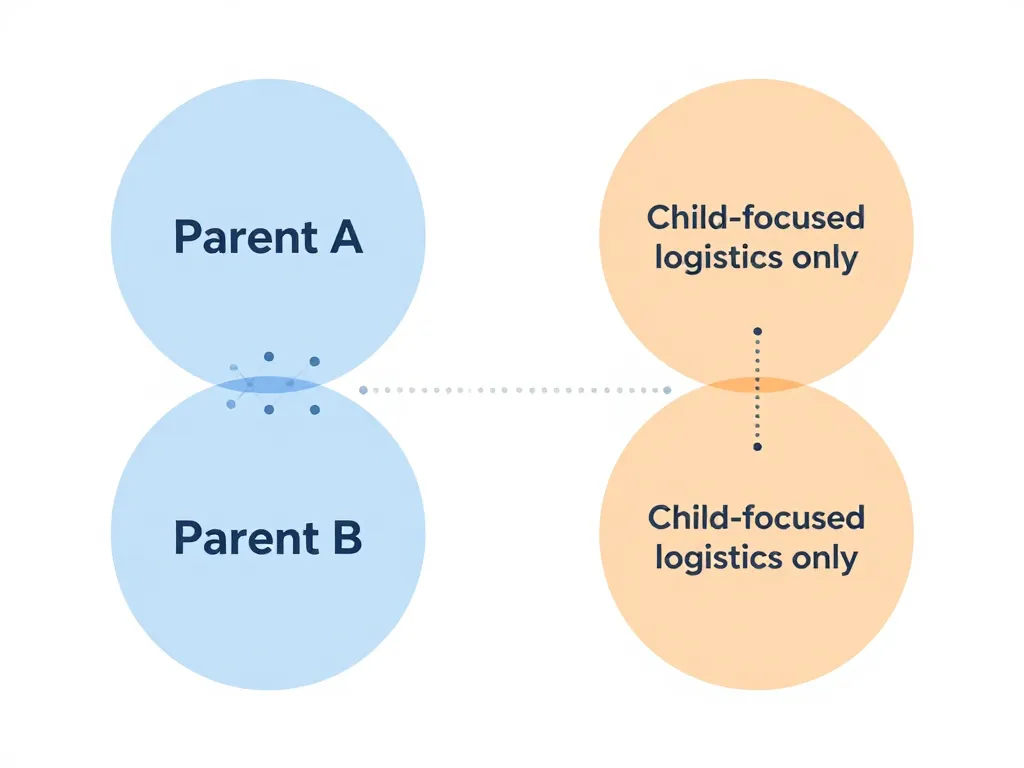
If cooperative co-parenting is two pilots flying the same plane, parallel parenting is two pilots flying two separate planes on the same route. The destination is the same — the well-being of your children — but you each control your own cockpit.
In practice, parallel parenting means:
- Minimal direct communication. Contact is limited to logistics: dates, times, locations, medical updates.
- Disengagement from the other parent's household rules. Unless there's a safety concern, what happens at their house stays at their house.
- Highly detailed parenting plans. The more specific the written agreement, the fewer opportunities for conflict.
- No improvisation. Changes to the schedule go through a formal request process, not a casual text.
When to Shift from Co-Parenting to Parallel Parenting
Consider making the shift if:
- You've tried cooperative communication repeatedly and it consistently escalates into conflict.
- Your co-parent uses flexibility against you (e.g., you agree to a schedule swap, and later they claim you "refused" the original plan).
- Your child's therapist, your attorney, or a mediator has flagged the dynamic as high-conflict.
- You notice your own mental health deteriorating from the constant tension of managing the relationship.
Parallel parenting isn't giving up. It's strategically protecting your family by removing the friction points that fuel conflict.

The BIFF Method: A Script for Responding to Hostile Messages
Developed by Bill Eddy, a family law attorney and mediator, the BIFF method is one of the most widely recommended high-conflict co-parenting communication tools. It stands for:
- Brief — Keep it short. Long responses give a high-conflict person more material to twist.
- Informative — Stick to facts. No opinions, no emotions, no editorializing.
- Friendly — Not warm, not cold. A neutral, businesslike courtesy.
- Firm — End the conversation. Don't leave openings for debate.
BIFF in Action: A Real-World Example
The hostile message:
"You ALWAYS do this. You let Maya stay up until midnight on a school night because you don't care about her grades. I'm the only one who actually parents. I'm documenting everything."
The instinctive response (don't send this):
"That's a complete lie. She was in bed by 9. Maybe if you didn't interrogate her every time she comes home, she wouldn't be anxious and making things up. And go ahead and 'document' — I have plenty of my own."
The BIFF response:
"Thanks for your concern about Maya's sleep schedule. She was in bed by 9:00 p.m. last night. Let me know if you have questions about the pickup time this Friday."
The BIFF response doesn't match the emotional intensity, corrects the factual claim without defending or attacking, and redirects to a logistical topic while closing the loop.
This takes practice. Your first draft will probably be angry. Write it, delete it, then write the BIFF version. Over time, it becomes instinct.
Building a Communication Firewall
Choose One Channel — And Stick to It
In high-conflict co-parenting, scattered communication across text, email, phone calls, and in-person exchanges creates chaos. Every additional channel is another opportunity for things to be misquoted, misunderstood, or denied.
Pick one primary channel, ideally one that creates a written record:
- Dedicated co-parenting apps (OurFamilyWizard, TalkingParents, AppClose) — These create timestamped, uneditable logs that are admissible in court.
- Email — Slower pace naturally discourages impulsive responses.
- Text messaging — Only if you're disciplined about boundaries and screenshots.
Avoid phone calls for anything other than genuine emergencies involving the child. If your co-parent insists on calling to discuss logistics, respond with: "I want to make sure we're both on the same page. Can you put that in writing so I can review and respond?"
The 24-Hour Rule
Unless your child is in immediate danger, give yourself 24 hours before responding to a provocative message. This isn't about being passive. It's about being strategic.
High-conflict individuals often escalate because they feed on immediacy. A delayed, measured response disrupts their pattern and keeps you in control of your own reactions.
During that 24 hours:
- Write your raw, emotional response in a notes app. Get it out of your system.
- Ask yourself: Does this require a response at all? Many hostile messages are bait. Not every text deserves a reply.
- If a response is needed, draft it using BIFF.
- Run it by a trusted friend, therapist, or attorney if the stakes are high.

Documentation: Your Quiet Superpower
In high-conflict co-parenting, what you can prove matters more than what actually happened. That sounds cynical, but anyone who's been through a contentious custody hearing knows it's true.
What to Document
- Every schedule violation — Date, time, what was agreed upon, what actually happened.
- Hostile or threatening messages — Screenshot and save to a secure folder (cloud backup recommended).
- Missed pickups or drop-offs — Note the time you arrived, how long you waited, and any witnesses.
- Concerning statements your child makes — Write them down verbatim with the date. Don't editorialize.
- Your own compliance — Keep records showing you followed the parenting plan. This protects you from false accusations.
How to Document Without Becoming Obsessive
Documentation should be a habit, not a hobby. Spend 5 minutes at the end of each exchange day logging the basics. Use a dedicated notebook, a shared Google Doc with your attorney, or an app designed for custody documentation.
Setting Boundaries That Actually Hold
Boundaries in high-conflict co-parenting aren't requests — they're structures. You're not asking the other parent to respect your limits; you're building systems that enforce them regardless of their cooperation.
| Instead of... |
Try this... |
| "Please stop texting me after 9 p.m." |
Turn off notifications after 9 p.m. Respond the next morning. |
| "Don't talk badly about me to the kids." |
Work with a child therapist who can give your kids tools to process loyalty conflicts. |
| "Stop changing the schedule without asking." |
Include a clause in your parenting plan: "Schedule changes require 48 hours written notice and mutual agreement." |
| "You need to communicate respectfully." |
Funnel all communication through a monitored app. Let your attorney address violations. |
Effective boundaries don't depend on the other person changing. They depend on you building structures, adjusting your own behavior, and involving third parties (therapists, attorneys, mediators, tools) when needed.
AI-powered mediation platforms like Servanda can provide structure here — helping co-parents formalize agreements in writing so that vague verbal promises don't become tomorrow's conflict.
Protecting Your Kids in a High-Conflict Dynamic
Children in high-conflict co-parenting situations are at higher risk for anxiety, depression, and loyalty conflicts. You can't single-handedly eliminate the conflict, but you can create a buffer.
What Helps Kids Most
- Never put them in the middle. Don't ask them to carry messages, report on the other parent's household, or choose sides.
- Validate without vilifying. If your child says, "Dad yelled at Mom's boyfriend," you can say, "That sounds like it was upsetting. You're safe here." You don't need to explain, defend, or condemn.
- Keep your home predictable. Consistent routines, clear expectations, and emotional calm in your household give your child a stable anchor.
- Get them professional support. A child therapist who specializes in divorce or family conflict can give your child a safe space to process feelings they may not feel comfortable sharing with either parent.
When to Involve Legal Professionals
Consider involving legal counsel if:
- Your co-parent is repeatedly violating the custody order.
- There are threats of violence, abduction, or parental alienation.
- Your co-parent is making major decisions (medical, educational, religious) without your consent when joint decision-making is required.
- Communication has become so hostile that it constitutes harassment.
- You need to modify the parenting plan and your co-parent refuses to negotiate.
A family law attorney experienced in high-conflict cases can help you pursue modifications, request a parenting coordinator, or document patterns for the court.
Frequently Asked Questions
How do you co-parent with someone who refuses to communicate?
You shift from cooperative co-parenting to parallel parenting. Reduce communication to only what's necessary — logistics about the child — and route it through a single written channel. If they still refuse to engage on essentials (medical decisions, school enrollment), your attorney or a court-appointed parenting coordinator can step in to break deadlocks.
Is parallel parenting legal?
Yes. Parallel parenting doesn't violate any custody order. It's a strategy for minimizing contact between parents while still honoring the parenting plan. Many family courts encourage parallel parenting in high-conflict cases, and some judges order it explicitly.
What do you do when your co-parent badmouths you to your child?
Resist the urge to counter with your own version of events. Instead, focus on being a steady, loving presence. Say things like, "I'm sorry you heard that. I love you and I'm here for you." If the behavior is severe and persistent, document it and discuss it with your attorney — courts take parental alienation seriously.
Can a high-conflict co-parenting situation ever improve?
Improvement usually comes from structural changes — a more detailed parenting plan, a parenting coordinator, therapy — rather than the other parent having a change of heart. Some high-conflict dynamics do soften over time, especially as children get older and the logistics of co-parenting become less frequent.
How do I stop letting my co-parent's behavior affect my mental health?
Therapy (specifically with someone experienced in high-conflict family dynamics), strict communication boundaries, and a reliable support system are the three pillars. Many co-parents also find that the documentation habit helps — it gives them a way to externalize the experience rather than carry it emotionally.
Moving Forward, One Boundary at a Time
High-conflict co-parenting is exhausting, isolating, and deeply unfair. You didn't choose this dynamic, and you can't fix it alone. But you can build a system around yourself and your children that minimizes the damage and gives you back some sense of control.
Start small. Pick one tool from this article — the BIFF method, the 24-hour rule, the communication firewall — and practice it for the next two weeks. Progress in high-conflict co-parenting isn't measured in breakthroughs. It's measured in the fights you didn't have, the bait you didn't take, and the quiet evenings you protected for your kids.