
Co-Founder Breakups: 5 Post-Mortem Lessons Learned
You built something together. Late nights. Shared risk. A pitch deck that felt like a manifesto. Then, somewhere between the seed round and product-market fit, the relationship fractured. Maybe it was slow — weeks of avoided conversations, resentment compounding like bad interest. Maybe it was sudden — a single meeting that ended everything.
Co-founder breakups are one of the most common reasons startups fail, yet they remain one of the least discussed. According to data from Harvard Business School researcher Noam Wasserman, 65% of high-potential startups fail due to conflict among co-founders. Not market timing. Not funding. People.
If you've been through a co-founder split — or feel one forming beneath the surface — this article is for you. We analyzed real post-mortem narratives from founders who lived through breakups and distilled them into five patterns that keep repeating. The goal isn't to assign blame. It's to make the wreckage useful.
Key Takeaways
- Most co-founder breakups trace back to unspoken assumptions, not sudden betrayals. The earlier you surface disagreements, the smaller they stay.
- Equity splits made "to keep things simple" almost always create complex problems later. Vesting schedules and contribution frameworks aren't optional.
- Role ambiguity is a slow poison. When both founders think they're the CEO, nobody is.
- Written operating agreements aren't a sign of distrust — they're a sign of maturity. The best time to negotiate terms is when you still like each other.
- A structured breakup process can preserve the company, your finances, and sometimes even the friendship.

Lesson 1: The "We're Aligned" Assumption Is the Most Dangerous One
What the post-mortems reveal
In 2018, two technical co-founders — let's call them Priya and Marcus — launched a developer tools company in Austin. They'd been friends for six years. They assumed alignment on everything: growth pace, fundraising philosophy, even eventual exit. They never discussed any of it explicitly because it felt unnecessary. "We just got each other," Priya later wrote in a candid Medium post about their split.
Eighteen months in, Marcus wanted to raise a Series A and scale aggressively. Priya wanted to stay bootstrapped and build deliberately. Neither position was wrong. But because they'd never articulated their visions in concrete terms, the disagreement felt personal — like a betrayal of shared values that had never actually been shared.
This pattern shows up in co-founder breakup stories with remarkable consistency. Founders conflate personal chemistry with strategic alignment. They skip the uncomfortable early conversations because the excitement of building something together feels like enough.
What to do instead
Before you write a line of code or file an LLC, sit down and answer these questions separately, then compare:
- What does success look like for this company in 3 years? In 10?
- Under what conditions would you want to sell? Go public? Shut down?
- How much personal financial runway do you have, and what happens when it runs out?
- How do you each feel about taking on outside investors?
- What's your tolerance for personal financial risk?
Write down your answers. Compare them. Disagree openly and early. Alignment isn't the absence of disagreement — it's knowing where the disagreements are and choosing to build together anyway.
Lesson 2: The 50/50 Equity Split Is a Ticking Time Bomb
What the post-mortems reveal
A 2023 analysis by startup accelerator Y Combinator found that equal equity splits are one of the strongest predictors of eventual co-founder conflict. Not because equality is inherently bad, but because it's usually chosen to avoid a hard conversation rather than to reflect a genuine assessment of contributions.
Take the case of a food-tech startup in Chicago — two co-founders, one with the domain expertise and industry network, the other with the engineering skills to build the platform. They split equity 50/50 on day one. Within a year, the technical co-founder was working 70-hour weeks while the business co-founder was still at their day job "transitioning slowly." The technical co-founder felt exploited. The business co-founder felt ambushed when it was brought up. Neither had a framework for the conversation.
What to do instead
Equity should reflect expected future contribution, not just past friendship. Consider:
- Use a vesting schedule. A standard four-year vesting schedule with a one-year cliff ensures that equity is earned over time. If someone leaves after six months, they don't walk away with half the company.
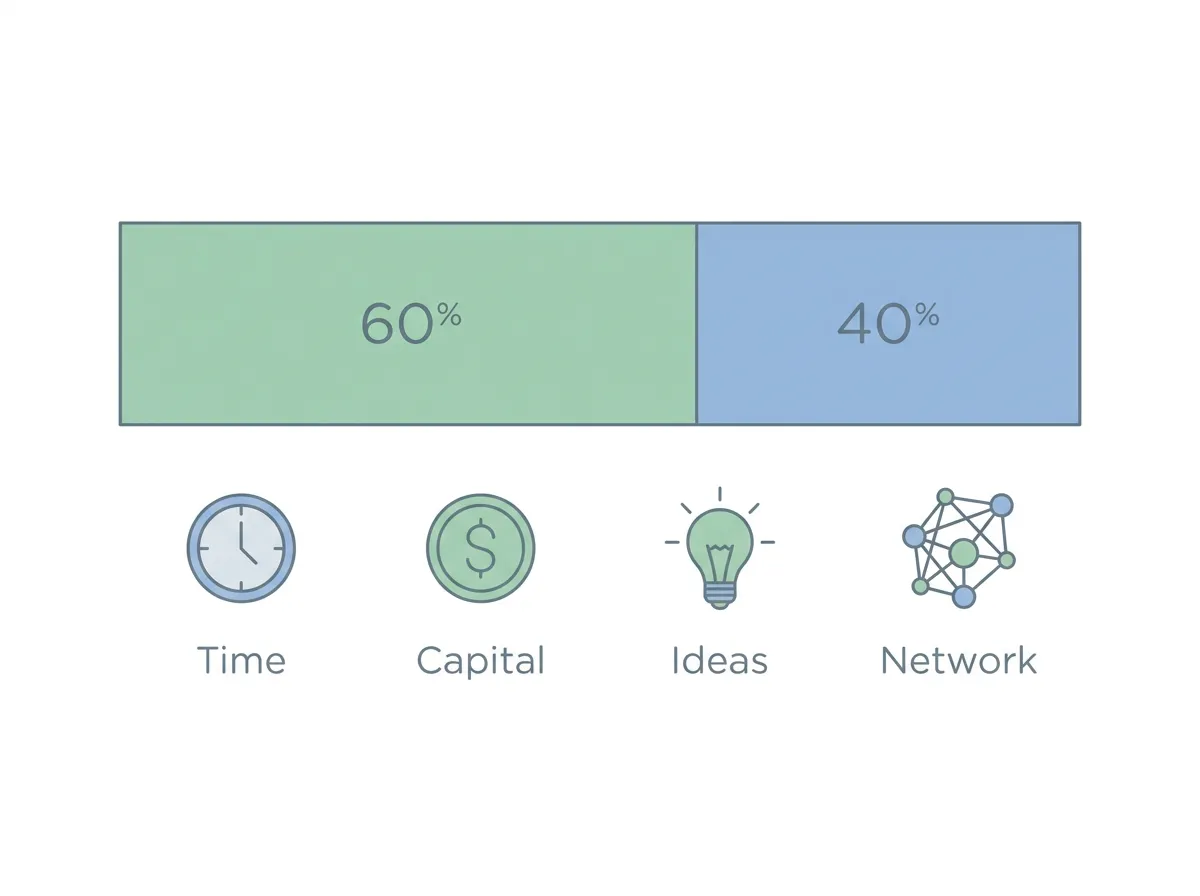
- Define contribution categories. Who's contributing capital? Full-time effort? Intellectual property? Industry connections? Weight these openly.
- Revisit annually. Some founding teams build in a structured equity review at each anniversary. This isn't about clawing back shares — it's about ensuring the split still reflects reality.
- Use dynamic equity frameworks. Tools like the Slicing Pie model assign equity based on tracked contributions, removing guesswork entirely.
The conversation about equity is uncomfortable. It's supposed to be. That discomfort is the cost of clarity.
Lesson 3: Undefined Roles Create Invisible Power Struggles
What the post-mortems reveal
A recurring theme in co-founder breakup stories is the phrase: "We both thought we were in charge."
One SaaS startup's retrospective described it this way: both co-founders were attending the same investor meetings, giving contradictory signals about strategy. One would promise a feature roadmap; the other would walk it back in a follow-up email. Investors got confused. Employees got anxious. The co-founders got resentful.
Role ambiguity doesn't just create inefficiency — it creates identity conflict. When your title and responsibilities are undefined, every decision becomes a referendum on who matters more. Small disagreements about button colors escalate into existential arguments about vision because there's no agreed-upon structure for who decides what.
What to do instead
- Assign clear domains of authority. One co-founder owns product; the other owns go-to-market. Or one owns technical architecture; the other owns business operations. The specific split matters less than the fact that it exists.
- Define a tiebreaker mechanism. When you disagree on something that crosses both domains, who makes the final call? Some teams rotate. Others designate a "first among equals" CEO. Others bring in a trusted advisor. Pick something before you need it.
- Document decisions and who made them. A shared decision log (even a simple spreadsheet) creates accountability and reduces the "I thought we agreed to..." conversations that erode trust.
Lesson 4: Without a Written Agreement, You're Building on a Handshake
What the post-mortems reveal
In one of the most widely shared co-founder breakup stories, two founders of a promising edtech startup in Berlin spent a year building product without any formal agreement. When they finally split, there was no documentation covering IP ownership, equity allocation, or non-compete terms. The legal battle that followed cost more than their total funding. Both founders later said the same thing: "We never thought we'd need it because we trusted each other."
Trust is essential. But trust without documentation isn't trust — it's hope. The operating agreement isn't there for when things are going well. It's there for when they're not.

What to do instead
A co-founder agreement should cover, at minimum:
- Equity allocation and vesting terms — including cliff periods and acceleration clauses
- Role definitions and decision-making authority
- IP assignment — all intellectual property created for the company belongs to the company, not to individual founders
- Exit provisions — what happens if one co-founder leaves voluntarily? Involuntarily? What triggers a buyback, and at what valuation?
- Dispute resolution process — mediation before litigation, with clear steps
- Non-compete and non-solicitation terms — within reasonable scope and timeframe
You don't need a $15,000 law firm to start. AI-powered platforms like Servanda can help co-founders draft structured agreements that cover these fundamentals, giving you a clear starting point before you bring in legal counsel to finalize.
The best time to write this document is the first month of your partnership. The second-best time is today.
Lesson 5: How You Break Up Determines What Comes After
What the post-mortems reveal
Not all co-founder breakups are failures. Some are the healthiest thing that can happen to a company.
Consider the story of a fintech startup where one co-founder realized, eight months in, that she was more interested in product consulting than in building a venture-scale company. She and her co-founder sat down, acknowledged the divergence honestly, and spent six weeks executing a structured transition. They agreed on a buyback price for her equity, created a timeline for her to transfer relationships and knowledge, and even co-authored a message to investors explaining the change. The company went on to raise its Series A three months later.
Contrast that with the more common approach: silence, avoidance, a blowup, then lawyers. When a co-founder split is handled reactively, the collateral damage is enormous — to the company, to employees, to investors, and to both founders' reputations and mental health.
What to do instead
If a breakup is inevitable, treat it like a project with its own timeline and deliverables:
- Acknowledge the situation early. The longer you avoid it, the messier it gets.
- Engage a neutral third party. A mediator, advisor, or board member can help depersonalize the logistics.
- Separate the personal from the procedural. You can feel hurt and still negotiate fairly. Handle the emotions with a therapist or trusted friend; handle the terms with your agreement and your lawyer.
- Create a communication plan. Decide together how and when to inform employees, investors, and customers. A unified message prevents speculation.
- Define the transition timeline. Knowledge transfer, client handoffs, access revocation, public announcements — put it all on a calendar.
- Document everything. Every agreement made during the breakup process should be in writing. Memory is unreliable, especially under emotional stress.
The Pattern Beneath the Patterns
If there's a single thread running through every co-founder breakup post-mortem, it's this: the problems were visible long before they became unbearable. Every founder who's been through a split can point to a moment — a conversation that didn't happen, a document that wasn't written, a role that wasn't clarified — and say, "That's where it started."
Co-founder breakups aren't inevitable. But they are common. And the founders who navigate them successfully — whether that means saving the partnership or executing a clean split — are the ones who built structure into their relationship before they needed it.
The startup mythology celebrates the handshake, the napkin sketch, the "we just knew" origin story. But the companies that endure are built on something far less romantic and far more reliable: clarity, documentation, and the willingness to have hard conversations on easy days.
Frequently Asked Questions
How do you know when a co-founder relationship is beyond repair?
When you've stopped being honest with each other — not about small things, but about direction, effort, and commitment. If you're venting to everyone except your co-founder, or if repeated conversations about the same issues produce no behavioral change, the relationship may need a structured exit rather than another attempt at repair.
What should you do first when a co-founder breakup starts?
Review your existing agreements (if you have them) and consult a startup attorney before making any verbal commitments about equity, IP, or transition terms. Even if the conversation feels amicable, get professional guidance early. The cost of a few hours of legal advice is negligible compared to the cost of an unstructured split.
Can you stay friends after a co-founder breakup?
Sometimes, yes — but usually only when the breakup is handled with transparency and fairness. Founders who follow a structured process, communicate openly with stakeholders, and resist the urge to assign blame have a much better chance of preserving the personal relationship. It helps to give each other space afterward before trying to resume the friendship.
How do you tell investors about a co-founder split?
Proactively, honestly, and with a plan. Investors expect setbacks — what they don't tolerate is being blindsided. Prepare a brief document that covers what happened, why, what the transition plan looks like, and why the company is positioned to continue. Present it together if possible. Confidence in the path forward matters more than the details of the disagreement.
Is a 50/50 equity split always a bad idea?
Not always, but it should be a deliberate choice rather than a default one. If both co-founders are contributing equally in terms of time, capital, skills, and risk, a 50/50 split can be appropriate — especially when paired with vesting schedules and a clear decision-making framework that prevents deadlock.
Moving Forward
If you're reading this after a co-founder breakup, know that what you're feeling — the confusion, the grief, the second-guessing — is normal. You're not the first founder to go through this, and the failure of a partnership doesn't mean the failure of you.
If you're reading this while still in a co-founding relationship, take one action today: pick any one of the five lessons above and address it. Draft the agreement. Define the roles. Have the conversation about vision. The ten minutes of discomfort now can save you months of damage later.
The best co-founder relationships aren't the ones that never face conflict. They're the ones that built the infrastructure to survive it.