Co-Parenting Like a Business: A Practical Guide
Introduction
It's 9:47 PM on a Tuesday. You open a text from your co-parent about this weekend's pickup time, and within three messages, you're relitigating an argument from 2019. The schedule question never gets answered. Your chest is tight. The kids are asleep upstairs, unaware that their weekend plans are now tangled in a fight about something that has nothing to do with them.
This pattern — where logistical co-parenting conversations collapse under the weight of unresolved personal history — is exhaustingly common. And it's not because either parent is a bad person. It's because the relationship was never restructured for its new purpose.
Co-parenting like a business changes everything. Not because your child is a transaction, but because the most effective partnerships run on structure, clarity, and shared objectives — not feelings about the past. This guide will show you exactly how to build that structure, starting today.

When people first hear "treat co-parenting like a business," they sometimes recoil. It sounds clinical. Detached. But consider this: in a good business partnership, both parties show up prepared, stay focused on shared goals, communicate clearly, and leave personal drama at the door.
That's not cold. That's respectful. That's effective.
The emotional history between you and your co-parent doesn't disappear just because you've separated. But your role has changed. You're no longer romantic partners navigating intimacy and shared dreams. You're operational partners managing the most important project of your lives: raising a healthy, secure child.
Businesses don't succeed on goodwill alone. They succeed with:
- Clear roles and responsibilities
- Written agreements
- Regular check-ins with defined agendas
- Metrics for success
- Boundaries around what's "in scope" and what's not
Let's build each of those for your co-parenting partnership.
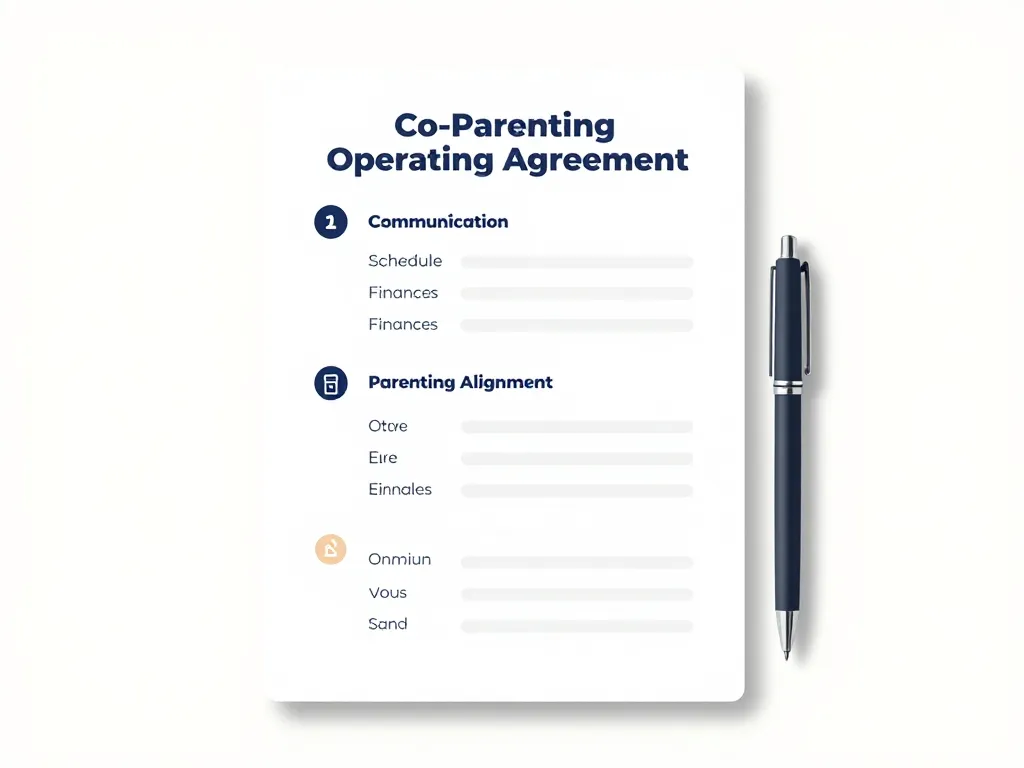
Step 1: Draft Your Co-Parenting Operating Agreement
Every successful business has foundational documents — articles of incorporation, partnership agreements, operating procedures. Your co-parenting relationship needs the same thing: a co-parenting operating agreement.
This isn't your legal custody order (though it should align with one). This is a living document that covers the day-to-day operational details courts don't address.
What to Include
Communication protocols:
- What channel do you use? (Text for logistics, email for longer discussions, phone calls for emergencies only.)
- What's the expected response time? (e.g., 24 hours for non-urgent matters.)
- What topics are off-limits in front of the children?
Schedule management:
- How far in advance must schedule changes be requested?
- What's the process for holidays, school breaks, and special events?
- Who is the "default" decision-maker when a quick call is needed and you can't reach each other?
Financial policies:
- How are extracurricular costs split?
- What's the threshold for a purchase that requires mutual approval? (e.g., anything over $150.)
- When and how is reimbursement handled?
Parenting alignment:
- Are there shared rules on screen time, bedtimes, or homework expectations?
- How do you handle discipline differences between homes?
- What's the protocol for introducing new partners to the children?
Real-world example: Marcus and Tanya, co-parents to an 8-year-old, spent the first year after their divorce arguing over nearly everything — from birthday party guest lists to whether their son could have a phone. After creating a one-page operating agreement, their conflicts dropped dramatically. "We still disagree sometimes," Marcus says, "but now we disagree about things that are actually debatable, not stuff we already decided six months ago."
Servanda can help co-parents create written agreements and document decisions so there's always a shared reference point — reducing the "I never agreed to that" spiral that derails many conversations.
Step 2: Run Meetings, Not Arguments
In business, you don't walk into a conference room and start free-associating about every grievance you've accumulated since last quarter. You work from an agenda. Co-parenting conversations need the same discipline.
The Weekly (or Biweekly) Co-Parenting Check-In
Set a recurring time — 20 minutes, no longer — to cover operational items. This isn't therapy. It's a business meeting.
Sample agenda structure:
- Schedule review (5 min): Confirm the coming week's pickups, drop-offs, and activities.
- Child updates (5 min): Share relevant information — school notices, health concerns, behavioral observations.
- Open items (5 min): Address any pending decisions (camp registration, doctor appointments, etc.).
- Action items (5 min): Summarize who's doing what and by when.
Ground Rules for the Meeting
- No revisiting the past. If it's not about a decision that needs to be made right now, it's off the agenda.
- One topic at a time. No stacking grievances.
- Write it down. Keep a shared document or email summary of decisions. "We agreed" is weaker than "Here's the note from March 12th."
- Use a timer if needed. This prevents a 10-minute check-in from becoming a 90-minute emotional excavation.
When You Can't Meet Without Conflict
Some co-parenting relationships are too volatile for real-time conversations, at least initially. In these cases:
- Move to written-only communication (email or a co-parenting app).
- Use a 48-hour rule: draft your message, wait 48 hours, reread it, then send.
- Consider parallel parenting — a model where each parent operates independently within their own home, with minimal direct interaction, while still aligning on major decisions.
Step 3: Define Your Shared KPIs
In business, KPIs (Key Performance Indicators) are the measurable outcomes that tell you whether you're succeeding. Co-parenting needs the same thing — not to grade each other as parents, but to create a shared definition of success that keeps conversations anchored.
Your co-parenting KPIs should center entirely on your child's well-being:
| KPI Area |
What to Track |
How to Monitor |
| Academic stability |
Grades, teacher feedback, homework completion |
Shared access to school portal, brief updates at check-ins |
| Emotional health |
Mood changes, anxiety, behavioral shifts |
Observations from both homes, therapist feedback if applicable |
| Schedule consistency |
On-time transitions, adherence to agreed routines |
Calendar tracking, honest self-assessment |
| Social development |
Friendships, extracurricular participation |
Notes from both parents |
| Conflict exposure |
How often children witness or sense parental tension |
Self-monitoring, child's behavior as a signal |
When both parents track the same outcomes, disagreements shift from "you always..." and "you never..." to "our child's math grades dropped this semester — what should we adjust?"
That's a fundamentally different conversation.

Step 4: Apply the Colleague Test to Every Interaction
Before you send a text, leave a voicemail, or respond to something that triggered you, ask: "Would I say this to a colleague I respect but don't particularly like?"
If the answer is no, revise.
This doesn't mean you suppress your emotions. Feel them fully — with your therapist, your journal, your best friend, your support group. But your co-parent is no longer the appropriate audience for your emotional processing about the relationship. They are your business partner in parenting, and the communication should reflect that.
What the Colleague Test Filters Out
- Sarcasm and passive aggression ("Sure, like YOU'D know what consistency looks like.")
- Emotional dumping ("I can't believe after everything you put me through, you're now asking for...")
- Relitigating the relationship ("This is exactly why we didn't work.")
- Weaponizing the children ("The kids told me they don't even want to go to your house.")
What Passes the Colleague Test
- "Can we revisit the holiday schedule? I'd like to propose an adjustment for Thanksgiving."
- "Heads up — she mentioned feeling anxious about the school presentation. Might be worth checking in."
- "I won't be able to accommodate the schedule change this week. Can we look at alternatives?"
The colleague test isn't about being fake. It's about being strategic. Your child benefits most when their parents communicate with clarity and calm.
Step 5: Handle Breaches Like a Contract Dispute, Not a Betrayal
Your co-parent will drop the ball. You will too. Missed pickups, forgotten permission slips, unapproved haircuts — it happens. The question is how you respond.
In business, when a partner violates an agreement, you don't burn the partnership to the ground. You:
- Document the issue — factually, without editorializing.
- Raise it directly — "The agreement says pickup is at 5:00. Today it was 5:45 without a heads-up. Can we address that?"
- Seek a remedy — not punishment. "Going forward, can we agree to a text if you're going to be more than 10 minutes late?"
- Escalate only when necessary — if breaches are frequent and unresolved, that's when you involve a mediator, parenting coordinator, or attorney.
The operating agreement is your reference point. When someone violates it, you point to the agreement, not to their flaws as a human being.
Common Pitfalls (and How to Avoid Them)
Pitfall 1: Using "Business" as Emotional Armor
The business metaphor is a framework, not a force field. If you use professional language to stonewall or dismiss legitimate concerns ("That's not on the agenda"), you're weaponizing structure. Stay professional and responsive.
Pitfall 2: Expecting Perfection Overnight
You're rewiring communication patterns that have been dysfunctional for years. There will be setbacks. The goal isn't zero conflict — it's a system for recovering from conflict faster.
Pitfall 3: Assuming Your Co-Parent Will Match Your Effort
You can only control your half of the dynamic. If your co-parent isn't interested in this approach, you can still apply the colleague test, set agendas for yourself, and document agreements unilaterally. Structure is still valuable even when it's one-sided.
Pitfall 4: Forgetting the "Why"
On the hardest days, remember the sole purpose of all this structure: a child who feels safe, loved, and free from the burden of their parents' conflict.
Frequently Asked Questions
How do I get my co-parent on board with this approach?
You don't need buy-in to start. Begin by modeling the behavior — send structured messages, propose agendas for conversations, and reference written agreements. Many co-parents naturally mirror professionalism when they consistently receive it. If they resist, focus on what you can control and consider involving a mediator to introduce the framework neutrally.
Is co-parenting like a business the same as parallel parenting?
Not exactly. Parallel parenting minimizes direct contact and lets each parent operate independently. The business co-parenting model still involves active collaboration — it just adds professional structure to that collaboration. However, if direct communication consistently escalates conflict, parallel parenting may be the healthier starting point, with the business model as a goal to work toward.
What if my co-parent uses our child to communicate instead of talking to me directly?
This is a boundary issue worth addressing head-on. You might say: "I'd prefer we keep the kids out of scheduling and logistics. Can we use text or email for that?" If the pattern continues, document it and raise it with a mediator or family therapist. Children should never be messengers between their parents.
How do I handle emergencies that don't fit the structured approach?
Emergencies — a child's injury, a safety concern, an urgent school issue — always override the structure. Define in your operating agreement what qualifies as an emergency (e.g., medical situations, safety threats) and agree on the protocol: direct phone call, immediate response expected. The structure exists to handle the routine co-parenting so you have clarity and calm for what isn't.
Can this approach work if there's a history of high conflict or abuse?
If there's a history of abuse or controlling behavior, direct business-style collaboration may not be safe or appropriate. In these cases, parallel parenting with minimal contact — often through a parenting coordinator or legal intermediary — is typically recommended. Safety always comes before structure. Work with a family law professional to determine the right communication model for your situation.
Conclusion
Co-parenting like a business isn't about stripping the emotion out of raising your child. It's about building a container strong enough to hold the emotion without letting it spill into every logistical conversation. Your operating agreement, your agendas, your KPIs, your colleague test — these are guardrails, not walls.
Most co-parents don't lack love for their children. They lack a functional system for working with someone they're no longer choosing to be with. A business framework gives you that system.
Start small. Pick one element from this guide — the colleague test, the weekly agenda, the operating agreement — and try it for two weeks. You don't have to overhaul everything at once. You just have to decide that your child's peace matters more than your co-parent's last text.