
The Cofounder Agreement You Need Now
You launched three months ago. Things are moving fast. You and your cofounder are finishing each other's sentences, pulling late nights, and riding the high of early traction. Formalizing things on paper feels unnecessary — maybe even a little awkward, like asking someone you love to sign a prenup.
Then one morning, your cofounder tells you they've been interviewing for a full-time role. Or they want to bring in a third partner you've never met. Or they believe their 50% equity entitles them to override your product decisions.
Suddenly, the handshake that launched your company isn't enough.
A cofounder agreement isn't a sign of distrust. It's a sign that both founders take the business — and each other — seriously enough to build on solid ground. This guide walks you through exactly what your cofounder agreement needs to cover, how to draft one without a $10,000 legal bill, and why the best time to create one was yesterday.
Key Takeaways
- A cofounder agreement is not optional. Nearly 65% of startups fail due to cofounder conflict, and the absence of a written agreement makes every dispute harder to resolve.
- Cover the hard conversations first. Equity splits, vesting schedules, roles, decision-making authority, and exit terms are the five non-negotiable sections of any cofounder agreement.
- Vesting protects everyone. A four-year vesting schedule with a one-year cliff ensures no one walks away with equity they haven't earned.
- Plan for the worst while you still like each other. Departure clauses, IP ownership, and dispute resolution processes are dramatically easier to negotiate when emotions are neutral.
- You don't need a lawyer to start. Draft the agreement together first, then have legal counsel review it. The conversation matters as much as the document.
Why Most Cofounders Skip the Agreement (And Pay for It Later)
The number one reason cofounders don't formalize their agreement is simple: it feels unnecessary when things are going well. You're aligned, you're excited, and stopping to negotiate legal terms feels like pouring cold water on momentum.
But here's what the data tells us: a Harvard Business School study found that founding team problems are responsible for 65% of startup failures. Not bad products. Not bad markets. People problems.
Consider this real scenario:
Two friends — let's call them Priya and Marco — started a SaaS company together. They split equity 50/50 over coffee and got to work. Eight months in, Priya was working 70-hour weeks while Marco had gradually reduced his involvement to 10 hours. When Priya confronted Marco, he pointed out that they'd agreed on equal equity. No written agreement defined roles, expectations, or what would happen if one founder stopped contributing. The company collapsed three months later — not from lack of customers, but from a fight over fairness that had no framework for resolution.
A cofounder agreement wouldn't have prevented Marco from pulling back. But it would have given Priya a clear, pre-agreed mechanism to address it. That's the difference between a difficult conversation and a company-ending one.
What Your Cofounder Agreement Must Cover
Below are the essential sections every cofounder agreement needs. Skip any of them, and you're leaving a gap that future conflict will fill.
1. Roles and Responsibilities
This is where most founders get vague, and vagueness breeds resentment. Your agreement should specify:
- Who handles what. Not just titles (CEO, CTO), but functional responsibilities. Who manages hiring? Who owns the product roadmap? Who handles fundraising?
- Decision domains. Which decisions can each founder make independently, and which require mutual agreement?
- Time commitment expectations. Is this full-time for both founders? If one keeps a day job during the early months, when does that change?
Be specific. "Marco handles engineering" is too loose. "Marco is responsible for all product development, technical architecture decisions, and engineering hiring, committing a minimum of 40 hours per week" gives everyone clarity.
2. Equity Split and Vesting
Equity is the most emotionally charged topic in any cofounder relationship, and it deserves a careful, honest conversation.
The split itself: Equal splits (50/50) are common but not always fair. Consider factors like:
- Who originated the idea
- Who's contributing capital
- Who's working full-time versus part-time
- Relevant expertise and networks each founder brings
- Opportunity cost each founder is absorbing
There's no universal formula. What matters is that both founders feel the split reflects their contributions and commitments — and that you discuss it openly rather than defaulting to equality out of politeness.
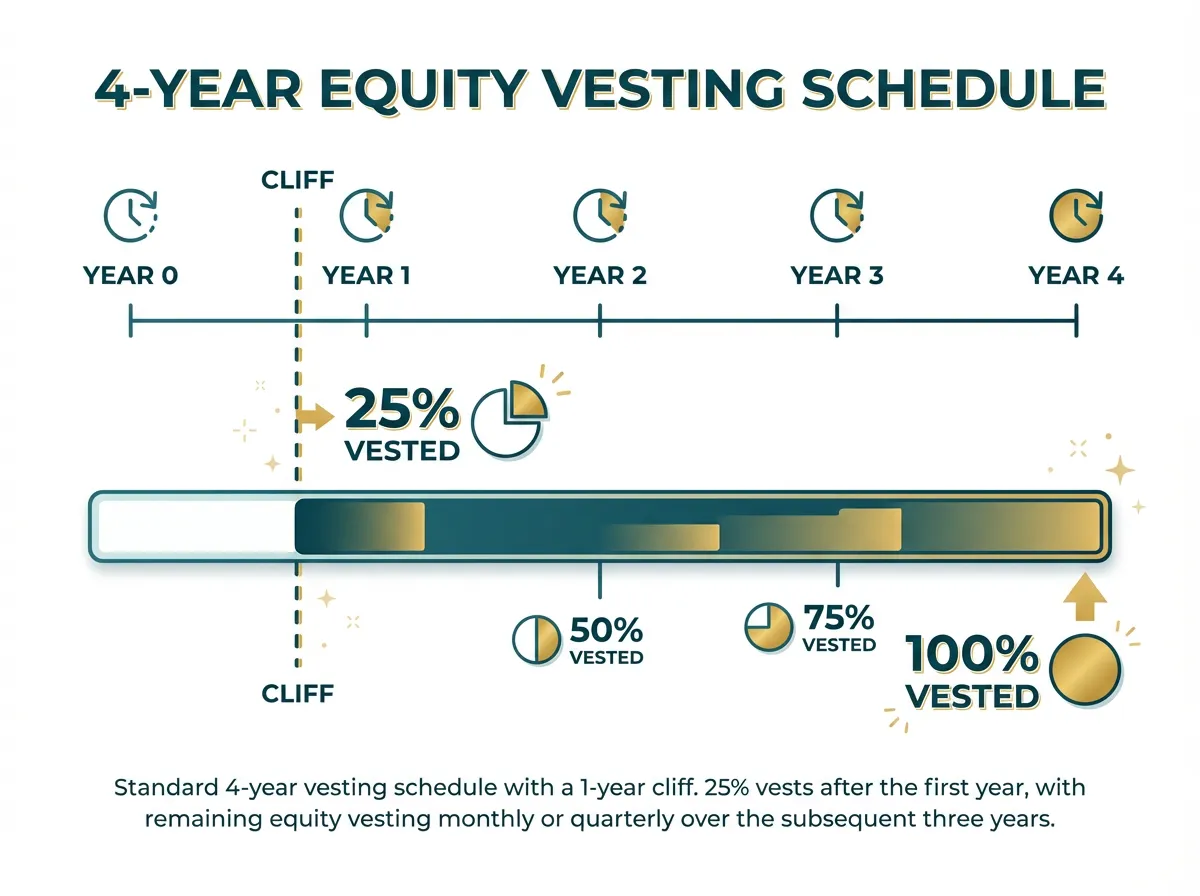
The vesting schedule: This is non-negotiable. Even if you trust your cofounder completely, vesting protects both of you.
The industry standard is:
- 4-year vesting period with a 1-year cliff
- After the cliff, 25% of equity vests. The remaining 75% vests monthly or quarterly over the next three years.
- If a founder leaves before the cliff, they receive no equity.
Vesting ensures that equity is earned through sustained contribution, not granted as a gift on day one.
3. Intellectual Property Assignment
This one is straightforward but frequently overlooked. Your cofounder agreement should state clearly:
- All intellectual property created for the company belongs to the company — not to the individual founder who created it.
- Any pre-existing IP a founder brings to the company should be explicitly listed and licensed or assigned.
- Work created by contractors or employees is covered by separate IP assignment agreements.
Without this clause, a departing cofounder could argue they own the codebase they wrote, the brand identity they designed, or the client relationships they built. That argument has destroyed companies.
4. Decision-Making and Deadlock Resolution
A 50/50 equity split with two founders means deadlocks are inevitable. Your agreement needs a plan for when you can't agree:
- Tiered decision-making. Day-to-day decisions under a certain financial threshold can be made independently. Strategic decisions (fundraising, pivots, major hires) require consensus.
- Deadlock breaker. Options include bringing in a trusted advisor to cast the deciding vote, agreeing to defer to the founder whose domain the decision falls in, or engaging a neutral third-party mediator.
- Escalation timeline. If you can't agree within 14 days, what's the next step? Don't leave this open-ended.
The goal isn't to prevent disagreements — those are healthy. The goal is to prevent disagreements from becoming paralysis.
5. What Happens When a Founder Leaves
No one wants to think about this when they're building together, but departure terms are the most important section of your cofounder agreement. Cover these scenarios:
- Voluntary departure. If a founder decides to leave, what happens to their unvested equity? (It should return to the company.) What about vested equity? (Typically, the company or remaining founder has the right to repurchase it at fair market value.)
- Involuntary removal. Under what circumstances can a founder be removed? What's the process? What's the vote threshold if there are more than two founders?
- Death or disability. Morbid but necessary. Does the company have the right to buy back the deceased founder's shares? At what price?
- Non-compete and non-solicit. Can a departing founder start a competing company? Can they recruit your employees?
Think of departure clauses as a fire escape plan. You hope you'll never need it, but it has to exist before the fire starts.
6. Financial Contributions and Compensation
If one founder is investing money while the other invests sweat equity, this must be documented. Your agreement should cover:
- Initial capital contributions from each founder
- Whether those contributions are treated as equity, loans, or convertible notes
- Salary expectations — when founders will start drawing compensation, how much, and whether it's equal
- Expense approval processes and spending limits
7. Dispute Resolution Process
Even with the best agreement, disagreements will arise. Build a resolution process into the document:
- Direct conversation — the founders attempt to resolve the issue between themselves within a defined timeframe.
- Facilitated mediation — if direct conversation fails, bring in a neutral third party. Tools like Servanda can help cofounders structure these conversations and reach written agreements before tensions escalate into legal disputes.
- Binding arbitration — if mediation fails, agree to binding arbitration rather than litigation. It's faster, cheaper, and private.
Specify the governing law (which state's laws apply) and the location for any legal proceedings.

How to Actually Draft Your Cofounder Agreement
Here's a step-by-step process that doesn't require a lawyer upfront:
Step 1: Have the conversation first. Before anyone drafts a single word, sit down together and discuss each section above. Take notes. This conversation will reveal misalignments you didn't know existed — and that's the point.
Step 2: Write a plain-language draft. Using your notes, write out the agreement in normal English. No legalese needed at this stage. The goal is to capture what you've agreed to in a way both founders understand and endorse.
Step 3: Use a template as a structural guide. Resources like Y Combinator's SAFE documents, Clerky, or Stripe Atlas offer cofounder agreement templates. Use these to make sure you haven't missed critical clauses, but don't copy them blindly — your agreement should reflect your specific situation.
Step 4: Have a lawyer review it. Once you've agreed on the substance, hire a startup attorney to formalize the language and catch anything you've missed. This review typically costs $500–$2,000 — a fraction of the cost of litigating a cofounder dispute later.
Step 5: Sign it and revisit it. Both founders sign. Store the agreement somewhere accessible (not someone's personal Google Drive). Set a calendar reminder to review it annually — your roles, contributions, and circumstances will evolve.
Common Mistakes to Avoid
- Defaulting to 50/50 to avoid a hard conversation. An equity split that feels unfair to one founder will corrode the relationship over time. Better to negotiate honestly now.
- Forgetting vesting. Without vesting, a founder who leaves after two months still owns half your company. This is the single most common cofounder agreement mistake.
- Making it too rigid. Your agreement should be a living document. Include an amendment clause that allows both founders to update terms by mutual written consent.
- Ignoring the IP clause. Especially relevant if either founder is contributing pre-existing code, designs, or content.
- Treating it as a one-time event. An agreement signed and never revisited becomes irrelevant as the company evolves.
When You Already Have a Dispute
If you're reading this because you're already in conflict with your cofounder, it's not too late to formalize things — but the process looks different.
Start by identifying what you actually disagree about. Is it equity? Roles? Direction? Often, what feels like a values conflict is actually a structural problem: there's no agreed-upon framework for making the decision at hand.
Even without a formal agreement, you can create one now. The document will be forward-looking — it won't retroactively resolve past grievances, but it will create a shared framework for navigating current and future ones.
If the conflict is too heated for direct negotiation, bring in a neutral third party. A business mediator, a mutual advisor, or even a structured AI mediation tool can help both founders articulate their positions and find common ground.
FAQ
Is a cofounder agreement legally binding?
Yes, a cofounder agreement is a legally binding contract when properly signed by all parties. While a handshake or verbal agreement can technically be enforceable in some jurisdictions, written agreements are dramatically easier to enforce and leave far less room for misinterpretation. Always have a lawyer review the final version.
Do we need a cofounder agreement if we're incorporating?
Incorporation documents (articles of incorporation, bylaws, operating agreements) cover corporate governance but typically don't address the specific interpersonal commitments between founders — things like role definitions, vesting schedules, or what happens if someone stops contributing. A cofounder agreement fills those gaps and works alongside your corporate documents.
Can we write a cofounder agreement ourselves or do we need a lawyer?
You can absolutely draft the agreement yourselves — and in fact, the drafting conversation is one of the most valuable parts of the process. However, you should have an attorney review the final document to ensure it's enforceable and doesn't contain gaps or contradictions. Think of it as: founders write the substance, the lawyer ensures the structure.
What if my cofounder doesn't want to sign an agreement?
A cofounder who refuses to formalize the relationship is telling you something important. Gently explore why — they may feel it signals distrust, or they may be uncomfortable with the commitments it requires. If they still refuse after an honest conversation, consider that a significant red flag. Building a company without a written agreement puts both of you at risk.
How often should we update our cofounder agreement?
Review your agreement at least once a year, and any time there's a major change: a new funding round, a new cofounder joining, a significant pivot, or a change in anyone's role or time commitment. Include an amendment clause in the original agreement that specifies how updates are made (typically, mutual written consent).
Conclusion
A cofounder agreement isn't paperwork — it's the foundation your entire company stands on. It protects both founders equally, eliminates ambiguity during high-stakes moments, and gives your partnership the structure it needs to survive the inevitable hard times.
The best cofounder agreements are drafted when things are good, when both founders are clear-headed and generous. They cover equity and vesting, roles and responsibilities, intellectual property, decision-making processes, departure terms, and dispute resolution.
You don't need a perfect document. You need an honest conversation and a willingness to put it in writing. Start today — open a shared document, walk through each section in this guide, and begin writing down what you've agreed to. Your future selves, and your future company, will thank you for it.