
Cofounder Breakup Post-Mortem: What Went Wrong
You started the company together over late-night whiteboard sessions and too much coffee. You finished each other's pitches. You told investors—and yourselves—that your cofounder relationship was your competitive advantage.
Then, somewhere between the seed round and the Series A, everything fell apart. Maybe it was a slow erosion. Maybe it was a single, volcanic argument that split the earth between you. Either way, you're now staring at the wreckage and asking the same question every broken-up founder asks: What actually went wrong?
If you're in the middle of a cofounder breakup—or looking back on one trying to make sense of it—this post-mortem framework is for you. We've studied real founder stories, from Yiren Lu's widely-shared account of her cofounder split to anonymized narratives from Y Combinator forums and founder therapy groups, and distilled them into repeatable patterns. Not so you can assign blame. So you can learn.
Key Takeaways
- Most cofounder breakups follow predictable patterns—misaligned vision, unspoken expectations, and avoidance of hard conversations show up in nearly every story.
- The "founding myth" can mask real incompatibility—early-stage chemistry doesn't guarantee long-term operational alignment.
- Equity and role ambiguity are silent killers—the conversations founders skip at the beginning become the conflicts that end the company later.
- A structured post-mortem helps you heal and learn—treating your breakup with the same rigor you'd give a failed product launch turns pain into wisdom.
- Written agreements aren't a sign of distrust—they're a sign of maturity—the founders who formalize expectations early are the ones who survive disagreements.
Why Cofounder Breakups Deserve a Real Post-Mortem
In engineering, we run post-mortems on system outages. In product, we debrief failed launches. But when a cofounder relationship collapses—arguably the most consequential failure a startup can experience—most founders just… walk away. They bury it under euphemisms in their LinkedIn updates ("pursuing new opportunities") and try to move on.
This is a mistake. Without a post-mortem, you carry the same patterns into your next venture, your next partnership, your next hire. You repeat the same mistakes with different people.
A cofounder breakup post-mortem isn't about relitigating who was right. It's a structured examination of the dynamics, decisions, and environmental factors that led to the split. Think of it as forensic analysis, not a courtroom.
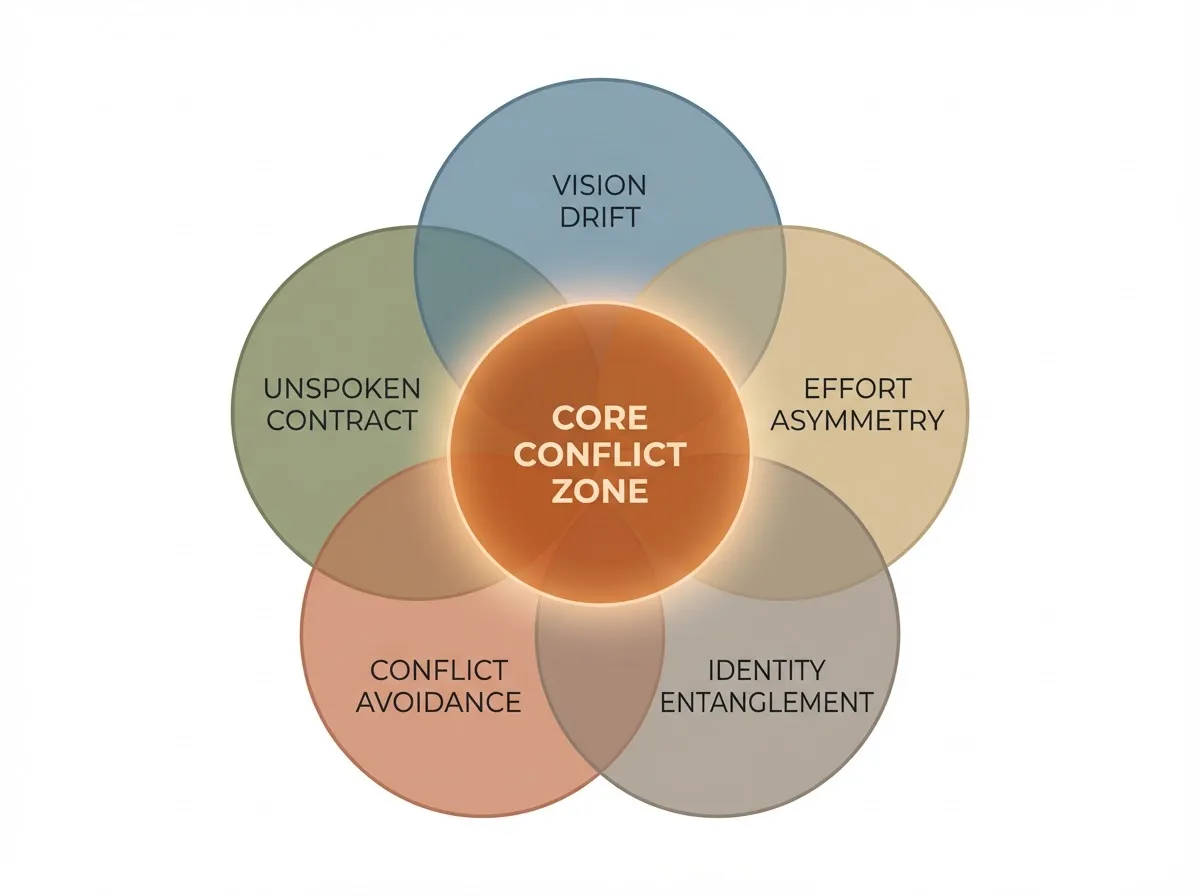
The Five Patterns Behind Nearly Every Cofounder Breakup
After analyzing dozens of founder breakup stories—public essays, podcast confessionals, and private conversations—the same five patterns surface over and over. Your breakup probably involves at least two of them.
Pattern 1: The Vision Drift
What it looks like: You started with a shared vision, but over time, each founder's definition of "what we're building" quietly diverged. One founder wants to build a venture-scale business; the other wants a profitable lifestyle company. One is chasing enterprise clients; the other is obsessed with consumer.
Real example: In Yiren Lu's account of her cofounder split, a core tension was the gradual realization that she and her cofounder had fundamentally different ideas about the company's direction—differences that were invisible during the excitement of starting but became undeniable under the pressure of execution.
Why it's so common: In the early days, vision is abstract enough that two people can nod along to the same pitch deck while imagining completely different futures. The specifics only matter when you have to make real trade-offs—and by then, you've built a company on top of the ambiguity.
The post-mortem question to ask: When did our visions actually diverge? Was there a specific decision point where we chose to paper over the difference instead of confronting it?
Pattern 2: The Unspoken Contract
Every cofounder relationship operates on two sets of expectations: the ones you discussed and the ones you assumed. The unspoken contract is the set of beliefs each founder holds about what they're owed, what's fair, and how decisions should be made—without ever actually articulating them.
What it sounds like after the breakup: - "I assumed we'd both be working 80-hour weeks. They started leaving at 5." - "I thought we agreed I'd be the CEO. They started making decisions without me." - "I brought in the technical expertise. I expected that to count for more equity."
Why it's dangerous: The unspoken contract feels so obvious to the person holding it that they never think to say it out loud. When the other founder violates it, it doesn't feel like a misunderstanding—it feels like a betrayal.
The post-mortem question to ask: What expectations did I never explicitly communicate? What assumptions did I treat as facts?

Pattern 3: The Effort Asymmetry
This is the pattern founders bring up most often, and it's also the trickiest. One founder feels like they're carrying the company while the other coasts. But here's the uncomfortable truth: in most cases, both founders feel like the one doing more.
Why both sides feel this way: Different founders contribute in different ways. The technical cofounder writes code until 2 AM but doesn't see the business cofounder's networking, fundraising, and emotional labor. The business cofounder closes deals but doesn't appreciate the invisible infrastructure the engineer is maintaining. Each person tracks their own sacrifice in high definition and their partner's contribution in low resolution.
When it becomes fatal: Effort asymmetry becomes a breakup catalyst when it intersects with Pattern 2 (unspoken expectations). If you never agreed on what "equal contribution" actually looks like in practice, you're both keeping score with different scoring systems.
The post-mortem question to ask: Did we ever define what each person's contribution would look like in concrete terms? Or were we relying on a vague sense of fairness?
Pattern 4: The Conflict Avoidance Spiral
This one is counterintuitive: many cofounder breakups happen not because the founders fought too much, but because they fought too little.
How the spiral works:
- A small disagreement surfaces (pricing strategy, a hire, a product decision)
- Neither founder wants to damage the relationship, so they compromise superficially or just drop it
- The underlying issue doesn't go away—it compounds
- Resentment builds in the background
- Eventually, the accumulated weight of a hundred un-had conversations collapses the relationship in a single explosive moment
Real pattern from founder forums: One anonymous YC founder described it this way: "We prided ourselves on never fighting. Turns out, we were just never resolving anything."
The post-mortem question to ask: What were the small conflicts we avoided? If I made a timeline of suppressed disagreements, what pattern would emerge?
Pattern 5: The Identity Entanglement
This is the pattern nobody talks about on podcasts but every founder therapist knows well. When your identity becomes inseparable from the company—and your cofounder—a business disagreement stops being a strategic question and becomes an existential threat.
What it looks like: - Criticism of an idea feels like criticism of you as a person - Your cofounder wanting to pivot feels like them rejecting your life's work - The prospect of the partnership ending feels like losing a part of yourself
Why it escalates: When identity is entangled, every conversation carries emotional stakes that are wildly disproportionate to the actual business decision at hand. A debate about pricing becomes a referendum on your worth. The rational part of your brain goes offline.
The post-mortem question to ask: Where did I stop being able to separate myself from the company? When did business disagreements start feeling personal?
How to Run Your Own Cofounder Breakup Post-Mortem
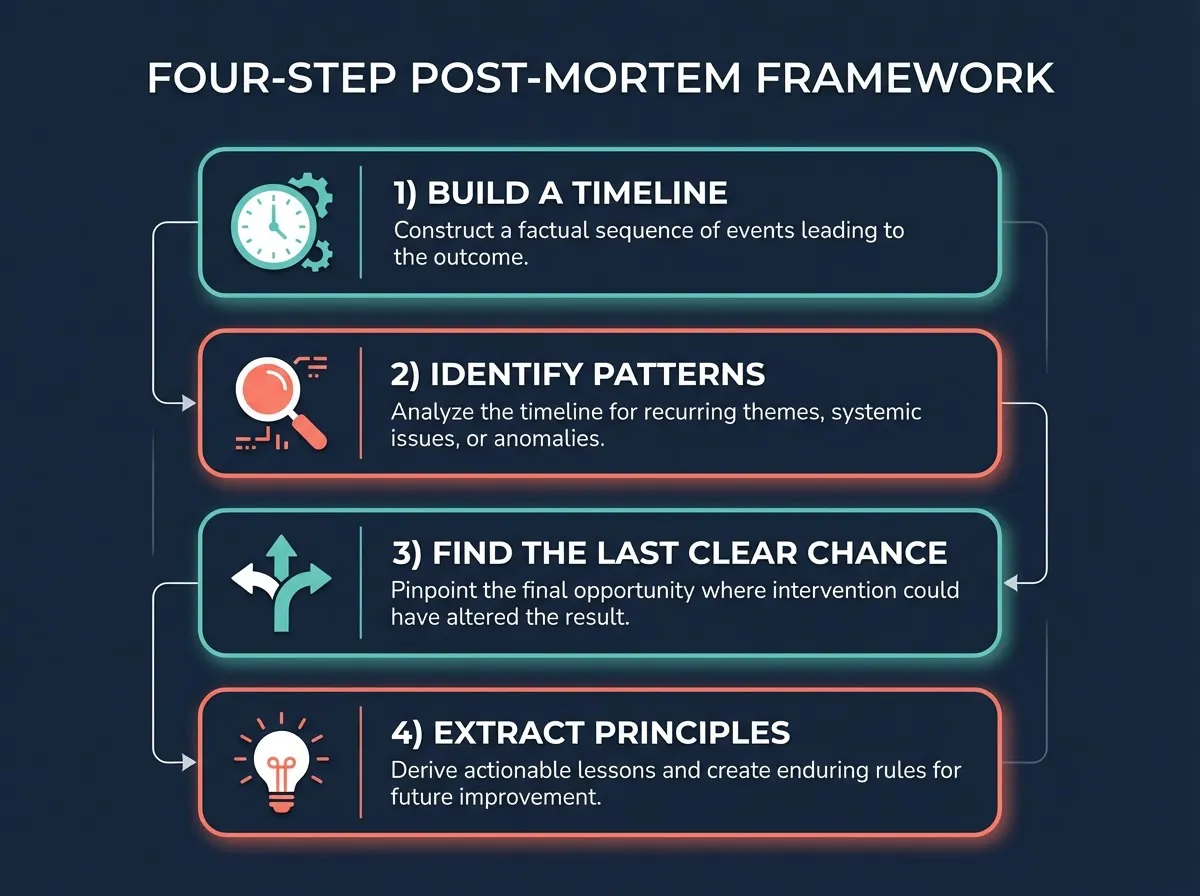
If you've been through a cofounder split and want to actually learn from it, here's a structured framework you can use—alone, with a therapist, or even with your former cofounder if you're both willing.
Step 1: Build a Timeline, Not a Narrative
Before you analyze anything, write down what happened chronologically. Dates, decisions, milestones, and turning points. Strip out interpretation. Just events.
Why this matters: our memories of conflict are heavily colored by emotion. The narrative in your head probably skips straight from "everything was great" to "everything fell apart." The timeline reveals the middle—the slow accumulation of friction that you've compressed into a clean story.
Step 2: Identify the Patterns
Look at your timeline through the lens of the five patterns above. Which ones show up? Most breakups involve two or three overlapping patterns.
Be honest about your own role. The hardest part of any post-mortem is resisting the urge to cast yourself as the reasonable one who was wronged. You might have been. But even if you were, there were moments where you made choices—to avoid a conversation, to assume instead of ask, to prioritize being right over being effective.
Step 3: Find the "Last Clear Chance"
In law, there's a concept called the "last clear chance" doctrine—the last moment when one party could have prevented the harm. Look for yours.
Was there a conversation you could have initiated? An agreement you could have formalized? A moment when you noticed something was off but chose to ignore it?
This isn't about self-blame. It's about identifying your leverage points for the future.
Step 4: Extract Your Principles
Based on what you've learned, write down 3-5 operating principles for your next partnership. Not generic advice—specific rules born from your specific experience.
Examples: - "I will never start a company without a written agreement covering roles, equity vesting, and exit terms—even with my best friend." - "I will schedule a monthly cofounder check-in where we explicitly discuss what's working and what isn't." - "I will raise disagreements within 48 hours instead of letting them fester."
These principles become your personal operating manual. They're worth more than any business book because they come from your actual scar tissue.
What You Can Do Right Now to Prevent the Next One
If you're reading this because you're currently in a cofounder relationship—not a former one—here's what you can do today:
1. Have the uncomfortable conversation you've been postponing. You know the one. About equity, about roles, about where you see the company in three years. The longer you wait, the harder it gets.
2. Write things down. Verbal agreements are just shared memories, and memories are unreliable. Document your expectations about roles, decision-making authority, what happens if someone wants to leave, and how you'll handle disagreements. Tools like Servanda can help cofounders formalize these agreements in a structured way before tensions rise—turning vague understandings into clear, written commitments.
3. Create a regular "state of the cofoundership" check-in. Not a business update—a relationship check-in. What's working? What's frustrating? What are you afraid to say? Schedule it monthly. Treat it as sacred.
4. Define decision-making authority explicitly. Who has final say on product? On hiring? On strategy? "We'll just figure it out together" works until it doesn't. Clear domains of authority prevent the slow-motion power struggles that corrode trust.
5. Agree on your exit terms before you need them. Vesting schedules, buyout provisions, IP ownership. Negotiating these when you still like each other is a thousand times easier than negotiating when you don't.
FAQ
How do I know if my cofounder relationship is heading toward a breakup?
Watch for these early warning signs: you're avoiding important conversations, you feel resentment after meetings, you're making decisions without consulting each other, or you find yourself venting to others instead of talking directly to your cofounder. One or two of these occasionally is normal. All of them consistently is a red flag that needs immediate attention.
Can a cofounder breakup be done well?
Absolutely. Some of the most successful companies in Silicon Valley history—including Apple and Twitter—went through cofounder departures and survived. The key is handling the separation with clear terms, legal structure, and mutual respect. A clean, well-documented breakup is infinitely better than a messy, drawn-out one that poisons the company.
Should I try to save my cofounder relationship or just end it?
That depends on whether the underlying issues are fixable. Vision misalignment and values differences tend to be fundamental—those don't resolve with better communication. But conflicts rooted in unclear expectations, role ambiguity, or poor conflict habits can often be repaired if both founders are willing to do the work. A structured conversation (or mediation) to identify the root cause is the best first step.
How do I protect myself legally during a cofounder split?
First, review your existing agreements—operating agreement, shareholder agreement, vesting terms, and IP assignments. If you don't have these (which is common and devastating), consult a startup attorney immediately. Document everything. Avoid making unilateral decisions about company assets. And no matter how angry you are, communicate in writing to create a clear record.
What should I do differently with my next cofounder?
Start with a "prenup" for the business: written agreements covering equity, vesting, roles, decision-making, and exit terms. Work together on a real project for at least a few months before formalizing anything. Have explicit conversations about vision, risk tolerance, and work style. And build in regular check-ins from day one—not as a sign of weakness, but as a foundation of trust.
Moving Forward
A cofounder breakup is one of the most disorienting experiences in a founder's life. It's a business failure and a personal loss wrapped into one. But it doesn't have to be wasted pain.
The founders who emerge strongest from breakups are the ones who treat the experience with curiosity instead of just bitterness. They run the post-mortem. They identify the patterns. They extract principles. And they carry those lessons—not the resentment—into whatever they build next.
Your breakup isn't the end of your founder story. It's a chapter that, if you read it honestly, makes every chapter after it better. The patterns are there if you're willing to look. And the next partnership you build will be stronger for it.