
I Quit My Own Startup: When to Walk Away
At 3:14 a.m. on a Tuesday, I was lying on my back staring at the ceiling, heart hammering at 112 bpm according to my watch, running through the same argument with my cofounder for the fifth consecutive night — except she wasn't in the room. She was asleep somewhere across town, probably fine. I was the one rehearsing rebuttals to things she'd said nine hours earlier, feeling the adrenaline spike every time I imagined the next morning's Slack message.
I'd built this company. I'd quit a good job, burned through savings, pitched sixty investors, and slept on an air mattress in our first office. And now I was wondering if the healthiest, smartest thing I could do was leave.
If you're a cofounder staring at that same ceiling, replaying the same fights, wondering whether walking away means you're a quitter or you're finally being honest with yourself — this article is for you.
Key Takeaways
- Cofounder conflict isn't just stressful — it's a measurable health crisis. Chronic insomnia, elevated cortisol, anxiety attacks, and cardiac strain are real consequences of staying in a broken partnership.
- There's a difference between productive tension and destructive conflict. Learn to identify which one you're living in before making a decision.
- Walking away is not the same as giving up. Leaving a deteriorating partnership can be the most responsible thing you do — for yourself, your team, and even the company.
- Formalize your exit before emotions peak. Having a cofounder agreement with clear exit terms turns a chaotic breakup into a structured transition.
- Your identity is not your startup. Disentangling the two is the hardest and most important work you'll do.
The Night My Body Made the Decision for Me

I want to tell you there was a single dramatic moment — a screaming match, a betrayal, a line crossed. But that's not how most cofounder breakups work. Mine was erosion.
Over eighteen months, my cofounder and I went from finishing each other's sentences to not finishing conversations at all. Decisions that used to take a whiteboard session now took weeks of passive-aggressive emails. I started dreading our Monday syncs. She started canceling them.
But here's what nobody talks about when they write about startup conflict: the body keeps score.
By month fourteen, I was averaging four hours of broken sleep a night. My resting heart rate, which had always hovered around 62, climbed to the low 80s. I developed a jaw-clenching habit so severe my dentist asked if I'd been in an accident. I had my first panic attack in a grocery store parking lot on a Sunday afternoon — not during a board meeting, not during a product crisis. While buying oat milk.
A 2023 study published in the Journal of Business Venturing found that interpersonal conflict between cofounders produces stress responses comparable to those seen in hostile workplace environments and high-conflict divorces. The researchers measured cortisol, sleep disruption, and cardiovascular markers. The numbers were grim.
I didn't need a study. I had a Fitbit and a growing prescription for Xanax.
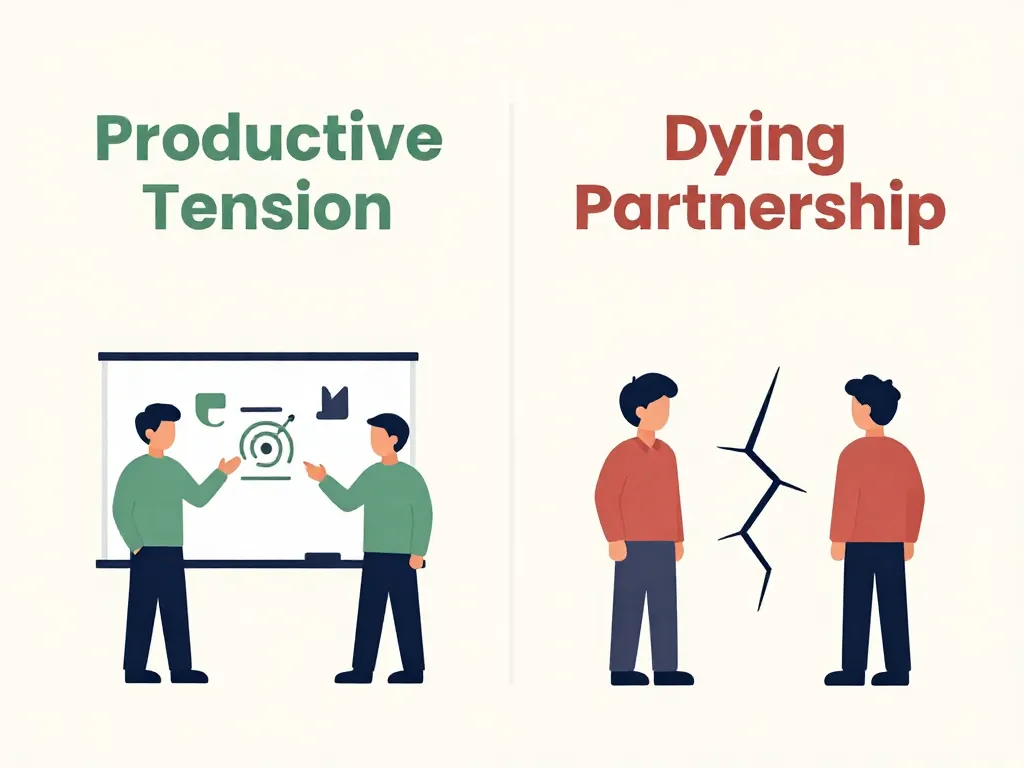
How to Tell If You're in Productive Tension or a Dying Partnership
Not all cofounder disagreement is bad. In fact, some of the best companies are built by cofounders who argue constantly — about strategy, product, priorities. The question isn't whether you disagree. It's how those disagreements resolve and what they leave behind.
Here's a framework I wish someone had given me earlier:
Signs of Productive Tension
- Disagreements are about the work, not about each other
- After an argument, you reach a decision and both commit to it
- You feel heard, even when you don't get your way
- Conflict doesn't follow you home (or into the shower, or onto your pillow at 3 a.m.)
- You still respect your cofounder's judgment
Signs of a Dying Partnership
- Arguments become personal — about character, motives, trustworthiness
- Decisions get relitigated repeatedly; nothing stays resolved
- You've stopped sharing what you really think because it's not worth the fight
- You're building a mental case against your cofounder, cataloging grievances
- Physical symptoms: insomnia, anxiety, appetite changes, elevated heart rate, dread
- You no longer believe your cofounder wants the same things you want
If the second list reads like a diary entry, keep reading.
The Five Questions I Asked Before I Quit My Own Startup
I didn't wake up one morning and decide to leave. I spent three months in a gray zone — too committed to walk away, too miserable to stay. Eventually, I forced myself to answer five questions with brutal honesty:
1. "If I met my cofounder today, would I choose to start a company with them?"
Not "do I love them as a person" or "are they talented." Would I actively choose this working relationship? My answer was no. It had been no for months. I'd just been too guilty to admit it.
2. "Am I staying because I believe in the future, or because I'm afraid of the loss?"
Sunk cost fallacy is the silent killer of cofounder relationships. I'd invested three years, significant money, and my professional reputation. Leaving felt like admitting those were wasted. They weren't — but I couldn't see that from inside the fog.
3. "What would I tell my best friend if they described this situation to me?"
This one broke the spell. I imagined a friend telling me they couldn't sleep, were having panic attacks, and dreaded every interaction with their business partner. I would have told them to get out. I would have been alarmed.
4. "Is there a version of this partnership that works, and have we tried to get there?"
This matters. I had to be honest about whether I'd actually tried — not just vented to friends or stewed in silence, but tried. Had we attempted mediation? Had we renegotiated roles? Had we acknowledged the conflict directly? In my case, we'd had one honest conversation about it, early on, and then retreated into avoidance. That avoidance was its own answer.
5. "What am I afraid will happen if I leave?"
I wrote this one down. The list was long: the company will fail. My cofounder will hate me. Investors will think I'm unreliable. My team will feel abandoned. I'll regret it. Some of those things happened. Most didn't. None of them were worse than what staying was doing to my health.
What Nobody Tells You About the Actual Exit
Let me save you some pain: the hardest part of leaving isn't making the decision. It's the logistics. And if you don't have a cofounder agreement — a real one, with vesting schedules, IP assignment, buyout terms, and a dispute resolution process — the logistics can turn into a legal nightmare that makes the emotional conflict look simple.
Here's what my exit actually involved:
The Conversation
I didn't ambush my cofounder. I told her I wanted to have a serious conversation about the future of our partnership, and I asked to do it with a neutral third party present. We used a startup-focused mediator. It cost $400 for a two-hour session. It was the best money I spent during my entire tenure at that company.
The conversation wasn't dramatic. It was sad. She admitted she'd been unhappy too. We'd both been performing "everything is fine" for the team, the investors, and each other.
The Agreement
Because we'd had the forethought — barely — to sign a cofounder agreement eighteen months earlier, we had a framework for what happened next. My vesting schedule dictated what equity I walked away with. Our agreement included a 90-day transition clause. It wasn't perfect, but it was something to negotiate from instead of fighting over from scratch.
If you don't have a cofounder agreement yet, stop reading this article and go make one. Seriously. Tools like Servanda help cofounders create written agreements that prevent future conflicts — including exit terms that feel abstract until the morning you desperately need them.
The Aftermath
I won't romanticize it. The first two months after leaving were disorienting. My identity had been fused with the startup for three years. Without it, I didn't know how to answer "So what do you do?" at dinner parties. I felt grief — real, physical grief — for a thing that was still alive but no longer mine.
But here's what else happened: within three weeks, my resting heart rate dropped back to 65. I slept through the night for the first time in over a year. The jaw clenching stopped. The panic attacks stopped.
My body had been screaming at me. I'd just been too busy listening to my ego.
When Walking Away Is the Strongest Move

Startup culture has a toxic relationship with perseverance. "Never give up" is a fine motto for product-market fit. It's a terrible motto for a human relationship that's making you sick.
Walking away from a cofounder conflict is not the same as walking away from your ambition, your vision, or your ability to build something. It's recognizing that this particular configuration isn't working, and that you deserve a working life that doesn't require a cardiologist.
Some data to sit with:
- 65% of startups fail due to cofounder conflict, according to Noam Wasserman's research at Harvard Business School.
- Founders experiencing chronic interpersonal conflict score significantly higher on burnout inventories than founders dealing with market or product challenges.
- A 2022 survey by First Round Capital found that cofounders who split amicably and early were more likely to start successful companies afterward than those who stayed in deteriorating partnerships.
Your next chapter might be better than this one. But you can't start it while you're trapped in a story that isn't working.
How to Leave Without Burning It All Down
If you've decided it's time, here's a practical roadmap:
-
Get legal advice first. Before you have The Conversation, understand your rights, your equity position, and your obligations. An hour with a startup attorney costs $300–$500 and can save you six figures.
-
Have the conversation with a neutral third party. A mediator, a mutual advisor, or even a therapist who specializes in professional relationships. Don't do this alone in a conference room.
-
Put the transition plan in writing. Who owns what. Who tells the team. Who talks to investors. What the timeline looks like. Ambiguity breeds resentment.
-
Tell your team honestly but carefully. They deserve to know, but they don't need every detail. "We've decided to go in different directions" is enough. Mean it.
-
Protect the relationship if you can. You may not be business partners anymore, but you shared something meaningful. A clean exit leaves the door open for mutual respect. A messy one closes it forever.
-
Get support. Therapy, a founder peer group, trusted friends. This is a significant life transition. Treat it like one.
Frequently Asked Questions
How do I know if cofounder conflict is bad enough to leave?
If the conflict is affecting your physical health — persistent insomnia, anxiety, elevated heart rate — or if you've lost fundamental trust in your cofounder's intentions, those are serious indicators. A good test: if nothing about the dynamic changed in the next six months, would you be okay staying? If the honest answer is no, it's time to plan your exit.
Can cofounder mediation save a partnership?
Absolutely — but only if both parties are genuinely willing to change. Mediation works best when the conflict is about misaligned expectations or poor communication structures, not broken trust. If you go in hoping the mediator will tell your cofounder they're wrong, it won't help.
What happens to my equity if I leave my own startup?
This depends entirely on your cofounder agreement and your vesting schedule. If you've vested a portion of your equity, you typically keep what's vested. If you don't have a written agreement, things get legally complicated fast. This is the single strongest argument for having a formal agreement from day one.
Will leaving my startup hurt my reputation with investors?
Less than you think. Experienced investors have seen dozens of cofounder splits. What they care about is how you handle it — whether you were professional, whether you ensured a smooth transition, and whether you protected the company during the process. A graceful exit can actually enhance your reputation.
How long does it take to recover emotionally from leaving a startup?
There's no universal timeline, but most founders I've spoken to describe a three-to-six-month adjustment period. The identity loss is the hardest part. Consider working with a therapist who understands entrepreneurship, and resist the urge to jump immediately into something new just to fill the void.
Moving Forward
I quit my own startup seventeen months ago. It was the hardest professional decision I've ever made and one of the best personal decisions.
The company still exists. My former cofounder and I exchange polite emails about quarterly reports. I no longer lie awake composing arguments. My health is back. I'm building something new — something better, partly because I now know what I need from a partnership and what I refuse to tolerate.
If you're in the gray zone right now, grinding your teeth and refreshing your cofounder's Slack messages at midnight, I want you to know: leaving isn't failing. Staying in something that's destroying you isn't brave. And the ceiling you're staring at tonight doesn't have any answers. Your body does. Listen to it.