
5 Warning Signs Your Cofounder Conflict Is Fatal
You're lying awake at 2 a.m. again. Not because of a product deadline or a funding crunch — but because of the conversation you had with your cofounder six hours ago. The one where you pitched a strategic pivot and they looked at you like you'd suggested burning the office down. Or maybe it was the silence afterward that rattled you — the kind where you both know something is deeply wrong, but neither of you has the vocabulary or the courage to name it.
Here's what no one tells you in the early days of starting a company together: most cofounder relationships end. Studies from Harvard Business School suggest that 65% of high-potential startups fail due to conflict among cofounders. And the hardest part isn't the fighting itself — it's the paralysis. You can't tell if what you're experiencing is the normal friction of building something hard, or the slow collapse of a partnership that's already dead.
This article is for the founders stuck in that gray zone. Not generic advice about "communicating better." Instead, these are the specific, documented red flags — drawn from startup post-mortems, Hacker News threads, and founder interviews — that signal it's time to stop fixing and start planning your exit.
Key Takeaways
- Diverging visions that can't be reconciled are different from healthy strategic debates — they erode the foundation of your entire company.
- Physical stress symptoms like insomnia, weight changes, and chronic anxiety are your body telling you something your brain hasn't accepted yet.
- Avoiding your cofounder rather than confronting issues is a sign the relationship has moved past productive conflict into silent decay.
- Contempt — not anger — is the true killer. When you've lost respect for your cofounder's judgment entirely, no amount of mediation can rebuild the partnership.
- The sooner you acknowledge a fatal conflict, the more you preserve — your equity, your team, your health, and your ability to build again.

Warning Sign #1: Your Visions Have Diverged — And Neither of You Will Bend
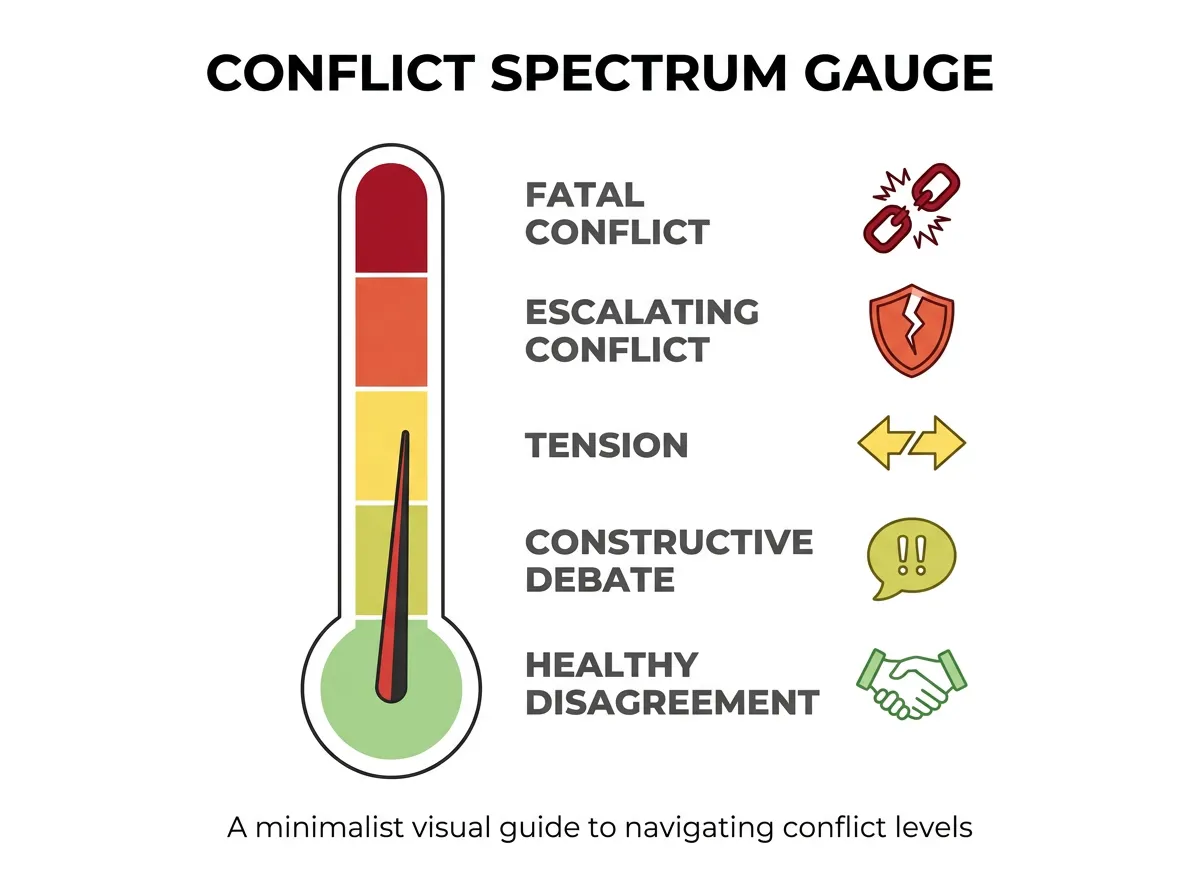
Healthy cofounders disagree about tactics all the time. Should we hire a salesperson or another engineer? Should we raise now or bootstrap for six more months? These are productive debates, and the tension they create often produces better decisions.
Fatal cofounder conflict looks different. It's not about how to reach the destination — it's about the destination itself.
Consider this anonymized story from a YC post-mortem: Two cofounders launched a developer tools company. Within 18 months, one wanted to go enterprise and chase large contracts. The other believed passionately in a self-serve, bottoms-up PLG model. They spent four months in a loop — presenting the same arguments, holding the same standoff, making no decision at all.
How to Recognize It
- You've had the same fundamental argument more than three times with no resolution.
- You find yourself making strategic decisions unilaterally because consensus feels impossible.
- When you imagine the company in two years, your picture and your cofounder's picture look like entirely different companies.
- Compromises feel like surrenders, not solutions.
The key distinction: tactical disagreements converge over time as data comes in. Vision disagreements tend to widen, because they're rooted in values, identity, and what each founder actually wants from their life — not just the business.
If you've been circling the same strategic impasse for months and the gap is getting wider, you're not dealing with a disagreement. You're dealing with two people who want to build two different companies.
Warning Sign #2: Your Body Is Keeping Score
Founders love to intellectualize everything. You'll build a pro-and-con spreadsheet about whether your cofounder relationship is working before you'll admit that you haven't slept through the night in three weeks.
But the body doesn't lie. In a widely-discussed Hacker News thread about cofounder breakups, a recurring theme emerged: founders who described their eventual split as "obvious in retrospect" almost always mentioned physical symptoms they had been ignoring for months.
The Physical Red Flags
- Chronic insomnia — not from excitement, but from dread. You're replaying conversations, rehearsing confrontations, catastrophizing.
- Appetite changes — either stress-eating or completely losing your appetite.
- Sunday anxiety — a knot in your stomach that builds on Sunday evenings, not because of work, but because of who you'll face at work.
- Increased alcohol or substance use to "take the edge off" after interactions with your cofounder.
- Jaw clenching, headaches, or back pain with no clear physical cause.
One founder described it this way in a post-mortem blog: "I'd lost 15 pounds. My doctor thought I had a thyroid problem. I didn't. I had a cofounder problem."
This isn't soft advice. Research on workplace conflict and health outcomes consistently shows that unresolved interpersonal conflict is one of the strongest predictors of burnout, anxiety disorders, and depression. Your startup isn't worth your health. Full stop.
What to Do
Start documenting. Not for legal purposes (though that may come) — for clarity. Write down what you're feeling physically, weekly, for a month. If the pattern is consistent and clearly tied to your cofounder dynamic, take it seriously. Talk to a therapist who understands entrepreneurial stress. And stop telling yourself this is normal.

Warning Sign #3: You're Avoiding Each Other — Not Fighting
Counterintuitively, the most dangerous phase of cofounder conflict isn't the loud one. It's the quiet one.
When cofounders are fighting, they're still engaged. They still care enough to argue. Avoidance is what happens after — when the emotional cost of another confrontation exceeds the perceived benefit. When you start routing around each other instead of through each other.
What Avoidance Looks Like in Practice
- You communicate primarily through Slack or email, even though you sit in the same office.
- You make decisions in your domain without informing your cofounder — not strategically, but because the conversation feels pointless.
- You dread one-on-one meetings and find reasons to cancel or shorten them.
- You've stopped sharing personal context — stress at home, health issues, doubts — because vulnerability feels unsafe.
- You've begun building a "shadow org" — relationships with team members, advisors, or investors that deliberately exclude your cofounder.
A founder on Hacker News described this phase as "running two startups under one roof." Each cofounder had carved out a separate fiefdom with its own priorities, its own team loyalties, and its own roadmap. The company looked functional from the outside. Inside, it was two organisms sharing a host.
Why This Is Fatal
Avoidance doesn't resolve conflict. It freezes it. The underlying issues remain, but now they're compounded by resentment, information silos, and a growing sense that you're no longer partners — you're roommates who share a cap table.
If you recognize this pattern, the question isn't whether you need to "improve communication." It's whether there's still a relationship worth communicating within.
Warning Sign #4: Contempt Has Replaced Respect
Relationship researcher John Gottman famously identified contempt as the single strongest predictor of divorce. The same principle applies to cofounder relationships with eerie accuracy.
Contempt isn't anger. Anger says, "I disagree with what you did." Contempt says, "I don't think you're capable of doing anything right." It's the eye-roll in a board meeting. It's the sarcastic comment about their work ethic to a mutual friend. It's the private conviction that you'd be better off without them — and that they're lucky to have you.
Signs of Contempt in a Cofounder Relationship
- You privately disparage your cofounder's intelligence, judgment, or work ethic to advisors, employees, or friends.
- When they propose an idea, your instinct is to find the flaw — not because you're being rigorous, but because you've stopped believing they produce good ideas.
- You feel embarrassed to be associated with them in investor meetings or customer calls.
- You've started mentally dividing contributions into "mine" and "theirs," with a clear hierarchy.
- You catch yourself thinking, "If I'd done this alone..."
Once contempt takes root, it is extraordinarily difficult to reverse. Unlike a disagreement about product strategy, which can be resolved with data and compromise, contempt is a judgment about a person's worth. You can't spreadsheet your way out of it.
A Hard Truth
If you feel contempt toward your cofounder, it's almost certainly mutual. Contempt leaks — through tone, body language, and the thousand micro-interactions that make up a working relationship. And once both cofounders are operating from a place of mutual contempt, every conversation becomes a confirmation of what each already believes about the other.
This is the red flag that most clearly separates recoverable conflict from fatal conflict. If you still respect your cofounder but disagree with them, there's something to work with. If respect is gone, you're not in a conflict — you're in a countdown.
Warning Sign #5: The Conflict Is Consuming the Company
The final warning sign isn't about you and your cofounder at all. It's about everyone around you.
When cofounder conflict metastasizes, it starts showing up in places that have nothing to do with the original disagreement:
- Team members start taking sides, or worse, start leaving because they don't want to be caught in the middle.
- Decision-making stalls because every choice becomes a proxy war for the larger conflict.
- Investors express concern — not about market risk or product risk, but about "team dynamics."
- Your best people start having "coffee chats" with recruiters, because the company culture has become anxious and unpredictable.
- You're spending more time managing the conflict than building the product.
A frequently cited startup post-mortem put it bluntly: "We didn't run out of money. We ran out of the ability to make decisions together. By the time we tried to fix things, three of our best engineers had already accepted offers elsewhere."
The Organizational Damage Is Often Irreversible
Here's what makes this warning sign especially urgent: even if you and your cofounder eventually resolve your differences, the organizational trust you've eroded may not come back. Employees who watched their leaders undermine each other for months don't simply forget. The culture absorbs the conflict like a sponge and wrings it out into every team dynamic, every hiring decision, every sprint planning meeting.
At this stage, formal intervention isn't optional — it's urgent. AI-powered mediation platforms like Servanda can provide structure when emotions are running high, helping cofounders document agreements, clarify roles, and create accountability frameworks before the organizational damage becomes permanent. But the window for intervention is narrow. If you're already seeing team attrition and decision paralysis, you're in triage mode.
What to Do If You Recognize These Signs
Recognizing the signs is the hard part. Once you're honest about where you are, the path forward usually narrows to a few options:
1. Get an Outside Assessment
Your perception of the conflict is, by definition, biased. Bring in a neutral third party — a trusted advisor, an executive coach, or a professional mediator. Not your mom. Not your investor (they have their own incentives). Someone who will tell you the truth about whether this is salvageable.
2. Set a Deadline for Resolution
Open-ended attempts to "work on things" tend to become open-ended suffering. Give yourselves 30-60 days with a structured process. Define what success looks like. If you can't reach it, you have your answer.
3. Plan the Separation Carefully
If you determine the conflict is fatal, the way you unwind the partnership matters enormously. A clean, respectful separation preserves:
- The company — one founder can often continue and thrive.
- Your reputation — the startup world is small, and how you handle this will follow you.
- Your equity — messy breakups lead to messy legal fights. Formalized agreements and vesting schedules protect both parties.
- Your mental health — prolonging a dead partnership is one of the most psychologically damaging things a founder can do.
4. Don't Confuse Loyalty with Obligation
Many founders stay in toxic cofounder relationships out of guilt — "We started this together" — rather than any genuine belief that the partnership is working. Loyalty is admirable. But loyalty to a person doesn't require loyalty to a structure that's harming you both.
FAQ
How do I know if my cofounder conflict is normal or a real problem?
Healthy conflict is specific, time-bound, and resolves with more information or compromise. Fatal conflict is recurring, rooted in values or vision, and leaves you feeling drained rather than energized. If you've been having the same unresolved argument for months and your stress is increasing, it's likely moved beyond normal friction.
Can a cofounder relationship be saved after trust is broken?
Sometimes — but only if both cofounders genuinely want to repair it, and only with structured outside help. If one or both founders have reached the contempt stage, the odds drop significantly. The key question isn't whether trust can be rebuilt, but whether both parties are willing to do the sustained, uncomfortable work of rebuilding it.
What's the best way to split with a cofounder without destroying the company?
Move quickly once the decision is made, agree on a narrative before talking to the team, and lean heavily on your legal agreements (vesting schedules, operating agreements, buy-sell clauses). If you don't have these agreements in place, get a lawyer involved immediately. The goal is a clean, structured separation — not a drawn-out emotional negotiation.
Should I talk to my investors about cofounder conflict?
Yes, but timing and framing matter. Investors generally prefer to hear about conflict from you rather than discover it through team attrition or missed milestones. Come with a plan, not just a problem. Tell them what you've tried, where you are, and what you intend to do. Most experienced investors have seen this before and can be a valuable resource — if you approach them with maturity.
How do I prevent cofounder conflict before it becomes fatal?
Formalize everything early — roles, decision-making authority, equity splits, vesting schedules, and exit scenarios. Have explicit conversations about vision, values, and working style before you're in conflict. And build in regular, structured check-ins where you discuss the partnership itself, not just the business. Prevention is dramatically cheaper than cure.
Conclusion
Not every cofounder conflict is fatal, and not every hard conversation means the end. But the founders who navigate this well share one thing in common: they're honest with themselves about what they're seeing. They don't romanticize friction as "passion." They don't mistake avoidance for peace. And they don't wait until the company is in ruins to acknowledge that the partnership is broken.
If you recognized yourself in one or two of these warning signs, you have time — and reason — to intervene. If you recognized yourself in four or five, the kindest thing you can do for yourself, your cofounder, and your team is to stop pretending and start planning.
Building a company is hard enough. You shouldn't have to do it while also surviving your cofounder relationship. Sometimes the bravest thing a founder can do isn't to persevere — it's to let go.