College Roommate Horror Stories: Lessons Learned
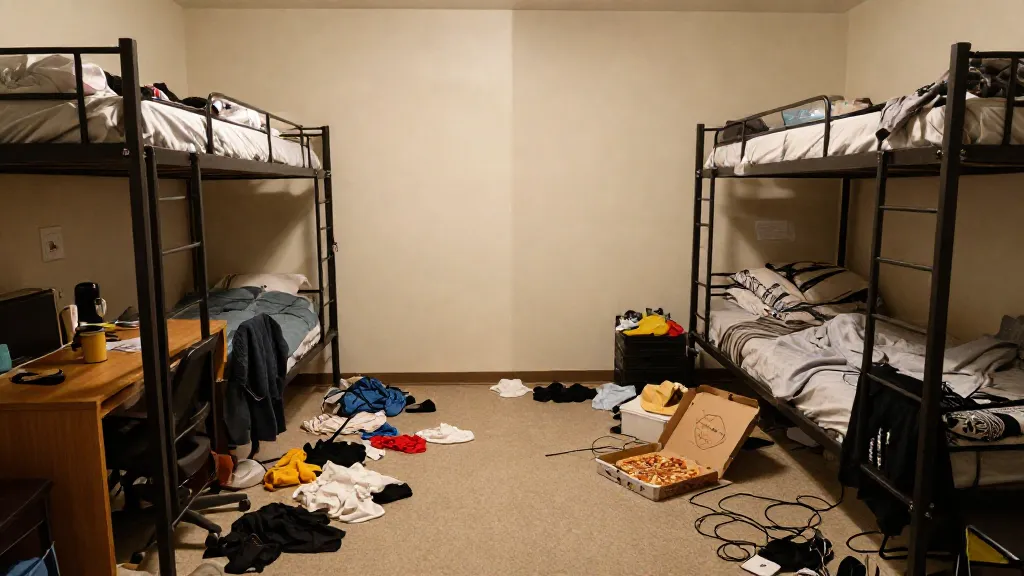
It's 2 a.m. on a Tuesday. You have an organic chemistry exam in six hours. And your roommate has just invited eleven people over for an impromptu karaoke session — for the third time this week. You're lying in the dark with a pillow clamped over your head, wondering how a person you met eight weeks ago now has more control over your sleep, your stress levels, and your GPA than you do.
College roommate horror stories are practically a rite of passage, shared in dining halls and dorm lobbies like war stories. Most of these nightmare situations don't erupt overnight. They build slowly, fueled by unspoken expectations, avoided conversations, and the uniquely intense pressure of sharing a tiny room with a stranger during one of the most stressful transitions of your life.
This article pairs real (anonymized) horror stories with concrete, actionable lessons — so you can learn from other people's worst moments instead of living through your own.
Horror Story #1: The Phantom Borrower
What Happened
"Priya" moved into her freshman dorm excited to share everything with her new roommate, "Dana." At first, borrowing felt mutual and fun — a shared tube of toothpaste, a sweater for a party. But by October, Priya noticed her laptop charger was perpetually missing. Then her meal plan card. Then a $120 textbook she needed for a midterm, which Dana had lent to someone in her study group without asking.
When Priya finally said something, Dana was genuinely confused. "I thought we were sharing people," she said. "You used my shampoo last week."
The argument escalated. Dana felt accused of stealing. Priya felt violated. They stopped speaking for three weeks, communicating only through passive-aggressive sticky notes on their respective desks.
The Lesson: Define "Sharing" Before It Becomes "Taking"
The problem here wasn't malice — it was a mismatch of assumptions. Dana grew up in a household where communal property was the norm. Priya's family had firm boundaries around personal belongings. Neither approach is wrong, but they're fundamentally incompatible without an explicit agreement.
What to do instead:
- During your first week, have a specific conversation about borrowing. Not "are you cool with sharing stuff?" but "which specific items are you okay lending, and do you want me to ask every time or just the first time?"
- Create a simple shared-items list. If it's not on the list, it's off-limits.
- Agree on a protocol for expensive items (textbooks, electronics, clothing over a certain value): always ask, always return within 24 hours, replace if damaged.
Horror Story #2: The Night Owl vs. The Early Bird
What Happened
"Marcus" was a pre-med student with 8 a.m. labs four days a week. His roommate, "Jake," was a film major whose creative energy peaked around midnight. Jake would edit videos with headphones on — but the blue glow of his triple-monitor setup turned their room into a lighting rig, and his mechanical keyboard sounded like a hailstorm on a tin roof.
Marcus asked Jake to work in the library after 11 p.m. Jake said the library closed at midnight and his desktop setup wasn't portable. Marcus started sleeping in his car. When his RA found out, she was horrified — not at Jake, but at the fact that Marcus had endured this for two months without filing a single complaint.
The Lesson: Quiet Hours Need Specifics, Not Just a Handshake
"Let's be respectful of each other's sleep" is not an agreement. It's a wish. Respect is subjective. Sleep schedules are not.
What to do instead:
- Set hard "lights out" and "quiet hours" times in writing. Be specific: "No overhead lights or desk lamps brighter than X after 11 p.m. on weeknights."
- Address the full sensory environment: light, sound, and vibration (yes, a subwoofer on a shared desk counts).
- Identify alternative workspaces together before the conflict starts. If the library closes at midnight, where else can a night owl work? Student union? 24-hour study room? A friend's common area?
- Invest in practical solutions early. A $15 sleep mask and a $20 white noise machine are cheaper than a semester of sleep deprivation.
Marcus's biggest mistake wasn't failing to "communicate" — it was absorbing the entire cost of the incompatibility himself. A good agreement distributes the burden. Jake might need to relocate after 11 p.m. on weeknights, while Marcus might agree to use headphones for early-morning alarms on weekends.

Horror Story #3: The Overnight Guest Who Never Left
What Happened
"Aisha" came back from Thanksgiving break to find a stranger sleeping in her desk chair. Her roommate, "Liz," had started dating someone over the holiday, and this person was now spending five or six nights a week in their room. They used Aisha's towel once. They ate food from Aisha's mini-fridge. When Aisha walked in after class, they were sometimes there alone — without Liz — watching TV on Liz's laptop.
Aisha tried to address it casually: "Hey, your boyfriend is here a lot." Liz's response: "He's basically homeless right now, his lease ended. What am I supposed to do?"
Aisha felt trapped between compassion for someone's housing situation and the reality that she was now living with an unauthorized third person who wasn't on the housing agreement.
The Lesson: Guest Policies Must Include Frequency, Duration, and Boundaries
This is one of the most common college roommate horror stories because it escalates so gradually. One overnight becomes two becomes five, and by the time you're uncomfortable, it feels too late to say anything.
What to do instead:
- Agree on a maximum number of overnight guest nights per week (two is a common starting point).
- Establish that guests are never in the room alone without the hosting roommate present — full stop.
- Clarify that guest policies apply to all guests equally, regardless of the nature of the relationship.
- If the situation involves someone who genuinely needs housing, that's a separate issue that involves your RA and your housing office — it's not your roommate's unilateral decision to make.
Aisha eventually involved her RA, who helped mediate a clear guest policy. But two months of resentment had already calcified. If the policy had existed from day one, the conversation would have been about enforcing an agreement rather than creating one under duress.
Horror Story #4: The Passive-Aggressive Cold War
What Happened
"Tommy" and "Raj" never had a single blowout argument. Instead, they had a semester-long cold war fought through escalating micro-aggressions. It started when Tommy left dishes in their shared sink. Raj cleaned them without saying anything, then "accidentally" unplugged Tommy's phone charger. Tommy retaliated by turning off Raj's alarm clock. Raj responded by locking Tommy out when he went to shower.
By finals week, they were each wearing noise-canceling headphones 100% of the time they were in the room. They communicated exclusively through their RA, who described the situation as "two grown adults playing the world's least fun chess game."
The Lesson: The 48-Hour Rule Prevents Cold Wars
Passive aggression isn't a personality flaw — it's what happens when someone feels unable to address a problem directly. Often the barrier isn't willingness but skill. Most 18-year-olds have never had to negotiate shared living space with a peer, and they default to the conflict styles they learned at home.
What to do instead:
- Adopt a 48-hour rule: if something bothers you, you bring it up within 48 hours — calmly, specifically, and without accusation.
- Use this format: "When [specific behavior], I feel [emotion], and I'd like to try [specific solution]."
- If direct conversation feels impossible, write it down. A brief, respectful text or written note is infinitely better than passive retaliation.
- Agree up front that neither of you will weaponize shared resources (chargers, alarms, locks, Wi-Fi passwords) under any circumstances.
Horror Story #5: The Hazmat Situation
What Happened
"Elena" discovered mold growing on a plate under her roommate "Casey's" bed — in March. The plate had been there since January. Casey's side of the room also featured an overflowing trash can, piles of unwashed gym clothes, and a collection of half-empty energy drink cans being used as "décor."
Elena had mentioned the mess several times. Casey always said "I'll clean this weekend" and never did. By spring break, the smell was noticeable from the hallway. Their neighbors filed a complaint. A custodial assessment found the room in violation of the university's health and safety standards.
The Lesson: Cleanliness Standards Need Measurable Benchmarks
"Keep the room clean" is meaningless because clean is subjective. What Elena considered basic hygiene, Casey considered neurotic. Neither was trying to be difficult.
What to do instead:
- Define cleanliness in observable, measurable terms: "Trash taken out every three days. No food left out overnight. Laundry in a closed hamper."
- Divide cleaning responsibilities explicitly. A simple alternating-week schedule for shared spaces (floor, bathroom if applicable, common surfaces) prevents the "I always clean and you never do" spiral.
- Agree on consequences. Not punishments — but clear next steps. "If the trash hasn't been taken out by Thursday night, I'll take it out and we'll revisit the schedule with our RA."
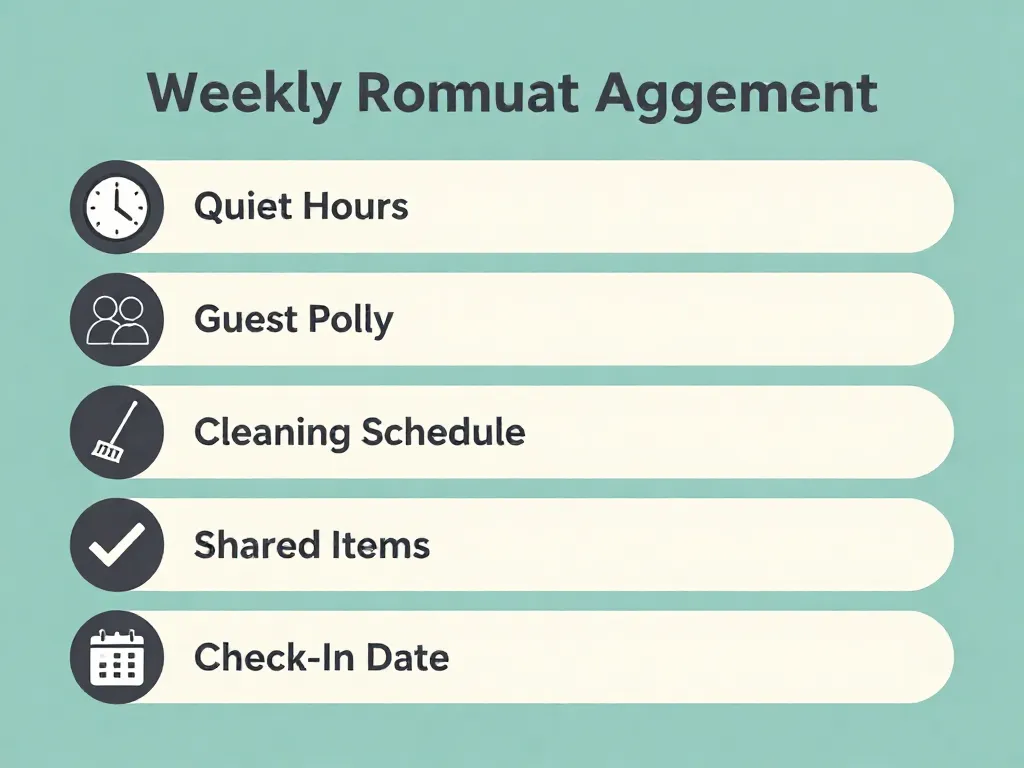
- Consider formalizing these agreements using a tool like Servanda, which helps roommates create written, structured agreements that you can actually reference later — instead of relying on verbal promises that conveniently get forgotten.
The Pattern Behind Every Horror Story
If you've read this far, you've probably noticed a theme. It's not that college roommates are uniquely terrible people. It's that:
- Expectations go unspoken. Each person walks in with a mental blueprint of "normal" shaped entirely by their own upbringing, and assumes their roommate shares it.
- Small problems get ignored. The dish in the sink, the late-night light, the borrowed charger — each one feels too minor to mention, until they aren't.
- Conversations happen too late. By the time someone finally speaks up, they're not addressing a behavior — they're unloading weeks or months of accumulated frustration.
- Nothing is written down. Verbal agreements are worse than no agreements at all, because both parties remember a different version.
How to Actually Prevent Your Own Horror Story
Here's a practical, week-by-week approach for the first month of living with a new roommate:
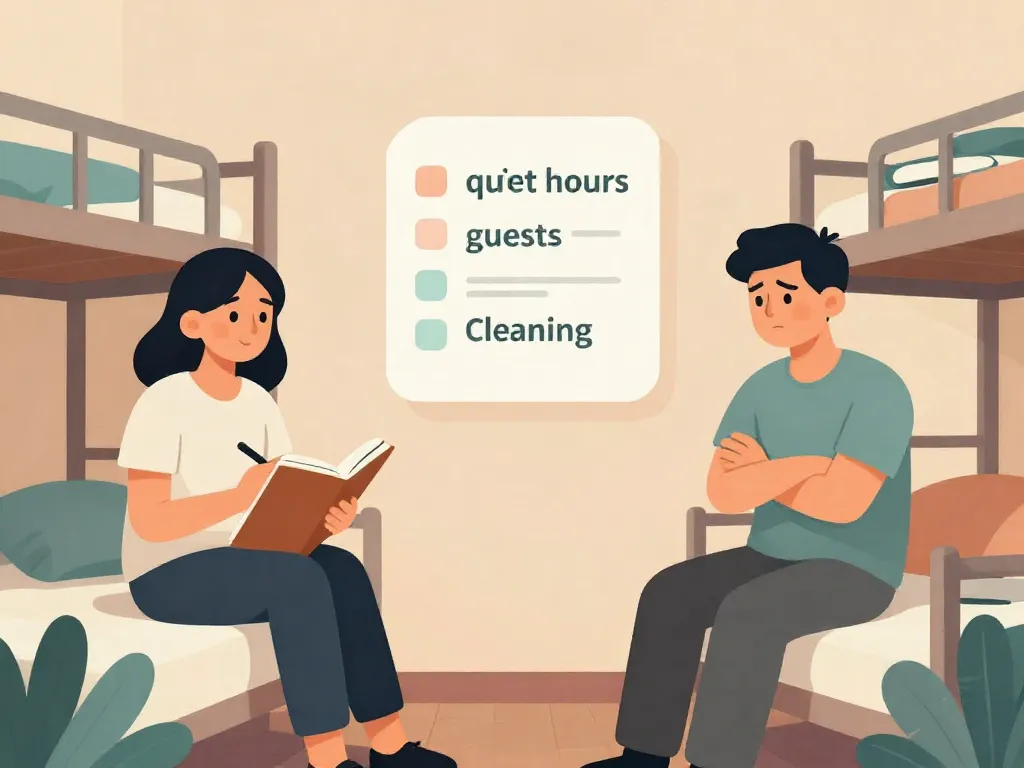
Week 1: The Ground Rules Conversation
Schedule a 30-minute sit-down (yes, actually schedule it) to discuss:
- Sleep schedules and quiet hours
- Guest policies (overnight and daytime)
- Sharing and borrowing boundaries
- Cleanliness standards and chore division
- Study habits and noise preferences
Write it down. Use your phone's notes app if nothing else. Date it. Both agree to it.
Week 2: The Check-In
Ask one question: "Is anything bugging you that we should adjust?" That's it. Normalize the check-in so it doesn't feel like a confrontation.
Week 3-4: The Adjustment
Revisit your ground rules. What's working? What isn't? Treat your agreement like a living document, not a contract carved in stone.
Monthly: The Reset
Keep a standing monthly check-in for the rest of the semester. Five minutes. Low stakes. This single habit prevents more roommate disasters than any other intervention.
FAQ
What should I do if my college roommate is doing something that makes me uncomfortable?
Address it directly and specifically within 48 hours, focusing on the behavior rather than the person. Use a simple format: describe what's happening, how it affects you, and what you'd like to change. If direct conversation feels unsafe or unproductive, involve your RA — that's literally what they're trained and paid to do.
Can I switch roommates in the middle of the semester?
Most universities allow room changes, but policies vary widely. Some have designated switch periods (often around midterms), while others require documented mediation attempts before approving a transfer. Contact your housing office early — don't wait until you're desperate, because waitlists for room changes can be long.
How do I bring up a roommate problem without starting a fight?
Timing and framing matter enormously. Choose a neutral moment (not right after the offending behavior), keep your tone matter-of-fact rather than emotional, and propose a specific solution rather than just airing a grievance. Starting with "I've been thinking about how we can make the room work better for both of us" lands differently than "We need to talk about your mess."
Is it normal to not be best friends with your college roommate?
Absolutely. The cultural expectation that roommates should be best friends creates enormous pressure and disappointment. A successful roommate relationship is one where both people feel respected, can sleep and study effectively, and maintain basic courtesy. Friendship is a bonus, not a requirement.
What if my roommate refuses to follow the rules we agreed on?
Document specific instances with dates and details, then escalate to your RA with that documentation. Most residence life programs have formal mediation processes and, if necessary, can issue housing policy violations. You don't have to solve every problem yourself — the support infrastructure exists for exactly these situations.
Every college roommate horror story shares a root cause: two people with different defaults trying to coexist in a small space without a shared operating manual. The dishes, the noise, the uninvited guests — these aren't the real problems. The real problem is the gap between what you expected and what you got, combined with the absence of a clear, written agreement to bridge it.
You don't need a perfect roommate to have a good living situation. You need a first-week conversation, a written agreement, monthly check-ins, and the willingness to address small things before they become big things. Your roommate doesn't have to be your best friend. They just have to be someone you can share a room with — and that starts with making the invisible rules visible.