Dirty Kitchen Standoff: Who Cleans Common Areas?
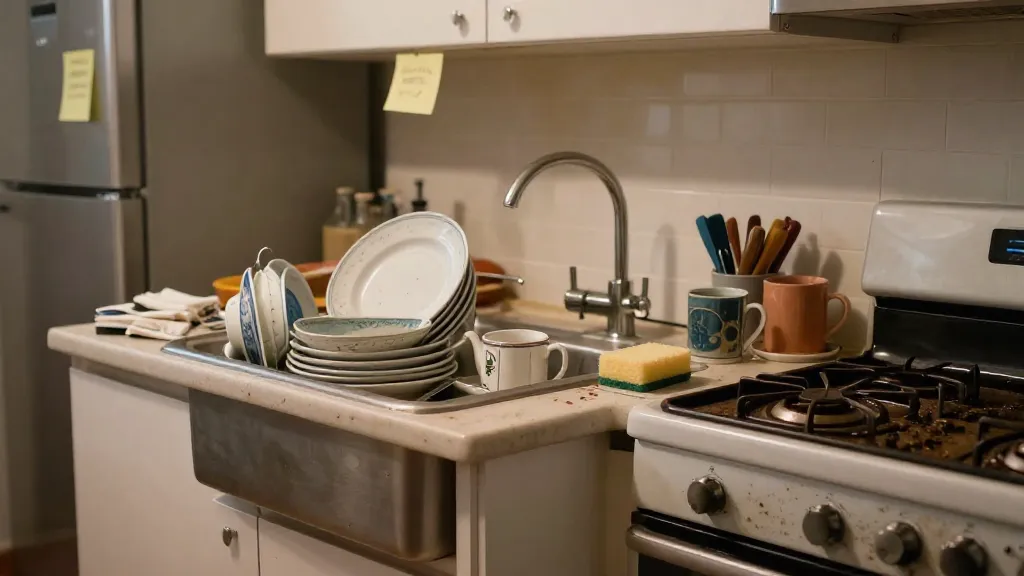
You walk into the kitchen Monday morning, half-asleep, craving coffee. But the counter is buried under someone else's crusty pasta pot, a grease-splattered stovetop, and a sink so full of dishes you can't even fill the kettle. You cleaned this exact kitchen two days ago. A familiar heat rises in your chest. You know who did this. And you know they're not going to clean it up — at least not without a passive-aggressive sticky note, a group chat meltdown, or three days of silent treatment first.
The dirty kitchen standoff is one of the most common — and most corrosive — roommate conflicts that exists. Unresolved common area cleaning disputes can destroy friendships, spike anxiety, and turn your own home into a place you dread. This problem is solvable. Not with vague promises to "do better," but with concrete systems that remove ambiguity and distribute responsibility.

Why the Dirty Kitchen Standoff Feels So Personal
Different Cleanliness Standards Are Real
People genuinely see mess differently. One roommate might register a sticky countertop as a crisis; another might not notice it for days. Neither person is lying or being difficult — they were raised in different households, with different norms. Research in environmental psychology confirms that tolerance for disorder varies widely and is shaped by upbringing, neurodivergence, stress levels, and cultural background.
When you assume your roommate sees the mess and simply chooses not to clean it, you've already cast them as the villain. In reality, they may literally not register the same cues you do.
It's About Respect, Not Just Dishes
The reason a dirty kitchen standoff escalates so quickly is that it stops being about the kitchen. It becomes a proxy for deeper questions: Do you respect me? Do you think your time is more valuable than mine? Do you even care that we share this space? Once the conflict reaches that emotional layer, no amount of scrubbing will resolve it. You have to address the system, not just the symptom.
The "I'm Not Your Parent" Trap
The roommate who cleans more often starts feeling like a nag or an unpaid housekeeper. They resent asking. The roommate who cleans less often feels micromanaged and defensive. Both people end up stuck in a dynamic that mirrors a parent-child relationship — and nobody signed up for that.
How to Split Common Area Cleaning Fairly
Fairness doesn't mean everyone does exactly the same tasks. It means everyone agrees the distribution is reasonable — and that agreement is explicit, not assumed.
Step 1: Name Every Task (Yes, Every One)
Most cleaning arguments stem from invisible labor. One person scrubs the stovetop but nobody acknowledges it. Another person always takes out the trash but feels like they're "not doing enough" because nobody sees them do it.
Sit down together — ideally at a neutral time when nobody is angry — and list every recurring cleaning task for shared spaces. Be granular. "Clean the kitchen" is too vague to be useful. Try:
- Wash dishes / load and unload dishwasher
- Wipe down counters and stovetop
- Clean microwave interior
- Sweep / mop kitchen floor
- Take out trash and recycling
- Clean bathroom sink, mirror, and counter
- Scrub toilet and shower
- Vacuum common living areas
- Wipe down dining table
- Clean up after shared meals or gatherings
This list alone can be a revelation. When you see everything written down, it becomes obvious that "keeping the place clean" is actually 15+ distinct tasks — and it's much easier to divide 15 tasks fairly than to argue about one amorphous responsibility.
Step 2: Agree on Standards, Not Just Tasks
For each task, define what "done" actually looks like.
For example:
- Dishes: Washed (or loaded into dishwasher) within 4 hours of use. No dishes left in the sink overnight.
- Stovetop: Wiped down after every cooking session. Deep cleaned once per week.
- Bathroom: Full clean every Sunday by noon.
These aren't arbitrary rules — they're negotiated agreements. The roommate who prefers a looser timeline can advocate for that. The roommate who prefers a tighter standard can explain why. The goal is a written standard everyone can reference without having to relitigate it each time.
Step 3: Choose a System That Matches Your Household
There's no single "right" way to divide common area cleaning. The best system is the one your specific household will actually follow.
| System |
Best For |
Watch Out For |
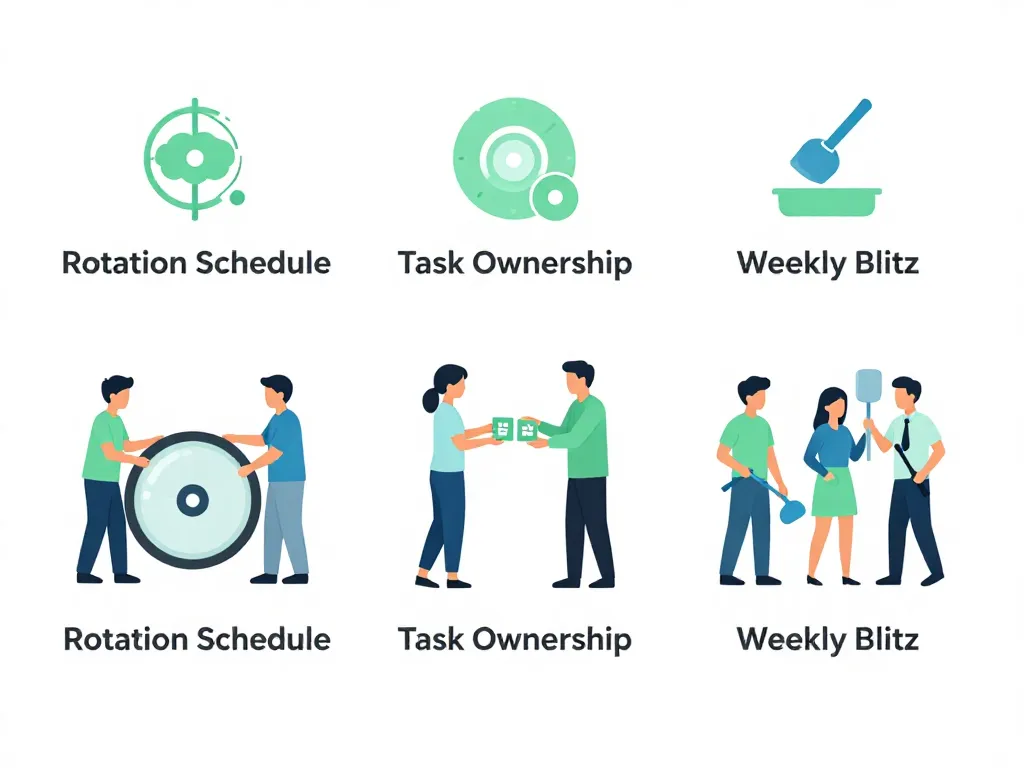
| Rotation Schedule: Each roommate is responsible for specific zones or tasks on a rotating basis (weekly or biweekly). Post the schedule on the fridge or in a shared app. |
Households of 3+ roommates where tasks are roughly equal in effort. |
People "forgetting" their week. Build in a specific check-in day. |
| Task Ownership: Each roommate permanently owns certain tasks based on preference or tolerance. Trade accordingly. |
Two-roommate setups where preferences are complementary. |
Resentment if one person feels they got the harder tasks. Revisit every few months. |
| Clean-As-You-Go with a Weekly Blitz: Everyone is responsible for cleaning up immediately after themselves (dishes, spills, counters). Then once a week, you do a 30-minute group clean where everyone tackles the deeper tasks simultaneously. |
Roommates who are generally tidy but struggle with deep cleaning. The shared blitz also builds camaraderie. |
The "clean as you go" part still needs a defined standard, or you'll end up right back in the standoff. |
Step 4: Put It in Writing
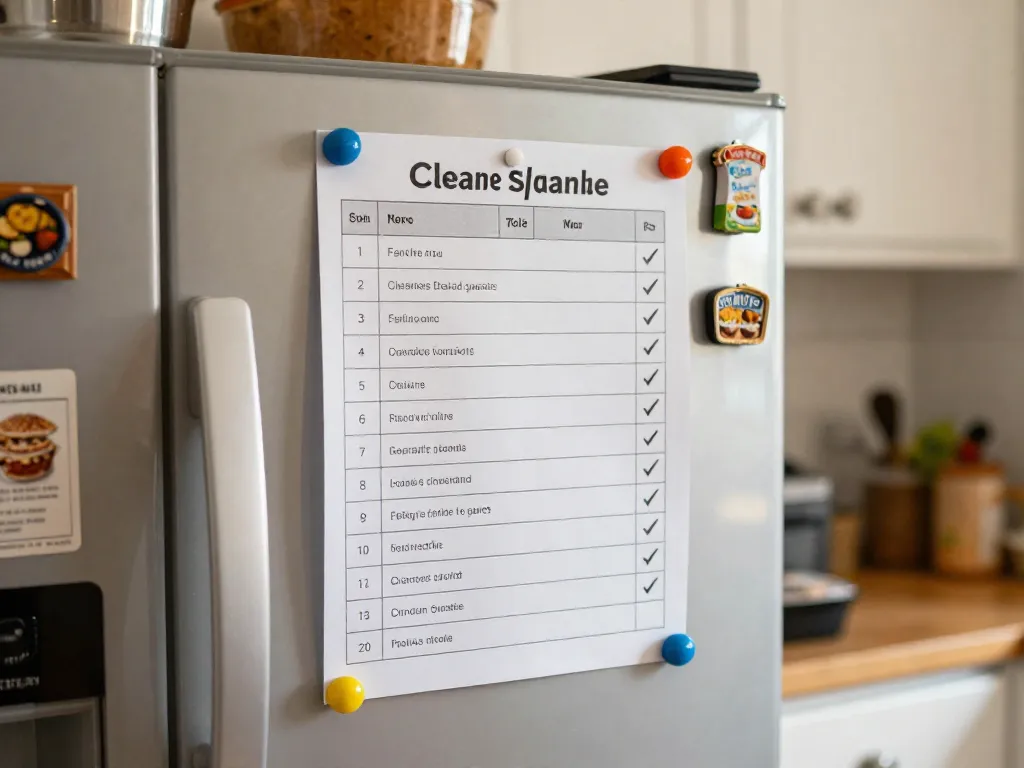
Verbal agreements dissolve the moment someone is stressed, busy, or annoyed. Written agreements hold. This doesn't have to be a formal legal document — even a shared Google Doc or a note on the fridge counts. What matters is that every roommate can point to the same source of truth.
Tools like Servanda can help roommates create structured written agreements that clarify expectations and prevent the kind of ambiguity that fuels cleaning standoffs.
Your written agreement should include:
- The task list
- Who's responsible for what (or the rotation order)
- The agreed-upon standard for each task
- What happens if someone doesn't follow through
- A date to revisit and revise the agreement
What to Do When Someone Doesn't Follow Through
Even the best system will face moments where someone drops the ball. Planning for this in advance — before emotions are involved — is what separates households that resolve conflicts from households that implode.
Use a Graduated Response
Not every lapse deserves the same reaction. Build a simple escalation framework into your agreement:
- First time: A low-key, private reminder. Text your roommate directly (not the group chat). Keep it factual, not accusatory. "Hey, I noticed the kitchen didn't get cleaned yesterday — are you able to get to it today?"
- Pattern emerges: A direct, sit-down conversation. "I've noticed the kitchen clean has been missed a few weeks in a row. Can we talk about what's going on and whether we need to adjust the schedule?"
- Ongoing issue: Revisit the entire agreement. Maybe the system itself isn't working. Maybe someone's life circumstances changed (new job, health issue, relationship stress). Redesign the system rather than just demanding more compliance.
Avoid These Common Mistakes
- The passive-aggressive group chat message: "Would be great if SOMEONE cleaned the kitchen 🙃." Everyone knows who you mean. It embarrasses the target and annoys everyone else. Always address the person directly.
- The martyr clean: Cleaning everything yourself in a fury, then bringing it up later as ammunition. If you choose to clean, own that choice. If you need help, ask before you start, not after.
- Scorekeeping without context: "I've cleaned 7 times this month and you've only cleaned 3." Scorekeeping ignores that one person might have worked 60 hours that week. Track tasks to inform conversation, not to win arguments.
- Weaponizing the mess: Deliberately leaving your own mess to "prove a point" or "teach them a lesson." This makes the home worse for everyone, including you.
Handling the Roommate Who Genuinely Doesn't Care
Sometimes you'll encounter a roommate whose cleanliness threshold is so far from yours that no rotation schedule will bridge the gap. They're not malicious — they simply don't experience a messy common area as a problem.
Renegotiate the Labor, Not the Standard
If one roommate doesn't mind mess but the other does, the person with the higher standard can take on more cleaning — in exchange for something else. Maybe the messier roommate pays a slightly larger share of a cleaning service. Maybe they take on a different household responsibility (groceries, taking out the trash, managing bills). Fairness isn't about identical tasks; it's about equitable contribution.
Hire a Cleaning Service and Split the Cost
A biweekly professional clean for common areas can cost $80–$150 depending on your city. Split among roommates, that's often less than $40 per person per month — a small price for household peace. Frame it as an investment in the relationship.
Accept What You Can't Control
If you've tried systems, conversations, and compromises, and your roommate still won't maintain shared spaces, you're facing a compatibility issue. That's valuable information for your next lease decision. In the meantime, focus on what you can control: your own spaces, your own dishes, your own response.
The Conversation Starter: A Script You Can Use Tonight
If you're reading this mid-standoff and need to break the ice:
"Hey, I want to talk about how we handle the kitchen and common areas. I'm not blaming anyone — I just think we'd both be less stressed if we had a clear system instead of winging it. Can we spend 15 minutes this week figuring out a plan that works for both of us?"
This works because it:
- Names the issue without assigning blame
- Frames the conversation as collaborative, not corrective
- Asks for a small, specific time commitment
- Focuses on a system, not a person
Quick-Reference: The Common Area Cleaning Agreement Checklist
Use this as a starting point for your own household agreement:
- [ ] All shared-space cleaning tasks listed
- [ ] Standards defined for each task (what "done" looks like)
- [ ] Division method chosen (rotation, ownership, or blitz)
- [ ] Timeline for each task (daily, weekly, after use)
- [ ] Process for handling missed tasks
- [ ] Agreement on shared costs (supplies, potential cleaning service)
- [ ] Review date set (monthly or quarterly)
- [ ] All roommates have signed off or confirmed
Moving Forward Without Resentment
The dirty kitchen standoff persists in households everywhere not because people are lazy or inconsiderate, but because most roommates never build the infrastructure that shared living requires. Your home deserves the same intentionality you'd bring to a business.
The fix is almost always structural, not personal. When you replace vague expectations with specific agreements, cleaning conflicts lose their emotional charge. The dishes become just dishes again — not a referendum on respect or character.
Start small. Pick one common area. Have one conversation. Write one agreement. You can refine the system over time, but you can't refine something that doesn't exist yet. The standoff ends the moment someone decides to build a system instead of waiting for the other person to change.
Frequently Asked Questions
How do you get a roommate to clean up after themselves?
Start by having a calm, blame-free conversation at a neutral time and propose creating a specific written cleaning agreement together. Define clear standards for each task (like "dishes washed within 4 hours of use") so expectations are explicit rather than assumed. If they still don't follow through, use a graduated approach — a private reminder first, then a direct conversation, then a full system redesign.
What's the fairest way to split cleaning duties with roommates?
List every recurring cleaning task, agree on standards, and then choose a system — rotation, task ownership, or a weekly group blitz — that everyone commits to in writing. Fairness doesn't mean identical tasks; it means everyone agrees the overall contribution is equitable, which might include trading tasks based on personal preferences or offsetting with other household responsibilities.
What should a roommate cleaning schedule include?
A good roommate cleaning schedule should include a granular list of all shared-space tasks, who is responsible for each one (or the rotation order), the frequency and deadline for each task, and a defined standard for what "complete" looks like. It should also outline what happens when someone misses their turn and include a date to revisit and revise the agreement.
How do you deal with a messy roommate without ruining the relationship?
Focus on building a system rather than criticizing the person — frame the conversation as "let's figure out a plan that reduces stress for both of us" instead of pointing fingers. If your cleanliness thresholds are genuinely different, negotiate equitable trade-offs like having the messier roommate cover a larger share of a cleaning service or take on other household tasks.
Is it worth hiring a cleaning service to avoid roommate fights?
A biweekly professional clean for common areas typically costs $40 or less per person per month when split among roommates, which is a small price for household peace. It removes the most friction-heavy deep-cleaning tasks from the equation and lets roommates focus only on day-to-day tidying.