
Dorm Room Boundaries: Exact Scripts That Work
It's 1:47 a.m. on a Tuesday. Your roommate's desk lamp is blazing, their keyboard is clacking, and you have a chemistry exam in six hours. You're lying there rehearsing what to say, cycling between "I don't want to be dramatic" and "I literally cannot live like this." So you say nothing. Again.
The problem isn't that you don't want to set dorm room boundaries — it's that you don't know exactly what words to use when the moment arrives. Vague advice like "just talk it out" doesn't help when your heart is pounding and you're afraid of making the rest of the semester unbearable.
This article gives you the actual scripts — word for word — for the most common dorm room boundary conversations. These aren't theoretical. They're drawn from real situations between real roommates, refined to be direct without being aggressive, and specific enough that you can adapt them tonight.
Why Exact Wording Matters
There's a reason therapists role-play conversations with their clients. The intention to set a boundary is only half the battle. The other half is the delivery — and delivery falls apart under stress.
When you're anxious, your brain defaults to one of two modes:
- Over-apologizing: "Hey, sorry, I know this is stupid, but like, maybe if you could possibly, I dunno, keep it down a tiny bit? No worries if not."
- Bottling then exploding: Three weeks of silence followed by, "I can't BELIEVE you think it's okay to have people over at midnight on a WEEKNIGHT."
Neither works. Over-apologizing signals that your boundary is optional. Exploding signals that you're unreasonable. Both leave your roommate confused about what you actually need.
Having a script isn't about being robotic. It's about having a reliable starting point so your brain doesn't freeze or spiral when the conversation gets real.
The Boundary Script Formula
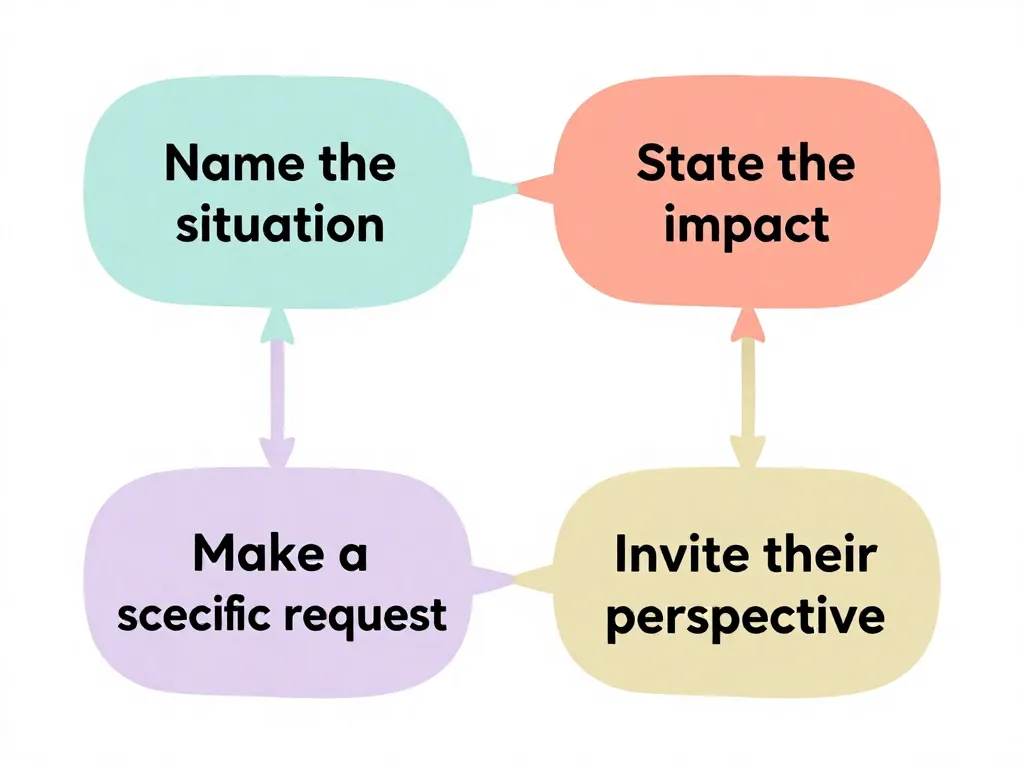
Every script in this article follows the same simple structure:
- Name the situation (not the person's character)
- State the impact on you (how it actually affects your life)
- Make a specific request (not a vague wish)
- Invite their perspective (make it a conversation, not a decree)
This formula works because it keeps the focus on the problem rather than on blame.
Scripts for the 6 Most Common Dorm Room Boundary Issues
1. Noise and Quiet Hours
The situation: Your roommate watches videos without headphones, talks on the phone late at night, or plays music while you're trying to study.
The script:
"Hey, can we figure out a noise plan that works for both of us? When there's audio playing in the room while I'm studying [or sleeping], I can't concentrate [or fall asleep], and it's starting to affect my grades. Could we agree on quiet hours — maybe 10 p.m. to 8 a.m. on weeknights — and use headphones during study time? What hours would work on your end?"
Why it works: You're not saying they're loud or inconsiderate. You're naming a specific behavior (audio playing), a specific impact (grades suffering), a specific request (headphones + hours), and leaving room for negotiation.
If they push back: "I hear you — I'm not asking for total silence all the time. I just need some predictable windows where I know I can count on quiet. What would feel fair to you?"

2. Overnight Guests and Significant Others
The script:
"I want to talk about overnight guests — not because anything is wrong, but because I'd rather us have a plan before it gets weird. Could we agree to give each other a heads-up by, say, 6 p.m. if someone's staying over? And maybe cap it at two weeknights a week? I want you to feel comfortable having people over, and I also need to feel comfortable in my own room."
Why it works: The phrase "before it gets weird" normalizes the conversation. You're framing it as proactive planning, not a complaint. Suggesting a specific cap (two weeknights) gives them something concrete to respond to, which is far easier than an open-ended "how often is okay?"
If they get defensive: "I'm not saying you've done anything wrong. I just know from talking to other people that this is the number one thing roommates fight about, and I'd rather we figure it out while we're both chill about it."
3. Cleaning and Shared Spaces
The situation: Dishes pile up, the floor is sticky, laundry migrates to your side of the room.
The script:
"Can we set up a quick cleaning routine? I notice I get stressed when the room gets cluttered, and I don't want to end up passive-aggressively cleaning everything myself and resenting you for it — that's not fair to either of us. What if we did a 15-minute tidy every Sunday, and we each keep our stuff on our side during the week? Is there a different system you'd prefer?"
Why it works: Admitting your own potential bad behavior (passive-aggressive cleaning) shows self-awareness and takes the accusation out of the equation. The 15-minute tidy is low-commitment and concrete.
If they say they don't mind mess: "That's totally valid — we just have different thresholds. Can we find a middle ground where the shared spaces stay clear even if our own sides are different?"
4. Borrowing Stuff Without Asking
The situation: Your roommate uses your snacks, toiletries, chargers, or clothes without permission.
The script:
"Hey — going forward, can we do a quick ask before borrowing each other's stuff? Even small things like a phone charger. It's not that I'd say no. It's that I want to know where my things are, and I'd rather us just have the habit so neither of us has to wonder. I'll do the same with your stuff."
Why it works: "Going forward" avoids rehashing past incidents. "It's not that I'd say no" removes the fear that you're being territorial. Offering reciprocity ("I'll do the same") makes it a shared norm rather than a rule you're imposing.
5. Different Sleep Schedules
The situation: One of you is a night owl, the other wakes up at 6 a.m. The clash feels unsolvable.
The script:
"Our schedules are pretty different, and I think that's just going to be our reality this semester. Can we build a plan around it instead of pretending it'll change? Here's what I'm thinking: after 11 p.m., we switch to headphones, low screens, and no overhead lights. Before 8 a.m., same deal — I'll get ready as quietly as possible. Does that split feel workable, or would you shift the times?"
Why it works: Acknowledging that neither person is going to fundamentally change their schedule is disarming and honest. You're offering a concrete trade — you'll be quiet in the morning if they're quiet at night — which makes it feel balanced.

6. When They're Always in the Room
The situation: You never get alone time. Your roommate is always there — on their bed, at their desk, existing in your shared 150 square feet. You feel guilty even wanting them to leave.
The script:
"This is kind of an awkward one, but I want to be honest rather than let it fester. I'm someone who needs solo time to recharge — it's not about you at all. Could we work out a couple of windows each week where we each get the room to ourselves? Even just two or three hours? I'm happy to be the one who leaves sometimes, too."
Why it works: Leading with "this is awkward" gives them permission not to be offended. Offering to leave yourself proves it's about the need for alone time, not about avoiding them specifically.
What to Do When a Script Doesn't Land
Sometimes you deliver a boundary perfectly and your roommate still reacts badly. They get defensive, dismissive, or agree in the moment and then ignore it.
Here's your escalation plan:
Step 1: Revisit it once. People sometimes need time to process.
"Hey, I want to circle back on what we talked about last week — the noise after 10 p.m. I noticed it's still happening, and I want to make sure we're on the same page. Is there a reason the plan isn't working for you?"
Step 2: Put it in writing. A simple shared doc or text message that outlines what you've agreed to. This removes the "I forgot" defense and creates a reference point. Tools like Servanda can help roommates formalize agreements into clear, written terms — which is useful when verbal agreements keep slipping.
Step 3: Involve your RA. If a boundary keeps getting ignored after two direct conversations, it's no longer a communication problem — it's a respect problem. Your Resident Advisor exists precisely for this. You're not "tattling." You're using the system that's there for you.
Quick-Reference: Phrases to Keep in Your Back Pocket
These are versatile lines you can drop into almost any boundary conversation:
- "Can we figure out a plan for this before it becomes a thing?" — Great for proactive boundary-setting.
- "It's not that I'm mad — I just want us to be on the same page." — Lowers defenses.
- "What would work for you?" — Signals collaboration.
- "I'd rather be honest now than resentful later." — Explains why you're bringing it up.
- "Let's try it for two weeks and see how it goes." — Makes any agreement feel low-stakes and revisable.
- "I'll do the same for you." — Establishes reciprocity.
Timing and Delivery Tips
The best script in the world will fail if you deliver it at the wrong moment.
- Don't have the conversation in the heat of the moment. If you're angry right now, write down what you want to say and bring it up tomorrow.
- Don't do it over text for the first conversation. Tone gets lost. Have the initial talk in person (or on a walk — side-by-side conversations feel less confrontational than face-to-face).
- Do follow up important agreements with a text. After you talk, send a quick message: "Just to make sure I'm remembering right — we agreed on quiet hours from 10 p.m. to 8 a.m. on weeknights and headphones during study blocks. Sound right?" This creates a paper trail and eliminates misunderstandings.
- Don't start with the hardest boundary. If you've never set a boundary with your roommate, start small. Nail the easy wins first and build the muscle.
The Real Goal: A Livable Semester
You and your roommate don't need to be best friends. You don't need to agree on everything. You need to be able to sleep, study, and exist in your room without dreading it.
Dorm room boundary scripts aren't about controlling another person — they're about giving both of you the information you need to share a small space without resentment building up. Most roommates aren't intentionally inconsiderate. They just don't know what you need until you tell them.
The scripts above give you a way to tell them that's clear, fair, and respectful. Pick the one that matches your most pressing issue, adapt the details to fit your life, and have the conversation this week — not after the next incident, not after the semester gets harder, but now, while it's still a conversation and not a confrontation.
Your future self — the one who actually slept before that exam — will thank you.
Frequently Asked Questions
How do I set boundaries with my roommate without making things awkward?
Focus on the behavior and its impact on you rather than criticizing your roommate's character, and frame the conversation as proactive planning rather than a complaint. Using phrases like "Can we figure out a plan for this before it becomes a thing?" normalizes the discussion and lowers defensiveness. Starting with a smaller, lower-stakes boundary first also helps build comfort for both of you.
What should I do if my roommate ignores the boundaries we agreed on?
First, revisit the conversation once — calmly ask if there's a reason the plan isn't working and whether adjustments are needed. If the behavior continues, put your agreement in writing using a shared document or a tool like Servanda so there's a clear reference point. If it's still ignored after two direct conversations, involve your Resident Advisor, as the issue has moved beyond communication into a matter of respect.
How do I ask my roommate to stop being so loud at night?
Propose a specific quiet-hours plan rather than just asking them to "keep it down" — for example, suggest headphones and low volume between 10 p.m. and 8 a.m. on weeknights. Explain the concrete impact, such as lost sleep affecting your grades, and then ask what hours would work for them so the agreement feels collaborative rather than one-sided.
Is it okay to ask my roommate for alone time in our dorm room?
Absolutely — needing solo time to recharge is normal and has nothing to do with disliking your roommate. Acknowledge that it might feel awkward, explain that it's about your own need for space, and offer to be the one who leaves sometimes too. Suggesting just two or three scheduled hours per week keeps the request reasonable and easy to agree to.
How do I bring up my roommate's overnight guests without sounding controlling?
Frame it as a shared planning conversation rather than a complaint by saying something like "I'd rather us have a plan before it gets weird." Suggest specific, reasonable guidelines — such as a heads-up by 6 p.m. and a cap of two weeknights per week — and emphasize that you want both of you to feel comfortable in the room. This approach makes it clear you're not judging their relationship, just protecting shared living space.