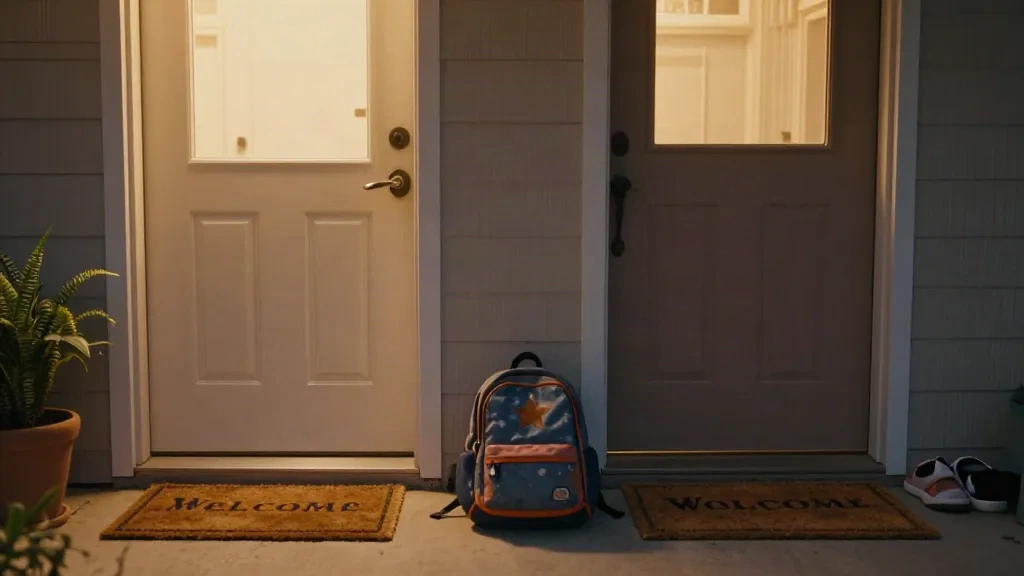
It's November 6th. The text arrives at 9:40 p.m.
"So I have the kids for Thanksgiving, right? My mom already booked the flights."
And the reply, typed and deleted twice: "No. You had them last year. I gave you last year because of your dad's surgery and you said we'd swap."
He doesn't remember saying that. She's certain he did. Neither of them is lying. Last year's arrangement was made in a parking lot in the second week of November while one of them was late for something, and it lived in exactly two places: two different memories, both of which have spent twelve months quietly editing themselves in their owner's favor.
This is the whole problem. Not stubbornness, not bad faith. An unwritten agreement between two people who no longer talk daily is not an agreement. It's a coin flip you both think you won.

Why does the same holiday argument happen every single November?
Because the agreement was made verbally, under time pressure, as a one-off exception, and nobody wrote down whether it was an exception or a new rule. Memory does the rest. Twelve months later you each recall the version where you were generous and the other person owes you.
The second reason is that most parenting plans handle holidays badly. They say something like "the parties shall alternate major holidays" and stop. Alternate starting when? Is Thanksgiving one day or four? Does Christmas mean December 25th or the whole school break? Who drives? What happens when Christmas Eve falls on your regular Tuesday? A clause that vague generates a fight every year it survives.
Compare that to how courts actually write it. The Indiana Parenting Time Guidelines, one of the more detailed state models, define the Christmas holiday as beginning at 8:00 p.m. on the day school releases and splitting into halves, with the second half running to December 30th at 7:00 p.m. Times. Dates. A specific hour. That's not bureaucratic overkill, that's the level of detail that stops the parking lot conversation from ever needing to happen.
What are the three holiday rotation patterns, and which one should you pick?
There are three that work, and the right one depends on how far apart you live and how old your kids are.
1. Alternating years. Parent A gets Thanksgiving in odd years, Parent B in even years, and you flip it for Christmas so nobody loses both. Best for parents who live more than an hour apart, or where either family does destination holidays. The child gets one real, unhurried holiday instead of two rushed halves. The cost is that you miss some holidays entirely, and the first year you sit alone on Christmas morning is genuinely hard. It's still the right call for most long-distance arrangements.
2. Split-day. Thanksgiving with Mom until 2:00 p.m., with Dad from 2:00 p.m. onward. Christmas Eve through 11:00 a.m. Christmas Day with one, the rest with the other. This only works if you live within about 30 minutes of each other and you both have a high tolerance for handoffs on days when everyone is overstimulated. It stops working around age 13, when kids start resenting being extracted from a family gathering mid-pie.
3. Fixed holidays. Some holidays never rotate. Mom always has Easter because it matters to her family; Dad always has July 4th because of the lake house; each parent always has their own birthday and Mother's/Father's Day. This is underused and it's the best tool you have. Take the two holidays you each care about most, assign them permanently, and rotate everything else. You've just removed the two highest-stakes negotiations from the calendar forever.
Most workable plans use all three: fixed for the two or three that carry real meaning, alternating years for Thanksgiving and Christmas, split-day for the local minor ones like Halloween.
The holiday schedule template you can fill in tonight
Copy this, fill in every blank, and don't leave any line as "we'll figure it out." The blanks you skip are next year's argument.
| Holiday |
Definition (start and end, with times) |
Odd years |
Even years |
Exchange time and place |
| Thanksgiving |
Wed. release from school to Sun. 6:00 p.m. |
|
|
|
| Christmas Eve / Day |
Dec. 24 noon to Dec. 25 noon; Dec. 25 noon to Dec. 26 noon |
|
|
|
| Winter break (rest) |
Dec. 26 to day before school resumes |
|
|
|
| New Year's Eve/Day |
Dec. 31 noon to Jan. 1 6:00 p.m. |
|
|
|
| Spring break |
Release from school to 6:00 p.m. day before return |
|
|
|
| Easter / Passover |
Sat. 6:00 p.m. to Sun. 7:00 p.m. |
|
|
|
| Memorial Day |
Fri. release to Mon. 6:00 p.m. |
|
|
|
| July 4th |
July 3, 6:00 p.m. to July 5, 10:00 a.m. |
|
|
|
| Labor Day |
Fri. release to Mon. 6:00 p.m. |
|
|
|
| Halloween |
Oct. 31, 4:00 p.m. to 8:30 p.m. |
|
|
|
| Mother's Day |
Sun. 9:00 a.m. to 7:00 p.m. |
Mother |
Mother |
|
| Father's Day |
Sun. 9:00 a.m. to 7:00 p.m. |
Father |
Father |
|
| Child's birthday |
|
|
|
|
| Each parent's birthday |
|
|
|
|
Then add these four sentences underneath, verbatim:
- Holiday time supersedes the regular schedule. No make-up days are owed for regular parenting time missed because of a holiday.
- Travel notice. A parent traveling out of state with the child during a holiday period provides dates, destination, and a contact number at least 21 days in advance.
- Changes are in writing. A swap agreed by text is a swap. A swap agreed in a doorway is not. Either parent may decline a swap without giving a reason.
- A swap is a one-time exception and does not change the rotation unless both parents write that it does.
That fourth line is the one that would have saved the couple at the top of this article. Write it down even if it feels petty. Especially then.
Once it's filled in, both of you need to actually agree to it in a form neither of you can later dispute, which is where a plain text thread falls down. Servanda is built for exactly this: getting a specific arrangement written, agreed, and stored somewhere neutral, so next November you're reading a document instead of relitigating a memory.
What breaks a holiday schedule that looked fine on paper?
Four things, reliably. Handle them now and the schedule survives contact with an actual December.
Undefined "holiday." If your plan says "Christmas," one of you means December 25th and the other means the twelve days school is out. Write the start and end with clock times.
The exchange itself. Name the place. "The Target parking lot on Route 9" beats "the usual spot," which you will each remember differently on a day when tempers are already thin. Set a grace window too: 20 minutes late is a text, an hour late is a problem.
Gifts. Say one of you buys the bike. The other has also bought the bike. Agree on a spending ceiling and a single shared list, and decide who claims the big-ticket item this year. Kids notice competitive Christmases faster than you think, and they read them correctly.
Extended family scheduling around you. Grandparents book flights in September. If your rotation is on paper by August, they book around it. If it isn't, their booking becomes the argument, and now you're negotiating with someone who isn't even in the conversation.
What if you can't agree on who gets Christmas this year?
Flip for the first year and lock the alternation permanently after that. Genuinely. A coin flip in October, witnessed in writing, costs you one holiday and buys you every holiday after it.
If that feels impossible because this year carries something specific (a grandparent's last Christmas, a milestone, a trip already booked), then trade explicitly and price it. "You take Christmas Day this year, I take Christmas Day the next two, and we resume alternating in 2028." Write the resumption year down. Unpriced favors are how people end up in parking lots in November.
Open a blank document, paste the table, and fill in the two columns for Thanksgiving and Christmas before you do anything else tonight. Then send it. The next twenty minutes are worth more than the next twenty conversations.