
How to Co-Parent When Parenting Styles Clash
It's Sunday evening. Your child walks through the door after a weekend at their other parent's house, wired on soda, up two hours past the bedtime you've carefully maintained for years, and announcing that "Dad says I don't have to do homework until Monday morning." You feel your jaw tighten. Not because soda or a late bedtime is the end of the world — but because it feels like everything you're building gets undone every other weekend.
If this scenario makes your stomach clench with recognition, you're not alone. Learning how to co-parent when parenting styles clash is one of the most common and most emotionally charged challenges separated or divorced parents face. The good news? Differing approaches don't mean your co-parenting arrangement is broken. In fact, research in child development consistently shows that children can adapt to different household rules — as long as both homes feel stable and respectful.
This article gives you concrete strategies to bridge those differences without demanding that either parent become someone they're not.
Key Takeaways
- Clashing parenting styles are normal, not a sign of failure. Even married couples rarely parent identically — different households will naturally have different rhythms.
- Focus on the "non-negotiables" first. Identify the 3-5 issues that genuinely affect your child's safety, health, and emotional security, and negotiate those before sweating the small stuff.
- Use written agreements to replace verbal arguments. Documenting shared expectations removes ambiguity and takes emotion out of recurring conflicts.
- Your child's behavior after transitions isn't a verdict on the other parent. Adjustment periods between homes are developmentally normal and usually short-lived.
- Compromise doesn't mean one parent wins. The best co-parenting agreements blend both styles in ways that give children consistency on what matters most.
Why Parenting Styles Clash Between Co-Parents
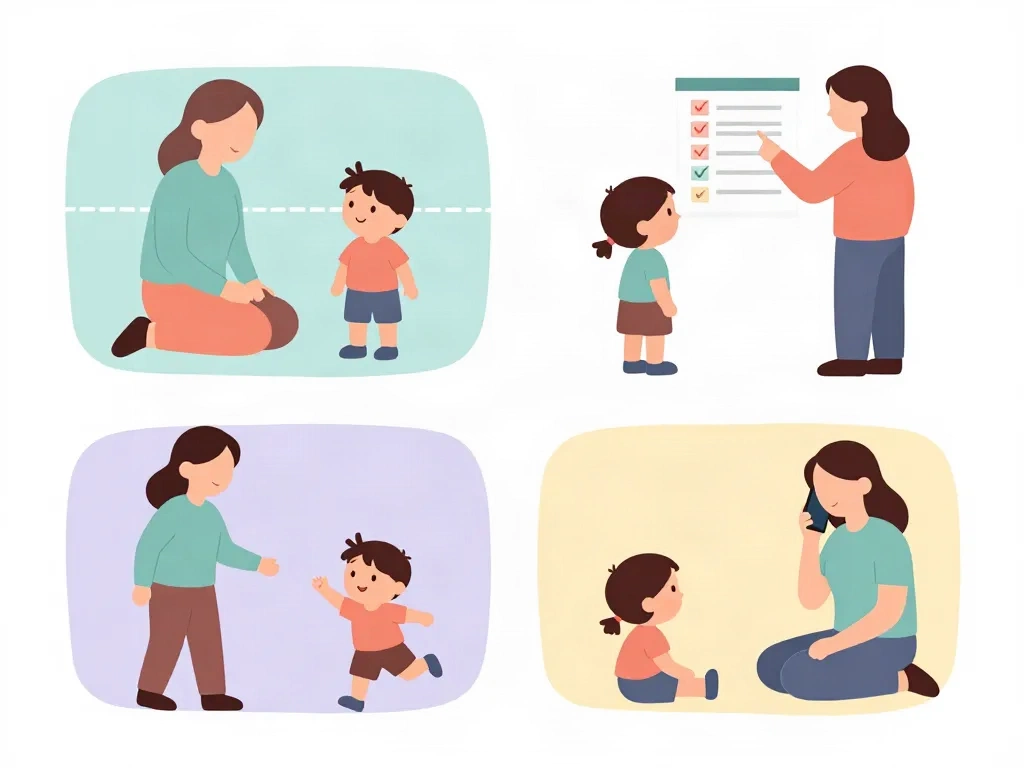
Before jumping into solutions, it helps to understand why these clashes happen — and why they're not evidence that one of you is doing it wrong.
Parenting styles are shaped by deeply personal forces: how you were raised, your cultural background, your personality, your current life circumstances, and your values. When two people are together, they often negotiate these differences in real time — sometimes well, sometimes poorly. After separation, that daily negotiation disappears, and each parent naturally drifts toward their own instincts.
Developmental psychologists generally describe four broad parenting styles:
- Authoritative: High warmth, firm boundaries, open dialogue. ("You need to be in bed by 8:30, but let's talk about why you're upset.")
- Authoritarian: High structure, less flexibility, emphasis on rules. ("Bedtime is 8:30. That's the rule.")
- Permissive: High warmth, fewer boundaries, child-led decision making. ("You can go to bed when you're tired.")
- Uninvolved: Low structure, low engagement. (Less common as a conscious choice, more often a sign of burnout or overwhelm.)
Most real parents don't fit neatly into one box. You might be authoritative about schoolwork but permissive about screen time. Your co-parent might be the reverse. That's not a crisis — it's two human beings with different priorities.
The friction comes when one parent interprets the other's style as harmful, lazy, or deliberately undermining. That interpretation is where conflicts escalate.
Step 1: Separate Preferences from Non-Negotiables
This is the single most important reframe in co-parenting conflict. Not every difference is a problem that needs solving. Your energy is limited — spend it where it matters.
What counts as a non-negotiable?
Non-negotiables are issues that directly affect your child's:
- Physical safety (car seats, supervision, allergen management)
- Medical needs (medication schedules, doctor's appointments)
- Emotional security (no badmouthing the other parent, consistent reassurance of love)
- Educational obligations (school attendance, homework completion)
- Legal requirements (custody schedule compliance, court orders)
What's probably a preference?
- Whether dinner is organic or from a drive-through
- Bedtime varying by 30-45 minutes between homes
- Different screen time limits
- One home having chores and the other not
- Different rules about sugar, sleepovers, or clothing choices
This doesn't mean preferences don't matter. It means they belong in a different conversation — one where both parents have equal standing to make choices in their own home.
A practical exercise: Each parent independently writes a list of their top five co-parenting concerns, ranked by importance. Then compare. You'll almost always find overlap on the top two or three. Start there.
Step 2: Build a "Shared Minimum Standard" Instead of Identical Rules

Many co-parents get stuck because they're trying to create mirror-image households. That's neither realistic nor necessary. Children are remarkably good at understanding that different places have different rules — they already do this at school, at grandparents' houses, and at friends' homes.
Instead of insisting on identical rules, aim for a shared minimum standard: a baseline that both homes agree to uphold, with freedom above that line.
Example: The Bedtime Conflict
The clash: Mom enforces an 8:00 PM bedtime strictly. Dad lets the kids stay up until 9:30 or whenever they're tired.
The shared minimum standard: Both parents agree that on school nights, kids will be in bed (lights out, screens off) by 9:00 PM. On weekends and holidays, each parent sets their own policy.
Notice what happened. Neither parent "won." Mom moved her line by an hour. Dad added structure he didn't have before. The child gets consistency where it counts (rested for school) and flexibility where it doesn't.
Example: The Discipline Divide
The clash: One parent uses time-outs and loss of privileges. The other believes in talking things through without consequences.
The shared minimum standard: Both parents agree never to use physical punishment, never to discipline in anger, and to follow through on any consequence they set. Beyond that, each parent uses the approach they believe in.
This gives the child a predictable emotional experience — "I will be treated with respect, and actions have outcomes" — even when the specific methods differ.
Step 3: Communicate About the Child, Not About Each Other
Most co-parenting arguments derail because they stop being about the child and start being about the other parent's character.
Compare:
- ❌ "You never enforce bedtime because you want to be the fun parent."
-
✅ "I've noticed that Mia seems really tired on Monday mornings. Can we look at Sunday night bedtimes?"
-
❌ "You're too strict. You're going to make them afraid of you."
- ✅ "Jake mentioned he's nervous about making mistakes at your house. Can we talk about how we both handle errors?"
The first versions assign motive and blame. The second versions name an observable concern and invite problem-solving.
The 24-Hour Rule
When your child comes home and reports something from the other household that frustrates you, wait 24 hours before raising it with your co-parent. In that time:
- Check your assumptions. Kids are unreliable narrators — not because they lie, but because they report through their own emotional lens.
- Ask yourself: Is this a non-negotiable issue or a preference? If it's a preference, consider letting it go.
- Draft your message in writing. Read it back and remove any sentences that are really about your feelings toward your co-parent rather than your child's wellbeing.
Step 4: Use Written Agreements to Replace Recurring Arguments
If you find yourselves having the same argument every few weeks — about sugar, about screen time, about who buys school supplies — that's a sign you need a written agreement, not another conversation.
Written agreements work because they:
- Remove the emotional charge from in-the-moment disputes
- Create a reference point that doesn't rely on memory
- Signal mutual respect ("We both agreed to this")
- Reduce the child's ability to play one parent against the other
What a Simple Written Agreement Looks Like
Topic: Screen time on school nights
Agreement: Both homes limit recreational screen time to 1 hour on school nights. Educational apps and school assignments don't count toward the limit. Each parent manages enforcement in their own way.
Review date: We'll revisit this in 3 months or when the school year ends, whichever comes first.
Tools like Servanda can help co-parents create and formalize these kinds of written agreements, providing structure and a clear record that prevents the same conflicts from cycling back.
Step 5: Handle Transition Behavior Without Blame

One of the most misunderstood parts of co-parenting is transition behavior — the way kids act in the first hours (or even days) after switching homes. Parents frequently interpret this behavior as proof that the other home is harmful or chaotic.
In reality, transition behavior is almost always a stress response to the shift itself, not a commentary on either household. Common signs include:
- Clinginess or withdrawal
- Testing boundaries ("But Dad lets me...")
- Emotional meltdowns over minor things
- Regression in younger children (thumb-sucking, baby talk)
- Defiance or attitude in older kids
What Helps
- Create a re-entry routine. A predictable first-hour ritual (snack, quiet time, unpacking together) gives kids a bridge between worlds.
- Don't interrogate. Resist the urge to ask detailed questions about the other home immediately. Let your child settle in first.
- Don't take it personally. Your child acting out after a transition doesn't mean they prefer the other home or that the other parent is doing something wrong.
- Give it time. Most transition behavior fades within 1-2 hours for older kids and up to a day for younger ones.
Step 6: Know When Flexibility Matters More Than Consistency
Consistency gets a lot of praise in parenting advice, and for good reason. But rigid consistency across two separate households can become its own source of conflict.
Ask yourself: Is this consistency serving my child, or is it serving my need to control what happens in the other home?
Some areas where flexibility between homes is usually fine:
- Food choices: Unless there's an allergy or medical dietary need, different menus won't harm your child.
- Household chores: One home having more structure around chores teaches adaptability.
- Entertainment and activities: Different hobbies and experiences at each home can actually enrich your child's life.
- Parenting "extras": One parent reading bedtime stories, the other playing bedtime music — both are valid expressions of care.
Some areas where consistency genuinely matters:
- Medication and medical routines
- School-related expectations (attendance, homework completion)
- Safety rules (seatbelts, helmets, supervision near water)
- Emotional boundaries (not putting kids in the middle, not using them as messengers)
What to Do When You Truly Can't Agree
Sometimes, despite good-faith effort, co-parents hit a wall. One parent sees an issue as a non-negotiable; the other sees it as a preference. Neither is willing to move.
Before escalating to legal action — which is expensive, slow, and stressful for everyone, including your child — consider these intermediate steps:
- Bring in a co-parenting counselor or mediator. A neutral third party can reframe the conflict in ways neither parent has considered.
- Ask your child's pediatrician or therapist. If the disagreement is about something like diet, sleep, discipline, or mental health, a professional opinion can depersonalize the debate.
- Try a time-limited experiment. Agree to try one approach for 30 days, with a specific check-in date to assess how it's working. This lowers the stakes — neither parent is committing permanently.
- Document, don't litigate (yet). If you believe the other parent's choices are genuinely harmful, keep factual records (dates, observations, your child's own words) rather than relying on emotional recollection later.
A Note on What Your Kids Actually Need
Children of separated parents don't need two identical homes. Research consistently shows that what they need is:
- Two parents who don't put them in the middle. This matters more than matching bedtimes.
- Predictability within each home. Rules can differ between homes, as long as rules within each home are consistent.
- Permission to love both parents. Children who feel they must choose sides suffer the most.
- Parents who manage their own emotions. Your child should never be your therapist, your messenger, or your ally against the other parent.
When you feel the urge to "fix" your co-parent's style, pause and ask: "Is my child actually struggling, or am I the one who's uncomfortable?"
That honest self-check is often the most powerful co-parenting tool there is.
Frequently Asked Questions
Is it bad for kids to have different rules at each parent's house?
Not inherently. Children adapt to different rules in different environments all the time — at school, at relatives' homes, at daycare. What matters is that the rules within each home are consistent and that core safety and wellbeing issues are aligned between both homes.
How do I stop my co-parent from undermining my rules?
First, check whether it's truly undermining or simply a different approach. If your co-parent allows something you don't, that's their choice in their home. Focus your energy on maintaining your own household standards and on negotiating the few genuinely shared non-negotiables. If it's a safety issue, document it and seek mediation.
What if my co-parent refuses to communicate about parenting decisions?
Start by keeping communication focused, brief, and in writing (text or email). If your co-parent won't engage at all, you can still control what happens in your home. For decisions that legally require both parents' input — like medical care or school enrollment — consult your custody agreement or a family law attorney.
Should co-parents present a "united front" to their kids?
A united front on major values (safety, respect, honesty) is helpful. But pretending to agree on everything can feel dishonest to kids, who are perceptive. It's okay for your child to know that Mom's house and Dad's house have some different expectations, as long as neither parent criticizes the other's approach in front of the child.
When should I involve a professional in co-parenting disagreements?
Consider involving a mediator or co-parenting counselor when the same conflicts repeat without resolution, when communication has broken down entirely, when your child is showing signs of distress (anxiety, behavioral changes, declining school performance), or when you suspect a genuine safety concern.
Moving Forward: Different Doesn't Mean Broken
Clashing parenting styles feel threatening because they touch on something deeply personal — your vision of what's best for your child. But different doesn't mean wrong, and disagreement doesn't mean dysfunction.
The most effective co-parents aren't the ones who agree on everything. They're the ones who learn to distinguish between what truly matters and what simply matters to them, who put agreements in writing instead of relying on memory and goodwill, and who give their children permission to thrive in two different — but equally loving — homes.
Start small. Pick one recurring friction point. Write down a shared minimum standard you can both live with. Try it for a month. That single step will teach you more about effective co-parenting than any amount of arguing over bedtimes ever could.