
Co-Parenting as a Business: Keep Emotions Out
It's 8:47 p.m. on a Tuesday. You texted your co-parent a simple question about Saturday's soccer game—what time is pickup?—and somehow, twelve messages later, you're relitigating who forgot the permission slip in March and why the divorce happened in the first place. Your chest is tight. Your kid is in the next room. And nothing about Saturday's soccer game has been resolved.
If this sounds familiar, you're not broken—you're human. But there is a better way. What if you stopped approaching your co-parent as an ex-partner and started treating the relationship like a business partnership? Not cold. Not heartless. Just structured, boundaried, and focused on the one shared objective that actually matters: raising your children well.
This article walks you through exactly how to make that mindset shift—and gives you concrete tools to do it starting today.
Key Takeaways
- Reframe the relationship: Your co-parent is your business partner in a child-raising enterprise—nothing more, nothing less.
- Use agendas, not arguments: Structured meeting formats keep conversations on track and prevent emotional spiraling.
- Choose neutral communication channels: Where and how you communicate matters as much as what you say.
- Create an operating agreement: Written protocols for recurring decisions eliminate the need for repeated negotiation.
- Separate the personal ledger from the parenting ledger: Past relationship grievances have no place in logistics conversations.

Why the "Business Partner" Mindset Works
Most co-parenting advice tells you to "communicate better." That's like telling someone with a broken leg to "walk better." The problem isn't that you lack communication skills—it's that you're trying to use relationship communication patterns inside a dynamic that is no longer a relationship.
Think about how you interact with a colleague at work. You don't bring up the time they annoyed you at last year's holiday party when you're trying to finalize a project timeline. You stay on topic. You use professional language. You document decisions in writing. And when the meeting is over, you close your laptop and move on with your day.
Treating co-parenting as a business applies the same logic:
- Defined roles and responsibilities replace ambiguous expectations.
- Written records replace he-said-she-said disputes.
- Scheduled check-ins replace reactive, emotionally charged texts at all hours.
- Shared goals (your children's wellbeing) replace competing personal agendas.
This isn't about suppressing your feelings. You're allowed to feel hurt, angry, or frustrated. But those feelings get processed with your therapist, your best friend, or your journal—not in a logistics conversation about who's buying school supplies.
Step 1: Draft Your Co-Parenting Operating Agreement
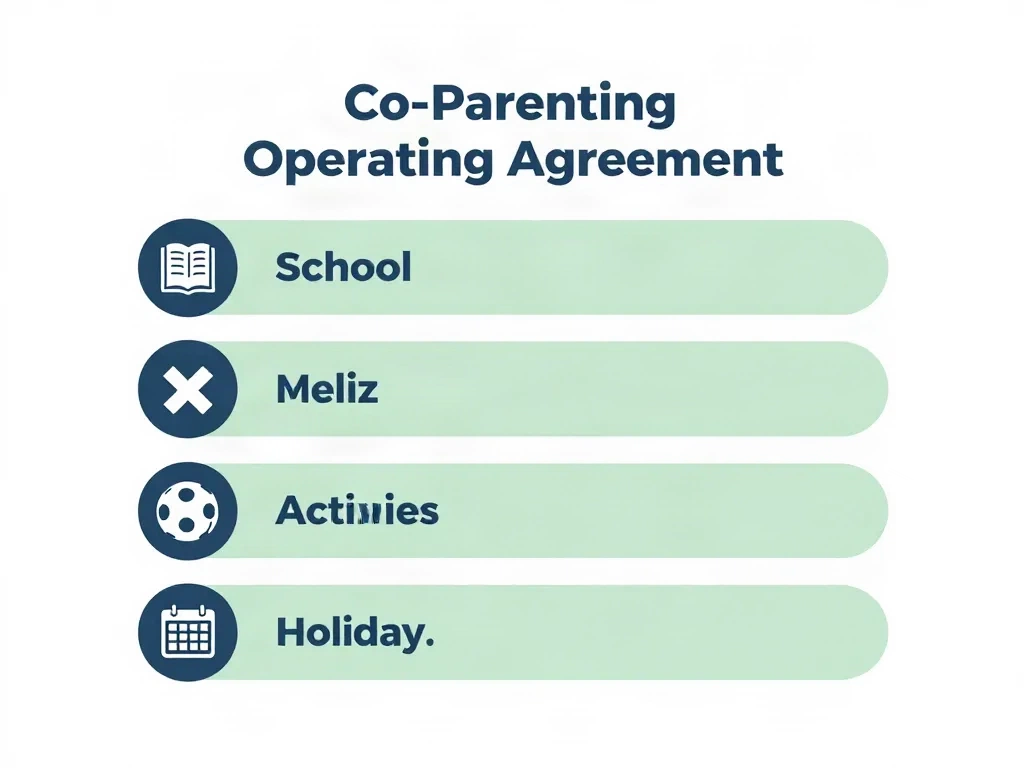
Every functional business has an operating agreement—a document that spells out who does what, when, and how. Your co-parenting arrangement needs one too, and it goes beyond what's in your custody order.
Sit down (separately, if needed) and outline protocols for:
Recurring Decisions
- School: Who attends parent-teacher conferences? How are you notified of school events? Who handles homework on their parenting days?
- Medical: Who schedules appointments? How are medication changes communicated? What's the protocol for emergencies?
- Extracurriculars: What's the budget? Who handles transportation? How are new activities approved?
- Holidays and vacations: What's the rotation? When is the deadline for submitting travel plans?
Communication Rules
- Allowed channels (email, a co-parenting app, text for emergencies only)
- Expected response times (e.g., 24 hours for non-urgent matters)
- Topics that are off-limits in written communication (anything about the past relationship)
Dispute Resolution
- What happens when you disagree? (e.g., 48-hour cool-down, then a structured phone call, then mediation if unresolved)
- Tools like Servanda can help co-parents formalize these agreements in writing and provide AI-guided structure when disagreements arise—before they escalate into full-blown conflicts.
The goal is to make as many decisions as possible in advance so that daily co-parenting requires as little real-time negotiation as possible.
Step 2: Hold "Board Meetings," Not Arguments
Here's a tactic that sounds unusual but works remarkably well: schedule a regular co-parenting meeting—weekly, biweekly, or monthly—and run it like a board meeting.
How to Structure Your Co-Parenting Meeting
- Set a fixed time and duration. Thirty minutes, every other Sunday at 7 p.m. Put it on both calendars. Treat it as non-negotiable.
- Use a shared agenda. Both parents add items to a shared document (Google Doc, shared note, co-parenting app) by 24 hours before the meeting. No agenda item? No meeting needed.
- Stick to the agenda. If something comes up that isn't on the list, table it for the next meeting unless it's urgent.
- Take notes. One parent takes brief notes on decisions made. Share them afterward so there's a written record.
- End on time. When the 30 minutes are up, the meeting is over. Period.
What This Looks Like in Practice
Let's say Marcus and Dani (names changed) divorced two years ago. Their Sunday meetings look like this:
Agenda – Oct 13 1. Thanksgiving schedule confirmation 2. Ella's orthodontist—who's taking her Nov 3? 3. Winter coat budget
They spend 10 minutes each on items 1 and 2, five minutes on item 3, and wrap up with five minutes to spare. Marcus wanted to bring up that Dani was 15 minutes late for pickup last Wednesday, but he recognizes that's a pattern conversation, not a single-incident emergency—so he adds it to next meeting's agenda as "Pickup punctuality—establishing a grace period."
No yelling. No guilt trips. No text thread that ruins both their evenings.
Step 3: Master the Language of Neutrality
In business, how you phrase things matters. The same is true in co-parenting. Emotional language triggers emotional responses. Neutral language keeps conversations productive.
The Swap List
| Instead of This... | Try This... |
|---|---|
| "You never tell me anything about their school." | "I'd like to be copied on school emails. Can we set that up?" |
| "You're spoiling them with junk food." | "Can we align on nutrition guidelines for both homes?" |
| "You forgot AGAIN." | "The permission slip is due Friday. Can you confirm it's submitted?" |
| "We need to talk." | "I've added an item to next week's agenda about summer camp." |
| "That's not what we agreed on." | "I'm referencing our agreement from [date]. Can we revisit?" |
Notice the pattern: every neutral version is specific, forward-looking, and solution-oriented. It doesn't assign blame. It doesn't reference a pattern of failures. It focuses on the next action.
The BIFF Method
Family law professionals often recommend the BIFF method for high-conflict co-parenting communication. Every message should be:
- Brief: Two to five sentences maximum.
- Informative: Share facts, not feelings.
- Friendly: A neutral or mildly warm tone. ("Thanks for handling that" goes a long way.)
- Firm: State your position or request clearly. No hedging, no passive-aggression.
Before hitting send, read your message out loud and ask: Would I send this to a colleague I respect but don't particularly like? If yes, send it. If not, revise.

Step 4: Separate the Two Ledgers
This is the hardest part, and it's where most co-parents struggle: separating the personal ledger (everything that happened in your relationship) from the parenting ledger (everything related to raising your children going forward).
The personal ledger holds real pain. Betrayal, disappointment, broken promises, lost futures. That pain is valid. But it does not belong in a conversation about whether your daughter should switch to a different math tutor.
Here's a practical way to enforce this boundary:
The Relevance Test
Before saying or typing something, ask:
- Is this about our child's wellbeing or logistics? → Say it.
- Is this about our past relationship or my feelings about my co-parent as a person? → Don't say it. Write it in your journal. Call your therapist. Tell your sister.
- Is this about a co-parenting pattern I need to address? → Add it to the meeting agenda with neutral, specific language.
If your co-parent violates this boundary—and they will, especially early on—you don't have to engage. A simple response like "I want to keep our communication focused on the kids. Can we get back to the schedule question?" redirects without escalating.
You are not responsible for your co-parent's emotional regulation. You are only responsible for your own.
Step 5: Build In Pressure-Release Valves
Running co-parenting as a business doesn't mean you become a robot. You will feel triggered. You will want to fire off a scathing text at midnight. The goal isn't to never feel those things—it's to have systems that prevent you from acting on them.
Practical pressure-release valves:
- The 24-hour rule: Unless someone is in danger, don't respond to a triggering message for 24 hours. Most of the time, your anger will have cooled enough to craft a BIFF response.
- A vent partner: Designate one trusted person who's willing to receive your unfiltered frustration—so your co-parent doesn't.
- A "drafts" folder: Write the angry text. Read it. Delete it. Then write the professional one.
- Physical reset: Before your board meeting, go for a 10-minute walk, do a breathing exercise, or splash cold water on your face. Entering the conversation with a regulated nervous system changes everything.
When This Approach Isn't Enough
The business-partner model works well for low-to-moderate conflict co-parenting situations. But it has limits.
If your co-parent is engaging in abuse, threats, or manipulation, professional structure alone won't solve the problem. In those situations:
- Work with a family law attorney to establish court-enforced boundaries.
- Use a court-approved communication platform that creates admissible records.
- Consider parallel parenting (minimal direct contact, fully independent decision-making within each home) instead of cooperative co-parenting.
- Seek support from a therapist experienced in high-conflict custody dynamics.
The business model is a tool, not a cure-all. Use it where it fits, and get professional help where it doesn't.
Frequently Asked Questions
How do I co-parent with someone who refuses to be professional?
You can only control your side of the equation. Stay consistent with your structured approach—BIFF responses, agenda-based communication, written records. Over time, many co-parents mirror the tone that's modeled for them. If they don't, your documented, professional communication still protects you legally and emotionally.
Is it realistic to keep all emotions out of co-parenting?
No, and that's not the goal. The goal is to process emotions outside of your co-parenting interactions, not to stop feeling them. Think of it like a surgeon: they may feel anxious before an operation, but they don't let that anxiety guide the scalpel. Your feelings are valid. Your co-parenting communication just isn't the right container for them.
What's the difference between co-parenting and parallel parenting?
Co-parenting involves regular, cooperative communication and shared decision-making. Parallel parenting minimizes direct contact—each parent makes day-to-day decisions independently during their parenting time, and communication is limited to essential logistics, often in writing only. Parallel parenting is often recommended for high-conflict situations as a stepping stone that may evolve into cooperative co-parenting over time.
How do I bring up this "business approach" without offending my co-parent?
Frame it as a benefit for both of you, not a criticism of how things have been going. You might say something like: "I've been reading about ways to make our communication smoother so we both have less stress. Would you be open to trying a weekly agenda for the next month and seeing if it helps?" Lead with the shared benefit—less conflict, more clarity—rather than implying they're the problem.
What tools can help co-parents communicate more professionally?
Co-parenting apps like OurFamilyWizard and TalkingParents offer structured messaging, shared calendars, and expense tracking. Shared Google Docs work well for meeting agendas. For formalizing agreements and resolving specific disputes, AI-powered platforms can provide guided frameworks. The best tool is whichever one you'll both actually use consistently.
Moving Forward
Reframing co-parenting as a business isn't about being cold—it's about being intentional. It's about recognizing that the most loving thing you can do for your children is remove them from the crossfire of adult conflict.
Start small. Pick one strategy from this article—the 24-hour rule, the BIFF method, the weekly agenda—and try it for two weeks. You don't need your co-parent's buy-in to begin. You just need your own commitment to showing up as the business partner your children deserve.
The relationship that ended was personal. The partnership that remains is professional. And your kids will be better for it.