The Housework Fight: Who Does More and Why It Hurts
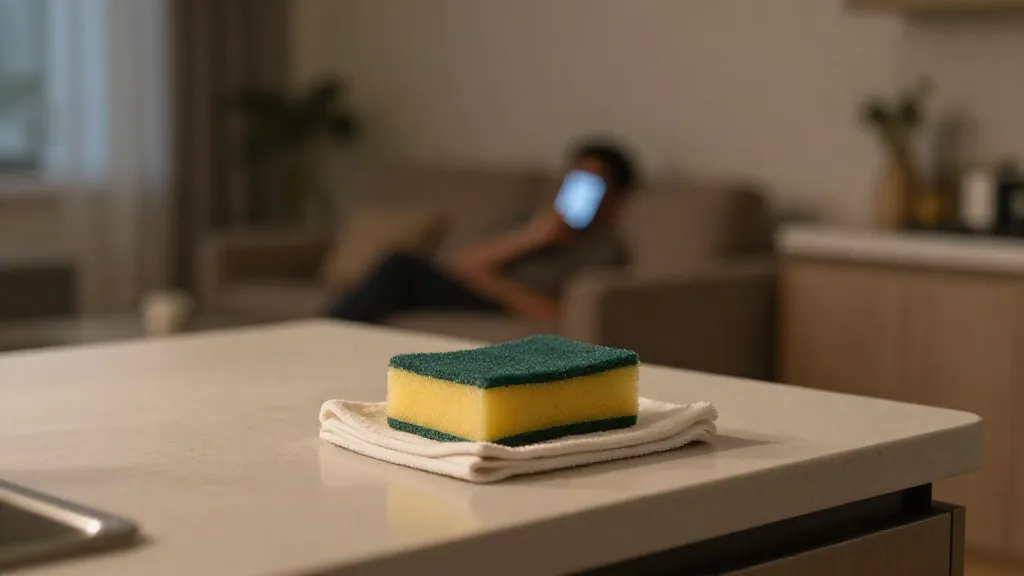
It's 9:47 p.m. on a Tuesday. One partner is wiping down the kitchen counter for the second time today. The other is on the couch, scrolling their phone, genuinely unaware that the trash still needs to go out, the kids' lunches aren't packed, and the laundry has been sitting damp in the washer since morning.
No one says anything. Not yet. But a familiar tightness builds in the chest of the person holding the sponge. It's not about the counter. It was never about the counter.
The housework fight is one of the most common — and most corrosive — recurring arguments couples have. Research from the Pew Research Center consistently ranks the division of household chores among the top sources of friction in relationships. And yet most couples treat it like a logistics problem: who should do what. The real issue runs deeper. It's about respect, recognition, and whether both people feel like equal partners in the life they're building together.

Why the Housework Fight Is Never Really About the Dishes
When Sarah and James (names changed) came to couples counseling, Sarah's opening line was: "He never cleans the bathroom." Thirty minutes later, the conversation had moved to something entirely different — Sarah felt like she was running the entire household alone while working full-time, and James felt like nothing he did was ever enough.
This is the pattern. The housework fight is a proxy war for three deeper issues:
1. Feeling Unseen (The Recognition Gap)
When one partner consistently handles more household labor, the sting isn't just physical exhaustion — it's the sense that their effort is invisible. They're not asking for applause. They're asking for their partner to notice that the toilet paper didn't replace itself.
2. The Mental Load (Invisible Labor)
The concept of "mental load" — popularized by French cartoonist Emma's viral comic "You Should've Asked" — describes the cognitive work of managing a household: remembering, planning, delegating, anticipating. Even when physical tasks are split evenly, one partner often carries the majority of this invisible project management.
Examples of mental load:
- Keeping track of when the dog's flea medication is due
- Knowing which kid has a field trip on Friday and needs a packed lunch
- Noticing the shower curtain is growing mildew before anyone asks
- Scheduling the dentist appointments for the whole family
- Remembering to buy a birthday gift for a partner's parent
This labor is exhausting precisely because it never clocks out. And it's difficult to quantify, which means it's easy for the other partner to underestimate or overlook entirely.
3. The Fairness Question (Am I Your Partner or Your Parent?)
Perhaps the most damaging undercurrent is the feeling that the relationship has shifted from a partnership into a caretaker dynamic. When one person has to ask for every task to be done — or worse, redo it after it's done poorly — they stop feeling like an equal partner and start feeling like a household manager supervising a reluctant employee.
This dynamic kills intimacy. It's hard to feel attracted to someone you're parenting, and it's hard to feel connected to someone who treats you like you're incompetent.
The Scorekeeping Trap (And Why It Backfires)
When resentment builds, the natural response is to start counting. I did the dishes three times this week. You did them once. The logic feels airtight.
But scorekeeping almost always makes the housework fight worse, for two reasons:
First, both partners are keeping different scorecards. One person counts the visible tasks (mowing the lawn, cooking dinner). The other counts the invisible ones (researching summer camps, managing the family calendar). Neither scorecard is wrong — but they don't overlap, which means both people feel underappreciated simultaneously.
Second, scorekeeping turns your partner into an opponent. The moment you're tallying points, you've stopped being a team. You're now in a competition where someone has to lose.
A more productive question than "Who does more?" is: "Does each of us feel like the other is genuinely trying?"
That shift — from quantifying output to assessing intent and effort — changes the entire conversation.
A Step-by-Step Framework to Actually Fix the Chore Division
Generic advice like "just talk about it" doesn't work because the housework fight usually starts as a conversation and devolves from there. What you need is structure. Here's a framework that works:
Step 1: Map Everything (The Full Task Audit)
Sit down together — not during an argument, not when either of you is tired — and create a complete list of every household task. Every single one. Include:
- Daily tasks: Dishes, cooking, tidying, pet care, packing lunches
- Weekly tasks: Laundry, grocery shopping, vacuuming, bathroom cleaning
- Monthly/seasonal tasks: Deep cleaning, yard work, car maintenance, bill review
- Mental load tasks: Scheduling appointments, meal planning, remembering birthdays, researching purchases, managing school communications
- Emotional labor: Checking in on extended family, coordinating social plans, remembering what your kid is anxious about this week
Writing it all down does something powerful: it makes the invisible visible. Many couples report that this step alone shifts the dynamic, because the partner carrying less load finally sees the full picture.
Step 2: Note Who Currently Does What
Next to each task, write the initials of who currently handles it. Be honest. If one person "helps" with dinner but the other plans the meal, checks the pantry, buys the ingredients, and tells them what to chop — that's not a 50/50 task.
Step 3: Talk About Preferences, Not Just Assignments
Not all chores are equally painful for all people. Some people don't mind folding laundry but despise scrubbing the stovetop. Lean into preferences where you can.
Ask each other:
- Which tasks do you actually not mind doing?
- Which tasks feel soul-crushing?
- Which tasks would you happily trade?
This step introduces goodwill into what can otherwise feel like a grim negotiation.
Step 4: Assign Ownership — Not Just Execution
This is the critical distinction most couples miss. Ownership means the task is entirely yours — noticing it needs doing, deciding when and how, and doing it without being reminded. Execution alone (doing it when asked) still leaves the mental load with the other partner.
For example: If Partner A owns grocery shopping, that means Partner A checks what's needed, makes the list, goes to the store, and puts everything away. Partner B doesn't need to think about it at all.
Ownership is what actually reduces mental load. Anything less is still delegation.
Step 5: Set a Check-In Date
Agree to revisit your arrangement in two to four weeks. This gives both partners permission to adjust without it feeling like a failure, and it creates accountability.
During the check-in, ask:
- Is this division feeling fair to both of us?
- Are there tasks falling through the cracks?
- Has anything changed in our schedules that requires a shift?
Consider writing down your agreements so there's a shared reference point. Tools like Servanda can help couples formalize these kinds of household agreements so they don't get lost in the blur of daily life.

What to Do When Standards Don't Match
One of the trickiest dimensions of the housework fight is differing standards. One partner thinks the kitchen is clean; the other sees crumbs on the counter and a greasy stovetop. Neither person is wrong — but the gap creates friction.
Here's how to navigate it:
- Define "done" together. For each task that causes conflict, agree on what completion actually looks like. "Clean the kitchen" is vague. "Wipe counters, put dishes in dishwasher, sweep the floor" is specific and measurable.
- Accept "good enough." If your partner owns a task and does it to a reasonable standard — even if it's not exactly how you'd do it — resist the urge to redo it. Redoing someone's work is one of the fastest ways to ensure they stop trying.
- Interrogate your own standards. Some standards are about hygiene and health. Others are about aesthetics or control. Know the difference, and be willing to flex on the latter.
When the Problem Isn't the Chores — It's the Refusal to Engage
Sometimes the housework fight isn't about logistics at all. Sometimes one partner won't participate — not because they're oblivious, but because they don't see it as their responsibility, or they've learned that if they do tasks poorly enough, they won't be asked again (a behavior researchers call "weaponized incompetence").
If this is your situation, the conversation needs to shift from chores to values:
- "When I'm the only one managing our home, I feel like I don't have a real partner."
- "I need to know that you see this as our shared responsibility, not a favor you're doing for me."
- "This isn't about cleaning. It's about whether we're building this life together or I'm building it alone."
These are hard conversations. But they're necessary ones. If your partner dismisses your experience or refuses to engage, that may point to a deeper relational issue worth exploring — potentially with a therapist or mediator.
How to Bring This Up Without Starting Another Fight
Timing and framing matter enormously. A few guidelines:
- Don't bring it up in the moment of frustration. "You never help" said while you're scrubbing a pot at 10 p.m. will not land well.
- Use "I" statements that describe your experience, not their character. "I feel overwhelmed managing most of the house" instead of "You're lazy."
- Frame it as a team problem. "I think we could set up a system that works better for both of us" positions you as allies, not adversaries.
- Come with curiosity, not a verdict. Ask how they experience the workload. You might be surprised — they may feel they're contributing more than you realize in areas you haven't considered.
- Propose the task audit (Step 1 above) as a joint project, not an indictment. "I want us to get on the same page" is disarming. "I want to prove to you how much I do" is not.
What the Research Tells Us
The data on this is clear and consistent:
- A 2023 Pew Research Center survey found that sharing household chores is one of the top factors people cite as very important for a successful marriage — ahead of having children and ahead of shared religious beliefs.
- Studies published in the Journal of Marriage and Family have found that perceived unfairness in the division of housework is a stronger predictor of relationship dissatisfaction than the actual hours spent on tasks. In other words, the feeling of unfairness matters more than the math.
- Research from the Gottman Institute shows that couples who divide labor equitably (not necessarily equally, but in a way both perceive as fair) report higher relationship satisfaction, more frequent intimacy, and lower divorce rates.
The takeaway: you don't need a perfectly equal split. You need a split that both partners experience as fair, respectful, and genuinely shared.
Frequently Asked Questions
How do I talk to my partner about unequal housework without blaming them?
Start by choosing a calm moment — not mid-argument — and framing the conversation as something you want to solve together, not something they're doing wrong. Lead with your own feelings ("I've been feeling overwhelmed") rather than accusations ("You never help"). Proposing a joint task audit gives the conversation a concrete, collaborative focus instead of becoming a blame session.
Is it normal to fight about chores in a relationship?
Absolutely. The division of household labor is consistently one of the top sources of conflict in romantic relationships, according to multiple national surveys. It's normal — but that doesn't mean it has to stay unresolved. Couples who address it directly and create explicit agreements tend to report significantly less friction over time.
What is mental load in a relationship and why does it matter?
Mental load refers to the invisible cognitive work of running a household — remembering, planning, tracking, anticipating, and delegating. It matters because it's exhausting, largely unrecognized, and disproportionately carried by one partner (often women, according to research). Failing to address mental load means even a "fair" split of physical chores can still leave one partner feeling overburdened.
How do you split chores fairly when both partners work full-time?
Start with a full inventory of every household task (including mental load tasks), then divide based on a combination of preference, schedule flexibility, and a mutual sense of fairness. The goal isn't a perfect 50/50 split — it's an arrangement where both partners feel the effort is genuinely shared. Revisit the arrangement regularly as schedules and circumstances change.
What is weaponized incompetence and how do I address it?
Weaponized incompetence is when a partner deliberately does a task poorly so they won't be asked to do it again. If you suspect this pattern, address it directly and calmly: "When this task is done in a way that means I have to redo it, it feels like the responsibility is still entirely mine." Make it clear that ownership means completing the task to a shared standard, and that this is a matter of partnership, not performance.
Moving Forward Together
The housework fight is one of the most common recurring arguments in relationships — but it's also one of the most solvable. Not because there's a magic formula for splitting chores, but because the real fix isn't about the chores at all. It's about building a shared understanding of what each partner carries, acknowledging the invisible work, and committing to a division that both people experience as genuinely fair.
You don't need to agree on everything. You don't need a perfect spreadsheet. You need two people willing to sit down, see each other's reality clearly, and say: "Let's figure this out as a team."
Start tonight. Pull out a piece of paper. Write down every task. And have the conversation — not about who does more, but about how to make sure neither of you feels alone in the work of building your life together.