How to Confront Your Roommate Without Ruining It
You've been lying awake for the third night in a row. Your roommate's alarm has been going off at 5:30 AM — and they keep hitting snooze for forty-five minutes. Or maybe it's the dishes piling up in the sink, the friends who crash on your couch every weekend without warning, or the thermostat war that's been silently escalating since October.
You know you need to say something. But every time you rehearse the conversation in your head, it ends in a shouting match, a slammed door, or months of icy silence in a space you both pay rent for.
It's not the confrontation itself that ruins roommate relationships. It's how and when and why you do it. Learning to confront your roommate directly and respectfully is a concrete, learnable skill.

Why Most People Avoid Confronting Their Roommate (And Why That Backfires)
Confrontation feels dangerous. Psychotherapist Dr. Harriet Lerner, author of The Dance of Connection, points out that most people operate from one of two default modes during conflict: they either over-function (explode, lecture, criticize) or under-function (withdraw, accommodate, go passive-aggressive).
Here's what under-functioning — avoidance — actually looks like in a roommate situation:
- You start spending more time in your room or away from the apartment entirely.
- You vent to friends or on social media instead of talking to your roommate.
- Small annoyances become evidence of a larger character flaw. "They didn't take out the trash" becomes "They have zero respect for me."
- You start doing passive-aggressive things — cleaning loudly at midnight, leaving notes on the fridge, "forgetting" to pass along their mail.
Residence advisors at universities across the country consistently report the same pattern: roommate conflicts that escalate into housing transfers or formal complaints almost always started as small issues that went unaddressed for weeks or months.
How to Prepare Before You Confront Your Roommate
The most important part of the conversation happens before you open your mouth.
Get Clear on the Specific Issue
Vague frustration produces vague complaints. Before you initiate anything, identify:
- The specific behavior (not personality trait) that's bothering you.
- The concrete impact it has on your daily life.
- What a realistic resolution would look like.
For example:
- ❌ "You're so inconsiderate about noise."
-
✅ "When music plays past midnight on weeknights, I can't fall asleep for my 8 AM shifts."
-
❌ "You need to be cleaner."
- ✅ "When dishes sit in the sink for more than a day, it attracts bugs and I can't use the kitchen comfortably."
Specific, behavioral language gives your roommate something actionable to work with instead of feeling like their entire personality is under attack.
Check Your Motive
Ask yourself: Am I trying to solve a problem, or am I trying to win?
If you're rehearsing devastating comebacks, cataloging every wrong they've ever committed, or fantasizing about "finally telling them how it is" — you're not ready. Your goal should be genuinely collaborative. You should be able to finish this sentence honestly: "I want to have this conversation because I want us to live together more comfortably."
Choose Your Timing Deliberately
Residence life professionals recommend what some call the "72-hour window": don't bring up an issue in the heat of the moment, but don't let it simmer for more than about three days either.
Avoid initiating when:
- Either of you just walked in the door from work or class
- It's late at night and you're both tired
- Friends, partners, or other roommates are present
- One of you is dealing with a separate stressful event (exams, family crisis, work deadline)
A good opening: "Hey, are you free to talk for a few minutes sometime today or tomorrow? There's something about our living situation I want to figure out together."
This gives them time to mentally prepare too, which reduces defensiveness.

The Conversation: A Step-by-Step Framework
Here's a practical framework drawn from conflict resolution research and real RA training programs.
Step 1: Open With Intention, Not Accusation
Start by naming your goal for the conversation.
"I want to talk about the kitchen situation — not to blame you, but because I want us to find something that works for both of us."
Step 2: Describe the Situation Using "I" Statements
"I" statements have three components:
- I feel [emotion] — not "I feel like you're being a jerk," which is a "you" statement in disguise
- When [specific observable behavior]
- Because [concrete impact on you]
Examples:
- "I feel anxious when the front door is left unlocked overnight because I don't feel safe sleeping."
- "I get stressed when guests stay over without a heads-up because I need to know when I can use the shared spaces."
- "I feel frustrated when I come home and the living room has food containers from the weekend because it affects my ability to relax in our shared space."
Notice what's absent: words like "always," "never," and "you should."
Step 3: Actively Listen to Their Response
This is the step most guides gloss over, but it's where conversations either succeed or collapse.
Active listening means:
- Reflecting back what they said: "So it sounds like you've been leaving dishes because your work schedule changed and you're exhausted by the time you get home — is that right?"
- Asking genuine questions: "What would make this easier on your end?"
- Acknowledging their perspective even if you disagree: "That makes sense. I didn't realize your hours shifted."
You might learn something that completely reframes the issue. Most people aren't trying to make your life worse — they're operating from their own set of defaults and assumptions.
Step 4: Problem-Solve Together
Move from "here's my complaint" to "here's our plan." Brainstorm options collaboratively:
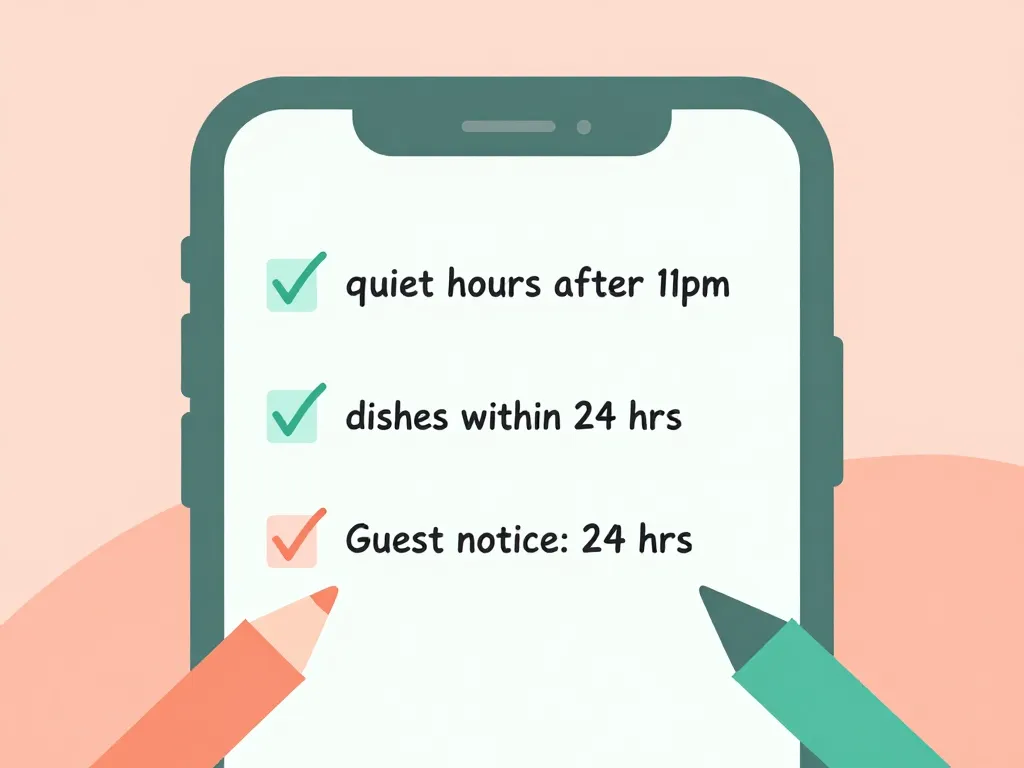
- "What if we set a rule that dishes get done within 24 hours, and whoever cooks, the other person washes?"
- "Could we agree on quiet hours after 11 PM on weeknights and midnight on weekends?"
- "What if we each give 24 hours' notice before having guests stay over?"
Let them propose solutions too. People are far more likely to follow through on agreements they helped design.
Step 5: Write It Down
After you've agreed on something, put it in writing — even if it's just a shared note on your phones.
A written agreement doesn't have to be formal or legalistic. It just needs to capture:
- What you both agreed to
- When it starts
- When you'll check back in
Tools like Servanda can help roommates create clear, written agreements that both parties can reference later.
What to Do When the Conversation Goes Sideways
Sometimes, despite your best preparation, things get heated.
They Get Defensive or Shut Down
Don't push. Say something like: "I can tell this feels like a lot. We don't have to figure everything out right now. Can we come back to this tomorrow?" Then actually come back to it.
They Counter-Attack With a List of Your Faults
Resist the urge to defend yourself point by point. Instead: "It sounds like you have some things you want to address too, and I'm genuinely open to hearing them. Can we finish talking about this issue first and then move to yours?"
You Realize You're Getting Angry
Name it. "I notice I'm getting frustrated and I don't want to say something unhelpful. Can we take a break and come back in an hour?"
Nothing Changes After the Conversation
This doesn't mean the conversation failed. Follow up directly: "Hey, I noticed the noise situation hasn't really changed since we talked. Can we revisit our plan and see if we need to adjust it?"
If repeated good-faith conversations produce zero change, you may need to involve a third party — an RA, a mutual friend, or a mediator — or begin exploring other living arrangements.
Real-World Example: How One Conversation Saved a Lease
Two roommates — let's call them Jordan and Alex — shared a two-bedroom apartment. Jordan worked from home; Alex was a night owl who frequently had friends over until 2 AM on weekdays.
For three months, Jordan said nothing. Instead, Jordan started wearing noise-canceling headphones to bed, texted complaints to other friends, and grew increasingly cold toward Alex. Alex, sensing the tension but not understanding it, assumed Jordan was just moody.
Finally, Jordan used a version of the framework above:
- Texted Alex asking if they could talk that evening.
- Opened with: "I want to figure out something about noise at night — I'm not mad, I just want us both to be comfortable here."
- Described the impact: early meetings, inability to sleep, growing resentment.
- Listened as Alex explained they had no idea the sound carried so much and that their social life was their main stress relief.
- They agreed together: weeknight guests leave by 11 PM, weekend guests by 1 AM, and Alex would give a heads-up text before having people over.
Six months later, they renewed their lease.
Frequently Asked Questions
How do I confront my roommate about cleanliness without sounding like a parent?
Focus on shared spaces and specific impacts rather than their personal habits. Instead of "you need to clean up after yourself," try "Can we figure out a system for the kitchen that works for both of us?" Framing it as a design problem rather than a discipline issue keeps things collaborative.
Is it better to text my roommate about issues or talk in person?
In-person is almost always better for the actual conversation because tone and body language prevent misunderstandings. However, a short text to set up the conversation is smart — something like "Hey, can we chat about the bathroom schedule tonight?" gives them time to prepare and signals that you're being thoughtful about it.
What if my roommate gets angry every time I bring something up?
If your roommate consistently responds to reasonable requests with anger, that's a pattern worth taking seriously. Try once more using the techniques above, and if the response is still hostile, consider involving a neutral third party — an RA, landlord, or mediator. You have a right to address issues in your own home.
Should I confront my roommate about something that only happened once?
It depends on severity. A one-time loud party? Probably worth a brief, low-key mention ("Hey, just for future reference, could you give me a heads-up before a big gathering?"). A one-time boundary violation — like entering your room without permission or using your belongings — deserves a direct conversation even if it only happened once.
How do I bring up money issues with my roommate?
Money conversations feel loaded, so specificity is your best friend. Rather than "you owe me money," use exact amounts and dates: "The electric bill from March was $140 and your half is $70 — can you Venmo me by Friday?" Agree upfront on a system for splitting costs, and use a shared spreadsheet or app to track everything transparently.
Moving Forward
Confronting your roommate isn't about winning an argument or delivering a speech you've rehearsed. It's about protecting a shared space and a relationship that shapes your daily life.
The techniques in this guide — specific language, deliberate timing, "I" statements, active listening, and written agreements — come from therapists, residence advisors, and real people who've used them to turn tense living situations into functional ones.
Start small. Pick the one issue that's weighing on you most, prepare using the framework above, and have the conversation this week. A roommate who responds well to a respectful, honest conversation is someone worth living with.