How to Resolve Roommate Conflicts Peacefully
It's 11:30 PM on a Tuesday. You have an 8 AM presentation tomorrow, and your roommate just invited three friends over to watch a movie — volume cranked, kitchen a disaster zone, laughter echoing through the thin walls. Your jaw tightens. You've already asked about this twice. Do you storm out of your bedroom and snap? Send a passive-aggressive text from ten feet away? Or just lie there, seething, adding this to the mental tally of grievances you'll eventually explode over?
Most roommate conflicts don't start as blowups. They start as minor annoyances that get swallowed, silently catalogued, and left to ferment. By the time someone finally speaks up, weeks or months of resentment have turned a solvable problem into a relationship fracture.
This guide gives you the exact scripts, frameworks, and steps to handle disagreements before they become disasters.

Why Roommate Conflicts Escalate (and Why Yours Doesn't Have To)
Shared living creates a unique pressure cooker. Unlike workplace disagreements, you can't clock out. Unlike family friction, you may not have years of built-up goodwill to fall back on. You're sharing the most intimate parts of daily life — sleep, food prep, hygiene routines, downtime — with someone who has entirely different defaults for what "normal" looks like.
Here's what typically goes wrong:
- The Assumption Trap: You assume your roommate knows the dishes should be done the same day. They assume a 24-hour window is fine. Neither of you has ever stated this out loud.
- The Avoidance Spiral: You avoid the conversation because it feels awkward. The behavior continues. Your resentment grows. When you finally say something, your tone carries three months of frustration — and your roommate is blindsided.
- The Text Trap: Serious topics handled over text almost always go sideways. Tone is invisible. Read receipts create pressure. Screenshots create distrust.
Step 1: Choose the Right Moment (Timing Is Everything)
Bringing up a conflict at the wrong time is sometimes worse than not bringing it up at all. Catching your roommate as they rush out the door, or confronting them in front of guests, almost guarantees a defensive reaction.
When to talk:
- Within 24–48 hours of the incident, while it's still specific enough to discuss clearly
- When you're both home, settled, and not in the middle of something
- When neither of you is hungry, exhausted, or intoxicated
- In a private, neutral space (the kitchen table, not standing over their bed)
When NOT to talk:
- In the heat of the moment, when your heart rate is still elevated
- Over text, for anything beyond simple logistics
- Right before one of you leaves for work or class
- When either person has company over
Real example: Maya noticed her roommate Priya had been leaving hair in the shower drain for two weeks. Maya's first instinct was to leave a note on the bathroom mirror. Instead, she waited until they were both eating dinner on a Sunday evening. "Hey, can I bring up something small before it becomes a thing?" That one sentence — casual, low-stakes, forward-looking — changed the entire dynamic of the conversation.
Step 2: Use the "I Notice / I Feel / I'd Like" Script
This is the single most effective framework for raising a concern without making your roommate feel attacked. It works because it focuses on observable facts, your internal experience, and a concrete request — not accusations.
- "I've noticed that…" (state the specific behavior — no generalizations like "you always")
- "It makes me feel…" (name the emotion — frustrated, anxious, disrespected)
- "I'd like us to…" (propose a specific, actionable solution)
Examples:
Noise conflict:
"I've noticed music playing past midnight a few times this week. It's been making it hard for me to sleep, and I'm dragging at work. I'd like us to agree on a quiet hours window — maybe 11 PM on weeknights? What works for you?"
Cleaning conflict:
"I've noticed dishes sitting in the sink for a few days at a time. Honestly, it stresses me out when the kitchen feels cluttered. I'd like us to figure out a system — maybe a 24-hour rule, or we each wash our own stuff after every meal. What do you think?"
Guest conflict:
"I've noticed your partner has been staying over most nights this week. I'm not trying to control your relationship at all — I just feel like I wasn't expecting a third person sharing the space that often. I'd like us to talk about a heads-up system or some boundaries around overnight guests."
Notice the last part of each script: "What do you think?" or "What works for you?" This transforms a complaint into a collaboration. Your roommate is far more likely to follow through on a solution they helped shape.
Step 3: Listen Like You Actually Want to Hear Them
Your roommate might have a completely valid perspective you haven't considered. Maybe they leave dishes because they're working double shifts and genuinely don't have energy until the weekend. Maybe they play music late because they have anxiety and silence makes it worse. You don't have to agree with their reasoning — but understanding it changes how you problem-solve together.
Practical listening moves:
- Reflect what you hear: "So it sounds like you're saying the cleaning schedule feels rigid because your work hours are unpredictable?"
- Ask before assuming: "Help me understand — when you have people over on weeknights, is that planned or spontaneous?"
- Acknowledge their side genuinely: "That makes sense. I didn't realize you were dealing with that."
The goal isn't to win the conversation. It's to reach an arrangement you can both live with.
Step 4: Build Written Agreements (Not Rules)
Verbal agreements dissolve. Someone forgets. Someone remembers differently. Two weeks later, you're right back where you started, only now there's an added layer of "but you said you would."
Written agreements solve this. They don't have to be legalistic or formal — even a shared note on your phones works. The point is to make expectations visible and specific.
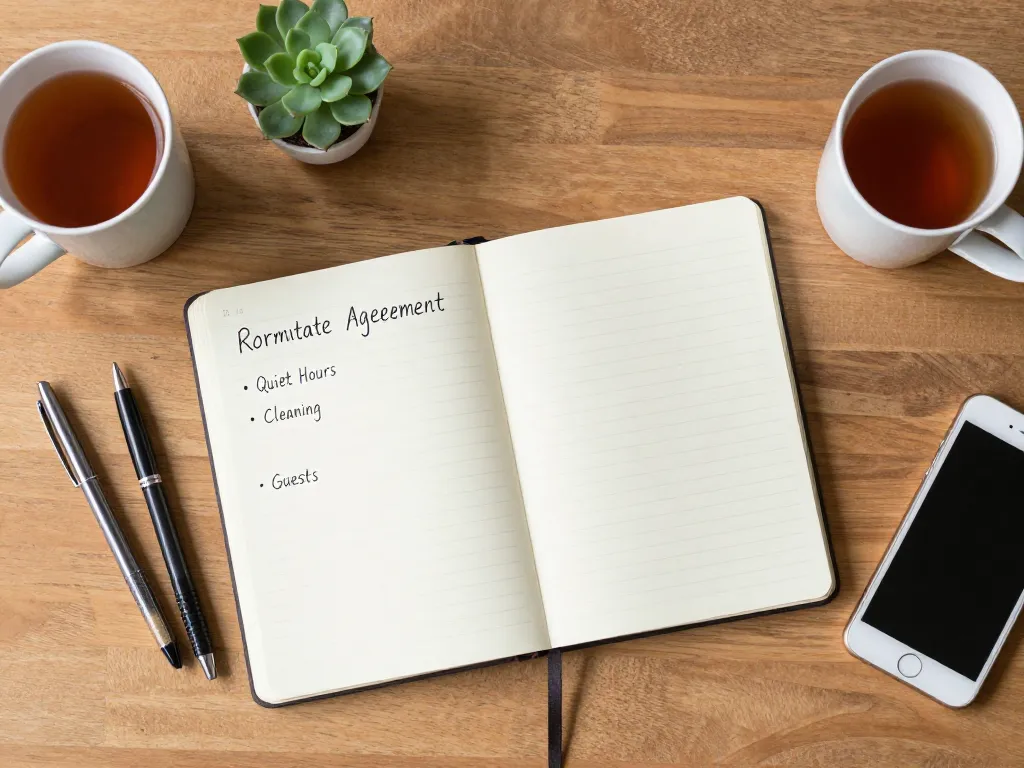
What to include in a roommate agreement:
- Quiet hours: Specific times, not vague concepts like "be respectful at night"
- Cleaning responsibilities: Who does what, how often, and what "clean" actually means (this varies wildly between people)
- Guest policies: Overnight guests, advance notice expectations, frequency limits
- Shared expenses: How to split groceries, supplies, utilities — and when to pay
- Conflict process: How you'll bring up issues (e.g., "We'll talk in person within 48 hours rather than texting about it")
Tools like Servanda help roommates create written agreements that prevent future conflicts, offering structured templates so you don't have to start from scratch or worry about forgetting a critical topic.
The act of writing things down forces clarity. "Keep the apartment clean" is meaningless. "Vacuum common areas every Sunday, alternating weeks" is something you can actually follow — and hold each other to without ambiguity.
Step 5: Hold Monthly Check-Ins (15 Minutes Max)
Set a recurring 15-minute check-in — maybe the first Sunday of each month. Make it low-pressure. Grab coffee or order food. Then each person answers three questions:
- What's working well right now?
- Is there anything small that's been bugging you?
- Do any of our agreements need adjusting?
This structure gives both roommates a predictable, safe venue to raise concerns before they metastasize. It also normalizes the idea that living together requires ongoing calibration — not a single conversation at move-in that's supposed to last forever.
Real example: Two roommates, Jada and Kenji, started monthly check-ins after a blowup over utilities. During their second check-in, Kenji mentioned — casually, without heat — that Jada's alarm going off three times every morning was waking him up. Jada had no idea the walls were that thin. She switched to a vibrating wristband alarm the next day. Without the check-in, Kenji would have stewed for months.
Step 6: Know When to Bring in a Third Party
Some conflicts can't be resolved one-on-one.
Signs you might need outside help:
- You've tried to discuss the issue more than twice with no change
- Conversations keep circling back to the same argument
- One or both of you shuts down or escalates every time
- The conflict involves lease violations, safety concerns, or financial disputes
Options for third-party help:
- A mutual friend both roommates trust (not someone who'll take sides)
- An RA or housing coordinator if you're in a university setting
- A community mediation center — many cities offer free or low-cost sessions
- Your landlord, but only for lease-related issues (landlords generally don't want to mediate personal disputes)
What to Do When You're the Problem
Sometimes you're the roommate leaving dishes in the sink, playing music too late, or forgetting to pass along a utility bill.
If your roommate raises a concern with you:
- Don't get defensive immediately. Your first instinct will be to explain or justify. Resist it for 30 seconds.
- Thank them for telling you. "Thanks for bringing that up directly" rewards the exact behavior you want them to repeat.
- Ask clarifying questions. "Can you give me an example?" or "What would be ideal for you?"
- Follow through. If you agree to a change, make it. Nothing erodes roommate trust faster than broken commitments.
Self-awareness is the most underrated conflict resolution skill. If you catch yourself thinking "they're just being dramatic," pause. Their experience is their experience, even if you wouldn't feel the same way in their position.
Frequently Asked Questions
How do I bring up a problem with my roommate without starting a fight?
Use the "I notice / I feel / I'd like" script described above, and choose a calm, private moment. Lead with curiosity, not accusations. Asking "What works for you?" at the end invites collaboration rather than defensiveness, which dramatically reduces the chance of the conversation becoming adversarial.
What should be included in a roommate agreement?
At minimum, cover quiet hours, cleaning responsibilities, guest policies, shared expenses, and a process for handling future disagreements. The more specific you are, the better — "take out trash when it's full" is vague; "take out trash every Wednesday and Saturday evening" is enforceable and clear.
Is it better to talk to my roommate in person or over text about a conflict?
Always in person for anything beyond simple logistics. Text strips away tone, body language, and the ability to course-correct in real time. A message intended as gentle can read as cold or passive-aggressive.
How do I deal with a roommate who won't communicate or refuses to talk?
Start by writing a brief, non-confrontational note or message asking for a specific time to talk: "I'd love 10 minutes to chat this week about how things are going — when's a good time for you?" If they consistently refuse, consider involving a neutral third party like a mutual friend, RA, or mediator. You can't force someone to engage, but you can make it as safe as possible for them.
When should I involve my landlord in a roommate dispute?
Only when the conflict involves lease violations, property damage, safety concerns, or financial issues like unpaid rent. Landlords are generally not equipped to mediate personal lifestyle disagreements. For day-to-day living conflicts, peer mediation or community mediation services are more effective and less likely to create additional tension.
Moving Forward Together
Resolving roommate conflicts peacefully isn't about having a perfect living situation — it's about having a repairable one. Disagreements will happen. Dirty dishes will sit in the sink. Someone will be too loud on a weeknight. What matters is whether you've built the habits and agreements to handle those moments before they corrode the relationship.
Start with one action today: schedule that first 15-minute check-in with your roommate. Write down three topics you'd like to discuss. Use the scripts in this article — not because they're magic words, but because they give structure to conversations that otherwise spiral. Living with another human being is inherently complicated. Having a plan makes it manageable, and sometimes even good.