How to Stop Co-Parenting Conflicts Before They Escalate
It starts small. A text about a schedule change that feels more like a demand than a request. A comment at pickup about the kids' bedtime that lands as criticism. A forgotten permission slip that becomes proof the other parent "never pays attention." Within hours, you're trading sharp messages, rehashing old grievances, and dreading every future interaction.
Co-parenting conflicts don't begin as major blowups. They begin as small friction points — minor disagreements, misread tones, unspoken expectations — that go unaddressed until they calcify into resentment. Co-parenting conflicts are far easier to resolve when you intervene early, before positions harden and emotions flood the conversation. This article gives you a concrete framework for catching those sparks before they become fires — not with vague advice about "being the bigger person," but with specific, repeatable techniques you can start using today.
Why Co-Parenting Conflicts Escalate (and Why Early Intervention Matters)
Conflict between co-parents rarely follows a rational trajectory. A disagreement about soccer practice can feel, beneath the surface, like a referendum on your parenting, your reliability, or your worth. That's because co-parenting conflicts carry emotional residue from the relationship that ended. Every new disagreement sits on top of old pain.
Here's what typically happens when a small issue goes unaddressed:
- The incident occurs — a late pickup, an unapproved haircut, a missed call.
- Internal narratives form — "They did this on purpose." "They don't respect my time." "This always happens."
- The response carries extra weight — the message you send isn't just about today's issue; it's loaded with frustration from every previous incident.
- The other parent responds to your tone, not your point — and now you're in a conflict about the conflict.
- Positions harden — both parents feel attacked, both dig in, and the original issue becomes unsolvable.
This cycle can unfold in a single afternoon. But at every stage, there's an off-ramp — if you know where to look.
Recognize Your Personal Escalation Signals
De-escalation doesn't start with what you say to your co-parent. It starts with what you notice in yourself.
Most people have reliable physical and emotional signals that appear right before they escalate a conflict. Learning yours is arguably the most important skill in this entire article.
Common Escalation Signals
- Physical: Jaw clenching, shallow breathing, chest tightness, clenched fists, heat in your face
- Mental: Rehearsing arguments in your head, composing angry replies before finishing reading the message, thinking in absolutes ("always," "never")
- Behavioral: Scrolling back through old messages to find ammunition, venting to friends before responding, the urge to respond immediately
What to Do When You Notice Them
The goal isn't to suppress these signals. It's to treat them as data.
When you notice an escalation signal, apply the 90-minute rule: unless the issue involves immediate safety, wait 90 minutes before responding. Ninety minutes — long enough for your cortisol levels to meaningfully drop, but short enough that you're not ignoring the issue.
During that window:
- Write out what you want to say in a notes app (not in the message thread)
- Identify the specific, concrete issue underneath your emotional response
- Ask yourself: "If I remove every past grievance, what is this message actually about?"
Example: Marcus receives a text from his co-parent: "The kids said you let them skip dinner again last night." His immediate reaction is fury — at the accusation, at the "again," at feeling monitored. After 90 minutes, he identifies the concrete issue: his co-parent wants consistency around mealtimes. He responds: "The kids ate late last night after their game — around 7:45 instead of the usual 6:30. I'll make sure they eat at regular times on my nights."
Notice what Marcus didn't do: he didn't defend, counter-attack, or address the accusatory tone. He addressed the issue. That alone can break the escalation cycle.

Use Structured Communication to Remove Ambiguity
Unstructured communication is where co-parenting conflicts thrive. Long, emotional texts with multiple topics. Phone calls where the conversation drifts from logistics to grievances. Vague agreements that each parent interprets differently.
Structure is the antidote.
The BIFF Method for Everyday Messages
Developed by conflict resolution specialist Bill Eddy, the BIFF framework keeps messages:
- Brief — two to five sentences maximum
- Informative — facts and logistics only
- Friendly — neutral or warm tone (not sarcastic warmth)
- Firm — ends the back-and-forth on this topic
Instead of: "You always change the schedule at the last minute without asking me. I had plans this weekend and now I have to rearrange everything because apparently my time doesn't matter."
Try: "I got your message about switching weekends. I'm not available to switch this Saturday, but I could do the following weekend instead. Let me know by Thursday if that works."
The first version invites a defensive response. The second version invites a decision.
One Topic Per Message
This rule alone prevents more escalation than any communication technique. When a single message covers the dentist appointment, the soccer carpool, and the overdue reimbursement, your co-parent will respond to the item that triggers them most — and ignore the rest.
Send separate messages for separate topics. It feels inefficient, but it dramatically reduces the chance that a routine logistical exchange turns into a multi-front argument.
Build Pre-Agreed Frameworks for Predictable Friction Points
Many co-parenting conflicts aren't actually about disagreements — they're about the absence of a clear agreement. If you haven't explicitly discussed how schedule change requests work, every single request becomes a negotiation (and a potential conflict).
The most effective co-parents front-load their decision-making. They identify recurring friction points and create specific, written protocols for each one.
Friction Points That Deserve Written Protocols
| Friction Point |
What the Protocol Should Cover |
| Schedule changes |
How much notice is required? What counts as a valid reason? Who has final say if you can't agree? |
| Expenses beyond child support |
Which expenses require joint approval? What's the threshold? How are receipts shared? |
| Medical decisions |
Who calls whom? What qualifies as an emergency vs. routine? How are differing opinions resolved? |
| Holiday/vacation scheduling |
When are requests submitted? How far in advance? How do you handle overlapping requests? |
| Introducing new partners |
Is there a waiting period? Are there agreed-upon milestones (e.g., 6 months of dating)? |
| Communication windows |
What hours are acceptable for non-emergency messages? What's the expected response time? |
These protocols don't need to be legalistic. They just need to be specific and written down. AI-powered platforms like Servanda can help co-parents create and formalize these kinds of written agreements, providing structure when it's hard to build it on your own.
Example: After their third argument about holiday scheduling, Priya and James sat down and agreed: holiday requests would be submitted by October 1 each year, the parent who didn't get first choice last year gets priority this year, and if there's still a conflict, they alternate by odd and even years. They haven't argued about holidays since — not because they always get what they want, but because the process is clear.
Master the Art of the Repair Attempt
Even with the best systems, tensions will rise. What separates co-parents who maintain a functional relationship from those who don't isn't the absence of conflict — it's what they do in the first 30 seconds after things start going sideways.
Researcher John Gottman calls these repair attempts: any statement or action that prevents negativity from spiraling. In co-parenting, effective repair attempts sound like:
- "I think we're getting off track. Can we come back to the specific question about Saturday?"
- "I realize that came across harsher than I meant. Let me rephrase."
- "I don't think we're going to resolve this over text. Can we revisit it tomorrow?"
- "I hear your concern. I don't agree, but I understand why it matters to you."
Repair attempts require swallowing your pride in the moment to protect the relationship long-term. They're not about conceding your point. They're about preserving the channel through which all future co-parenting decisions will flow.
When a Repair Attempt Fails
Sometimes your co-parent doesn't accept the repair. They keep escalating. In that moment, you have two options:
- Disengage with a clear boundary: "I want to work this out, but I'm going to step away from this conversation for now. I'll follow up tomorrow at 10 a.m."
- Move to a different medium: If texting is escalating, propose email (slower, more deliberate). If direct communication is failing, propose a mediator for that specific issue.
What you should never do: match their escalation to "make them understand." It has never worked.
Create a Conflict Triage System
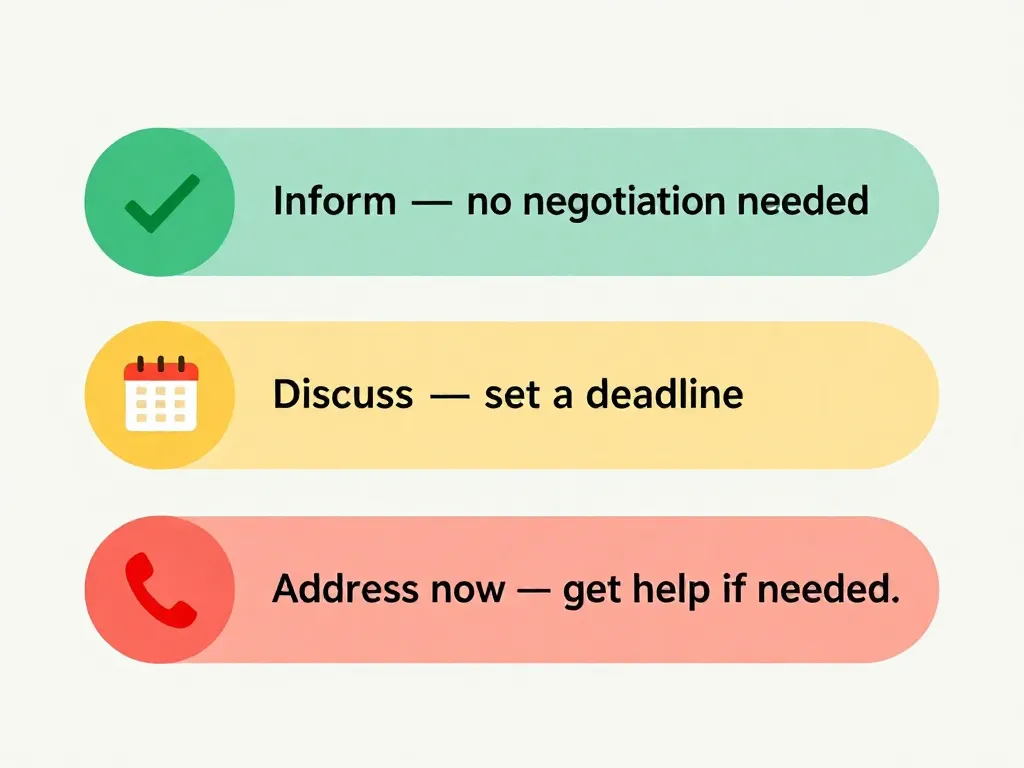
Not every disagreement deserves the same level of energy. Co-parents who avoid escalation tend to categorize issues quickly:
- Green (Inform, don't negotiate): "I'm taking the kids to the park Saturday morning." This doesn't need approval.
- Yellow (Discuss, with a deadline): "I'd like to switch our weekends in March. Can we decide by Friday?" This needs input but isn't urgent.
- Red (Address immediately, possibly with help): Safety concerns, major medical decisions, legal issues. These justify a phone call or in-person conversation.
The mistake most co-parents make is treating every issue as red. When everything is urgent, nothing gets resolved thoughtfully. Triaging issues explicitly — even saying "I think this is a yellow issue, so can we discuss by end of week?" — brings the emotional temperature down immediately.
What to Do When You've Already Escalated
Maybe you're reading this after a blowup, not before one. That's okay. De-escalation after the fact is possible.
- Wait for the emotional storm to pass — for both of you. This might take hours or days.
- Acknowledge your part without qualifiers: "I escalated that conversation, and I'm sorry" is complete. "I'm sorry, but you started it" is not an apology.
- Separate the issue from the interaction: "I still think we need to figure out the holiday schedule, but I want to do it differently next time."
- Propose a specific structural change: "Next time we disagree about scheduling, let's each email our preferred plan and try to find the overlap, instead of hashing it out in real-time texts."
Frequently Asked Questions
How do I co-parent with someone who always wants to fight?
You can't control your co-parent's behavior, but you can refuse to participate in the pattern. Use structured, written communication exclusively, keep messages BIFF-compliant, and disengage clearly when conversations escalate. Over time, many high-conflict co-parents moderate their behavior when they stop getting a reactive response.
What's the difference between parallel parenting and co-parenting?
Co-parenting involves collaboration, shared decision-making, and regular communication. Parallel parenting is a structured approach for high-conflict situations where each parent operates independently, with minimal direct communication and clearly defined boundaries. Parallel parenting isn't a failure — it's a legitimate strategy when direct cooperation consistently leads to conflict.
Should I respond to a hostile text from my co-parent right away?
Almost never. Unless there's a genuine safety issue, waiting 90 minutes to several hours leads to dramatically better outcomes. Immediate responses to hostile messages are almost always reactive and escalatory. Write your response in a notes app, let it sit, then revise before sending.
How do I keep co-parenting conflicts from affecting my kids?
Children are perceptive and absorb parental conflict even when it happens behind closed doors. The most protective thing you can do is resolve disagreements through writing rather than in person at exchanges, never ask children to carry messages or take sides, and maintain consistent routines across both homes so kids don't feel caught in logistical chaos.
Consider mediation when the same issue has come up three or more times without resolution, when communication has broken down to the point where every exchange becomes hostile, or when a significant decision (relocation, school choice, medical treatment) requires input from both parents and you can't reach agreement on your own.
Moving Forward
Stopping co-parenting conflicts before they escalate isn't about becoming a perfectly calm, endlessly patient person. It's about building systems and habits that compensate for the fact that co-parenting is inherently emotional. The 90-minute rule, BIFF-compliant messages, written protocols, repair attempts, conflict triage — none of these require you to feel differently. They just require you to respond differently.
Every small conflict you de-escalate successfully builds evidence — for you, for your co-parent, and most importantly for your children — that their parents can work things out. That evidence compounds over time. The first de-escalation is the hardest. The fiftieth is almost automatic.
Start with one technique from this article today. Pick the one that fits your most immediate friction point. The goal isn't perfection. The goal is fewer fires and faster recoveries when sparks inevitably fly.