
How to Survive a Co-Founder Breakup Without Killing Your Startup
You built this thing together. Late nights in a cramped apartment, shared Figma boards, arguments about pricing that somehow ended with a better product. And now one of you is leaving — or maybe both of you know it's over, but neither wants to be the one to say it.
A co-founder breakup is one of the most destabilizing events a startup can face. According to data from Noam Wasserman's research at Harvard Business School, 65% of high-potential startups fail due to conflict among co-founders. Not bad markets. Not bad products. People.
But here's what nobody tells you: a co-founder breakup doesn't have to kill your company. Plenty of startups have survived — even thrived — after a founder departed. The difference isn't luck. It's process. This article is the tactical playbook you need when you're in the thick of it, covering what to do about equity, your team, your investors, and your own sanity — all at once.
Key Takeaways
- A co-founder breakup is a multi-front crisis: you need to manage legal, emotional, operational, and financial dimensions simultaneously, not sequentially.
- Equity and IP should be settled in writing before anything is announced — verbal agreements made during emotional conversations rarely hold.
- Investor communication should be proactive and brief: tell them what happened, what's changing, and what's not. They've seen this before.
- Team morale depends on speed and honesty: the longer the ambiguity, the more people start updating their LinkedIn profiles.
- Your operating agreement (or lack of one) will define how painful this gets — formalize your co-founder terms before or during the split, not after.
Step 1: Acknowledge What's Actually Happening
Before you draft legal documents or call your lawyer, take a beat. Name the situation honestly.
Co-founder breakups usually don't happen overnight. They simmer. One founder feels they're carrying more weight. Another feels their vision is being sidelined. Someone checks out emotionally months before they check out formally. By the time the conversation happens, there's often a long trail of resentment.
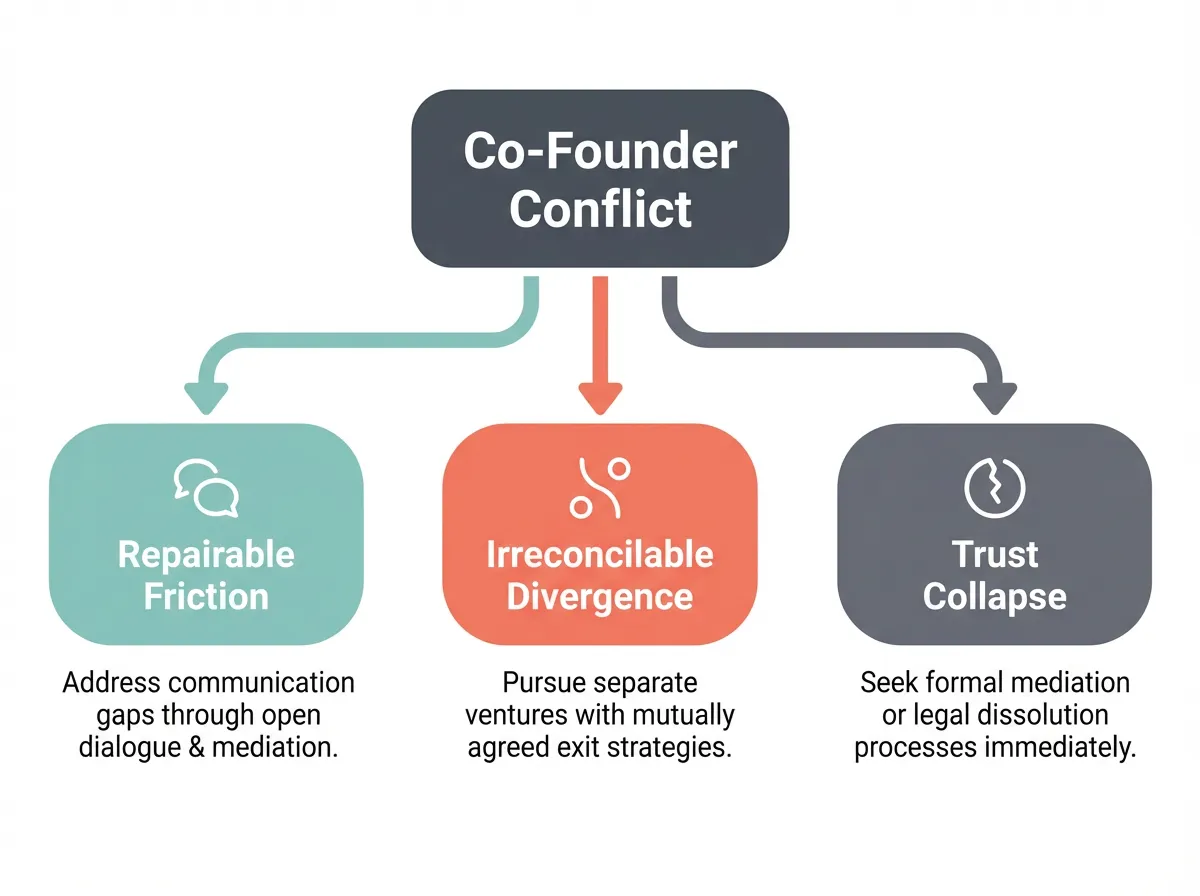
Here's a framework for diagnosing where you actually are:
- Repairable friction: You disagree on strategy, roles, or workload, but both still want to build this company. This is a negotiation, not a breakup.
- Irreconcilable divergence: Your visions for the company have fundamentally split. One of you wants to bootstrap; the other wants to raise a Series A. Neither is wrong — but you can't do both.
- Trust collapse: Someone feels betrayed — about money, effort, honesty, or loyalty. This is the hardest to come back from.
If you're in category two or three, this playbook is for you. Don't waste months pretending you're in category one.
What "Naming It" Looks Like in Practice
Sit down — in person if possible — and say something like: "I think we need to talk about whether we should keep building this together, and if not, how we separate without destroying what we've built."
That sentence is terrifying. It's also the most responsible thing you can do for your company, your team, and each other.
Step 2: Secure the Legal and Financial Foundation
This is where most founders make their biggest mistakes. Emotions are high, and people either rush to "just get it over with" or avoid the hard conversations entirely. Neither works.
Equity: The Hardest Conversation You'll Have
The central question: what happens to the departing founder's equity?
If you have a vesting schedule with a cliff, this is more straightforward. The departing founder keeps their vested shares and forfeits the unvested portion. If you don't have a vesting agreement — and a startling number of early-stage co-founders don't — you're in harder territory.
Here are the most common scenarios:
| Scenario | Typical Outcome |
|---|---|
| 4-year vesting, 1-year cliff, founder leaves at month 18 | Departing founder keeps ~18.75% of their original allocation |
| Equal 50/50 split, no vesting agreement | Negotiation required — often the most contentious scenario |
| Departing founder contributed IP before incorporation | May retain rights unless IP assignment was signed |
What to do right now:
- Pull out every document you have: articles of incorporation, operating agreements, any written or email-based agreements about equity.
- Hire a startup attorney — not your uncle who does estate planning. Look for someone who's handled founder separations specifically. Budget $3,000–$10,000 for this process.
- Don't agree to anything verbally. Seriously. That handshake deal about "keeping it fair" will mean completely different things to each of you in three months.
Intellectual Property: Who Owns What?
If the departing founder wrote core code, designed the product, or developed proprietary processes, you need to clarify IP ownership immediately. This typically means:
- Confirming that an IP assignment agreement was signed (if it wasn't, get one signed as part of the separation)
- Documenting all contributions
- Ensuring the departing founder can't take the technology to a competitor

The Separation Agreement
Every co-founder breakup should end with a signed separation agreement. This document should cover:
- Equity allocation post-departure
- IP assignment and non-compete terms
- Ongoing obligations (board seat, advisory role, or clean break)
- Non-disparagement clauses (you'll both want this)
- Transition timeline with specific dates and deliverables
AI-powered mediation platforms like Servanda can provide structure when emotions run high, especially for founders who don't have the budget for extensive legal mediation but need a clear, fair framework for dividing responsibilities and formalizing their separation terms.
Step 3: Tell Your Investors Before They Hear It Somewhere Else
If you have investors, they need to hear this from you — not from a mutual contact, not from Twitter, and definitely not from the departing founder's LinkedIn update.
The Investor Communication Playbook
When to tell them: After you and your co-founder have agreed on the basic terms of separation, but before any public announcement. Ideally within the same week you finalize the outline of the agreement.
How to tell them: Schedule a call. Don't bury this in a monthly update email.
What to say:
- "[Name] and I have decided to part ways. Here's why, briefly." (Keep it factual. No blame.)
- "Here's what we've agreed on regarding equity and transition." (Shows you're handling it like adults.)
- "Here's my plan for continuity — team, product, and timeline." (This is what they actually care about.)
- "I'd welcome your advice on [specific thing]." (Investors like being asked. It also signals confidence, not desperation.)
What NOT to say:
- Don't trash your co-founder. Even if they deserve it. Your investors will lose confidence in your judgment, not theirs.
- Don't minimize it. "It's totally fine" is a red flag. "It's hard, and here's how I'm handling it" is not.
Most experienced VCs and angels have seen co-founder breakups before. What they're evaluating isn't whether it happened — it's whether you can navigate it.
Step 4: Manage Your Team Through the Transition
Your team already knows something is wrong. Co-founder tension is not subtle, no matter how well you think you're hiding it. The whisper network has been active for weeks.
The All-Hands Announcement
Do this within days of finalizing the separation terms. Ambiguity is the enemy of retention.
What to cover:
- What's changing: who's leaving, when, and what their role was
- What's NOT changing: the mission, the product roadmap, their jobs
- What's next: who's taking over the departing founder's responsibilities, and on what timeline
- Space for questions: let people ask. You won't have all the answers, and that's okay to say
The Retention Risk You're Not Thinking About
The biggest flight risk isn't your most junior employee — it's the senior person who was personally recruited by the departing founder. They may feel loyalty to the person, not the company. Have one-on-one conversations with these individuals within 48 hours of the announcement. Ask directly: "What do you need from me to feel confident about staying?"
Sometimes the answer is equity. Sometimes it's a title change. Often, it's just honesty.

Step 5: Protect Product and Operational Continuity
A co-founder departure creates an immediate operational vacuum, especially if they were technical or product-focused. Here's how to fill it without panicking.
Conduct a "Bus Factor" Audit
List every critical function the departing founder handled. For each one, answer:
- Who else on the team understands this?
- Is there documentation?
- What's the minimum viable handoff?
Prioritize Ruthlessly for 90 Days
The quarter after a co-founder breakup is not the time for ambitious new initiatives. Focus on:
- Keeping existing customers happy — churn during a transition is a death spiral
- Shipping what's already in progress — don't start new features; finish current ones
- Hiring for the gap — but only once you've stabilized
The 30-60-90 Day Framework
- Days 1–30: Execute the separation agreement. Complete all handoffs. Announce internally and to investors.
- Days 31–60: Redistribute responsibilities. Identify the one or two roles you need to hire for immediately.
- Days 61–90: Evaluate the new operating rhythm. Are decisions getting made faster or slower? Is the product roadmap on track? Adjust.
Step 6: Take Care of Yourself (No, Really)
Founders going through a co-founder breakup often describe it as emotionally comparable to a divorce. You built something intimate, high-stakes, and identity-defining with another person — and now it's fracturing.
This isn't a section about bubble baths. It's about functional sustainability.
- Get a therapist or executive coach who understands startup dynamics. Your friends mean well, but they don't get the stakes.
- Separate your identity from the partnership. You are not a failure because your co-founder relationship didn't work out. You are a founder who's navigating something hard.
- Set a decision moratorium on non-essential choices for two weeks. You're not in your best judgment mode right now. Don't redesign the brand, pivot the product, or fire anyone in the immediate emotional aftermath.
Real-World Examples: Founders Who Survived the Split
The "Quiet Departure" (SaaS Company, Series A)
Two co-founders of a B2B SaaS company realized 18 months in that one wanted to build an enterprise product and the other wanted to serve SMBs. Instead of fighting it out, they agreed: the enterprise-focused founder would stay, the other would depart with their vested equity (25%) and a 12-month advisory agreement. They told investors together on a joint call. The company went on to triple revenue the following year.
The "Messy Middle" (Pre-Seed Consumer App)
Two founders with no vesting agreement and a 50/50 split couldn't agree on anything after month 6. The departing founder demanded 50% equity for 6 months of work. After an expensive mediation process, they settled on 15% with a buyback clause. The remaining founder later said the $8,000 spent on legal fees was "the best investment I ever made in the company."
Frequently Asked Questions
How do you split equity when a co-founder leaves early?
If you have a vesting schedule, the departing founder keeps vested shares and forfeits the rest. Without a vesting agreement, you'll need to negotiate — consider factors like time contributed, capital invested, IP created, and opportunity cost. Get a startup lawyer involved to formalize whatever you agree on.
Can a co-founder take the company's code or IP when they leave?
It depends on whether an IP assignment agreement was signed. If the departing founder signed one, all work product belongs to the company. If not, they may have a legal claim to code or designs they personally created. This is why IP assignment should be one of the very first documents any startup puts in place.
Should I tell customers about my co-founder leaving?
For most early-stage startups, no — unless the departing founder had direct customer relationships. In that case, a warm, brief introduction to their replacement is sufficient. Focus on continuity: "You'll now be working with [Name], who's been involved in your account and knows your setup."
How long does a co-founder breakup process usually take?
From the initial conversation to a signed separation agreement, expect 4–8 weeks for a relatively amicable split and 3–6 months if it's contentious. The operational transition often takes another quarter beyond that. Planning for a 90-day stabilization period is realistic.
What if my co-founder won't agree to leave or negotiate?
This is where your operating agreement and corporate bylaws matter. If you have a board, the board can vote to remove a co-founder from their officer role (though equity is separate). If you're deadlocked at 50/50 with no tiebreaker mechanism, you may need formal mediation or, in worst cases, legal action. This is the single best argument for putting a buyout clause and dispute resolution process in your co-founder agreement from day one.
Moving Forward
A co-founder breakup is not the end of your startup — unless you let it be. The companies that survive these splits share a few traits: the remaining founder moves quickly on the legal and financial side, communicates with radical honesty to investors and team, protects the product roadmap during the transition, and gives themselves permission to grieve the partnership while still leading.
You didn't plan for this. But you can still plan your way through it.
The playbook is straightforward, even when the emotions aren't: secure the legal foundation, communicate proactively, stabilize your team, protect the product, and take care of yourself. Do those five things, and you'll come out the other side with a company that's still standing — and possibly stronger for having been tested.
Your startup was always bigger than any single partnership. Now's the time to prove it.