
How to Survive a Cofounder Breakup Without Losing Everything
You built something real together. Late nights debugging code, pitching investors who didn't call back, splitting ramen budgets when revenue was still a fantasy. And now one of you wants out — or worse, you both know it's over but neither of you has said it yet.
A cofounder breakup is one of the most destabilizing events a startup can face. According to research by Noam Wasserman at Harvard Business School, 65% of high-potential startups fail due to conflict among cofounders. Not market fit. Not funding. People. And when the split actually happens, most founders are blindsided — not by the conflict itself, but by how little they prepared for the possibility.
This guide is the playbook nobody gave you. It covers the legal mechanics, the financial landmines, and the emotional toll of a cofounder split — along with concrete steps you can take this week to protect your company, your stake, and your sanity.
Key Takeaways
- Don't wait for the blowup. The moment you sense a serious rift, start documenting contributions, agreements, and company assets — even informally.
- Separate the legal exit from the emotional one. Handle equity, IP, and vesting schedules with a lawyer or structured process before you try to hash out "who was right."
- Your operating agreement (or lack of one) dictates everything. If you have one, read it tonight. If you don't, that's your first action item.
- A clean break protects the company more than a prolonged cold war. Speed and clarity are your allies.
- Get outside help early. A mediator, lawyer, or structured resolution process will save you more money and time than trying to negotiate across a table of resentment.

Step 1: Acknowledge Reality Before It Acknowledges You
Most cofounder breakups don't begin with a dramatic fight. They begin with months of quiet withdrawal — missed standups, passive-aggressive Slack messages, a growing sense that you're pulling in different directions.
Here's what matters: the earlier you name the problem, the more options you have.
There's a meaningful difference between "we have different visions for the company" and "we haven't spoken in three weeks and the board is asking questions." The first scenario gives you room to negotiate a structured exit. The second forces you into damage control.
Signs the split is real (not just a rough patch):
- One cofounder has mentally checked out — missing commitments, disengaged from product or strategy decisions
- Fundamental disagreements about company direction that have resurfaced 3+ times without resolution
- Loss of mutual respect or trust (not just frustration — actual contempt)
- One founder is exploring other opportunities or has started a side project
- You've stopped being honest with each other about the business
If more than two of these resonate, you're past the "let's grab coffee and talk it out" stage. You need a plan.
Step 2: Lock Down the Legal Foundation
This is where most founders lose the most — not because the law is unfair, but because they never wrote anything down.
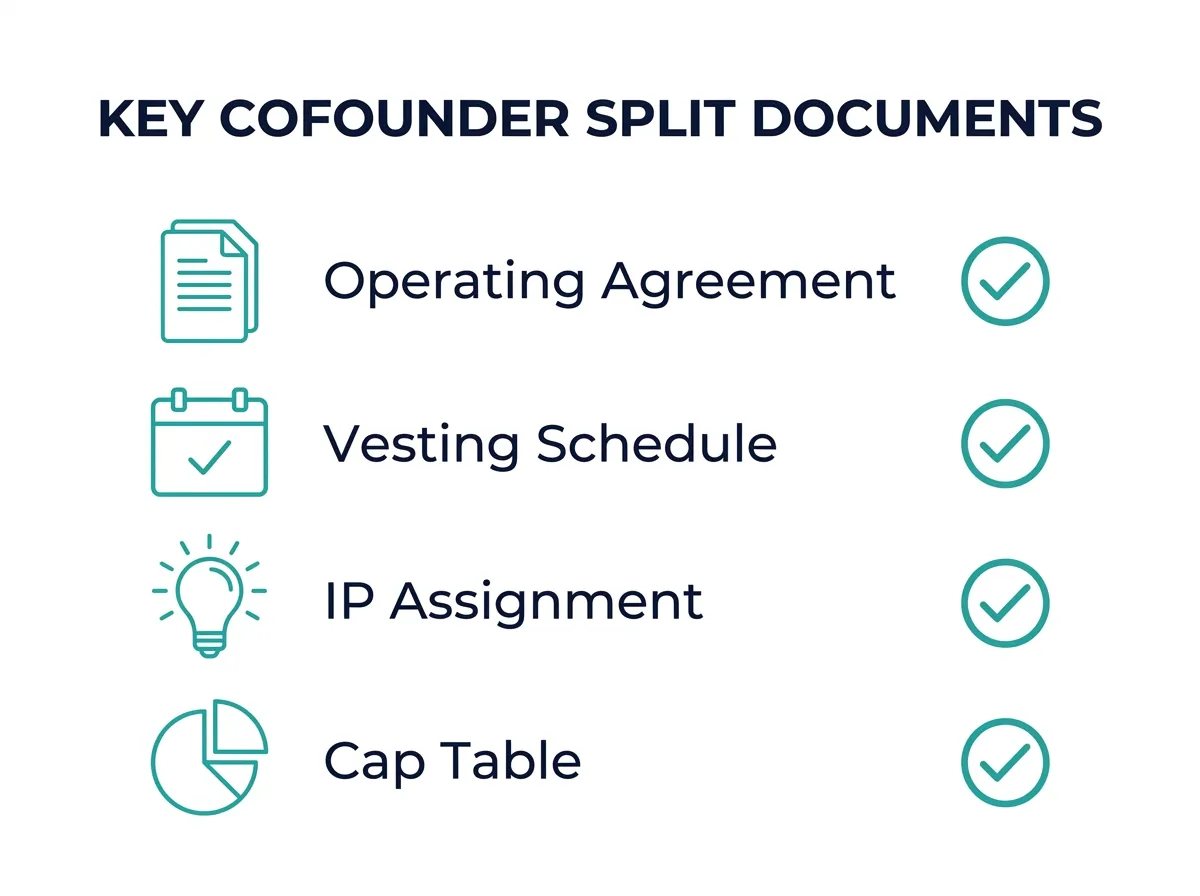
Review (or create) these documents immediately:
-
Operating Agreement / Shareholders' Agreement — This is the single most important document in your split. It should define what happens when a cofounder leaves, including buyout terms, vesting acceleration (or clawback), and voting rights. If you have one, read every clause. If you don't, hire a startup attorney this week.
-
Vesting Schedule — How much equity has each cofounder actually earned? If you set up a standard four-year vesting schedule with a one-year cliff, a cofounder who leaves at month 10 may walk away with nothing. If you never formalized vesting at all, you have a much messier situation.
-
IP Assignment Agreements — Who owns the code, the designs, the patents? If your departing cofounder wrote 80% of the codebase and never signed an IP assignment to the company, you may have a serious problem.
-
Cap Table — Get a clean, current snapshot of who owns what. Use Carta, Pulley, or even a spreadsheet — but make it precise.
Real-world example: Two founders — call them Mira and Jake — built a SaaS product together over 18 months. They'd split equity 50/50 on a handshake. When Mira wanted to leave, Jake assumed he'd keep the company and she'd walk away with nothing since she was the one quitting. Mira assumed she'd keep her 50% passively. Neither was right, and without a written agreement, they spent $40,000 in legal fees reaching a resolution that a $500 operating agreement could have defined upfront.
Hire a lawyer — but the right kind
You need a startup/corporate attorney, not your uncle who does estate planning. Specifically, look for someone experienced in:
- Founder disputes and equity negotiations
- Delaware corporate law (if your startup is incorporated there, as many are)
- Mediation-friendly approaches (litigation should be a last resort)
Budget $5,000–$15,000 for legal fees in a moderately complex cofounder separation. It sounds steep. It's a fraction of what a messy, prolonged fight will cost.
Step 3: Negotiate the Financial Split
Equity is the headline issue, but it's not the only one. A complete financial separation needs to address:
Equity and Buyout Terms
- Will the departing cofounder keep vested equity? In most cases, yes — but the terms matter. Will they retain voting rights? Board seats? Pro-rata rights in future rounds?
- Is there a buyout? If the remaining founder (or the company) wants to buy back the departing founder's shares, at what valuation? A common approach is to use the most recent 409A valuation or a mutually agreed independent appraisal.
- Accelerated vesting? Some agreements include partial acceleration upon departure. Others don't. This is a negotiation point.
Financial obligations
- Personal guarantees on leases, credit lines, or loans
- Outstanding expenses or reimbursements
- Convertible notes or SAFEs the departing founder personally holds
Ongoing commitments
- Non-compete and non-solicitation clauses (enforceability varies wildly by state)
- Advisory role or transition period
- Confidentiality obligations
Negotiation tip: Frame every discussion around what's best for the company's survival, not who deserves what. Investors, employees, and customers are all watching. A cofounder who leaves gracefully and maintains a small equity stake in a company that thrives is better off than one who fights for a larger share of a company that implodes during the battle.
Step 4: Communicate the Split Without Torching the Company
How you tell people matters almost as much as the split itself.
Internal communication (team)
- Tell your team before they hear rumors. Uncertainty is more damaging than bad news.
- Present a united front if at all possible. Even if you're furious, a joint message that says "we've decided to go in different directions, here's the transition plan" preserves team confidence.
- Be specific about what changes and what doesn't. Who's taking over the departing founder's responsibilities? Is the roadmap changing? Are jobs safe?
External communication (investors, customers, partners)
- Notify your investors early and directly. A phone call, not an email. They've seen cofounder splits before. What scares them isn't the departure — it's finding out late or sensing the remaining team is in chaos.
- For customers and partners, keep it simple: leadership transition, continued commitment to the product, no disruption to service.
- Avoid public blame. Even a single snarky tweet can surface in future due diligence.
What NOT to do:
- Don't announce the split before the legal terms are finalized
- Don't badmouth your cofounder to employees, investors, or on social media
- Don't let the departing cofounder's access to critical systems linger — update credentials, admin access, and banking permissions on the day of formal departure

Step 5: Protect Your Mental Health (This Part Is Not Optional)
Founders almost never talk about this publicly, but a cofounder breakup can feel like a genuine grief event. You may experience:
- Identity confusion — "If I'm not the CTO of our company, who am I?"
- Guilt — especially if you're the one staying and your cofounder is struggling
- Anger that has nowhere to go — the legal process is slow, and you can't just "win" your way out of the feeling
- Isolation — your cofounder was probably one of the few people who truly understood what you were building
What actually helps:
- Talk to other founders who've been through it. Not for advice — for normalization. Organizations like Founders Network or even a candid conversation with a YC alum can be grounding.
- Get a therapist who understands entrepreneurship. General therapists are fine, but someone who grasps the stakes of equity, identity, and startup pressure will be more effective.
- Set a hard boundary on how much headspace the split gets. Dedicate specific times to deal with legal and transition tasks. Outside those windows, redirect your focus to the work.
- Move your body. This sounds trivial. It isn't. The cortisol load from a high-stakes conflict is physical. Exercise is the fastest release valve you have.
You don't need to be "fine." You need to be functional enough to lead the company through the transition. Those are different standards.
Step 6: Prevent the Next Breakup Before It Starts
If you're bringing on a new cofounder, or if you're the remaining founder rebuilding with a new leadership team, don't repeat the same structural mistakes.
Non-negotiable agreements to have in place from Day 1:
- Vesting schedules for all founders (four-year vest, one-year cliff is standard for a reason)
- A clear operating agreement that covers departure scenarios, decision-making authority, and dispute resolution mechanisms
- Defined roles and decision rights — not just titles, but who has final say on product, hiring, fundraising, and spending
- A conflict resolution clause — specify that disputes go to mediation before litigation. Tools like Servanda can help cofounders create structured, written agreements that address these scenarios before emotions enter the picture.
- Regular cofounder check-ins — a recurring, structured conversation about the relationship itself, not just the business. Monthly is ideal. Quarterly is the minimum.
Real-world example: After a painful split with his first cofounder, a founder we'll call David brought on a new technical cofounder with a detailed operating agreement that included a "conscious uncoupling" clause — a pre-negotiated exit framework with specific buyback prices at different milestones. Eighteen months later, when the new cofounder got an offer she couldn't refuse from a public company, they executed the exit in two weeks with zero drama. David's company didn't miss a single sprint.
Frequently Asked Questions
What happens to equity when a cofounder leaves a startup?
It depends entirely on your vesting schedule and shareholder agreement. If the departing cofounder has vested shares, they typically keep them (though the company or remaining founders may have a right of first refusal to buy them back). Unvested shares are usually forfeited. If you never set up vesting, the situation is more complicated and will likely require negotiation or legal intervention.
Can a cofounder be forced out of a startup?
Yes, depending on corporate structure and governance documents. If the company has a board of directors, the board can vote to remove a cofounder from their officer role. However, removing someone from their equity position is much harder and usually requires a buyout or legal action. This is why shareholder agreements with clear exit provisions are essential.
How do you split a company between cofounders during a breakup?
The cleanest approach is for one cofounder to buy out the other based on a fair valuation — either using a recent 409A, an independent appraisal, or a formula defined in your operating agreement. In rare cases, the company itself is dissolved and assets are divided. Mediation is strongly recommended over litigation, as it's faster, cheaper, and preserves more value.
Should I get a lawyer for a cofounder dispute?
Yes — even if the split is amicable. A startup attorney can help you avoid tax traps, protect intellectual property, and draft separation documents that hold up over time. Think of it as insurance: the cost of a lawyer now is almost always less than the cost of a legal fight later.
How do you prevent cofounder conflicts from escalating?
Formalize everything early — roles, equity, decision-making authority, and what happens if someone wants to leave. Schedule regular cofounder check-ins that specifically address the working relationship, not just tasks. And when disagreements arise, address them within days, not months. Unspoken resentment is the number one accelerant of cofounder breakups.
Moving Forward
A cofounder breakup doesn't have to mean the end of your company — or your career. Some of the most successful startups in history, from Twitter to Zipcar, survived brutal cofounder splits and came out the other side.
The founders who navigate these transitions well share three traits: they act quickly once the decision is made, they separate legal and emotional processes, and they invest in the structure that prevents the next conflict from becoming the next crisis.
If you're in the middle of a split right now, here's your action list for this week: read your operating agreement (or admit you don't have one), call a startup attorney for a consultation, and tell one trusted person outside the company what you're going through.
You built something once. You can protect it — and build again.