In-Law Drama Ruining Your Marriage? Here's What to Do
It's Sunday evening. You and your partner just got home from dinner at your in-laws' house, and the car ride was silent — the bad kind of silent. Maybe your mother-in-law made another comment about how you're raising the kids. Maybe your father-in-law "joked" about your career again. Or maybe your partner sat there and said nothing while it happened, and now you're wondering whose side they're actually on.
Research consistently ranks in-law conflict among the top sources of marital stress. The pain isn't about the in-laws themselves — it's about feeling like your partner won't protect the marriage. And for the partner caught in the middle, the guilt of feeling disloyal to either side can be paralyzing.
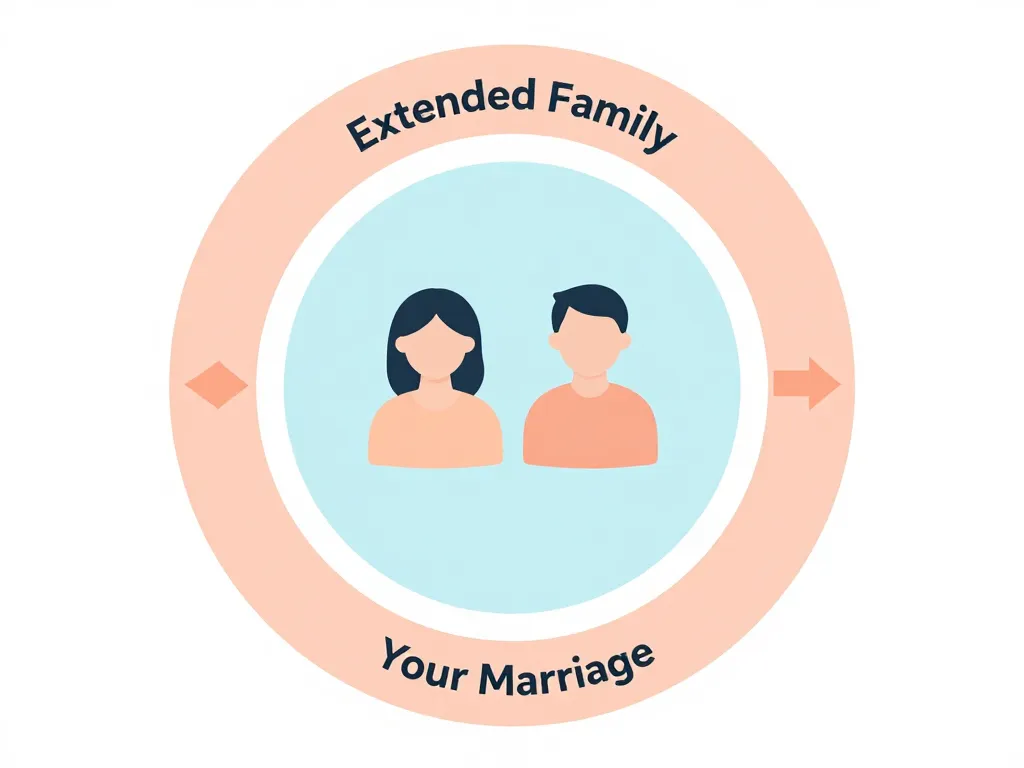
Why In-Law Conflict Cuts So Deep
Most couples don't fight about the surface-level issue — the comment at Thanksgiving, the unannounced visit, the unsolicited parenting advice. They fight about what those moments mean.
When your partner doesn't speak up while their parent criticizes you, what you hear is: "I won't protect you. My family matters more."
When you confront your partner afterward, what they hear is: "You're forcing me to choose. I'll never be enough for both sides."
This is the loyalty bind, and it's the engine behind most in-law drama in marriage. Until you name it, you'll keep arguing about the symptoms instead of the cause.
The Three Patterns That Make It Worse
- The Triangle: Your mother-in-law calls your partner to complain about you. Your partner relays the complaint. Now you're furious at both of them — and your partner is the messenger getting shot.
- The United Front Collapse: You and your partner agree on a boundary privately ("We're not doing Christmas at your parents' this year"), but when confronted, your partner caves.
- The Scorekeeper: One partner feels they've sacrificed far more for the other's family, and resentment builds silently until it detonates over something seemingly trivial.
Recognizing which pattern is yours is the first step to breaking it.
Step 1: Align as a Couple Before You Address Anyone Else
The single biggest mistake couples make is trying to manage in-laws before they've gotten on the same page with each other. You can't set external boundaries from an internal divide.
The Alignment Conversation
Set aside 30–45 minutes with no distractions. Each partner answers these questions, then you discuss:
- "What specific behaviors from my family bother you most?" (Not vague complaints — name the behavior, the context, and how it made you feel.)
- "What would you need me to do differently when that happens?"
- "What's one thing about my family relationship that you respect, even if it's hard for you?"
This last question matters. It signals that you're not asking your partner to hate their family — you're asking for changes to specific behaviors.
Example: Jordan and Alex had been arguing for months about Alex's mother, who would show up unannounced every weekend. Jordan felt invaded; Alex felt torn. During their alignment conversation, Jordan said: "I respect how close you are to your mom. I'm not asking you to see her less. I'm asking that we agree on a schedule together and that drop-ins on Saturday mornings stop." That specificity gave Alex something concrete to work with instead of an impossible demand.

Step 2: Adopt the "Ambassador Rule"
Here's the principle: each partner is the primary boundary-setter with their own family of origin.
Why? Because when you confront your partner's parents directly, it almost always backfires. They see you as the outsider pulling their child away. But when your partner sets the boundary, it's framed as their decision — which it should be.
What the Ambassador Rule Sounds Like
Instead of: You telling your mother-in-law, "You need to stop criticizing how I cook."
Try: Your partner telling their mother, "Mom, I need you to stop commenting on how we run our kitchen. We've got it handled, and those comments put me in an uncomfortable position."
Notice the language: "put me in an uncomfortable position." The partner isn't saying "you're upsetting my spouse." They're owning the boundary as their own. This prevents the in-law from targeting the other partner as the source of the problem.
When Your Partner Struggles With This
Some people have spent decades avoiding conflict with their parents. Asking them to suddenly set firm boundaries can feel like asking them to rewire their entire nervous system.
Be patient — but be clear. Try: "I understand this is hard for you, and I'm not asking you to be aggressive. I'm asking you to let your mom know what we've decided together. I'll be right there supporting you, but it needs to come from you."
If your partner consistently refuses to set any boundaries despite understanding your pain, that's a deeper issue that may require professional support.
Step 3: Use Ready-Made Scripts for Common Scenarios
The worst time to figure out what to say is in the moment, when emotions are high and your in-laws are staring at you across the dinner table. Prepare in advance.
Script: The Unsolicited Parenting Advice
"Thanks, Mom — I know you raised us well, and I appreciate that you care. We've talked about it and decided to handle [bedtime / discipline / screen time] this way. We'll let you know if we want input."
Script: The Guilt Trip About Not Visiting Enough
"I hear that you'd like to see us more, and we want that too. Here's what works for our schedule right now: [specific days/frequency]. Let's plan something for [specific date]."
"I need you to stop saying things like that about [partner's name]. They're my partner, and I chose them. When you criticize them, it doesn't bring me closer to you — it pushes me away."
Script: The Boundary Violation After a Limit Was Set
"We talked about this, and I was clear that [boundary]. I'm not going to argue about it again. If it happens again, we'll need to [consequence — leave, skip next visit, take a break from calls]."
These aren't magic words. They'll feel awkward the first time. But having them rehearsed means you won't freeze, backtrack, or say something you regret.

Step 4: Build a Family Engagement Plan
This is where most advice articles stop — at "set boundaries" — without giving you a system to maintain them. A Family Engagement Plan is a written agreement between you and your partner that covers the logistics of in-law interactions.
What to Include
- Visit frequency and format: "We visit your parents twice a month. Visits are capped at 3 hours. We drive separately so we can leave if needed."
- Holiday rotation: Spell it out. Alternating years, splitting the day, hosting at your home — whatever you agree on, write it down.
- Communication norms: "Your mom can call you anytime, but group texts about parenting decisions get a response only after we've discussed privately."
- The exit strategy: Agree on a signal (verbal or otherwise) that means "I need us to leave" — no questions asked in the moment, discussion afterward.
- The review date: Revisit the plan every 3–6 months. Families change. Your plan should too.
Consider using a tool like Servanda to formalize your Family Engagement Plan into a clear, written agreement you can both reference — it removes the ambiguity that leads to "I thought we agreed on..." arguments.
Step 5: Handle the Fallout Without Caving
When you start setting boundaries with in-laws who aren't used to them, there will be pushback. Sometimes it's guilt trips. Sometimes it's the silent treatment. Sometimes another family member gets recruited to pressure you.
This is the moment most couples abandon their boundaries — and the in-laws learn that escalation works.
How to Stay the Course
- Expect discomfort. Boundaries feel rude to people who benefited from you having none. That discomfort is not evidence that you're wrong.
- Don't JADE. JADE stands for Justify, Argue, Defend, Explain. When an in-law pushes back, resist the urge to over-explain. A boundary is a statement, not a negotiation.
- Debrief as a couple after hard interactions. Ask each other: "How did that go? What do we want to do differently next time?" This keeps you on the same team.
- Acknowledge your partner's sacrifice. If your partner just set a hard boundary with their parent, say so: "I know that wasn't easy. Thank you for doing that for us." Validation makes the next time less daunting.
When In-Law Drama Signals a Bigger Problem
Sometimes the issue isn't about boundaries with in-laws — it's about a partner who fundamentally hasn't differentiated from their family of origin. Signs include:
- Your partner shares private marital details with their parents without your consent
- Financial decisions are influenced or controlled by in-laws
- Your partner consistently prioritizes their parents' feelings over yours, even after repeated conversations
- Your in-laws have veto power over decisions that should be yours as a couple
If you recognize these patterns, couples therapy with a licensed professional — ideally one trained in family systems — isn't a sign of failure. It's a sign that you're taking your marriage seriously enough to get expert support.
Frequently Asked Questions
How do I set boundaries with in-laws without causing a family rift?
Start small and specific. Instead of a sweeping declaration, address one behavior at a time. Use warm, firm language — and always have the boundary come from your partner (the Ambassador Rule). Most families adjust over time once they see the boundary is consistent and non-negotiable.
What if my spouse refuses to stand up to their parents?
This is common and frustrating. Start by expressing your feelings without ultimatums: "When your mom criticizes me and you stay silent, I feel alone in this marriage." If repeated conversations don't lead to change, suggest couples counseling. A neutral third party can help your spouse see the pattern without feeling attacked by you.
Is it normal to argue about in-laws this much?
Yes — in-law conflict is one of the most frequently reported sources of marital tension, especially in the first decade of marriage. The frequency of arguments isn't the problem; it's whether you have a system for resolving them. Couples who argue about in-laws but repair well are in much better shape than couples who avoid the topic entirely.
Should I ever confront my in-laws directly?
In most cases, the Ambassador Rule works best — let your partner handle their own family. However, if your partner is fully supportive and your in-law is directly addressing you, a calm and direct response is appropriate. The key is that you and your partner have agreed on the message beforehand.
How long does it take for boundaries with in-laws to actually work?
Expect a testing period of 2–6 months. Most in-laws will push back initially, then gradually adjust when they see the boundary is consistent. If behavior hasn't changed after six months of firm, consistent limits, it may be time to reduce contact frequency and seek professional guidance.