Post-Grad Roommate Noise Fights: A Survival Guide
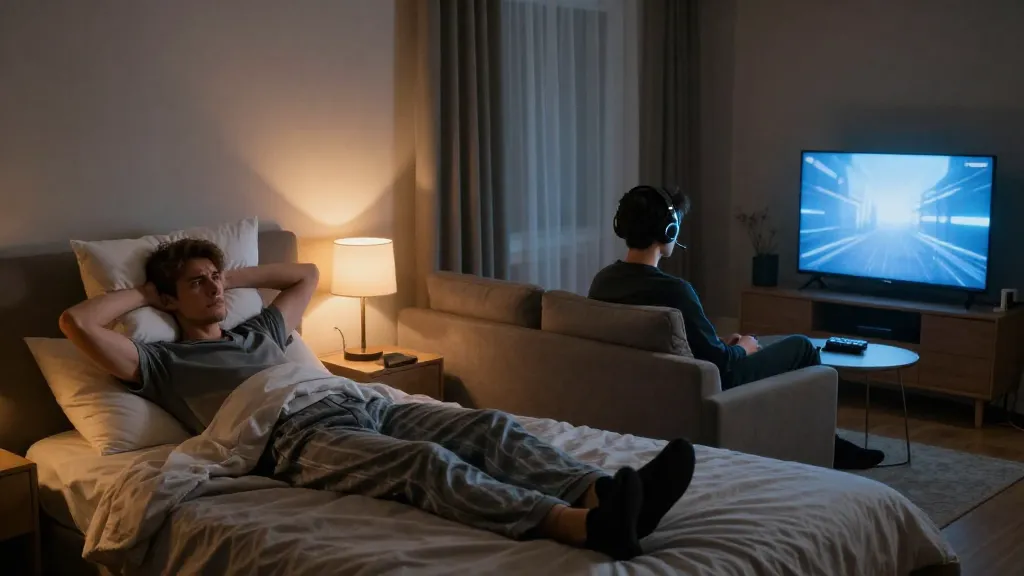
It's 11:47 p.m. on a Tuesday. You have a client presentation at 8 a.m. Through the wall, your roommate's video game headset is leaking a tinny stream of explosions and trash talk. You've already asked once — politely, you thought — and got a shrug and a "yeah, sure, sorry" that changed nothing. Now you're lying in bed doing mental math: How many months are left on the lease? Could I afford a studio? Is it legal to cut someone's internet cable?
Post-grad roommate noise conflicts are one of the most common — and most corrosive — sources of tension in shared living. Unlike college, where everyone's schedule was roughly chaotic in the same ways, adult roommates often work different hours, decompress differently, and carry very different assumptions about what "reasonable noise" means. The stakes feel higher, too: your job performance, your mental health, and your ability to rest in the place you pay rent all hang in the balance.
This guide offers concrete steps you can take — starting tonight.
Why Noise Fights Hit Harder After College
In a dorm, noise was ambient and expected. Everyone was roughly on the same page: late nights, communal chaos, weekends that started on Thursday. Post-grad living strips away that shared context and replaces it with diverging lives.
Here's what actually changes:
- Schedules diverge drastically. One roommate works a 7-to-3 hospital shift. The other is remote and stays up until 2 a.m. Neither schedule is wrong — but they're incompatible without a plan.
- Recovery needs increase. Full-time work, commuting, and adult responsibilities make rest feel non-negotiable in a way it didn't at 20.
- The power dynamic shifts. In college, you could switch rooms or wait out a semester. With a 12-month lease and shared financial obligations, walking away isn't simple.
- Tolerance drops when you're paying real rent. Spending $1,200 a month on a place where you can't sleep rewires your patience threshold fast.
The core problem isn't that anyone is being unreasonable. It's that two people with legitimate but conflicting needs are sharing space without explicit agreements about how noise works in their home.
The Anatomy of a Roommate Noise Fight
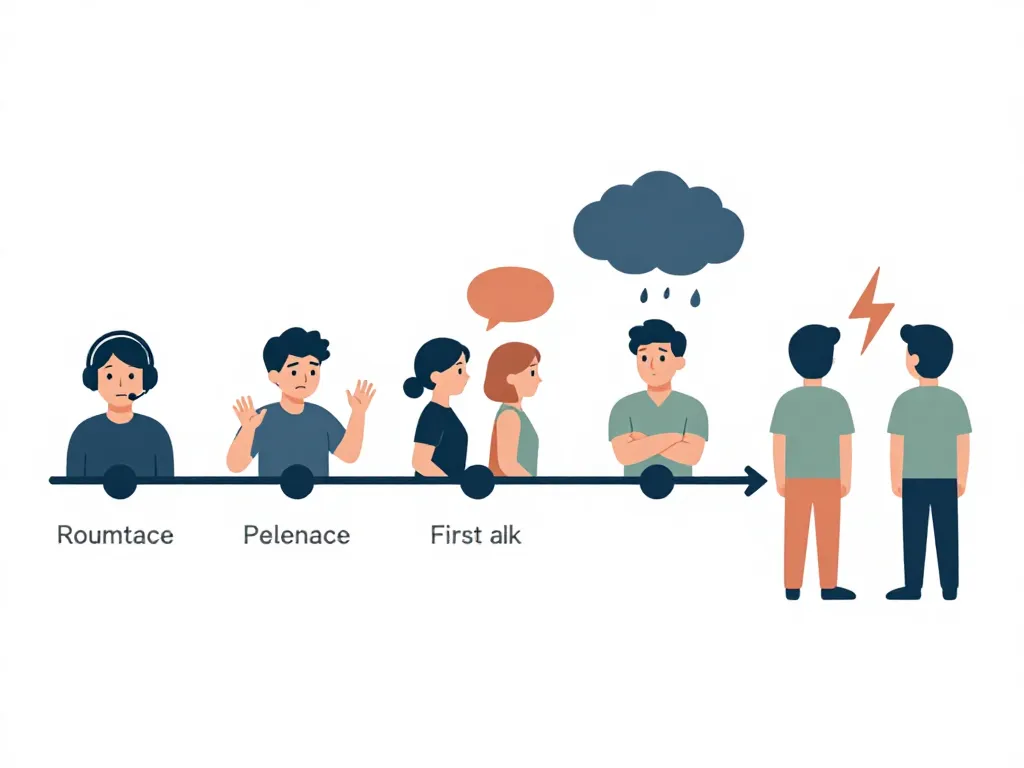
Most noise conflicts don't start as fights. They start as mild irritation that gets swallowed, repeated, and eventually erupts. Understanding the typical escalation pattern can help you intervene before things get hostile.
Stage 1: The Silent Tolerance Phase
You hear the noise. It bothers you. You say nothing because you don't want to be "that person." You put in earplugs, turn on a white noise machine, or just seethe quietly. This phase can last weeks or months.
Stage 2: The Passive Signal
You start closing your door a little harder. You make a comment that's technically a joke: "Wow, sounded like a concert in here last night, ha." Your roommate may or may not register the signal. Usually not.
Stage 3: The First Direct Ask
You finally say something explicitly. It might come out perfectly calm or slightly loaded, depending on how long Stage 1 lasted. Your roommate apologizes, adjusts for a day or two, then drifts back to baseline. This is the most critical moment — and the one most people handle without any structure.
Stage 4: The Resentment Loop
The noise returns. You feel ignored. Every sound becomes evidence that your roommate doesn't respect you. Conversations become tense. Small unrelated issues — dishes, the thermostat, grocery shelf space — start carrying the weight of the unresolved noise problem.
Stage 5: The Blowup or the Freeze-Out
Either someone snaps and there's a genuine argument, or both roommates retreat into cold, transactional coexistence. Neither outcome solves the noise issue.

Step-by-Step: How to Resolve a Noise Conflict (Without Destroying the Relationship)
Step 1: Name the Problem in Concrete Terms
Before you say a word to your roommate, get specific with yourself. Vague frustration leads to vague conversations that solve nothing.
Ask yourself:
- What specific sounds bother me? (TV volume, phone calls on speaker, music, late-night cooking, early morning alarms)
- When do they bother me? (After 10 p.m.? Before 7 a.m.? During work-from-home hours?)
- How often is this happening? (Nightly? A few times a week? Only on weekends?)
- What would "solved" actually look like?
Write your answers down. This isn't journaling for fun — it's preparation for a conversation that needs to be precise.
Step 2: Choose the Right Moment to Talk
Do not bring this up:
- While the noise is actively happening (you're already activated)
- Right before one of you leaves for work
- Over text (tone is impossible to control)
- After drinking
Do bring this up:
- During a calm, neutral moment — maybe a weekend morning over coffee
- When you both have at least 20 minutes without a deadline
- In person, face to face, in a shared space
Step 3: Lead with the Impact, Not the Accusation
There's a meaningful difference between these two openings:
❌ "You're always so loud at night and it's inconsiderate."
✅ "I've been struggling to sleep on weeknights because of sound coming through the walls after about 10:30. I wanted to figure out something that works for both of us."
The first one assigns character judgment. The second one describes a specific problem and invites collaboration. Your roommate is far more likely to engage constructively with the second framing — not because it's a "trick," but because it's actually more accurate. The problem isn't that they're a bad person. The problem is that sound travels and your schedules don't align.
Step 4: Listen to Their Side (Genuinely)
Your roommate may have constraints you haven't considered:
- They might be on late-night calls for work in a different time zone
- Gaming or music might be their primary stress outlet after a hard day
- They might not realize how much sound carries through your walls
- They might have their own noise complaints about you that they've been sitting on
This step isn't about giving ground. It's about understanding what you're actually negotiating.
Step 5: Draft a Noise Agreement Together
This is where most people stop short. The conversation goes well enough, everyone nods, and then nothing is written down. Two weeks later, you're back to unresolved conflict.
A practical noise agreement doesn't have to be a legal document. It just has to be specific and mutual. Here's what to include:
| Category |
Details |
| Quiet Hours |
Specify explicitly: "Weeknights (Sun–Thu), quiet hours start at 10:30 p.m. and end at 7:00 a.m. Weekends: midnight to 9:00 a.m." Define "quiet" as: headphones for all media, no speaker calls, low-volume conversation only. |
| Daytime Noise Norms |
If either roommate works from home, specify focus hours where loud activities (calls on speaker, music without headphones, vacuuming) should be avoided. Example: "Between 9 a.m. and noon on weekdays, both roommates use headphones for calls and media in shared spaces." |
| Guest and Social Noise |
How much notice before having people over on a weeknight? What's the volume expectation for weekend gatherings? Is there a guest cutoff time? |
| Heads-Up Protocol |
Agree on how to flag noise in the moment without it feeling like an attack. A simple text with a pre-agreed emoji or a brief "Hey, could you bring it down a notch?" works better than a knock on the door at midnight. |
| Review Date |
Set a date (maybe 3–4 weeks out) to check in on whether the agreement is working. Schedules change, life changes — the agreement should be a living document. |
Tools like Servanda can help you formalize these agreements in writing so both roommates have a clear, shared reference point — which eliminates the "I thought we said..." disputes that derail progress.
What to Do When the Conversation Doesn't Work
Sometimes you do everything right and your roommate still doesn't engage. Maybe they dismiss the problem, agree but don't follow through, or get defensive. Here's how to handle the common roadblocks.
"You're being too sensitive."
This is dismissal, and it stings. But responding with escalation won't help. Try: "I hear that we might see this differently. But the sleep issue is real for me, and I'd like to find a middle ground. Can we try the quiet hours for two weeks and see how it goes?"
You're not asking for permission to have needs. You're proposing a time-limited experiment, which is harder to refuse than an open-ended demand.
They agree but nothing changes.
This is the most common outcome, and it's usually not malicious — it's habit. People revert to baseline without structure. That's exactly why the written agreement matters. If you have one, you can reference it without re-litigating the whole conversation: "Hey, just a heads-up — it's past 10:30 and the sound is carrying. Can you switch to headphones?"
If they consistently ignore the written agreement, you're dealing with a respect issue, not a noise issue, and it may be time to involve a third party — a mutual friend, a mediator, or your landlord if the lease includes noise provisions.
They have counter-complaints.
Good. Seriously. If your roommate comes back with their own grievances — "Well, your alarm goes off three times every morning and wakes me up" — that's a sign they're engaging. Address their concern with the same seriousness you want for yours. Reciprocity is the foundation of any workable agreement.
Practical Noise Reduction Hacks That Actually Help
While you work on the interpersonal side, these low-cost, high-impact changes can reduce the physical reality of noise transfer:
- Weatherstripping tape on bedroom doors — costs about $5 and reduces sound leakage significantly
- Heavy curtains or moving blankets on shared walls — absorbs mid-range frequencies (voices, TV audio)
- Bluetooth headphone sets for both roommates — consider splitting the cost as a shared household investment
- White or brown noise machines — brown noise is effective at masking bass-heavy sounds like footsteps and music
- Area rugs on hard floors — reduces impact noise (footsteps, dropped items) dramatically
- Rearrange furniture — a bookshelf against a shared wall provides surprising sound insulation
None of these replace a conversation, but they lower the ambient tension while you're working on a longer-term solution.
When It's Time to Escalate — And How
If you've had the conversation, written the agreement, tried physical noise solutions, and your roommate consistently disregards everything, you have a few options:
- Check your lease. Many leases include quiet enjoyment clauses or specific noise provisions. Document ongoing violations (dates, times, descriptions) and contact your landlord in writing.
- Suggest mediation. A neutral third party — even a trusted mutual friend — can break the dynamic where both people feel unheard. Community mediation centers often offer free or low-cost sessions.
- Explore a sublease or lease transfer. If the relationship is fundamentally broken and the noise issue is a symptom of broader incompatibility, a clean exit may be healthier than grinding through months of conflict.
- Know your local noise ordinances. Most cities have enforceable quiet hours (typically 10 p.m. to 7 a.m.). If noise is extreme and persistent, you have legal standing to file a complaint — though this should be a last resort between roommates.
A Note on the Emotional Side
Noise conflicts feel disproportionately personal because your home is supposed to be safe. When someone disrupts your ability to rest in your own space, it triggers something deeper than annoyance — it can feel like a violation of trust, especially if you've already asked them to stop.
It's worth acknowledging that to yourself. You're not overreacting by being upset. And your roommate probably isn't trying to make your life miserable. Most noise conflicts are two decent people with incompatible habits and no shared framework for resolving the gap.
Building that framework — specific, written, revisited regularly — is the single most effective thing you can do.
Post-grad roommate noise conflicts aren't a sign that you chose the wrong person to live with. They're a predictable consequence of two adults with different rhythms sharing thin walls and a lease. The fix isn't about one person winning and the other conceding. It's about getting specific — specific about what bothers you, when it bothers you, and what "resolved" actually looks like — and then putting that agreement in writing where both people can reference it without relitigating the original conversation.
Start tonight: write down the three noise issues that bother you most, in concrete terms. That list is the foundation of every step that follows. The roommate relationship you're protecting is worth twenty minutes of honest specificity.
Frequently Asked Questions
How do I tell my roommate they're too loud without starting a fight?
Bring it up during a calm, neutral moment — not while the noise is happening or over text — and frame it around the impact on you rather than their character. Something like "I've been having trouble sleeping because of sound after 10:30 — can we figure out something that works for both of us?" invites collaboration instead of triggering defensiveness.
What should a roommate noise agreement include?
A good noise agreement covers specific quiet hours for weeknights and weekends, daytime norms for work-from-home hours, guest and social noise expectations, and a simple heads-up protocol for flagging noise in the moment. Set a review date a few weeks out so you can adjust the agreement as schedules or circumstances change.
What can I do if my roommate agrees to be quieter but keeps being loud?
Reversion to old habits is usually about lack of structure, not lack of respect — which is why having a written agreement matters. Reference the agreement with a brief, neutral reminder like "Hey, it's past 10:30 — can you switch to headphones?" If they consistently ignore it, you may be dealing with a deeper respect issue that warrants involving a mediator or checking your lease's noise provisions.
How do I block roommate noise cheaply?
Weatherstripping tape on your bedroom door, a brown noise machine, and heavy curtains or moving blankets hung on the shared wall can make a noticeable difference for under $30 total. Placing a filled bookshelf against the shared wall and adding area rugs on hard floors also helps absorb sound, especially footsteps and bass-heavy audio.
Can I break my lease over a noisy roommate?
Most leases include a "quiet enjoyment" clause that entitles you to peaceful use of your home, so persistent noise violations — once documented with dates, times, and descriptions — give you grounds to involve your landlord. If the situation is unresolvable, explore sublease or lease-transfer options as a cleaner exit than grinding through months of unresolved conflict.