
5 Roommate Boundaries That Save Friendships
You moved in together because you genuinely like each other. Six months later, you're lying awake at 11:47 PM, seething because someone left a crusty pan "soaking" in the sink for the third day in a row — and you can't bring yourself to say anything because you don't want to be that roommate.
Here's what most people get wrong about roommate boundaries: they think setting them is the thing that causes tension. In reality, not setting them is what slowly poisons the relationship. That low-grade irritation you swallow every day? It compounds. Psychotherapists who specialize in relational dynamics consistently point out that unspoken expectations are the number one driver of roommate resentment — not personality differences, not messiness, not noise.
This article walks through five specific roommate boundaries that therapists recommend — not as rules to enforce, but as acts of care that keep friendships intact when you share a living space.
Key Takeaways
- Boundaries aren't confrontation — they're maintenance. Setting expectations early prevents the slow resentment that actually destroys roommate friendships.
- The five critical boundaries cover shared spaces, guests and visitors, money and shared expenses, quiet hours and personal time, and how you handle conflict itself.
- Timing matters more than wording. Have these conversations when things are calm, not after an incident.
- Written agreements aren't cold — they're clarifying. Putting things in writing removes the "I thought we agreed" problem entirely.
- Revisiting boundaries regularly is normal, not a sign that something is broken.

Why Roommate Boundaries Feel So Hard to Set
Let's name the elephant in the room: asking your friend-roommate to clean the bathroom feels different than asking a stranger. There's more at stake. You're not just risking an awkward conversation — you're risking a friendship.
Psychotherapist Nedra Glover Tawwab, author of Set Boundaries, Find Peace, explains that many people conflate boundaries with ultimatums. But a boundary isn't a threat. It's information. It says: Here's what I need to feel comfortable in my own home. That's not aggressive — that's honest.
The guilt you feel about setting roommate boundaries usually stems from one of three beliefs:
- "If we were really compatible, we wouldn't need rules." Even the most compatible people have different thresholds for mess, noise, and social energy. Compatibility doesn't eliminate the need for agreements — it just makes you more willing to reach them.
- "They should just know." This is the most dangerous assumption in any shared living situation. What feels obvious to you ("of course you wash your dishes the same day") may genuinely not occur to someone else.
- "Bringing it up will make things weird." It might feel briefly uncomfortable. But the alternative — months of silent frustration — makes things far weirder.
Now, let's get into the five boundaries that matter most.
Boundary 1: Shared Spaces Get Shared Standards
The Problem
Jamie and Alex moved into a two-bedroom apartment after being college friends for three years. Jamie is a "clean as you go" person. Alex is a "batch clean on the weekend" person. Neither approach is wrong, but in a shared kitchen, the clash created daily friction. Jamie felt disrespected. Alex felt micromanaged. Neither said a word for two months.
The Boundary
Agree on a specific, observable standard for shared spaces — not a vague "let's keep things clean." Vague agreements fail because everyone interprets them through their own lens.
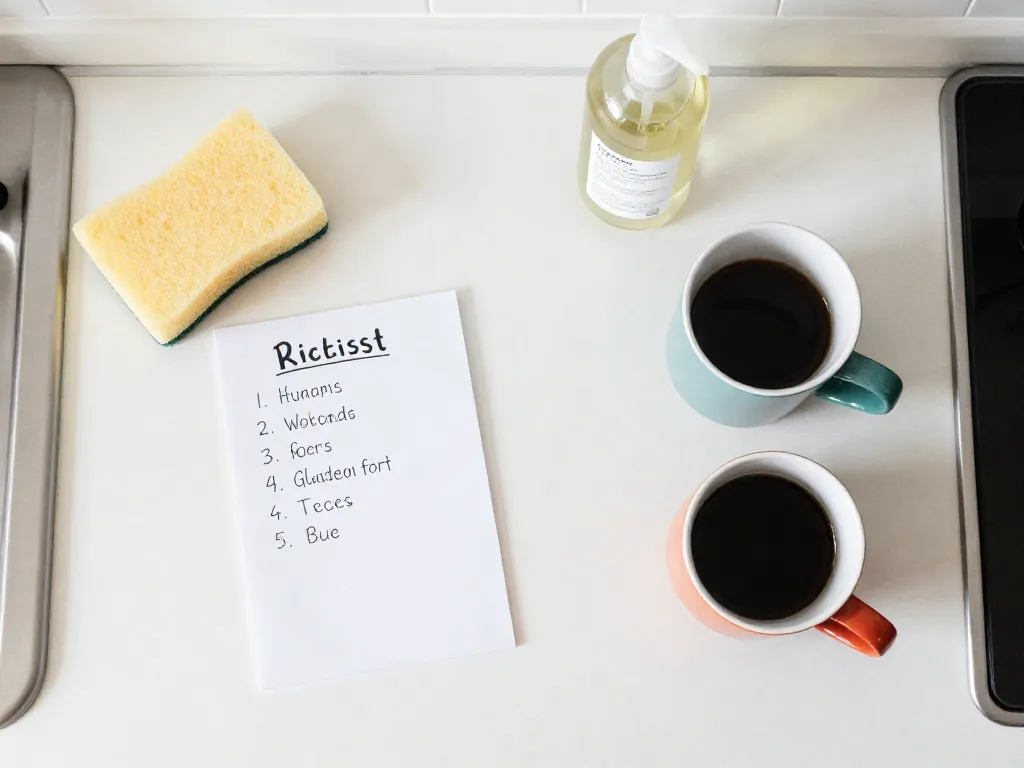
Here's what a workable agreement actually looks like:
- Kitchen: Dishes go in the dishwasher (or are washed) within 12 hours. Counters are wiped after cooking. Trash goes out when the bag is full — no balancing.
- Bathroom: Each person has a designated shelf or caddy. Shared surfaces (toilet, sink, floor) get cleaned on a rotating weekly schedule.
- Living room: Personal items get moved back to your room by the end of the day. Blankets on the couch are fine; dirty laundry on the couch is not.
Why It Works
Specificity removes interpretation. "Within 12 hours" is harder to accidentally violate than "in a timely manner." And when you've both agreed to the same concrete standard, pointing out a lapse isn't nagging — it's referencing a mutual agreement.
How to Bring It Up
Don't wait for a dirty-dish incident. Instead, frame it proactively:
"Hey, I know we both want this place to feel comfortable. Can we spend 15 minutes figuring out what 'clean enough' looks like for the kitchen and bathroom? I just want us on the same page so neither of us has to guess."
Boundary 2: Guests and Overnight Visitors
The Problem
This is the boundary most people skip — and the one that causes the most explosive conflicts. Whether it's a partner who's over five nights a week, a friend group that stays until 2 AM, or a relative crashing for an undefined "few days," guest-related tensions escalate fast because they touch on territory, privacy, and safety.
The Boundary
Cover three specific dimensions:
- Heads-up window: How much notice do you give before having someone over? A text that afternoon? 24 hours for overnight guests? Be specific.
- Frequency caps for overnight guests: Many therapists suggest starting with a number — for example, no more than 2–3 overnight stays per week for a partner — and adjusting from there. The number matters less than the fact that one exists.
- Shared-space conduct: Guests follow house rules. If your roommate's friend uses your cookware and doesn't clean it, that's your roommate's responsibility to address, not yours.
A Real Conversation Starter
"I want us both to feel free to have people over — that's part of having a home. Can we just set some ground rules so neither of us ever feels surprised or uncomfortable? Like, what feels right for overnight guests?"
Notice the framing: you're not restricting anyone. You're building a system that lets both people feel safe.
Boundary 3: Money and Shared Expenses
The Problem
Money ruins roommate relationships faster than almost anything else — and it usually isn't about big amounts. It's the $14 dish soap that one person always buys. The electricity bill that spikes because someone runs the AC at 65 degrees. The streaming subscription one person signed up for "temporarily" eight months ago.
The Boundary
Split expenses into three categories and agree on how each one works:
- Fixed bills (rent, utilities, internet): Decide the split upfront. Equal? Proportional to room size? Based on income? There's no universally correct answer, but there needs to be an explicit one.
- Shared consumables (toilet paper, cleaning supplies, kitchen basics): Either split costs 50/50 with a shared expense app, or alternate who buys them on a rough rotation.
- Personal expenses: Define what's personal. If you drink oat milk and your roommate drinks regular, maybe dairy alternatives are a personal cost. If one person uses significantly more electricity (e.g., a window AC unit in their room), talk about adjusting the split.
The Non-Negotiable
Set a date for when shared bills get paid. Not "around the first" — an actual date. Late payments create disproportionate stress for whoever's name is on the account.
Consider formalizing your agreements with a tool like Servanda, especially for financial splits and shared responsibilities — having things in writing eliminates the "I thought we agreed" conversations that erode trust over time.
Boundary 4: Quiet Hours and Alone Time
The Problem
Priya and Dana had been friends for five years before moving into a one-bedroom-plus-den apartment. Priya works from home and needs silence between 9 AM and 5 PM. Dana is a night owl who unwinds with video calls and music after 10 PM. Both felt like the other person was being unreasonable. Neither was.
The Boundary
This boundary has two parts — noise and social energy.
Noise agreements: - Set specific quiet hours (e.g., 10 PM–8 AM on weekdays, 11 PM–9 AM on weekends). - During quiet hours: headphones required for media, phone calls taken in your room with the door closed, no running the washing machine or blender. - Outside quiet hours: reasonable noise is expected. If something specific bothers you, name it.
Alone-time agreements:
This is the one people feel most guilty about, and it's arguably the most important. You are allowed to need your home to yourself sometimes. That doesn't mean you dislike your roommate.
Workable approaches include:
- Designating one evening per week where each person gets the common areas to themselves.
- Agreeing that a closed bedroom door means "I'm not available for conversation right now" — no explanation needed, no offense taken.
- Using a low-key signal (even something as simple as wearing headphones in the living room) to indicate "I'm in my own world right now."
Why This Matters So Much
Psychologists who study cohabitation stress that the need for solitude isn't antisocial — it's regulatory. Introverts and extroverts alike need time to decompress without performing sociability. When roommates can't access that, the apartment stops feeling like home and starts feeling like an obligation.

Boundary 5: A Conflict Protocol (How You'll Handle Disagreements)
The Problem
Every other boundary on this list will eventually get tested. Someone will forget. Someone will push a limit. Something unforeseen will come up. The question isn't whether you'll have a disagreement — it's whether you'll have a way to handle it that doesn't leave someone feeling blindsided, ganged up on, or dismissed.
The Boundary
Agree on a process before you need one. Here's a framework that therapists frequently recommend for roommates:
- Direct first. If something bothers you, you bring it up with your roommate directly — not with your group chat, not with your partner, not through passive-aggressive Post-it notes. This protects the other person's dignity.
- Timing matters. Don't ambush someone when they walk in the door or right before bed. Say: "Hey, there's something I want to talk about — when's a good time today?" This gives both people a chance to be emotionally present.
- Use the format: Observation → Impact → Request. Instead of "You never clean up after yourself," try: "I noticed the dishes were in the sink for three days (observation). It made me feel like I'd have to do them or live with the mess (impact). Can we stick to the 12-hour rule we agreed on? (request)."
- Cool-down option. Either person can say "I need to think about this" and pause the conversation — but you agree to come back to it within 24 hours. Walking away permanently isn't allowed.
- Escalation plan. If you genuinely can't resolve something between yourselves, agree in advance on what happens next. Maybe it's a trusted mutual friend. Maybe it's a mediation service. Having a plan means neither person feels trapped.
Why This Boundary Is the Most Important One
Without a conflict protocol, every other boundary is unenforceable. You can agree that dishes get done within 12 hours, but if there's no safe way to say "hey, the dishes," the agreement is decorative.
The magic of a conflict protocol is that it separates the issue from the relationship. When you follow an agreed-upon process, raising a concern doesn't feel like a personal attack — it feels like two adults maintaining their shared space.
How to Actually Have "The Boundaries Conversation"
Knowing what to discuss is only half the equation. Here's a practical playbook for when and how:
When to Do It
- Ideally: Before you move in, or within the first two weeks.
- If you're already living together: Pick a calm, neutral moment. A lazy Sunday afternoon. Not right after someone left dishes in the sink.
- Frame it positively: "I've been reading about how roommates can avoid the stuff that usually causes problems. Want to go through a few things together? I think it'll actually make things easier for both of us."
How to Structure It
- Set aside 30–45 minutes. Treat it like a brief, friendly meeting — not an interrogation.
- Go through each of the five categories above. For each one, ask: "What would work for both of us?"
- Write it down. A shared Google Doc, a note on your fridge, a text thread you can both reference. Written agreements aren't cold — they're clarifying.
- Schedule a check-in for 4–6 weeks later. Boundaries aren't static. Life changes, schedules shift, new partners enter the picture. A built-in review removes the awkwardness of raising something new.
What If Your Roommate Resists?
Some people hear "let's set boundaries" and interpret it as "you've done something wrong." If your roommate seems defensive:
- Lead with your own vulnerability: "Honestly, I know I can be particular about kitchen stuff, and I don't want that to become a thing between us. I'd rather just get on the same page now."
- Emphasize that boundaries protect them too: "This way, if something's bugging you about how I do things, you have a way to tell me without it being a big deal."
- Start small. You don't have to cover all five boundaries in one sitting. Even addressing shared spaces and quiet hours is a strong start.
FAQ
How do you set boundaries with a roommate without being rude?
The secret is timing and framing. Bring up boundaries when things are calm — not in the heat of a frustration — and frame them as something that helps both of you, not just you. Saying "I want to figure this out together so we're both comfortable" lands very differently than "you need to stop doing this." Boundaries delivered with care almost never come across as rude.
What if my roommate agrees to boundaries but doesn't follow them?
This is where a conflict protocol (Boundary 5) becomes essential. Reference the specific agreement calmly: "Hey, we agreed dishes would be done within 12 hours — can you take care of those tonight?" If the pattern continues after 2–3 direct conversations, it's time for a more serious discussion about whether the living arrangement is working. Consistent boundary violations are data, not just annoyances.
Is it normal to need alone time from your roommate?
Absolutely. Needing solitude in your own home isn't a sign that something's wrong with the relationship — it's a basic psychological need. Research on cohabitation consistently shows that people who can access private, uninterrupted time in their living space report higher satisfaction with their roommate relationships, not lower.
Should roommates have a written agreement?
Yes — even if you're best friends. Especially if you're best friends. A written agreement isn't a sign of distrust; it's a tool that removes ambiguity. Memory is unreliable, and what you "remember agreeing to" often diverges after a few weeks. Even a simple shared document covering the five boundaries in this article can prevent most common roommate conflicts.
How often should roommates revisit their agreements?
A good starting point is every 6–8 weeks, or whenever there's a significant life change (new job, new relationship, change in financial situation). Think of it like a quick maintenance check — you're not reopening negotiations from scratch, just asking: "Is this still working? Anything we should adjust?" Normalizing these check-ins makes it far easier to raise concerns before they calcify into resentment.
Conclusion
The five roommate boundaries above — shared-space standards, guest policies, financial agreements, quiet hours and alone time, and a conflict protocol — aren't about control. They're about removing ambiguity so your friendship doesn't have to absorb the weight of unspoken frustration.
The paradox of boundaries is that they feel restrictive in theory but create freedom in practice. When you know the expectations, you stop walking on eggshells. When your roommate knows yours, they stop guessing. The space between you becomes clearer, and the friendship gets room to breathe.
You don't need to have a perfect conversation. You don't need to cover everything in one sitting. You just need to start — ideally today, while things are still good. That's the whole point: boundaries work best when they're set before you need them.