Roommate Keeps Bringing People Over Without Asking
You come home after a long day. You're looking forward to eating leftovers on the couch in your pajamas, maybe watching something terrible on your laptop. Instead, you open the door to three strangers sitting in your living room, your roommate's music playing, and someone you've never met using your favorite mug.
It's not the first time.
When your roommate brings guests over without asking, it doesn't just disrupt your evening — it chips away at your sense of home. Your apartment stops feeling like a place you can relax and starts feeling like a space you have to brace yourself for. The frustration builds quietly at first: a tight smile, a retreat to your bedroom, a passive-aggressive text to a friend. But eventually, it becomes the thing you think about every time you put your key in the lock.
This is one of the most common roommate conflicts, and one of the most avoidable. Here's how to actually address it — not with a blowup or a cold shoulder, but with a clear plan.

Why This Feels Like Such a Big Deal
Before you say anything to your roommate, it helps to understand why uninvited guests bother you so much. It's rarely about the guests themselves.
It's About Control Over Your Own Space
Home is supposed to be the one place where you don't have to perform. You don't have to be "on." When someone else repeatedly fills that space with people you didn't expect or invite, you lose the ability to decompress. Research on environmental psychology consistently shows that perceived control over one's living space is directly tied to wellbeing and stress levels. When that control disappears, anxiety goes up — even if nothing objectively bad is happening.
It's About Respect
When your roommate keeps bringing people over without asking, the unspoken message — whether they intend it or not — is: my social life matters more than your comfort. That message stings, especially when you're the one retreating to your room in your own apartment.
It's About Unspoken Expectations
Most roommate conflicts around guests come down to mismatched assumptions. Your roommate might have grown up in a house where people dropped by constantly. You might have grown up in a home where visitors were planned a day in advance. Neither is wrong. But without a conversation, you're both operating from invisible rulebooks that don't match.
Before the Conversation: Get Clear With Yourself
The worst time to figure out what you want is in the middle of a confrontation. Before you bring this up with your roommate, spend ten minutes answering these questions honestly:
- What specifically bothers me? Is it the frequency? The lack of notice? Overnight guests? Noise levels? People being in common areas when you need to study or sleep?
- What would "good enough" look like? You probably aren't going to get a guest-free apartment (nor would that be fair to ask for). What's the realistic middle ground you'd genuinely be okay with?
- Am I reacting to a pattern or a single incident? If it happened once, a casual mention might suffice. If it's a pattern, you need a more structured conversation.
- Is there something else going on? Sometimes guest frustration is the surface issue, and the real problem is that you feel disrespected in other ways too — dishes, noise, shared expenses. Be honest about what's actually fueling the resentment.
Write your answers down. You don't need to share them, but having clarity on your own position prevents the conversation from spiraling into vague complaints.

How to Have the Conversation (Without It Becoming a Fight)
Choose the Right Moment
Don't bring this up when guests are currently over. Don't bring it up when either of you is rushing out the door, hungry, stressed, or already in a bad mood. Find a neutral window — a weekend morning, a weeknight when you're both home and calm.
A simple opener: "Hey, do you have a few minutes? I wanted to talk about something with the apartment before it becomes a bigger deal."
That framing does two things: it signals that this is a real conversation, and it positions you as someone trying to prevent conflict rather than start it.
Lead With Your Experience, Not Their Behavior
There's a significant difference between:
- "You always have people over without telling me"
- "I've been feeling on-edge coming home because I don't know if there will be people here"
The first one puts your roommate on the defensive. The second one gives them a window to understand how you're affected. You're not accusing them of being a bad roommate — you're describing what it's like to live with unpredictability.
Name the Pattern Without Exaggerating
Be specific. Instead of "you always do this," try: "In the last two weeks, I've come home to guests I didn't know about maybe four or five times. That's been hard for me."
Ask About Their Perspective
After you've said your piece, genuinely ask for theirs. "I'm curious how you see it — is this something you've thought about, or does it just kind of happen naturally?"
You might learn that they didn't realize it was bothering you. You might learn that they're going through something and leaning on their social circle more than usual. You might learn that their previous roommate was fine with constant guests. All of that is useful information.
Propose a Solution Together
Rather than dictating rules, co-create them.
Building a Guest Policy That Actually Works
A guest policy doesn't need to be a legal document. It just needs to be specific enough that both of you can point to it later without ambiguity.
Here are the areas your policy should cover:
1. Advance Notice
Agree on a minimum heads-up window. Some options:
- Same-day text: A simple "Hey, [name] is coming over around 7" gives you time to mentally prepare or make other plans.
- 24-hour notice for groups: If it's more than one or two people, a day's notice is reasonable.
- Flexible exceptions: If your roommate runs into a friend and wants to invite them back spontaneously, a quick text before they arrive.
The goal isn't to make your roommate ask permission — it's to make sure you're not blindsided.
2. Overnight Guests
Be explicit:
- How many nights per week is acceptable?
- Does the guest use shared spaces (bathroom, kitchen) in the morning?
- Who handles extra utility costs if an overnight guest becomes semi-permanent?
A common guideline is no more than two or three overnight stays per week for any single guest. Beyond that, you're effectively adding a third roommate who isn't paying rent.
3. Quiet Hours and Shared Spaces
Agree on:
- Quiet hours: Guests should be gone or in your roommate's room by a certain time on weeknights.
- Common area use: If you need the living room to study, what's the protocol? Can you claim it with advance notice?
- Kitchen and bathroom: Guests should clean up after themselves. Your roommate is responsible for making sure that happens.
4. Off-Limits Spaces and Items
If you don't want guests in your room, using your things, or eating your food, say so now. This isn't petty — it's practical.
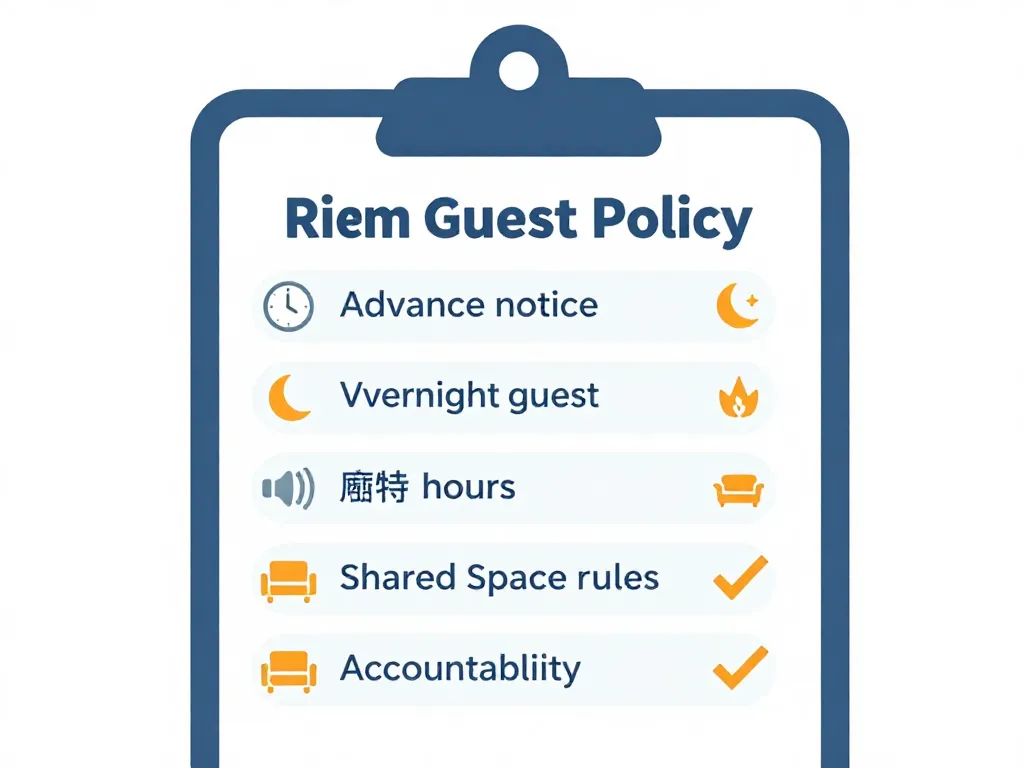
5. What Happens When the Policy Is Broken
Agree in advance on how you'll handle violations:
- A direct text in the moment: "Hey, remember we agreed on a heads-up. Can we stick to that?"
- A check-in conversation once a month to see if the policy is working for both of you.
- An agreement that if the same issue keeps coming up, you'll revisit and adjust the policy rather than just stewing.
Consider putting your guest policy in writing. It doesn't have to be fancy — a shared note on your phones works fine. Tools like Servanda can help you create a written roommate agreement that captures these specifics, so there's no room for "I don't remember agreeing to that" later on.
What If Your Roommate Doesn't Take It Seriously?
Sometimes you have the conversation, you reach an agreement, and nothing changes.
Restate the Agreement Clearly
The first time the policy is broken after your conversation, address it directly and without emotion: "Hey, just a reminder — we agreed on a text before guests come over. I didn't get one tonight."
Keep it factual. You're not attacking their character; you're referencing a mutual commitment.
Escalate Gradually
If it keeps happening:
- Have a second, more direct conversation: "We talked about this two weeks ago and I've noticed it hasn't changed. I need to understand — is the agreement we made not working for you, or is it just slipping your mind?"
- Put it in writing: If you haven't already, write the agreement down and share it. Written commitments carry more psychological weight than verbal ones.
- Involve a third party if needed: If you're renting together, your landlord may have occupancy or guest policies that support your position. If you're in student housing, your resident advisor can mediate.
Know Your Non-Negotiables
There's a point where a roommate's guest habits become genuinely unlivable — when guests are there every night, when you feel unsafe, when your sleep is consistently disrupted, when your belongings are being used or damaged. If your roommate refuses to respect basic boundaries after multiple clear conversations, it's worth considering whether this living arrangement can continue.
That's not failure. That's self-respect.
Common Scenarios and How to Handle Them
Scenario: Your roommate's partner is essentially living there.
Say this: "I really like [partner's name], and I'm glad you're happy. But they've been here almost every night for the past few weeks, and it's starting to feel like we have a third roommate. Can we figure out a schedule that works?"
Scenario: Your roommate hosts loud gatherings on weeknights.
Say this: "I've got early mornings this semester, and the noise on weeknights is making it really hard to sleep. Could we keep weeknight hangouts smaller or wrap up by 10?"
Scenario: Your roommate's guests make you uncomfortable.
Say this: "I need to be honest with you — I don't feel comfortable around [specific person or behavior]. I'm not trying to control who you hang out with, but I need to feel safe in our apartment."
Scenario: You've said something once and feel awkward bringing it up again.
Say this: "I know we touched on this before, and I felt awkward bringing it up again. But it's still happening, and I'd rather talk about it than let it build up."
Frequently Asked Questions
How do I tell my roommate to stop having guests over so much?
Instead of demanding they stop entirely, have a calm conversation where you describe how the frequency is affecting you and propose a guest policy together. Focus on specifics like advance notice, a cap on overnight stays per week, and quiet hours — this makes the request feel fair rather than controlling.
Is it unreasonable to ask my roommate to tell me before they bring someone over?
Not at all — asking for a heads-up text before guests arrive is one of the most common and reasonable roommate boundaries. It's not about asking permission; it's about making sure neither of you is blindsided in your own home.
What do I do if my roommate's boyfriend or girlfriend is basically living with us?
Bring it up directly but kindly, acknowledging the relationship while pointing out the practical impact — a near-permanent guest affects shared spaces, utilities, and your comfort. A common guideline is capping any single guest at two or three overnight stays per week; beyond that, they should be contributing to rent and expenses.
How do I bring up a roommate problem again after I already mentioned it once?
It's normal to feel awkward, but letting it fester is worse than a brief moment of discomfort. Simply say something like, "I know we touched on this before, but it's still happening and I'd rather talk about it than let resentment build up," then reference the specific agreement you made together.
Should I put a roommate guest agreement in writing?
Yes — written agreements carry more psychological weight than verbal ones and eliminate "I don't remember agreeing to that" disputes later. A shared phone note or a tool like Servanda can help you capture the specifics of notice periods, overnight limits, and quiet hours so both of you can reference it when needed.