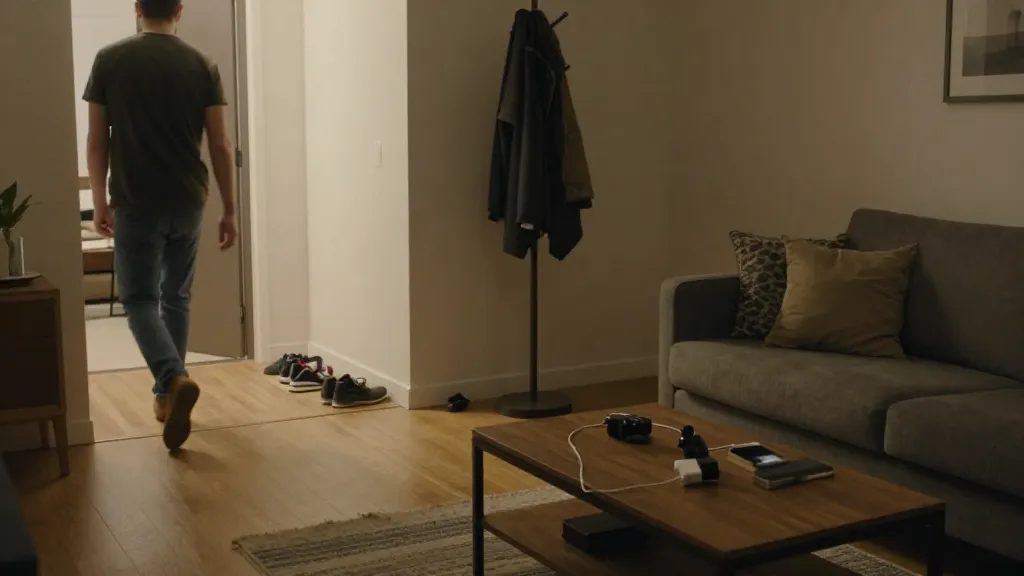
My Roommate's Partner Basically Lives Here Now
It starts innocently. Your roommate's partner stays over on a Friday night. Then Saturday becomes Sunday morning. Soon, their toothbrush appears in the bathroom holder, their shampoo crowds yours in the shower caddy, and you're tripping over their shoes every time you walk through the front door. You open the fridge and half of it is food they bought. The living room TV is on their show when you get home from work. You're splitting rent two ways, but it feels like three people live here — because, functionally, three people do.
When your roommate's partner basically lives here, it creates tension that's hard to name at first. You don't want to be controlling. You don't want to seem jealous. But something feels fundamentally unfair, and you can't keep swallowing it. You're not being dramatic — this article will walk you through exactly what to do about it.

Why This Feels So Uncomfortable (And Why You're Not Overreacting)
When you signed a lease or agreed to live together, you signed up for a specific arrangement: a certain number of people, a certain share of costs, a certain amount of personal space. When someone's partner is there five, six, seven nights a week, that arrangement changes — but only for one of you.
Here's what's actually happening beneath the surface:
- Your shared spaces shrink. The bathroom schedule gets tighter. The kitchen is busier. The couch isn't available when you want to decompress.
- Utility costs increase. More showers, more electricity, more heating or cooling, more water — and you're still splitting the bill 50/50.
- Your sense of privacy erodes. Your home is supposed to be your refuge. When someone you didn't choose to live with is constantly present, that refuge disappears.
- The social dynamic shifts. You start feeling like a third wheel in your own apartment. You might avoid common areas or feel like you need to be "on" when you just want to exist in your own space.
- It feels unfair — because it is. Your roommate gets the benefit of practically living with their partner while paying half the rent. You get a smaller share of the space you're fully paying for.
None of this makes you petty. It makes you someone whose living situation changed without their consent.
How to Tell If It's Actually a Problem
Not every partner visit is an issue. But how do you know when "visiting" has crossed into "basically living here"?
Ask yourself these questions:
- Is the partner there more than four nights a week, consistently? Four-plus nights per week, week after week, is functionally cohabitation.
- Do they have personal belongings permanently stored at your place? Drawers of clothing, toiletries, a dedicated phone charger — these signal residency, not visiting.
- Are they using shared resources daily? Cooking in the kitchen, running laundry, taking long showers — this is household membership.
- Are they there when your roommate isn't? If the partner is home alone in your apartment while your roommate is at work or out, you've crossed well beyond "guest" territory.
- Do you feel like you need permission to use your own common areas? If you hesitate before walking to the kitchen in your pajamas, that's a sign your comfort has been compromised.
If you answered yes to two or more of these, you have a legitimate issue worth addressing.

Having the Conversation: A Step-by-Step Approach
This is the part most people dread. You've been stewing on this for weeks, maybe months. Here's how to approach it with clarity and fairness.
Step 1: Talk to Your Roommate — Not Their Partner
This is a conversation between you and your roommate. Don't confront the partner directly (they may not even realize there's an issue), and don't bring it up in a group setting where anyone feels ambushed.
Choose a time when you're both home, relatively relaxed, and the partner isn't there. Frame it as a practical household check-in.
Step 2: Lead With the Impact, Not the Accusation
The fastest way to shut down a productive conversation is to make your roommate feel attacked. Compare these two openings:
- ❌ "Your boyfriend is here literally all the time and it's not fair."
- ✅ "Hey, I've noticed our space has been feeling more crowded lately, and I wanted to talk about how we handle overnight guests going forward."
The second version addresses the situation without turning it into a character judgment.
Step 3: Be Specific About What's Bothering You
Vague complaints get vague responses. Your roommate might genuinely not understand the scope of what you're experiencing. Instead, name the concrete impacts:
- "I've noticed our water bill went up $30 last month, and I think it's partly because there's an extra person showering here daily."
- "I haven't been able to use the living room in the evenings because they're usually watching TV when I get home."
- "I feel uncomfortable walking around in my own apartment because there's always someone extra here."
Specifics make the problem tangible and harder to dismiss.
Step 4: Propose Solutions, Don't Just Air Grievances
Coming with proposed solutions signals that you want to fix this together. Here are some reasonable proposals to have in your back pocket:
- Set a guest limit. Something like three or four overnight stays per week is a common standard.
- Adjust the financial split. If the partner is there the majority of the time, propose a three-way split on utilities, shared supplies, or even a portion of rent.
- Define quiet hours and shared-space norms. Maybe the partner isn't in common areas before you've left for work, or they don't use the kitchen during your dinner prep window.
- Set a timeline for reassessment. "Let's try this for a month and see how it feels" takes the pressure off both of you.
Step 5: Listen to Their Side
Your roommate might have context you're missing. Maybe they're going through something and need their partner around for support. Maybe they didn't realize how often their partner was staying. None of this erases your needs, but understanding their perspective will help you find a solution that doesn't blow up the relationship.

What a Fair Overnight Guest Policy Actually Looks Like
There is no universal normal — there's only what works for the people who share a specific space. Here's a framework that's worked for a lot of roommates:
The Basics
- Maximum overnight stays: 3–4 nights per week for any single guest
- Advance notice: A quick heads-up text for overnight stays (not asking permission — just common courtesy)
- No guests when the roommate is home alone and uncomfortable: This applies to any guest, not just partners
- Shared spaces return to neutral: Guests don't leave belongings in common areas
The Financial Piece
If a guest is staying over more than half the week, it's reasonable to revisit the cost split. Here's one approach:
| Situation |
Rent Split |
Utilities Split |
| Guest stays 0–2 nights/week |
50/50 |
50/50 |
| Guest stays 3–4 nights/week |
50/50 |
60/40 (roommate with guest pays more) |
| Guest stays 5+ nights/week |
Consider 3-way rent split |
3-way utilities split |
These numbers aren't laws — they're starting points for your own negotiation.
Put It in Writing
Verbal agreements fade and get reinterpreted over time. Whatever you agree on, write it down. It doesn't need to be a formal legal document — even a shared Google Doc or a text thread summary works. Tools like Servanda can help roommates formalize these kinds of agreements so there's a clear reference point if the situation comes up again.
What to Do If Your Roommate Gets Defensive
Sometimes the conversation doesn't go smoothly. Your roommate might say things like:
- "You're being controlling."
- "It's my apartment too — I can have whoever I want over."
- "You're just jealous because you're single."
These responses are defensive, not factual. Here's how to hold your ground without escalating:
Stay focused on the practical. "I hear you, and I'm not trying to control your relationship. I'm asking that we figure out a fair arrangement since the situation has changed from what we originally agreed to."
Reframe it as a roommate issue, not a relationship issue. "This isn't about your partner as a person. If I had a friend who was here every single day, we'd be having the same conversation."
Name the lease. If your lease has a clause about long-term guests (many do), bring it up factually. "Our lease actually says guests can't stay more than X consecutive nights. I'm not trying to be legalistic, but it's something we should both be aware of."
Know your limits. If your roommate refuses to engage at all and the situation continues, you have options: mediate through a mutual friend, contact your landlord (especially if the lease is being violated), or start planning your exit from the living arrangement.
When the Real Answer Is a Bigger Change
Sometimes the guest conversation reveals a deeper incompatibility. Your roommate might genuinely want to live with their partner. You might realize you need more privacy than a roommate situation allows. The living arrangement might have run its course.
If that's the case, the healthiest move isn't to keep fighting about overnight limits — it's to start an honest conversation about the future of the lease. Can your roommate's partner officially take over your spot? Can you find a subletter? Is the lease ending soon enough that you can both go your separate ways naturally?
Frequently Asked Questions
How many nights a week can my roommate's partner stay over before it's a problem?
There's no universal rule, but most roommate agreements consider 3–4 overnight stays per week a reasonable upper limit for a single guest. Once a partner is consistently staying five or more nights a week, they're functionally living there and it's fair to renegotiate costs and shared-space expectations.
Should my roommate's partner pay rent if they're always at our apartment?
If the partner is staying more than half the week on an ongoing basis, it's reasonable to propose a three-way split on utilities and potentially a portion of rent. Start by presenting the increased costs — like higher water and electricity bills — and suggest a split that reflects actual usage.
How do I bring up my roommate's partner staying over too much without causing a fight?
Choose a calm, private moment when the partner isn't there and frame it as a household check-in rather than a complaint. Focus on specific, practical impacts like crowded shared spaces or rising utility bills, and come prepared with solutions such as a guest-night cap or adjusted cost split.
Can my landlord do anything about my roommate's partner staying over all the time?
Many leases include clauses limiting how many consecutive nights a guest can stay or requiring landlord approval for additional occupants. Check your lease for guest-related language, and if the partner's presence violates those terms, you can bring it to your landlord's attention as a factual lease compliance issue.
What if my roommate says I'm being controlling about their partner visiting?
Stay focused on the practical realities — increased costs, reduced shared space, and changes to the original living agreement — rather than making it about the relationship. Reframe the issue by pointing out that you'd raise the same concern about any person who was effectively living in the apartment without contributing to rent or utilities.