Bathroom Hogging: A Fair Schedule for Shared Bathrooms
It's 7:42 a.m. on a Tuesday. You're already running late. Your coffee is getting cold, your outfit is laid out on the bed, and the only thing standing between you and the door is your roommate — who has been in the bathroom for the past 45 minutes. You can hear the faint sound of a podcast playing over the shower. You knock. Nothing. You knock again, louder. "Almost done!" comes the muffled reply, the same reply you got twelve minutes ago.
Bathroom access is one of the most common — and most visceral — sources of roommate friction. Unlike dishes in the sink or noise after midnight, a hogged bathroom creates an immediate, physical bottleneck. You literally cannot get ready for your day. Yet most roommates never sit down to build a fair shared bathroom schedule until the resentment is already baked in.
This article gives you the tools, templates, and talking points to fix that — whether you're drafting a plan before move-in day or trying to salvage the peace after weeks of silent fuming.

Why Bathroom Conflicts Hit Harder Than Other Roommate Issues
Bathroom hogging isn't just annoying — it touches on deeply personal territory:
- It's time-sensitive. You can ignore a messy kitchen for a day. You can't ignore needing to shower before a job interview in thirty minutes.
- It's body-related. Needing to use the toilet is not optional, and being forced to wait when the need is urgent feels dehumanizing.
- It's repetitive. Unlike a one-off party that was too loud, bathroom conflicts happen every single morning — building a compounding sense of injustice.
- It feels personal. When someone takes a 40-minute shower while you're pacing the hallway, it's hard not to interpret that as "my comfort matters more than yours," even if they're genuinely unaware.
Understanding why this particular conflict stings helps you approach the conversation with your roommate from a place of clarity rather than accumulated rage.
Before the Schedule: Having the Conversation
A shared bathroom schedule only works if everyone actually agrees to it. Getting to that agreement requires a conversation that doesn't start with "We need to talk about how long you take in the bathroom."
Frame It as a Design Problem, Not a Blame Problem
Instead of "You're always hogging the bathroom," try: "Our mornings are getting stressful because we both need the bathroom around the same time. Can we figure out a system that works for both of us?"
This reframe matters. The first version puts your roommate on the defensive. The second invites collaboration on a shared problem.
Map Out Everyone's Actual Needs
Before you can build a schedule, you need data. Sit down together and answer these questions honestly:
- What time do you need to leave the house? (Work, classes, commute deadlines)
- How long does your bathroom routine realistically take? (Not the ideal version — the real version, including the time you spend scrolling your phone.)
- Which parts of your routine must happen in the bathroom? (Showering, yes. Skincare? Maybe that can happen at your bedroom mirror.)
- Are there parts of your routine that are flexible by day? (e.g., hair washing only happens three times a week)
- Do you have any non-negotiable time constraints? (Early medication schedules, medical needs, etc.)
This isn't an interrogation. It's two people comparing blueprints so they can build something that fits both of their lives.
How to Build a Shared Bathroom Schedule That Actually Works
Below are several scheduling models, ranging from simple to detailed. Pick the one that matches your living situation.
Model 1: The Time Block System
Best for: Two roommates with predictable weekday schedules.
Assign each person a morning time block during which they have priority access to the bathroom. "Priority" means the other person can use it for quick needs (brushing teeth, grabbing something), but longer routines wait.
Example:
- Roommate A (leaves at 8:00 a.m.): Priority block 6:30–7:15 a.m.
- Roommate B (leaves at 9:00 a.m.): Priority block 7:15–8:00 a.m.
Build in a 15-minute buffer between blocks for overlap and flexibility. Whoever has the earlier departure gets the earlier block — this is the most intuitive fairness principle and tends to feel reasonable to everyone.
Model 2: The Alternating Day System
Best for: Roommates with similar schedules who both need the bathroom at exactly the same time.
On odd days of the month, Roommate A goes first. On even days, Roommate B goes first. Simple, memorable, and eliminates any daily negotiation.
The advantage is radical simplicity. The downside is that on "your" wait day, you still might be late if the first person runs long. That's why it pairs well with a time cap (see below).
Model 3: The Routine Audit and Redistribute
Best for: Situations where one person genuinely needs much more bathroom time than the other (extensive medical routine, detailed grooming for professional reasons, etc.).
Instead of splitting time 50/50, acknowledge that equal time isn't always equitable. The person with the longer routine gets a longer block, but in exchange, they take the less convenient time slot (e.g., getting up earlier).
Example:
- Roommate A needs 20 minutes. Gets the 7:00–7:20 a.m. slot.
- Roommate B needs 45 minutes. Gets the 6:00–6:45 a.m. slot.
This feels fair because the person using more of the shared resource is also absorbing the inconvenience of an earlier wake-up. It trades one cost for another rather than forcing one person to bear all of them.
Model 4: The Flex System (for Households with 3+ People)
Best for: Larger households or apartments with varying schedules.
Create a shared digital calendar (Google Calendar works fine) where each person books their bathroom slot the night before. First come, first served, with a maximum block length of 30 minutes during peak hours (typically 6:30–9:00 a.m. and 9:00–11:00 p.m.).
Ground rules for the flex system:
- Book by 10:00 p.m. the night before.
- No back-to-back bookings by the same person during peak hours.
- Emergency/urgent needs (illness, sudden schedule change) override bookings — but the person who gets bumped gets priority the next day.
The Secret Ingredient: A Time Cap
Regardless of which model you choose, a time cap during peak hours is the single most effective rule you can add. It works like this:
During agreed-upon peak hours, no one occupies the bathroom for more than [X] minutes without a break. Thirty minutes is a common starting point. When your time is up, you exit — even if you're not fully done — and give the other person their turn. You can return to finish up after they're out.
This makes the wait finite and predictable, which is psychologically much easier to tolerate than "I don't know when they'll be done."
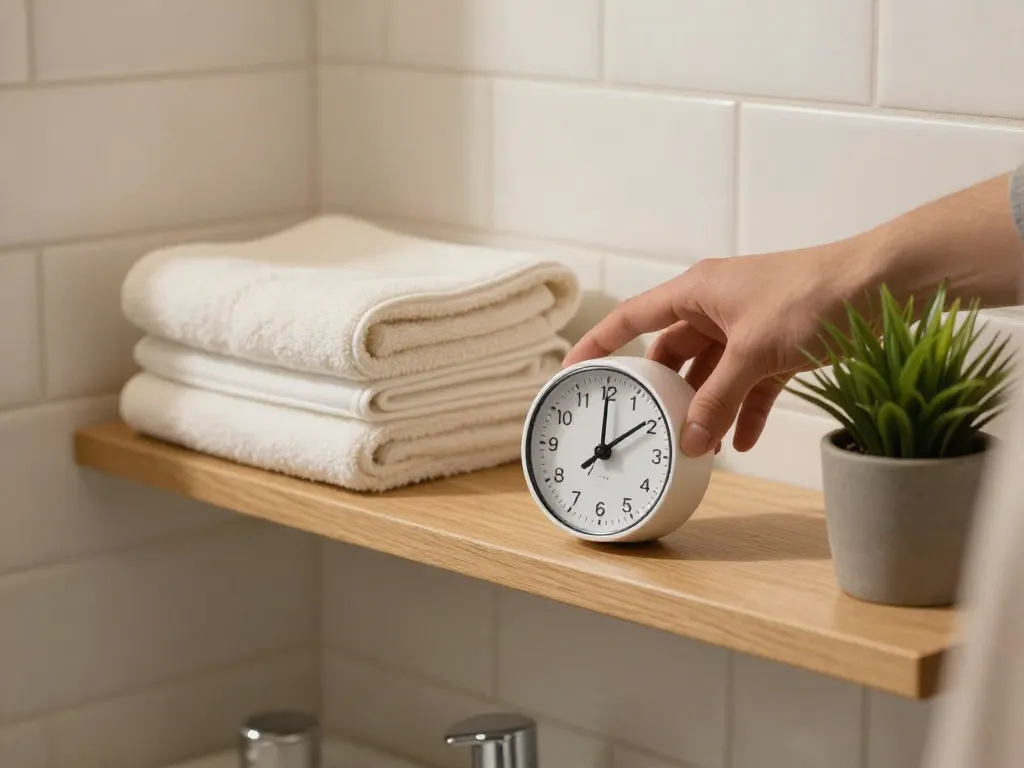
Pro tip: Use a simple kitchen timer or phone alarm visible to both parties. Making the time tangible reduces arguments about how long someone was actually in there.
Reducing Bathroom Demand in the First Place
The best shared bathroom schedule is one that has to do less work because you've reduced the bottleneck. Here are practical ways to shrink the problem:
Move What You Can Out of the Bathroom
- Skincare and makeup: A bedroom mirror with good lighting handles this perfectly.
- Hair drying and styling: Invest in a mirror and outlet setup in your room.
- Getting dressed: Lay clothes out the night before instead of doing your entire outfit selection in the bathroom.
- Phone time: If ten minutes of your "shower" is actually standing under the water reading Reddit, that's ten minutes your roommate is waiting.
Stagger Your Schedules Voluntarily
If one of you has any flexibility in your start time — remote work days, a class that doesn't start until 10:00 — use that flexibility to avoid peak overlap entirely. This is a strategic choice that benefits everyone, including you, since you'll have an unhurried bathroom experience.
Invest in Shared Infrastructure
- A shower caddy system so no one is rummaging for products during their turn.
- A second mirror in a common area for quick grooming.
- Over-the-door organizers so personal items are grab-and-go, not scattered across the counter.
These small investments shave minutes off each person's routine — minutes that compound into meaningful schedule relief over weeks and months.
What to Do When Someone Breaks the Agreement
No system survives without accountability. Here's a realistic framework for handling violations:
First Offense: Assume Good Faith
People oversleep. Alarms don't go off. Stomachs revolt at inopportune times. The first time someone blows past their time block, a simple "Hey, I noticed you went over this morning — everything okay?" is sufficient.
Repeated Pattern: Name It Directly
If it happens three or more times in a short span, it's a pattern, not a fluke. Address it directly but without accusation: "I've had to wait past my block a few mornings this week. Can we revisit whether the current schedule is realistic for you?"
Notice the framing — you're questioning whether the schedule fits, not whether your roommate is selfish. This opens the door for them to say, "Actually, I've been struggling to get everything done in 25 minutes" — which leads to a productive adjustment rather than a defensive argument.
If direct conversations haven't worked, put the agreement in writing. A documented roommate agreement — even a simple shared Google Doc — transforms a verbal understanding into something concrete and referenceable. Tools like Servanda help roommates create written agreements that prevent future conflicts by giving both parties a clear, structured record of what was promised.
If you're in a managed living situation (university housing, a sublet with a landlord), a written agreement also gives you something tangible to reference if you need to involve a third party.
Edge Cases and Special Considerations
One Bathroom, Opposite Schedules
If one of you works 9-to-5 and the other works nights, you may not need a schedule at all. But watch out for the crossover window — the evening, when the night worker is getting ready to leave and the day worker wants a relaxing bath. Identify that overlap window and apply the time cap there.
Guests and Partners
This is a frequently overlooked trigger. Your roommate's partner staying over three nights a week effectively adds a third person to the bathroom rotation. Address this proactively: guests follow the host roommate's time block, not their own. If a partner is over frequently enough to strain the system, that's a separate conversation about guest policies.
Medical and Accessibility Needs
Some people have IBS, Crohn's disease, diabetes-related needs, or other conditions that make bathroom access genuinely urgent and unpredictable. If this applies to anyone in the household, build it into the system from the start — not as an afterthought or an exception that requires disclosure during a conflict. A simple clause like "medical needs override the schedule, no questions asked" protects everyone's dignity.
A Sample Written Agreement
Here's a starting template you can adapt:
Shared Bathroom Agreement — [Address/Unit]
Effective date: [Date]
Roommates: [Names]
Peak hours: 6:30–9:00 a.m. and 9:00–11:00 p.m.
Schedule model: [Time block / alternating / flex — describe specifics]
Maximum single-use time during peak hours: [X] minutes
Guest policy: Guests use host roommate's time block.
Medical override: Medical needs take priority, no explanation required.
Review date: We'll revisit this agreement on [date, ~4 weeks out] to see if adjustments are needed.
Signed: __ / __
The review date is critical. It gives both people permission to say "this isn't working" without it feeling like an attack. Schedules that adapt survive. Schedules that are carved in stone get abandoned.
Conclusion
Bathroom hogging isn't a personality flaw — it's a resource allocation problem with a human face. And like most resource problems, it responds well to structure, transparency, and a willingness to revisit what isn't working.
The best shared bathroom schedule accounts for everyone's real needs, includes a time cap to keep things predictable, and lives in a written agreement rather than in someone's memory of a conversation that happened three months ago. Start with an honest mapping of routines, choose a scheduling model that fits your household, and commit to reviewing it within a month.
You don't need to love your roommate's 40-minute skincare routine. You just need a system where it doesn't make you late for work. That's a solvable problem.
Frequently Asked Questions
How do you split bathroom time fairly with a roommate?
Start by mapping out each person's real departure times, routine lengths, and which tasks actually require the bathroom. Then choose a scheduling model — such as time blocks based on who leaves earliest or an alternating-day system — and pair it with a peak-hour time cap of around 30 minutes. Put the agreement in writing and revisit it after a month to make adjustments.
What's a good time limit for a shared bathroom?
Thirty minutes during peak morning and evening hours is a widely accepted starting point that gives most people enough time to shower and handle essentials. Use a visible kitchen timer or phone alarm so both roommates can track the time objectively. If someone's routine genuinely requires more time, they can take an earlier or less popular slot in exchange for the extra minutes.
How do you talk to a roommate about hogging the bathroom without starting a fight?
Avoid leading with blame like "You always take forever." Instead, frame it as a logistics problem you both share: "Our mornings are stressful because we need the bathroom at the same time — can we design a system?" This collaborative framing invites problem-solving rather than defensiveness.
Should a roommate's partner follow the bathroom schedule?
Yes — the simplest and fairest rule is that overnight guests use their host roommate's assigned time block rather than claiming a separate slot. If a partner is staying over frequently enough to consistently strain the schedule, that's a sign you need a broader conversation about guest policies. Address this proactively in your written agreement before it becomes a source of tension.
What if my roommate keeps ignoring the bathroom schedule?
Give the benefit of the doubt the first time and check in casually. If it becomes a pattern — three or more violations in a short period — address it directly by asking whether the schedule needs adjusting rather than accusing them of being inconsiderate. If the problem persists, formalize the agreement in a written document using a tool like Servanda, which gives both parties a clear record to reference or escalate if needed.