Sublet or Break Your Lease? A Roommate's Guide
It's a Wednesday night and your roommate just told you they got a job offer across the country. They're leaving in six weeks. You're happy for them, but your stomach drops when you think about the lease. Seven months left. Your name is on it too. Now what?
When a roommate needs to leave before the lease ends, the remaining roommates face a decision that can cost hundreds or even thousands of dollars: should you sublet or break your lease? Both options carry financial and legal consequences, and the right choice depends on your specific lease terms, local laws, and how well you and your roommates can coordinate under pressure.
This guide breaks down the real differences between subletting and lease-breaking for roommates, walks through the costs and risks of each, and gives you a concrete framework to decide which path makes the most sense for your situation.
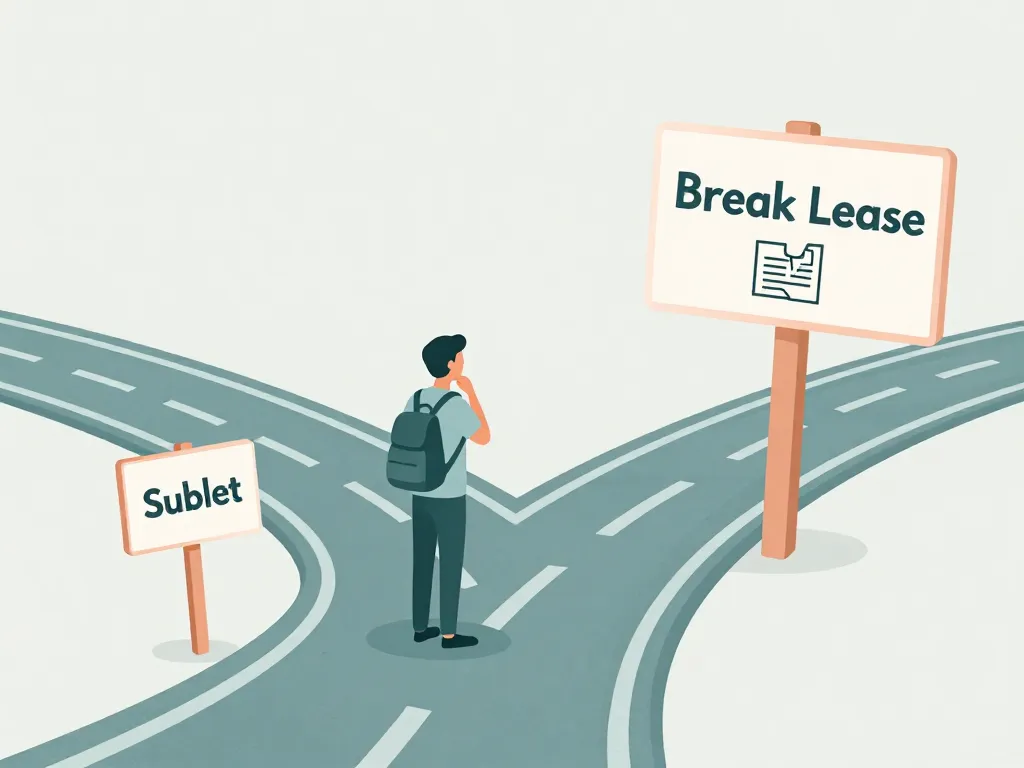
What Does It Actually Mean to Sublet?
Subletting means the departing roommate finds a temporary or replacement tenant who takes over their portion of the rent — while the original roommate's name typically stays on the lease. The original tenant (called the sublessor) remains legally responsible for the rent and any damage the subtenant causes.
How subletting works in a roommate situation
- The departing roommate finds a subtenant, usually with approval from the landlord and remaining roommates.
- The subtenant pays rent directly to the departing roommate or to the remaining roommates, depending on the arrangement.
- The lease stays intact. No one's credit gets dinged, and the landlord doesn't lose a tenant on paper.
- The departing roommate remains on the hook. If the subtenant stops paying, the original roommate is still liable.
When subletting makes sense
- The departure is temporary (e.g., a summer internship, study abroad, or short-term relocation).
- The remaining roommates don't want to restart the apartment search.
- The landlord allows subletting (check your lease — many require written consent).
- You have time to vet a subtenant properly.
When subletting gets messy
Subletting between roommates breaks down fast when expectations aren't documented. Consider this scenario:
Jordan left for a four-month work assignment and sublet their room to a friend of a friend. The subtenant paid rent on time but threw loud parties every weekend. The remaining roommates, Priya and Marcus, had no written agreement with the subtenant about house rules. Jordan, now 800 miles away, didn't want to get involved. By month two, Priya was sleeping at her partner's place to avoid the noise, but still paying rent.
A subletting arrangement without a written agreement about shared expectations is a ticking time bomb.
What Does Breaking a Lease Actually Involve?
Breaking a lease means terminating the rental contract before its end date. This can involve all roommates leaving, or — more commonly in shared housing — one or more roommates asking to be removed from the lease.
The typical costs of breaking a lease
Lease-break penalties vary widely, but here's what roommates commonly face:
- Early termination fee: Often one to two months' rent, though some leases charge more.
- Rent through re-rental: Some leases require you to keep paying until the landlord finds a new tenant.
- Forfeited security deposit: Not guaranteed, but some landlords withhold the deposit when a lease is broken.
- Credit impact: If unpaid balances go to collections, it can affect everyone whose name is on the lease.
When breaking the lease makes sense
- The living situation has become untenable (safety concerns, habitability issues, or severe roommate conflict).
- Everyone on the lease agrees to move on.
- The remaining time on the lease is short enough that the penalty is less than months of ongoing rent.
- The landlord is willing to negotiate a buyout.
Sublet or Break Your Lease: A Side-by-Side Comparison
| Factor |
Subletting |
Breaking the Lease |
| Upfront cost |
Low (advertising, background check fees) |
High (early termination fee, possible continued rent) |
| Ongoing risk |
Original tenant still liable for subtenant's behavior and rent |
Clean break once penalties are paid |
| Lease status |
Stays active; all original names remain |
Terminated or amended |
| Credit impact |
None, if subtenant pays |
Possible negative impact if balances go unpaid |
| Roommate disruption |
Moderate — new person in the home |
High — everyone may need to relocate |
| Landlord involvement |
Requires landlord approval in most cases |
Requires landlord cooperation and paperwork |
| Timeline |
Can happen relatively quickly once approved |
Can take weeks to negotiate; penalties may extend |
| Best for |
Temporary departures, strong subtenant candidates |
Permanent departures, mutual agreement to leave |
The Hidden Costs Roommates Forget
When you're scrambling to figure out whether to sublet or break your lease, it's easy to focus only on the dollar signs. But some of the most painful costs aren't financial.
Emotional labor
The roommate who stays often absorbs the stress of finding a subtenant, onboarding them, and managing any issues that arise. If your departing roommate checks out emotionally the moment they decide to leave, the burden falls unevenly. Name this dynamic early and divide the work explicitly.
Relationship strain
Money disputes between roommates can permanently damage friendships. Who pays the early termination fee? Does the departing roommate owe anything for leaving the remaining roommates in a tough spot? These conversations are uncomfortable, but having them upfront is far less painful than having them in a group chat at 11 p.m. after a missed rent payment.
Time cost
Vetting a subtenant, negotiating with a landlord, or apartment-hunting under pressure all eat into your work, school, and personal time. Factor this in when comparing options — sometimes paying a lease-break fee saves you 30 hours of logistical headaches.
A Step-by-Step Framework for Deciding
Step 1: Read your lease — the whole thing
Look for these specific clauses:
- Subletting policy: Does the lease allow it? Does it require landlord written consent? Are there fees?
- Early termination clause: What's the penalty? Is there a buyout option?
- Joint and several liability: This means each roommate is individually responsible for the full rent, not just their share. This is critical for understanding your risk.
Step 2: Talk to your landlord before deciding
Landlords often have more flexibility than the lease suggests. Some would rather approve a subtenant than deal with a broken lease and empty unit. Others may offer a reduced termination fee if you give adequate notice. You won't know until you ask.
Step 3: Run the numbers together
Sit down with all roommates and calculate:
- Cost of subletting: Advertising, any subletting fees the landlord charges, potential gap in rent while finding someone.
- Cost of breaking the lease: Termination fee, continued rent obligations, lost deposit.
- Cost of doing nothing: Can the remaining roommates afford the full rent? For how long?
Step 4: Put the agreement in writing
Whichever path you choose, document it. This isn't about mistrust — it's about making sure everyone has the same understanding of who owes what, by when, and what happens if things go sideways. Tools like Servanda can help roommates create structured written agreements that clarify responsibilities before tensions escalate.

Step 5: Set a deadline for the decision
Open-ended deliberation leads to missed rent payments and rising resentment. Give yourselves a clear timeline — for example, "We'll decide by this Friday and notify the landlord by next Monday." Deadlines force action.
What to Include in a Subletting Agreement Between Roommates
If you go the subletting route, don't rely on a handshake. Your agreement with the subtenant (and between remaining roommates) should cover:
- Rent amount, due date, and payment method
- Security deposit or damage provisions — who holds it, what it covers
- Duration of the sublet — exact start and end dates
- House rules — guests, quiet hours, cleaning expectations, shared supplies
- Utilities — how they're split, whose name they're under
- What happens if the subtenant breaks the agreement — notice period, eviction process, financial responsibility
- Communication expectations — how issues get raised and resolved
A simple Google Doc is better than nothing, but a signed document with clear terms protects everyone.
What to Include in a Lease-Break Agreement Between Roommates
If you're all walking away, agree in writing on:
- How the early termination fee is split — equally? Or does the departing roommate pay a larger share?
- Security deposit — who gets what back, and when?
- Move-out responsibilities — cleaning, repairs, returning keys
- Shared furniture or household items — who takes what?
- Timeline for moving out — especially if roommates have different departure dates
Real Talk: What If Your Roommate Refuses to Cooperate?
Sometimes the departing roommate ghosts. Or the remaining roommates refuse to approve a subtenant. Or everyone disagrees about who should pay what.
Here's what you can do:
- Document everything. Save texts, emails, and payment records. If this ends up in small claims court or a landlord mediation, you'll need receipts.
- Escalate to the landlord. If a co-tenant is unresponsive, your landlord may be willing to work directly with the remaining tenants on a lease amendment.
- Know your local tenant rights. Many cities have tenant protection offices or hotlines that can explain your options at no cost. Some jurisdictions require landlords to make reasonable efforts to re-rent the unit, which limits your liability.
- Consider mediation. A neutral third party can help roommates reach an agreement when direct conversation has broken down.
Quick Checklist Before You Decide
- [ ] I've read the lease and understand the subletting and termination clauses
- [ ] I've spoken with my landlord about both options
- [ ] I've calculated the costs of each path
- [ ] I've discussed the decision with all roommates on the lease
- [ ] We've agreed on how costs will be split
- [ ] We've put our agreement in writing
- [ ] We've set a deadline for action
Conclusion
The decision to sublet or break your lease comes down to math, timing, and the specifics of your rental agreement. Subletting keeps the lease intact and works well for temporary departures, but it carries ongoing risk for the original tenant. Breaking the lease offers a cleaner exit but comes with upfront financial pain.
Neither option is inherently better. The best choice is the one where every roommate understands their obligations, the costs are split fairly, and the agreement is documented before anyone hands over keys or writes a check.
Start by reading your lease tonight. Everything else follows from there.
Frequently Asked Questions
Can my roommate sublet their room without my permission?
It depends on your lease terms and local laws, but most leases require written landlord approval before subletting, and many also give remaining roommates input. If your lease includes a clause about subletting, your roommate likely cannot bring in a subtenant without consent. Check your lease carefully and communicate with your landlord if your roommate tries to bypass the process.
Who pays the lease-break fee if only one roommate wants to leave?
There's no universal rule — it comes down to what you negotiate among yourselves and put in writing. In many cases, the departing roommate covers a larger share of the early termination fee since they're the one initiating the break. However, if you have joint and several liability, the landlord can pursue any or all of you for the full amount, so it's critical to agree on the split before notifying your landlord.
What happens if a subtenant stops paying rent?
The original tenant whose name is on the lease remains legally responsible for the rent, even if the subtenant defaults. This means the landlord can come after the departing roommate — and potentially the remaining co-tenants under joint and several liability — for any unpaid rent. That's why vetting your subtenant thoroughly and having a written subletting agreement with clear payment terms and consequences is essential.
Can I break my lease without it hurting my credit score?
If you pay all required termination fees and settle any outstanding balances with your landlord, a lease break generally won't appear on your credit report. However, if unpaid rent or fees get sent to collections, it can negatively affect the credit of everyone named on the lease. Negotiate a clean termination with your landlord in writing to protect yourself.
How long does it take to find a subtenant for a roommate situation?
Timelines vary by market, but in most urban areas you should plan for two to four weeks to advertise, screen candidates, and get landlord approval. Factor in additional time if your landlord has a formal application process for subtenants. Starting the search immediately and listing on multiple platforms — local housing groups, university boards, and rental sites — can speed things up significantly.